- Age and Wear: The rubber seals on a cartridge are in near-constant contact with water and under pressure. Over 5-10 years, they simply wear out, become less pliable, and fail.
- Hard Water Minerals: The number one enemy of plumbing fixtures. Calcium and magnesium deposits can build up on the seals, preventing them from seating properly. They can also abrade the ceramic discs.
- Debris in Water Lines: Small particles of sediment, rust, or sand from your water mains (or from an aging water heater) can get lodged in the cartridge, scoring the ceramic discs or tearing a rubber seal.
- Overtightening the Handle: While it feels like the right thing to do, reefing on the handle to stop a drip can actually accelerate the failure of the seals by compressing them excessively.
Plumbing · Leak
| Project category | Plumbing |
|---|---|
| Problem type | Leak |
| Trade required | Plumbing |
| Urgency | Emergency — act now |
| Safety risk | High safety risk |
| DIY suitability | DIY for experienced homeowners |
| Cost category | Low cost |
| Typical timeline | Shut water off now; repair usually same or next day |
| Contractor type | Licensed plumber |
Repair option
Isolate at the shutoff, replace the failed component, and dry the cavity fully.
Replacement option
Repipe the run or the branch when corrosion is widespread.
Common causes
- Failed supply line or shutoff valve
- Worn washers, cartridges, or P-trap connections
- Pinhole corrosion in older copper
Relevant tools:emergency checklistdiy or hire a pro
Published June 8, 2026Last updated August 17, 2026
Tools & materials you'll need
Affiliate links- AmazonAllen Wrench Set (Hex Keys)For removing the handle set screw.
- AmazonGroove-Joint Pliers or Adjustable WrenchFor unscrewing the cartridge retaining nut.
- AmazonFlathead ScrewdriverFor prying off the decorative handle cap.
- AmazonClean RagsFor protecting the faucet finish and cleaning the valve body.
As an Amazon Associate FixlyGuide earns from qualifying purchases — at no extra cost to you. Prices and availability are accurate as of publication and subject to change.
Quick Answer
A kitchen faucet that drips after being turned off is most often caused by a worn-out internal cartridge, not a simple washer. This plastic or ceramic component controls water flow. Replacing it involves shutting off the water, removing the handle and retaining nut, pulling the old cartridge, inserting a matching new one, and reassembling the faucet. This typically costs under $20 and takes less than an hour.
The Problem
It’s a sound that can test the patience of the calmest homeowner: the steady, rhythmic drip... drip... drip of a kitchen faucet that refuses to fully shut off. You’ve turned the handle firmly, jiggled it, maybe even given it an extra forceful twist, but the drop persists. A few seconds or even a minute after you walk away, another droplet forms and falls, leaving a small, taunting splash in the basin.
This isn't just an auditory annoyance; it's a tangible waste of money and resources. A single faucet dripping at a rate of one drop per second can waste over 3,000 gallons of water per year—enough for 180 showers. That adds up on your water bill. Furthermore, if it’s a hot water drip, your water heater is pointlessly firing up, adding to your energy bill as well.
Many homeowners instinctively think of old, leaky faucets and assume the culprit is a degraded rubber washer. For faucets from 30 or 40 years ago, that would be a good guess. But the vast majority of modern faucets—especially the single-handle models common in kitchens for the last two decades—don’t use simple washers. The internal mechanism is more sophisticated, and when it fails, it produces this exact symptom. The real issue is the failure of a small, hard-working component hidden from view: the faucet cartridge.
How It Works
To understand why replacing the cartridge is the definitive fix for a modern dripping kitchen faucet, you need to understand what it does. Think of the cartridge as the brain and heart of your faucet, all in one. This cylindrical plastic or brass-and-ceramic unit is a self-contained valve system that controls both the volume and the temperature of the water coming out of the spout.
When you move the faucet handle, you aren't just tightening a screw to clamp down on a rubber washer anymore. Instead, you are rotating or lifting an internal part of the cartridge. Inside, precisely engineered plates or discs slide against each other. These discs have intricate holes and channels.
-
Ceramic Disc Cartridges: These are the most common type in modern mid-range to high-end faucets. They consist of two extremely hard, polished ceramic discs. One disc is fixed in the cartridge body, while the other rotates with the handle. The discs have identical openings. When you move the handle, the top disc slides over the bottom one. When the openings align perfectly with the hot and cold water inlets, you get full flow. When they are partially aligned, you get reduced flow. When the solid parts of the top disc completely cover the openings on the bottom disc, the water is shut off. A thin, watertight seal is formed between the ultra-smooth ceramic surfaces.
-
Ball-Type and Compression Cartridges: Other types exist, like Moen's 1225 compression cartridge, which uses a stem that moves up and down inside a plastic housing. The principle remains the same: internal seals are responsible for stopping the water flow.
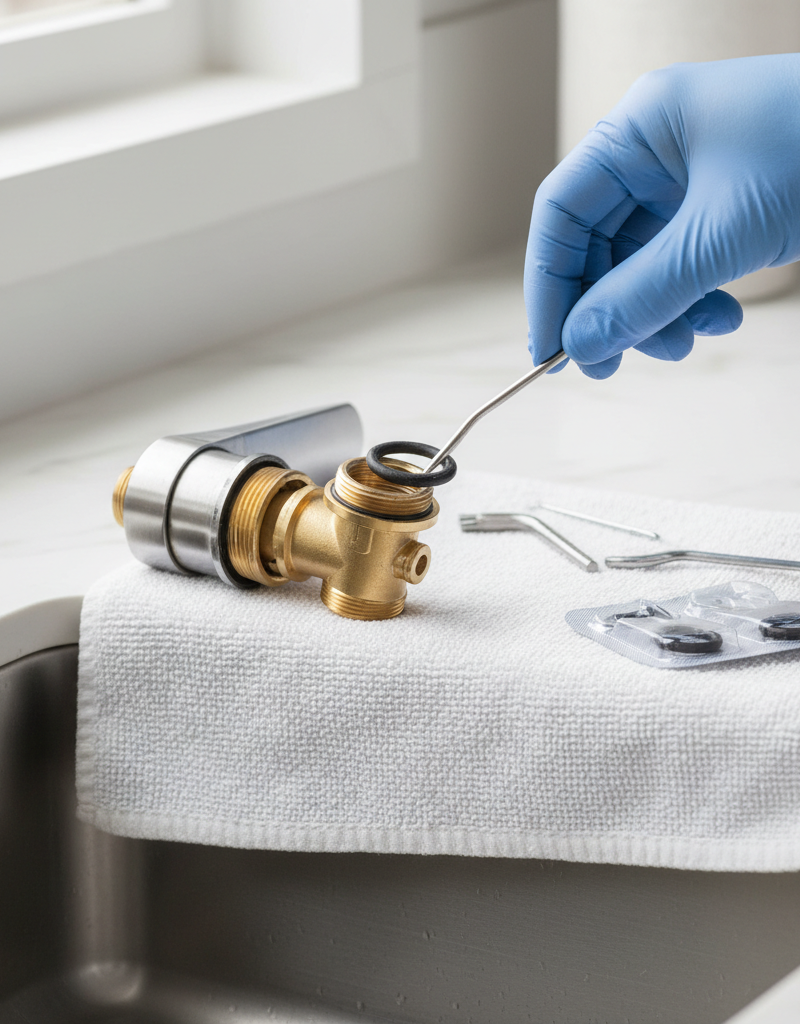
The failure point isn't the hard ceramic or plastic itself, but the tiny, delicate rubber O-rings and seals at the base of the cartridge. These seals press against the inside of the faucet body, preventing water from seeping out around the cartridge. Over thousands of cycles, these small seals can become compressed, brittle, or torn. Mineral deposits from hard water can build up on them, preventing a perfect seal. When this happens, even with the cartridge in the "off" position, a tiny amount of water can press past the compromised seal and continue to the spout, creating the tell-tale drip.
Step-by-Step Fix
This is a straightforward repair that most homeowners can accomplish in under an hour. The key is preparation and patience.
SAFETY FIRST: Before starting any work, you MUST shut off the water to the kitchen faucet. Look for two handles (one for hot, one for cold) on the pipes in the cabinet directly beneath the sink. Turn them clockwise until they are fully closed. Turn the faucet on to drain any remaining water in the lines; the flow should stop completely after a few seconds.
1. Identify Your Faucet and Cartridge: This is the most critical step. There is no "universal" cartridge. You need the exact model for your faucet brand (e.g., Delta, Moen, Kohler, Price Pfister). Look for a brand name or logo on the faucet body. If you can't find one, take clear photos of the faucet from multiple angles. You will show these photos (or the old cartridge itself) to the staff at your local hardware or plumbing supply store.
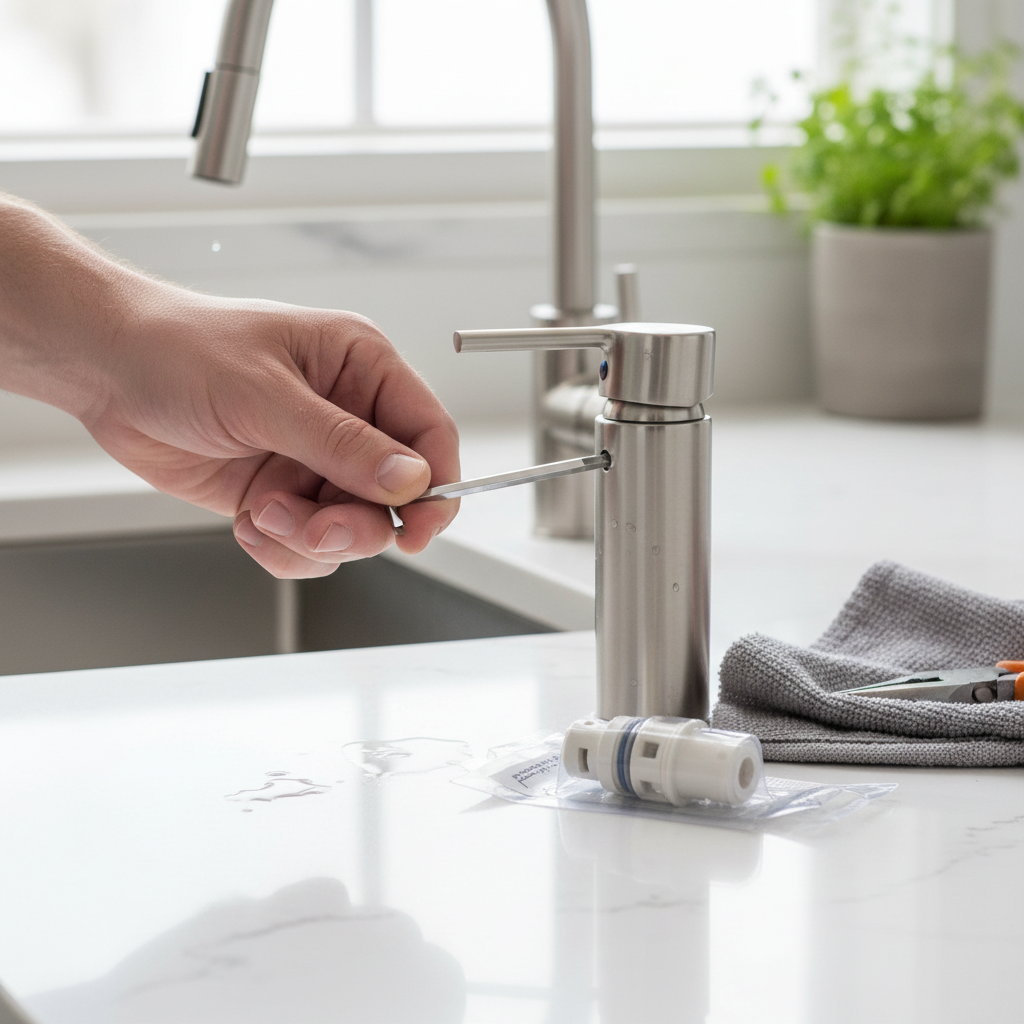
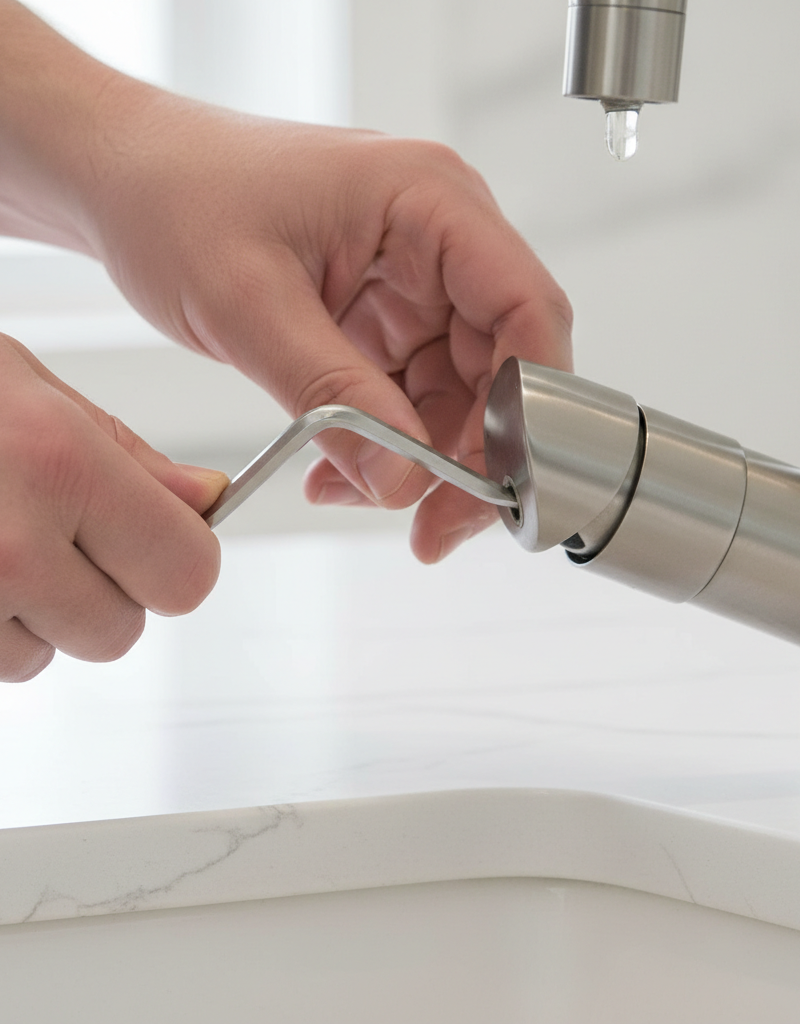
2. Remove the Handle: Most single-handle faucets have a small set screw that holds the handle to the cartridge stem. This screw is often hidden behind a small decorative cap on the handle, which might have a red/blue hot/cold symbol. Carefully pry this cap off with a small flathead screwdriver or even a fingernail. Inside, you'll see the head of a small screw, usually requiring a small Allen wrench (hex key).
3. Loosen the Set Screw: Insert the correct size Allen wrench and turn it counter-clockwise. You typically only need to loosen it a few turns; you don’t need to remove it completely. Once loose, the handle should lift straight up and off the faucet body.
4. Remove the Decorative Trim (if any): Some faucets have a dome-shaped or conical decorative piece that covers the part you need to access next. This usually just lifts off or may unscrew by hand.
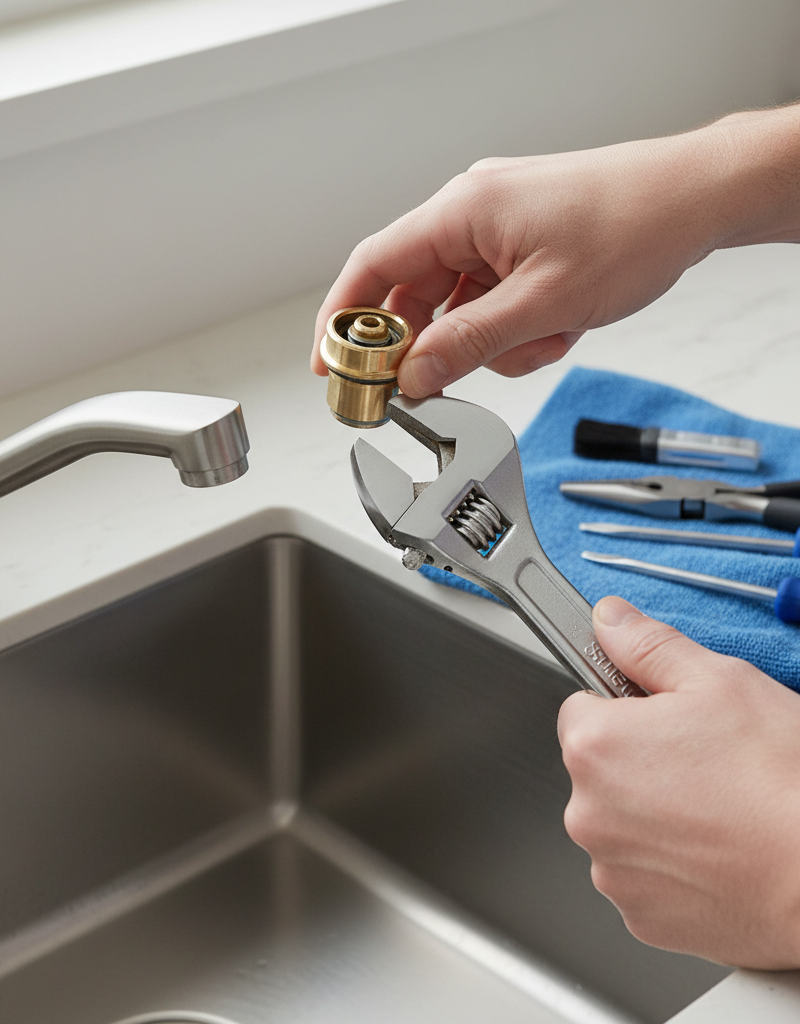
5. Expose and Loosen the Retaining Nut: You should now see a large nut (often brass or plastic) that threads down over the top of the cartridge, holding it in place. This is the retaining nut or "bonnet nut." It may have flat sides for a wrench or grooves for groove-joint pliers.
6. Unscrew the Retaining Nut: This can be the trickiest part. Use an adjustable wrench or groove-joint pliers to grip the nut firmly and turn it counter-clockwise. Pro Tip: Wrap the jaws of your pliers with a cloth or electrical tape to avoid scratching the faucet's finish. If the nut is stuck due to mineral buildup, you can try applying a penetrating oil or a 50/50 vinegar-water solution and letting it sit for 20-30 minutes before trying again.
7. Note the Cartridge Orientation: With the nut removed, the top of the cartridge is now exposed. Before pulling it out, look for any alignment tabs or notches on the cartridge that fit into corresponding slots in the faucet body. Take a quick photo with your phone for reference. This ensures you install the new one correctly.
8. Pull the Old Cartridge Out: The cartridge should pull straight up and out of the faucet body. If it has a retaining clip (common on Moen faucets), you'll need to pull that out first with pliers. If the cartridge is stuck, you can try wiggling it gently or use pliers to grip its stem and pull firmly upwards. Some replacement cartridges even come with a small plastic tool to help you twist and loosen the old one.
9. Clean the Inside of the Faucet Body: With the cartridge removed, peer down into the empty valve body. You will likely see some white, crusty mineral deposits or even small bits of debris. Use a soft rag or a plastic scouring pad to wipe the inside of the body clean. Pay special attention to the areas where the new cartridge's seals will sit. A clean surface is crucial for a good seal.
10. Insert the New Cartridge: Unbox your new cartridge. It should be an exact match to the old one. Align the tabs on the new cartridge with the slots in the faucet body you noted earlier. Press it firmly down into the faucet body until it is seated all the way.
11. Reassemble the Faucet: Simply reverse the steps. Thread the retaining nut back on and tighten it—snug is good, but do not overtighten, as this can damage the cartridge or faucet. Place the decorative cover back on, re-install the handle, and tighten the set screw. Pop the decorative cap back on.
12. Test Your Work: Turn the water supply valves under the sink back on (counter-clockwise). Slowly turn the faucet on. Check for leaks around the base of the handle. Test both hot and cold, then turn it off. The drip should be gone. Congratulations, you’ve just solved the problem!
Common Causes
- Age and Wear: The rubber seals on a cartridge are in near-constant contact with water and under pressure. Over 5-10 years, they simply wear out, become less pliable, and fail.
- Hard Water Minerals: The number one enemy of plumbing fixtures. Calcium and magnesium deposits can build up on the seals, preventing them from seating properly. They can also abrade the ceramic discs.
- Debris in Water Lines: Small particles of sediment, rust, or sand from your water mains (or from an aging water heater) can get lodged in the cartridge, scoring the ceramic discs or tearing a rubber seal.
- Overtightening the Handle: While it feels like the right thing to do, reefing on the handle to stop a drip can actually accelerate the failure of the seals by compressing them excessively.
Common Mistakes to Avoid
- Buying the Wrong Cartridge: It's tempting to grab a "universal" kit, but they rarely work perfectly. Bring your old cartridge or clear photos of your faucet to the store to get an exact match. One model can have a dozen variations.
- Forgetting to Turn Off the Water: The most basic and most disastrous mistake. You will have a major flood on your hands if you loosen the retaining nut with the water on.
- Scratching the Finish: Using bare metal pliers on a finished faucet will leave permanent scratches. Always a use a rag or tape to protect the chrome, brushed nickel, or other finish.
- Not Cleaning the Valve Body: Putting a new cartridge into a dirty, crusty faucet body is a recipe for failure. The new seals won’t be able to create a perfect seal, and the drip will return.
- Losing the Set Screw: That tiny handle screw is notorious for falling down the drain. Close the sink stopper before you start disassembly to prevent this.
Cost & Time Breakdown
This repair offers one of the highest ROIs for any home maintenance task.
| Item / Task | DIY Cost | Pro Cost | DIY Time | Pro Time |
|---|---|---|---|---|
| Parts | ||||
| Faucet Cartridge | $12 - $25 | $15 - $30 | 15 mins (trip) | - |
| Labor | ||||
| Preparation/Cleanup | $0 | - | 10 mins | - |
| Removal & Install | $0 | $150 - $250 (min) | 30 mins | 45-60 mins |
| Total | $12 - $25 | $165 - $280 | ~55 minutes | ~1 hour |
Tips & Prevention
- Know Your Faucet: When you install a new faucet, keep the manual and part number list in a safe place. This makes finding a replacement cartridge years later a 5-minute task.
- Regularly Clean the Aerator: The small screen at the tip of your faucet is the aerator. Unscrew it every 6 months and clean out any sediment. This can reduce back-pressure and stress on the internal components.
- Be Gentle: Modern ceramic disc faucets require very little force to operate and shut off. Teach family members not to force the handle.
- Consider a Water Softener: If you live in an area with very hard water, a whole-house water softener can dramatically extend the life of all your appliances and plumbing fixtures, including faucet cartridges.
When to Call a Professional
While this is a very manageable DIY project, there are a few scenarios where calling a licensed plumber is the wiser choice:
- The Drip Continues: If you've correctly replaced the cartridge with the right model and the faucet still drips, there could be a crack or imperfection in the faucet body itself. The faucet may need to be replaced.
- Corroded Parts: If the faucet is very old and the retaining nut or the faucet base is visibly corroded or "welded" in place with mineral deposits, you risk breaking the faucet or the water lines trying to force it. A plumber has specialized tools and the experience to handle this without causing a bigger problem.
- Leaking from the Base: If you see water pooling around the entire base of the faucet on the countertop, the problem may be with the supply lines or internal gaskets, not just the cartridge.
This fix for a dripping kitchen faucet is a perfect weekend project. It requires minimal investment, builds your confidence as a homeowner, and silences that maddening drip for good.
Should you do this yourself?
Answer five quick questions before you start. Safety outranks savings every time.
Your experience with work like this
How high do you have to work?
Does the job involve any of these?
Will it need a permit?
Specialty tools
Free and instant. Educational guidance only — not a quote, inspection, or professional diagnosis.
What should this project cost?
Enter your project details for a realistic cost range before you call anyone.
Common repairs run $150–$650; repipes and water-heater replacements reach $1,500–$4,500.
- Regional adjustment
- National average
- Labor share (typical)
- ~$754
- Quotes to collect
- 3 written estimates
Educational estimate based on national averages — not a binding quote. Always confirm with written local estimates.
Fixly Project Decision Box
- DIY difficulty
- Moderate
- Estimated time
- 30 minutes – half a day
- Cost level
- Moderate
Main tools / materials
- Adjustable wrench
- Plunger or drain auger
- Bucket and towels
- Thread tape
When to stop and call a pro
- Water you cannot shut off at the fixture or main
- Sewage backing up into more than one fixture
- Water near electrical panels or outlets
- Gas water heater work beyond relighting a pilot
Need professional help?
Get a Licensed PlumberFrequently asked questions
How do I know which faucet cartridge to buy?+
The best way is to identify the faucet's brand (e.g., Moen, Delta, Kohler) and model name/number if possible. If you don't know the model, shut off the water, remove the old cartridge, and take it with you to a plumbing supply or hardware store. The staff can help you find an exact match.
Can a small dripping faucet really increase my water bill much?+
Yes, significantly. A faucet dripping just one drop per second can waste over 3,000 gallons of water in a year. This can add a surprising amount to your water and sewer bill over time, often far more than the cost of the replacement cartridge.
What if my faucet is really old, like 20+ years?+
For older faucets, especially two-handle models, the problem might be a simple rubber washer and O-ring. However, many single-handle faucets from 20 years ago still used cartridges. The repair process is largely the same, but you may face more difficulty with corroded parts. It is even more critical to identify the correct replacement part for an older model.
The new cartridge is in, but the handle turns the wrong way. What did I do wrong?+
You likely installed the cartridge 180 degrees off. Some cartridges have notches that allow them to be inserted in two ways. Pull the cartridge back out, rotate it 180 degrees, and re-insert it. This should align the handle's movement correctly with the hot and cold inlets.
Discussion
Loading comments…