- Occupancy Levels: More people in a home generate more skin flakes, clothing fibers, and general household dust. A single person living alone will have a much slower filter buildup than a family of five.
- Pets: Dogs, cats, and other furry friends shed hair and dander, which are major contributors to filter clogging. The more pets you have, especially long-haired ones, the faster your filter will accumulate debris.
- Construction or Renovation: Nearby or in-home construction projects significantly increase airborne dust, drywall particles, and other debris, requiring much more frequent filter changes.
- Outdoor Air Quality: Living near busy roads, agricultural areas, or in regions prone to wildfires or heavy pollen seasons can introduce more particulates into your home, accelerating filter saturation.
HVAC · High energy usage
| Project category | HVAC |
|---|---|
| Problem type | High energy usage |
| Trade required | HVAC |
| Urgency | Planned project |
| Safety risk | Low safety risk |
| DIY suitability | DIY for experienced homeowners |
| Cost category | High cost |
| Typical timeline | Assessment within weeks; replacement planned off-season |
| Contractor type | Licensed HVAC technician |
Repair option
Duct sealing, insulation, and a tune-up before touching the equipment.
Replacement option
High-efficiency replacement sized by a load calculation, not a rule of thumb.
Common causes
- Aging, low-efficiency equipment
- Leaking ducts losing conditioned air
- Insufficient attic insulation
- Oversized system short-cycling
Relevant tools:project cost estimatorrepair or replace
Published May 12, 2026Last updated August 18, 2026
Tools & materials you'll need
Affiliate links- AmazonReplacement HVAC filterEnsure correct size (e.g., 20x25x1) and MERV rating (e.g., MERV 8-11)
As an Amazon Associate FixlyGuide earns from qualifying purchases — at no extra cost to you. Prices and availability are accurate as of publication and subject to change.
Quick Answer
Most homeowners underestimate the importance of their HVAC filter and, consequently, don't change it often enough. This oversight can lead to a cascade of problems, including higher energy bills, reduced system lifespan, and compromised indoor air quality. While a common guideline suggests changing filters every 30-90 days, the optimal frequency is highly individualized, depending on specific factors such as household occupancy, the presence of pets, allergy sensitivity, and the filter's MERV rating. Rather than following a rigid schedule, it's more effective to inspect your filter monthly and replace it when it appears dirty or clogged, typically within that 1-3 month window.
The Problem
Many homeowners set it and forget it when it comes to HVAC filters, often letting months, sometimes even a year, go by without a replacement. The result is a system struggling to pull air through a dense barrier of dust, pet dander, pollen, and other airborne particulates. This isn't just about a "dirty" filter; it's about restricted airflow, which forces your HVAC unit to work harder and longer to achieve desired temperatures. This added strain not only drives up your energy consumption and utility bills but also accelerates wear and tear on critical components, such as the blower motor and evaporator coil. Over time, a neglected filter can lead to reduced cooling or heating efficiency, uneven temperatures throughout your home, and even system breakdowns that require costly repairs. Beyond mechanical issues, a clogged filter becomes less effective at trapping new contaminants, diminishing your indoor air quality and exacerbating allergy and asthma symptoms for occupants. The true problem isn't complex; it's simply a lack of understanding regarding the filter's critical role and the dynamic factors that influence its lifespan.
How It Works
Your home's HVAC system operates by circulating air—either heated or cooled—through a network of ducts to maintain a comfortable indoor environment. At the heart of this circulation is the air handler, which houses a powerful blower fan. Before the air can enter the blower, it must pass through the air filter, typically located in a dedicated slot in the return air duct or directly at the air handler unit itself. The filter's primary job is to protect the sensitive internal components of your HVAC system, particularly the evaporator coil in an AC unit or the heat exchanger in a furnace, from accumulating dirt and debris. These components are designed to transfer heat efficiently, and even a thin layer of dust can significantly impede that process.
The filter itself is a mesh-like barrier, made from materials such as pleated paper, fiberglass, or synthetic fibers. The effectiveness of this barrier is measured by its MERV (Minimum Efficiency Reporting Value) rating, ranging from 1 to 20. Higher MERV ratings indicate a finer mesh capable of trapping smaller particles, from large dust bunnies (MERV 1-4) to microscopic allergens like pet dander, pollen, mold spores, and even some bacteria and viruses (MERV 8-16+). As air passes through the filter, these particles are caught and held within its fibers. Over time, as more particles accumulate, the filter becomes increasingly restrictive, creating a "dirt load" that impedes airflow. This reduced airflow forces the blower motor to work harder, pulling more electricity, and can even cause the evaporator coil to freeze over in an air conditioning system due to insufficient warm air moving across it. Likewise, a furnace may overheat. Understanding this mechanism highlights why regular filter replacement isn't just a recommendation—it's essential for the system's health, efficiency, and your indoor air quality.
Step-by-Step Fix
1. Locate Your Filter — Begin by finding where your HVAC filter is installed.
- Your filter will typically be in one of two main locations: either in a dedicated filter slot in the return air duct, often found in a wall or ceiling, or directly at the air handler (furnace/AC unit) itself, usually where the large return duct connects to the unit. Look for a small arrow on the filter frame indicating airflow direction.
- If you have multiple returns: Some homes, especially larger ones, might have several return air grilles, each with its own filter. Check all major return vents.
2. Check the Airflow Direction — Note the arrow on the old filter.
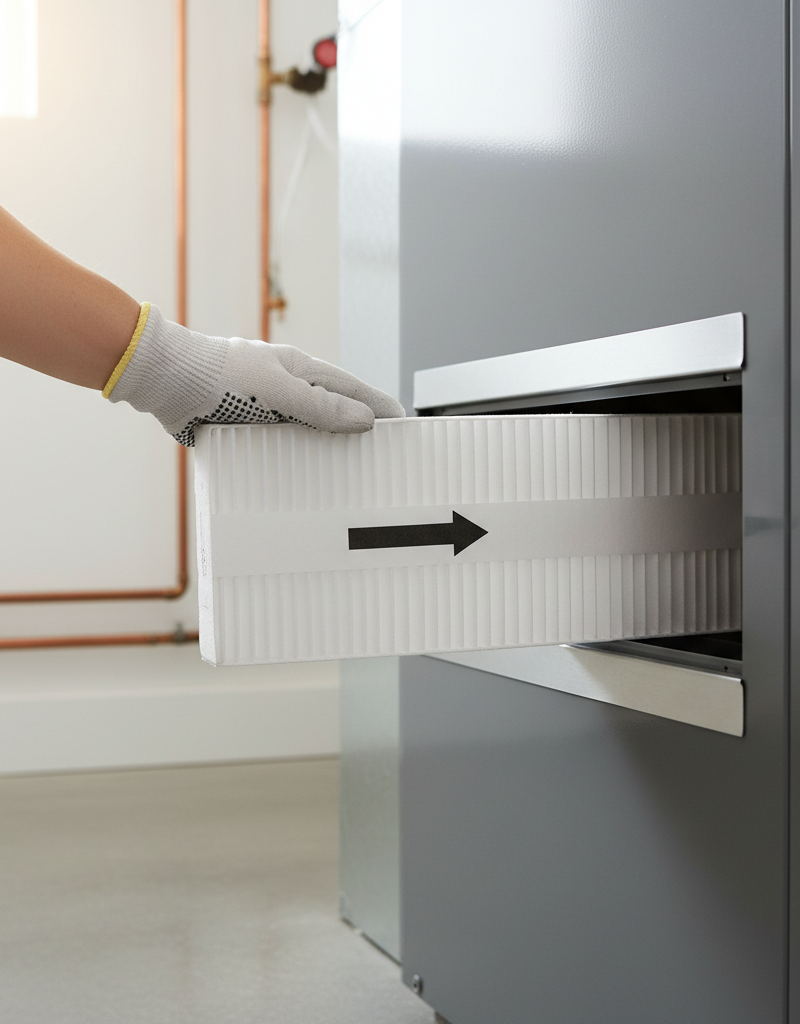
- Every HVAC filter has an arrow printed on its frame. This arrow indicates the direction of airflow into your HVAC system. It is crucial to install the new filter with the arrow pointing in the same direction—towards the furnace/air handler and away from the return duct opening.
- Safety Note: Always make sure your HVAC system (both heating and cooling) is turned OFF at the thermostat before removing or inserting a filter. This prevents the blower from accidentally turning on and pulling in unfiltered air or causing injury.
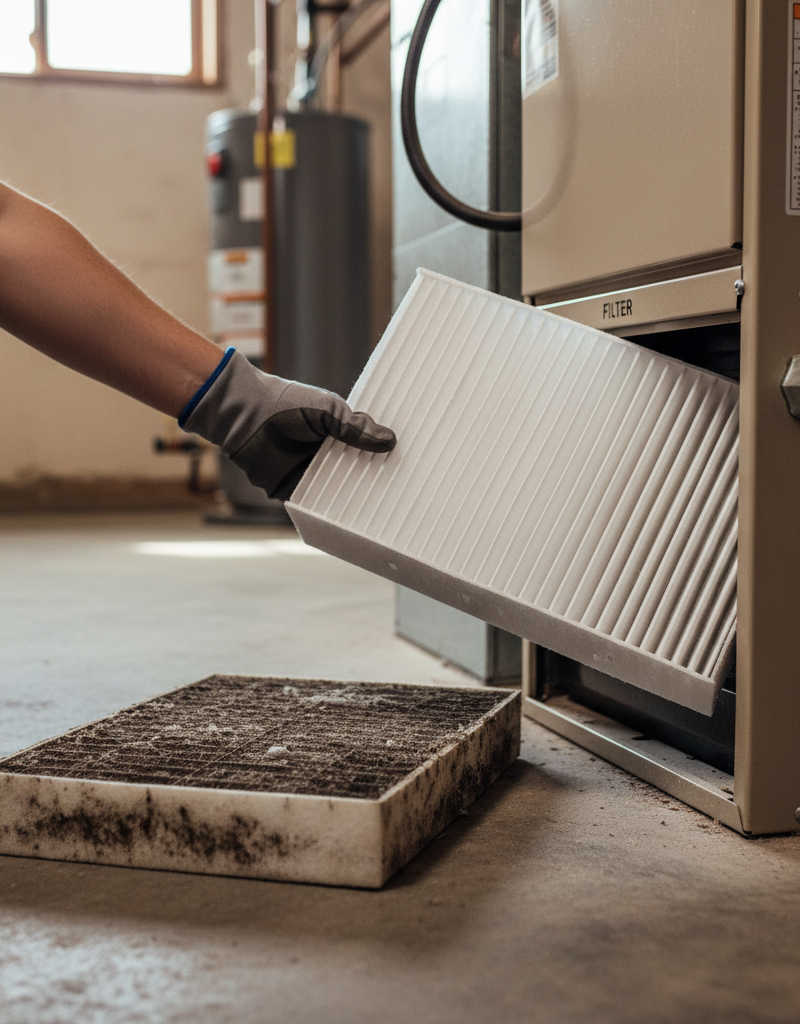
3. Remove the Old Filter — Carefully slide out the dirty filter.
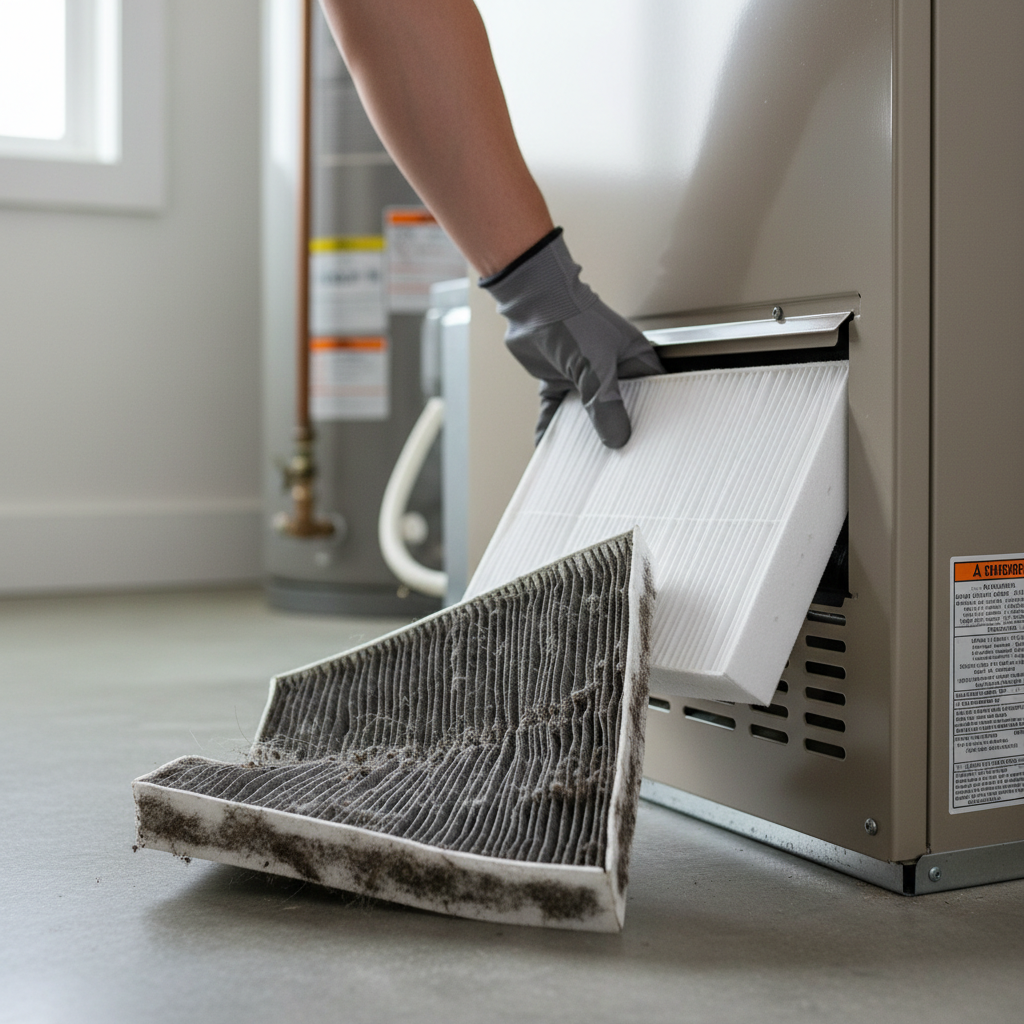
- Depending on your filter location, you might need to unlatch clips, slide open a cover, or simply pull the filter directly out. Be prepared for a puff of dust as the old filter is removed. Do not try to shake or clean the old filter; it's designed for one-time use.
- Pro Tip: Take a picture of the old filter's dimensions and MERV rating while it's still in the system for easy reference when purchasing a new one.
4. Note the Dimensions and MERV Rating — Crucial information for buying a replacement.
- Look at the frame of the old filter for printed dimensions (e.g., "20x25x1" or "20x25x4") and the MERV rating (e.g., "MERV 8" or "MERV 11"). These are standard measurements and are essential for buying the correct replacement.
- Understanding MERV: A higher MERV rating (generally 8-13 for most homes) means better filtration but can restrict airflow more. Consult your HVAC system's manual or an HVAC professional if you're unsure what MERV rating is appropriate for your specific system. Using too high a MERV can damage your system.
5. Purchase a New Filter — Select the right size and MERV for your home.
- With your dimensions and MERV rating in hand, head to a home improvement store, hardware store, or order online. Buying multi-packs can often be more cost-effective.
- Consider your household needs: If you have pets, allergies, or live in a dusty area, consider a MERV 8-11 filter. If you have severe allergies or immunocompromised individuals, MERV 11-13 might be appropriate, but always confirm compatibility with your HVAC system first.
6. Insert the New Filter — Orient it correctly.
- Slide the new filter into the slot, ensuring the airflow arrow points in the correct direction (towards the furnace/air handler). The fit should be snug but not forced. There should be no gaps around the filter where air can bypass it.
- Verify proper seating: Make sure the filter is fully inserted and the access panel or clips are securely closed. This prevents air leakage and ensures all return air passes through the filter.
7. Set a Reminder — Don't forget to check it next month.
- Mark your calendar, set a recurring reminder on your phone, or write the installation date on the filter frame itself. Aim to check it monthly for dirt buildup.
- Proactive replacement: Even if it doesn't look completely caked, a filter starts losing efficiency after a certain period. Replace it at least every 90 days, or more frequently based on the factors discussed below.
Common Causes
The primary "cause" for needing to change an HVAC filter is simply its effective functioning: it's doing its job by trapping airborne particles. However, several factors accelerate how quickly a filter gets dirty and needs replacement:
- Occupancy Levels: More people in a home generate more skin flakes, clothing fibers, and general household dust. A single person living alone will have a much slower filter buildup than a family of five.
- Pets: Dogs, cats, and other furry friends shed hair and dander, which are major contributors to filter clogging. The more pets you have, especially long-haired ones, the faster your filter will accumulate debris.
- Allergies and Asthma: Homes with occupants sensitive to allergens often use higher MERV filters to capture smaller particles like pollen, mold spores, and pet dander. While beneficial for air quality, these finer filters can clog faster due to their increased trapping efficiency.
- Construction or Renovation: Nearby or in-home construction projects significantly increase airborne dust, drywall particles, and other debris, requiring much more frequent filter changes.
- Fan Operation: If your HVAC fan is set to "On" rather than "Auto," it runs continuously, constantly circulating and filtering air. While this provides more consistent air quality, it also means the filter is working non-stop and will get dirty faster.
- Outdoor Air Quality: Living near busy roads, agricultural areas, or in regions prone to wildfires or heavy pollen seasons can introduce more particulates into your home, accelerating filter saturation.
- Type of Filter (MERV Rating): Higher MERV filters (e.g., MERV 11-13) are designed to trap smaller particles and, consequently, can become restrictive more quickly than lower MERV filters (e.g., MERV 1-4) because there are more tiny spaces to get blocked.
Common Mistakes
- Ignoring the Airflow Arrow: Installing the filter backward forces impurities into the clean air stream and directly onto sensitive HVAC components, defeating the filter
Related Articles
Keep troubleshooting with these hand-picked guides from FixlyGuide:
- The #1 Reason Your AC Blows Warm Air (And It's Not What You Think) — A dirty air filter is often the overlooked culprit behind an air conditioner blowing warm air, hindering its ability to cool your home effi…
- The #1 HVAC Mistake Costing You Hundreds (And How Often to Really Change Your Filter) — Discover the surprising truth about how often you should change your HVAC filter and prevent common problems that can cost you hundreds in…
- The #1 Mistake Homeowners Make With HVAC Filters (And How Often to Really Change Them) — Discover the crucial mistake most homeowners make with HVAC filters and the specific schedule you should follow to avoid costly HVAC issues…
- The #1 Mistake Homeowners Make When Heat Pumps Stop Heating in Winter — Discover the crucial mistake most homeowners make when their heat pump struggles in cold weather and how to fix it, potentially saving hund…
- The #1 Mistake Homeowners Make Installing a Smart Thermostat (and How to Fix It) — Avoid the most common pitfall when installing a smart thermostat yourself and ensure a smooth, energy-efficient setup.
- The #1 Mistake When Fixing Baseboards That Pull Away From Walls — Discover the crucial mistake homeowners make when reattaching baseboards and how to properly secure them for a lasting fix.
What should this project cost?
Enter your project details for a realistic cost range before you call anyone.
Service calls and common repairs run $150–$900; full system replacement typically $6,000–$12,000.
- Regional adjustment
- National average
- Labor share (typical)
- ~$1,935
- Quotes to collect
- 3 written estimates
Educational estimate based on national averages — not a binding quote. Always confirm with written local estimates.
Fixly Project Decision Box
- DIY difficulty
- Advanced
- Estimated time
- Homeowner checks 20–30 minutes
- Cost level
- Moderate
Main tools / materials
- Clean air filter
- Garden hose for condenser coils
- Shop vac for the condensate line
When to stop and call a pro
- Burning smell, smoke, or a tripping breaker
- Refrigerant lines iced over or hissing
- Any work inside the sealed refrigerant circuit (EPA-licensed only)
- Gas smell near a furnace — leave and call the utility
Need professional help?
Find an HVAC Pro Near YouFrequently asked questions
How often should I change my HVAC filter?+
While a general guideline is every 30-90 days, the optimal frequency depends on factors like pets, allergies, fan usage, and the filter's MERV rating. It's best to check your filter monthly and replace it when it appears dirty or clogged.
What happens if I don't change my HVAC filter?+
Failing to change your HVAC filter regularly can lead to reduced system efficiency, higher energy bills, poor indoor air quality, increased wear and tear on components like the blower motor and evaporator coil, and even system breakdowns.
What MERV rating should I use for my HVAC filter?+
For most homes, a MERV rating of 8-11 provides a good balance between air filtration and airflow. Homes with pets or allergy sufferers may benefit from MERV 11-13. Always consult your HVAC system's manual or a professional before using higher MERV filters, as they can restrict airflow and potentially damage some older systems.
Can a dirty filter damage my HVAC system?+
Yes, a dirty filter significantly restricts airflow, forcing your HVAC system to work harder. This can lead to the blower motor overheating, the evaporator coil freezing (in AC systems), and premature wear and tear on various components, ultimately causing costly repairs or system failure.
How do I know which way to put the new filter in?+
Look for an arrow printed on the frame of the new filter. This arrow should always point in the direction of the airflow, which is typically towards the furnace or air handler unit and away from the return air duct.
Discussion
Loading comments…