- Install Mini Water Hammer Arrestors at the Fixture — If the banging keeps up after you’ve drained the house and checked the supports, install retro-fit mechanical arrestors directly onto your shutoff valves.
- Torque: Snug the brass nut down by hand, then give it an additional 1/2 to 3/4 turn with your wrench. Don’t use Teflon tape on compression threads—the brass ferrule makes the seal.
- Reconnection: Screw the faucet’s braided supply lines directly onto the top male threads of the new arrestors, repressurize the system, and check for leaks with a dry paper towel.
Plumbing · Leak
| Project category | Plumbing |
|---|---|
| Problem type | Leak |
| Trade required | Plumbing |
| Urgency | Emergency — act now |
| Safety risk | High safety risk |
| DIY suitability | DIY for experienced homeowners |
| Cost category | Low cost |
| Typical timeline | Shut water off now; repair usually same or next day |
| Contractor type | Licensed plumber |
Repair option
Isolate at the shutoff, replace the failed component, and dry the cavity fully.
Replacement option
Repipe the run or the branch when corrosion is widespread.
Common causes
- Failed supply line or shutoff valve
- Worn washers, cartridges, or P-trap connections
- Pinhole corrosion in older copper
Relevant tools:emergency checklistdiy or hire a pro
Published November 2, 2026Last updated November 2, 2026
Tools & materials you'll need
Affiliate linksAs an Amazon Associate FixlyGuide earns from qualifying purchases — at no extra cost to you. Prices and availability are accurate as of publication and subject to change.
Quick Answer
If your faucet makes a hard thump or shudder every time you shut it off, you’re usually dealing with water hammer or a loose part inside the valve. That sudden shutoff slams moving water into a closed valve, and the pressure spike can hit 300 PSI. Most times, you can quiet it down in under an hour by draining the lines to recharge the air chambers, tightening up loose supply tubes, or swapping out worn shutoff washers.
The Problem
You turn off the kitchen sink or ease the bathroom faucet handle down, and BANG. A sharp, metallic shudder runs through the wall. Sometimes it sounds like somebody smacked a 2x4 against the studs. Other times it’s a quick machine-gun chatter shaking the countertop.
Water moves through your home’s 1/2-inch or 3/4-inch copper and PEX lines at roughly 30 to 60 PSI, and it’s carrying real momentum. Water doesn’t compress. So when you stop that moving column in a split second, all that energy’s got to go somewhere. It bounces back through the plumbing like a shockwave moving over 4,000 feet per second.
And no, it’s not just an annoying little house noise. That repeated hit loosens pipe hangers, cracks soldered copper elbows, chews up fixture seals, and can eventually blow out a flexible braided supply line while you’re out at work. I pulled a water heater in Frisco last month that had exactly this kind of banging—turned out the washer in the shutoff was half gone and the line was slapping a joist like a loose belt.
How It Works
To stop the racket, you’ve got to picture what’s happening between your city meter and the faucet spout. Pressurized water sits in the supply lines until you lift or turn the faucet cartridge. Open the tap, pressure drops at the fixture, and water starts moving out through the aerator.
Most modern homes count on two defenses against pressure spikes: mechanical water hammer arrestors and pipe strapping. A water hammer arrestor is a small sealed cylinder with a gas-charged piston or rubber bladder inside. When the water stops fast, some of that flow gets shoved into the cylinder, which pushes against the piston and softens the hit like a shock absorber on an old pickup.
[City Water at 50 PSI] ---> [Open Pipe] ===> Water Rushes to Faucet
Faucet Closes Abruptly:
[Rushing Water Column] ===> [Slammed Valve] ---> Shockwave Bounces Back
With Arrestor: Shockwave pushes internal air piston (No noise)
Without Arrestor: Shockwave flexes unsupported pipe against wood framing (Loud BANG)
Older homes—especially builds from the 1970s through early 1990s—used vertical capped pipe stubs in the wall cavities instead of mechanical pistons. Over time, the trapped air in those stubs dissolves into the standing water, and that leaves them waterlogged. No air pocket means no cushion. Toss in a worn shutoff valve stem or an unstrapped PEX line tapping the joist, and you’ve got a loud bang every single time you shut the water off.
Step-by-Step Fix
Before you start cutting drywall or buying commercial expansion tanks, do the no-cost hydraulic reset first, then check the faucet hardware.
-
Shut Down the Main Water Meter — Walk out to your water meter box or basement shutoff valve and turn the ball valve a quarter-turn clockwise until the handle sits perpendicular to the pipe. If you’ve got an older gate valve, spin the wheel clockwise until it seats firmly—don’t muscle it past that brass stem.
- Safety Note: If the main valve is stiff, corroded, or weeping green verdigris, don’t force it with a pipe wrench; use light hand pressure so you don’t snap the stem.
-
Drain the Entire Plumbing System — Open the lowest faucet on the property—usually an outside hose bib or a basement utility sink—and let it run wide open. Then go upstairs and open every sink faucet, shower valve, and tub spout in the house to break the vacuum.
- What this does: As gravity pulls the standing water out through the lowest tap, air gets drawn down through the open upper fixtures, clearing out waterlogged vertical air chambers in the walls.
- Time required: Leave everything open for at least 15 to 20 minutes until the sputtering stops completely.
-
Recharge and Test the System — Close all the open faucets and exterior hose bibs, then head back to the main supply valve. Slowly crack the main valve open about one-third of the way so you repressurize the system without blasting a high-pressure air shot through your ceramic cartridges.
- Execution detail: Once you hear the main stop hissing, open it fully. Walk to the problem faucet, purge the sputtering air for 30 seconds, shut it off fast, and listen closely.
- If this doesn't work: If the thud is still the same, the air chambers didn’t clear or your house doesn’t have them anymore, so you’ve got to check the hardware under the sink.
-
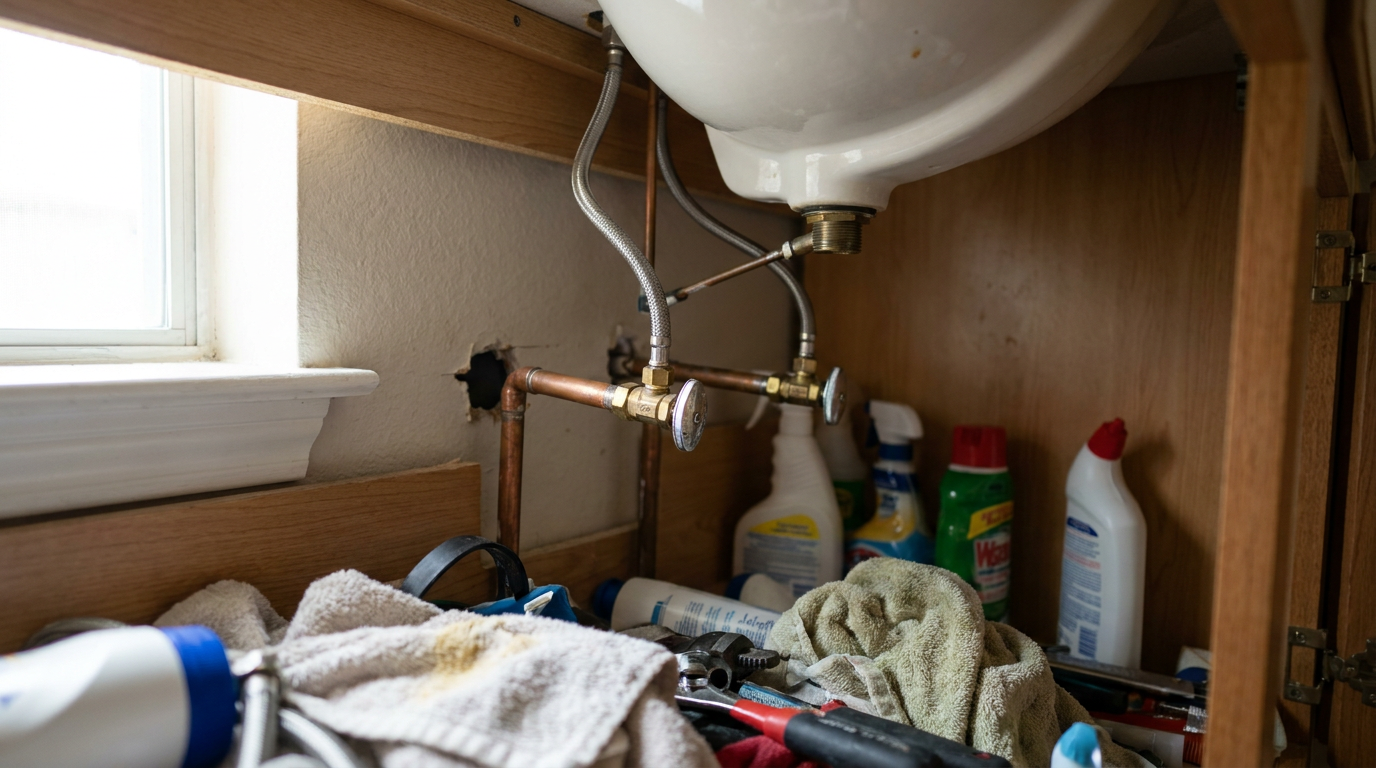
Inspect the Under-Sink Angle Stops — Slide under the sink with a flashlight and check the shutoff valves coming out of the wall. If an angle stop is only partly open—say, halfway between on and off—the incoming water cavitates around the gate and starts chattering like crazy.
- Adjustment: Make sure both hot and cold angle stops are turned all the way counterclockwise (fully open). If they’re modern quarter-turn ball valves, the handles should run dead parallel to the braided line.
-
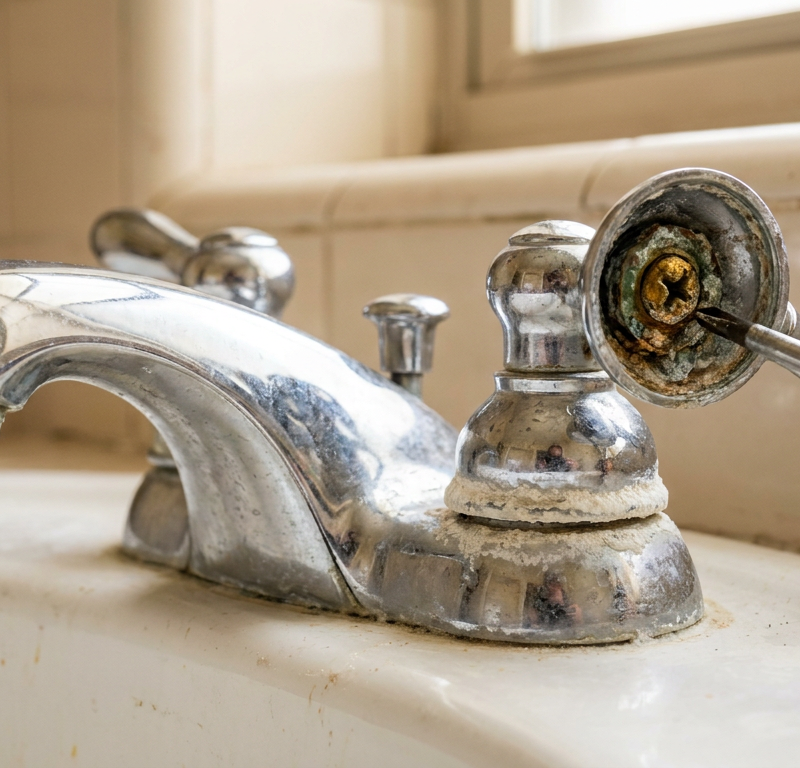
Disassemble and Inspect the Shutoff Valve Washers — Turn off the main supply again and back the bonnet nut off your angle stop with an adjustable wrench while holding the valve body with a second wrench. Pull the stem assembly out and inspect the small neoprene washer held on by a brass screw at the tip.
- The culprit: A cracked, worn, or loose washer will flutter against its brass seat like a reed in a saxophone at high flow rates, and that vibration shakes the whole pipe.
- The fix: Tighten the center brass screw or replace the rubber washer with an exact-match multi-turn bibb washer from an assortment pack.
-
Check Supply Line Bracing and Wall Penetrations — Grab the flexible stainless-steel braided supply lines under the sink and give them a gentle shake. Look up into the vanity cabinet where the rigid copper or PEX tubing comes through the drywall or cabinet backboard.
- The inspection: If the pipe wiggles freely in an oversized hole, every valve closure sends it banging against the cabinet wood or the drywall behind it.
- The fix: Slide a split-ring plastic pipe escutcheon or a high-density foam pipe insulator around the pipe inside the cabinet hole to soften the side-to-side movement.
-
Anchor Any Exposed Basements or Crawlspace Runs — Follow the water lines feeding that faucet down into the basement, crawlspace, or nearby utility closet. Look for any unsupported pipe spans over 4 feet on copper or 32 inches on flexible PEX.
- Tools needed: Drive galvanized or plastic suspension clamps straight into the joists with 1-1/4-inch wood screws.
- Crucial rule: Don’t use steel straps on copper pipe. Dissimilar metal contact causes galvanic corrosion that eats through copper in a few seasons. Use copper-plated straps or heavy-duty plastic talon clips.
-
Install Mini Water Hammer Arrestors at the Fixture — If the banging keeps up after you’ve drained the house and checked the supports, install retro-fit mechanical arrestors directly onto your shutoff valves.
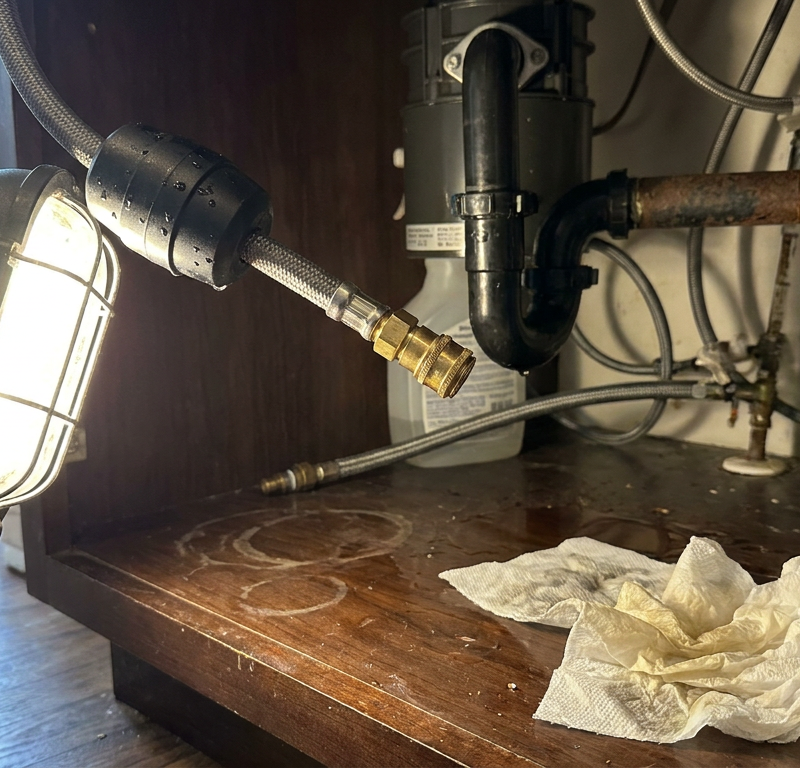
- Installation steps: Disconnect the existing 3/8-inch braided faucet supply lines from the top of the angle stops. Thread a 3/8-inch female compression x 3/8-inch male compression mini water hammer arrestor straight onto each angle stop outlet.
- Torque: Snug the brass nut down by hand, then give it an additional 1/2 to 3/4 turn with your wrench. Don’t use Teflon tape on compression threads—the brass ferrule makes the seal.
- Reconnection: Screw the faucet’s braided supply lines directly onto the top male threads of the new arrestors, repressurize the system, and check for leaks with a dry paper towel.
Common Causes
Figuring out pipe noise means tracing where pressure changes turn into freewheeling kinetic energy. These are the usual suspects:
- Waterlogged Air Chambers: Old-school vertical pipe dead-ends lost their trapped air bubble to natural absorption, so the cushion is gone.
- Excessive Household Water Pressure: Municipal systems routinely push water at 80 to 110 PSI to reach fire hydrants. If your home’s Pressure Reducing Valve (PRV) fails, baseline pressure jumps into ugly territory and every shutoff gets louder.
- Loose or Degraded Valve Stems: A worn washer inside a multi-turn shutoff valve or a cracked ceramic faucet cartridge can flutter in the stream and make a rhythmic rattle.
- Inadequate Pipe Anchoring: Unsecured pipe runs inside wall cavities or floor joists will whip against wood framing every time the water stops hard.
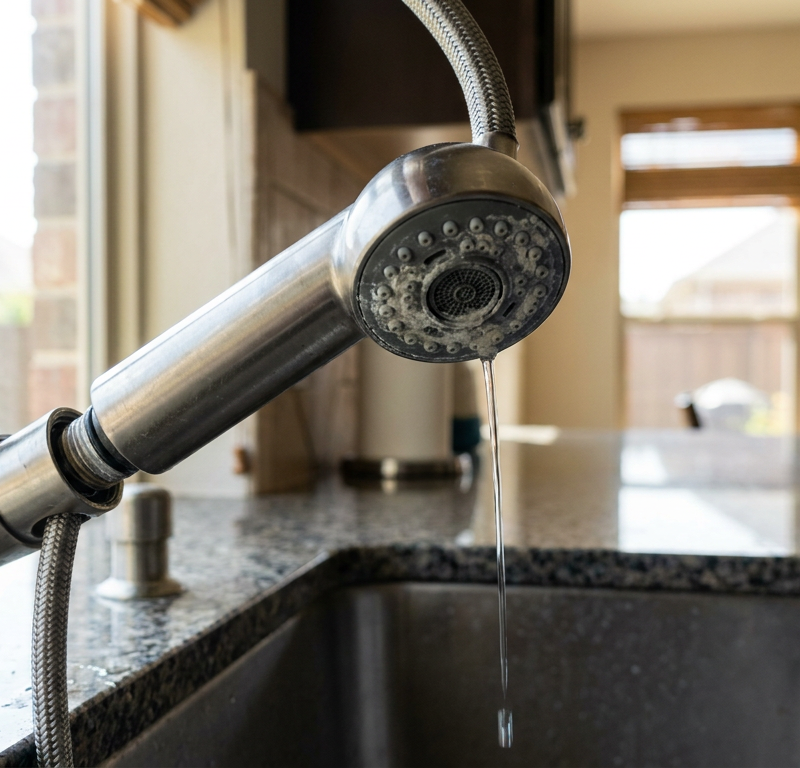
- Faulty Faucet Cartridge Check Valves: Modern pull-out spray faucets have built-in spring check valves inside the wand coupling to stop back-siphonage. A broken spring lets the internal poppet slam around under pressure.
Common Mistakes
Watch out for these DIY slipups when you’re chasing down noisy pipes:
- Dousing Compression Fittings in Thread Sealant: Smearing Teflon paste or tape on 3/8-inch brass compression fittings keeps the nut from seating squarely against the brass ferrule. That gives you slow leaks behind the vanity. Seal NPT pipe threads only—never compression or flare joints.
- Over-Constraining PEX Tubing: PEX expands and contracts up to 1 inch per 100 feet for every 10°F temperature shift. If you hammer rigid metal clamps tight around hot-water PEX lines, you’ll crush the pipe and make stress points that wear through as the plastic shifts. Use loose plastic suspension clips so the tubing can slide.
- Ignoring the Whole-House PRV: Putting arrestors at the sink while your whole house is sitting at 90 PSI is like slapping a bandage on a broken arm. Check pressure with a cheap hose-bib gauge first; if it’s over 75 PSI, adjust or replace the main regulator.
- Assuming the Noise Is Always Inside the Wall: Sound rides along metal piping better than most folks think. A loud bang that sounds like it’s inside the master bath wall is often a supply line slapping the bottom of the kitchen cabinet thirty feet away. Check exposed lines first before you start cutting drywall.
- Ripping Out Pipes Before Draining the System: A lot of homeowners jump straight to hiring a plumber or buying pricey fittings when the whole system really needed was a simple 20-minute gravity drain to recharge the air reserves.
Cost & Time Breakdown
| Task | DIY Cost | Pro Cost | Time |
|---|---|---|---|
| Full System Gravity Drain | $0 | $120–$180 | 30–45 mins |
| Angle Stop Washer Replacement | $3–$8 | $150–$225 | 20–30 mins |
| Add Pipe Straps & Foam Buffers | $10–$25 | $175–$250 | 45–60 mins |
| Install Dual Under-Sink Arrestors | $30–$55 | $220–$320 | 30–40 mins |
| Replace Whole-House PRV | $85–$160 | $350–$650 | 2–3 hours |
Tips & Prevention
Keep your plumbing quiet and leak-free with these simple maintenance habits:
- Test System Pressure Annually: Screw a $12 water pressure test gauge onto your lowest outdoor hose bib or water heater drain valve once every spring. Your reading should land strictly between 45 and 65 PSI. Anything over 75 PSI means it’s time to adjust the pressure-reducing valve.
- Swap Multi-Turn Stops for Quarter-Turn Ball Valves: Multi-turn valves use rubber bibb washers that wear out and fall apart over 5 to 10 years, which leads to fluttering and chatter. Modern quarter-turn ball valves use solid brass or stainless spheres seated in Teflon, so there aren’t loose parts hanging around.
- Exercise Shutoff Valves Bi-Annually: Minerals in municipal water can lock valve stems in place. Close and open every angle stop under the sinks twice a year to knock off calcification before it seizes the mechanism.
- Listen for Tone Changes: A dull, low thud points to pipe movement against framing. A sharp, high-pitched metallic click means an internal valve part is slamming shut under too much pressure.
When to Call a Professional
If you install water hammer arrestors at the problem faucet and the thumping keeps going inside the wall, you’re probably dealing with broken or missing pipe supports deep inside finished cavities. Fixing that takes strategic sheetrock cutting, careful strapping, and clean drywall repair.
And if your pressure test gauge jumps past 80 PSI and adjusting the screw on your main bell-shaped Pressure Reducing Valve (PRV) doesn’t change a thing, call a licensed plumber right away. High incoming city pressure puts serious hydraulic stress on your water heater tank, ice maker solenoids, and washing machine supply lines. If you see active seepage around wall penetrations, leaking soldered copper joints, or weeping pinholes along green-tinted copper pipe, stop fooling with it and bring in a pro before something ruptures.
Frequently Asked Questions
Can water hammer damage my pipes if I ignore it?
Yes, absolutely. Water hammer sends sudden hydraulic shockwaves over 300 PSI, which is well past the rated limit for standard household fittings. Over time, those pressure spikes weaken soldered copper joints, shake threaded joints loose, and crack the plastic internal parts of modern single-handle ceramic cartridges. Worst of all, it raises the chances of blowing out flexible stainless-steel braided hoses under your sink.
What is the difference between water hammer and pipe chatter?
A true water hammer is a single, sharp, heavy bang that lands the exact second a valve closes and the rushing water column stops. Pipe chatter is a fast, machine-gun rattling or buzzing sound that happens while water is still moving through the pipe. Chatter usually comes from a loose washer fluttering inside an angle stop valve or a worn check-valve spring inside a pull-out spray wand.
Why did my faucet suddenly start banging after years of silence?
Your house probably depended on internal vertical air chambers (dead-end copper risers capped inside the wall framing) that slowly became waterlogged. Over years of normal use, the trapped air pockets in those pipes dissolved into the moving water. Once those pipes fill all the way with water, the cushion disappears and every shutoff bangs against solid fluid.
Do modern quarter-turn single-handle faucets make water hammer worse?
Yes, they do. Old two-handle compression faucets take several full turns to open or shut off, so the water tapers down over a few seconds. Modern single-handle faucets use polished ceramic discs that snap the flow shut in a fraction of a second. That near-instant cutoff throws a much stronger shockwave through the lines.
Will installing a water hammer arrestor void my faucet warranty?
No, it won’t. A lot of major fixture makers actually recommend—or even require—mechanical arrestors to protect their ceramic cartridges from shock damage. Adding an arrestor uses standard 3/8-inch compression fittings right at the shutoff valve and doesn’t alter the faucet’s internal parts in any way.
How do I adjust my home's Pressure Reducing Valve (PRV)?
Find your bell-shaped brass PRV on the main water line where it enters the house, usually near the main shutoff valve or crawlspace access. Loosen the locknut on the adjustment bolt with a wrench, then use a flathead screwdriver or socket to turn the center bolt counterclockwise to reduce line pressure. Check your pressure on an exterior hose-bib gauge as you adjust, and make sure you land between 50 and 65 PSI before snugging the locknut back down.
Do mechanical water hammer arrestors wear out over time?
Yes, they do. Mechanical arrestors have internal rubber seals, O-rings, and gas-charged chambers or springs that keep absorbing hydraulic impact. Depending on your water quality and line pressure, standard residential mini arrestors usually last between 5 and 10 years before the internal seal fails or the gas charge fades. When that happens, the banging comes back, and you just thread on a new one.
Can high water pressure cause water hammer by itself?
High water pressure usually isn’t the only trigger, but it sure pours gas on the fire. When your plumbing runs at 85 or 90 PSI instead of a healthy 50 PSI, water moves through the pipes much faster. When a valve snaps shut, that extra speed makes a much harder shockwave than your pipes would ever see under normal conditions. Always fix the high baseline pressure before you start chasing the other plumbing gremlins.
Related Articles
Keep troubleshooting with these hand-picked guides from FixlyGuide:
- Kitchen Faucet Leaking Under the Sink When Sprayer Runs? 5 Causes and the Step-by-Step Fix — Fix that hidden water leak under your kitchen sink. Step-by-step diagnostic and repair instructions for leaking pull-out hoses, bad O-rings…
- Bathroom Faucet Handle Stuck? 12 Steps to Free It Without Breaking the Stem — Stuck bathroom faucet handle won't budge? Learn how to safely dissolve hard water scale, use a handle puller, and rebuild the valve cartrid…
- The Secret Culprit Behind Your Leaky Refrigerator (It’s Not Always a Hose) — Discover the hidden causes of your refrigerator leaking water and how to fix them with our comprehensive troubleshooting guide.
- Kitchen Faucet Low Pressure? 10 Steps to Restore Weak Flow — Kitchen pull-out faucet suddenly lost water pressure? Learn how to clear clogged aerator screens, flush internal check valves, and fix unde…
- The 4 Hidden Reasons Your Toilet Tank Fills Slowly (And How to Fix Them in Under an Hour) — A toilet tank that fills slowly is a common, annoying plumbing problem, often caused by easily fixable issues within the fill valve or wate…
- The 4 Hidden Reasons Your Entire Home Has Low Water Pressure — Low water pressure throughout your house can stem from several hidden issues, ranging from municipal supply problems to your home's main sh…
Should you do this yourself?
Answer five quick questions before you start. Safety outranks savings every time.
Your experience with work like this
How high do you have to work?
Does the job involve any of these?
Will it need a permit?
Specialty tools
Free and instant. Educational guidance only — not a quote, inspection, or professional diagnosis.
What should this project cost?
Enter your project details for a realistic cost range before you call anyone.
Common repairs run $150–$650; repipes and water-heater replacements reach $1,500–$4,500.
- Regional adjustment
- National average
- Labor share (typical)
- ~$754
- Quotes to collect
- 3 written estimates
Educational estimate based on national averages — not a binding quote. Always confirm with written local estimates.
Fixly Project Decision Box
- DIY difficulty
- Moderate
- Estimated time
- 30 minutes – half a day
- Cost level
- Moderate
Main tools / materials
- Adjustable wrench
- Plunger or drain auger
- Bucket and towels
- Thread tape
When to stop and call a pro
- Water you cannot shut off at the fixture or main
- Sewage backing up into more than one fixture
- Water near electrical panels or outlets
- Gas water heater work beyond relighting a pilot
Need professional help?
Get a Licensed PlumberBefore you start
Check the difficulty, permits, and safety risk — then decide whether to call a pro.
- Estimate this projectGet a cost range for your scope and ZIP before you call anyone.Open
- Get local estimatesSend one request and compare written estimates from vetted pros.Open
Free, no signup required. Estimates are educational guidance, not a quote or an inspection.
Get the print-ready PDF of this guide
A clean, ad-free, printable version you can keep on your phone or pin to the workshop wall. Free with a FixlyGuide account.
- Print-optimized layout
- Tools, materials & every step included
- Saved to your account
Frequently asked questions
Can water hammer damage my pipes if I ignore it?+
Yes, absolutely. Water hammer generates sudden hydraulic shockwaves exceeding 300 PSI, which is well past the rated limit for standard household fittings. Over time, these violent pressure spikes weaken soldered copper joints, shake threaded joints loose, and crack the plastic internal parts of modern single-handle ceramic cartridges. Worst of all, it dramatically increases the risk of blowing out flexible stainless-steel braided hoses under your sink.
What is the difference between water hammer and pipe chatter?+
A true water hammer is a single, sharp, heavy bang that hits the precise second a valve closes and the rushing water column stops. Pipe chatter is a rapid-fire, machine-gun rattling or buzzing sound that happens while water is actively flowing through the pipe. Chatter is almost always caused by a loose washer fluttering inside an angle stop valve or a worn check-valve spring inside a pull-out spray wand.
Why did my faucet suddenly start banging after years of silence?+
Your home likely relied on internal vertical air chambers (dead-end copper risers capped inside the wall framing) that gradually became waterlogged. Over years of normal fixture use, the trapped air pockets inside those pipes dissolved directly into the passing water stream. Once those pipes fill completely with water, the natural cushion disappears, and every valve shutoff bangs against solid fluid.
Do modern quarter-turn single-handle faucets make water hammer worse?+
Yes, significantly worse. Old-fashioned two-handle compression faucets require several complete revolutions to turn water fully on or off, shutting the flow down gradually over several seconds. Modern single-handle faucets use polished ceramic discs that snap the water flow shut in a fraction of a second. This near-instantaneous cutoff creates a much stronger shockwave through your lines.
Will installing a water hammer arrestor void my faucet warranty?+
No, it won't. In fact, many major fixture manufacturers strongly recommend or even require mechanical arrestors to protect their delicate ceramic cartridges from shock damage. Adding an arrestor uses standard 3/8-inch compression fittings right at the shutoff valve and does not alter or damage the faucet's internal components in any way.
How do I adjust my home's Pressure Reducing Valve (PRV)?+
Locate your bell-shaped brass PRV on the main water line where it enters your home, usually near the main shutoff valve or crawlspace access. Loosen the locknut on the adjustment bolt with a wrench, then use a flathead screwdriver or socket to turn the center bolt counterclockwise to reduce line pressure. Check your pressure on an exterior hose-bib gauge as you adjust, making sure you end up between 50 and 65 PSI before snugging the locknut back down.
Do mechanical water hammer arrestors wear out over time?+
Yes, they do. Mechanical arrestors contain internal rubber seals, O-rings, and gas-charged chambers or springs that continually absorb hydraulic impact. Depending on your home's water quality and line pressure, standard residential mini arrestors generally last between 5 and 10 years before their internal seal fails or their gas charge dissipates. When they go, the banging returns, and you simply thread on a new replacement.
Can high water pressure cause water hammer by itself?+
High water pressure is rarely the sole trigger, but it acts like high-octane fuel for the problem. When your plumbing grid runs at 85 or 90 PSI instead of a healthy 50 PSI, water rushes through your pipes at a much higher velocity. When an opening snaps shut, that extra velocity creates a far stronger shockwave than your pipes would ever see under normal operating conditions. Always fix high baseline pressure before chasing other plumbing gremlins.
Discussion
Loading comments…