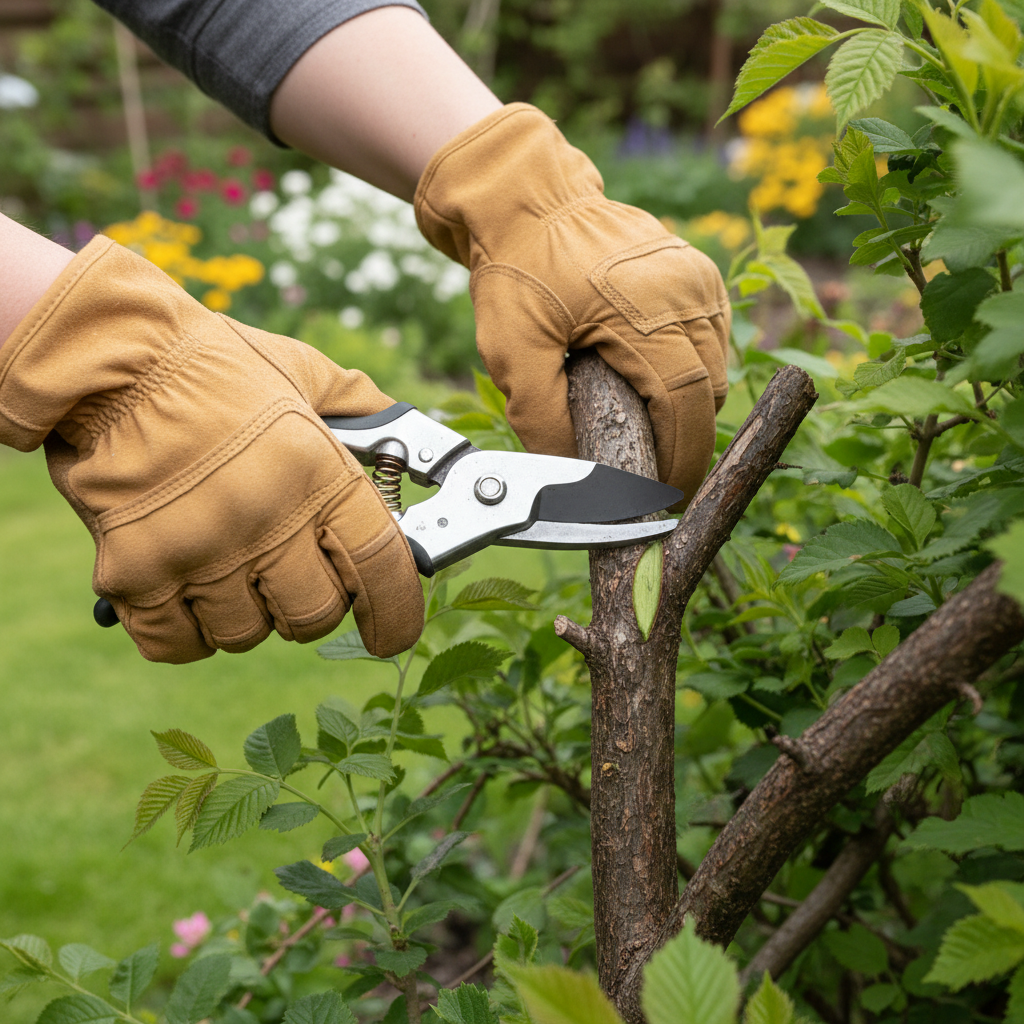
- Year 1: Identify and remove one-third of the oldest canes at ground level.
- Year 2: Remove another one-third of the remaining old canes.
- Year 3: Remove the last of the original old canes. By this point, the shrub will be composed of healthy new growth from the past two years, plus one- and two-year-old stems.
Landscaping · Deck or fence project
| Project category | Landscaping |
|---|---|
| Problem type | Deck or fence project |
| Trade required | Landscaping |
| Urgency | Planned project |
| Safety risk | Moderate safety risk |
| DIY suitability | DIY for experienced homeowners |
| Cost category | High cost |
| Typical timeline | Most builds 3–10 days depending on size |
| Contractor type | Landscaping contractor |
Repair option
Replace failed boards, posts, and hardware; reseal the surface.
Replacement option
Rebuild when framing or the ledger connection is unsafe.
Common causes
- Rot at posts and ledger
- Storm damage
- Adding outdoor living space
Relevant tools:home improvement material pricesproject cost estimator
Published April 18, 2026Last updated August 17, 2026
How it works
Pruning is a strategic intervention that redirects a plant's energy and manipulates its natural growth patterns for improved health, structure, and productivity. The process is governed by fundamental plant biology, primarily the concept of apical dominance. The terminal bud at the very tip of a branch produces a hormone called auxin, which flows downward and suppresses the growth of lateral (side) buds below it. When you make a pruning cut that removes this terminal bud, you break the chain of apical dominance. This allows the previously dormant lateral buds just below the cut to activate and grow, resulting in a fuller, bushier plant.
All pruning cuts are wounds. A plant responds by forming callus tissue over the cut surface, a process similar to scarring. Making clean cuts with sharp tools at the correct location—just outside the branch collar (the slightly swollen area where a branch joins a larger stem)—enallows the plant to compartmentalize the wound efficiently and prevent decay from entering the main stem.
For overgrown shrubs, pruning serves three main purposes. First, it removes non-productive material: dead, diseased, or old, woody stems that consume resources but contribute little to flowering or foliage. Second, it improves light penetration and air circulation throughout the plant's interior. This is crucial for photosynthesis in lower leaves and significantly reduces the humid, stagnant conditions that foster fungal diseases like powdery mildew. Finally, by selectively removing old canes and shortening others, you stimulate the growth of new, vigorous stems from the base or on existing branches, effectively renewing the shrub and ensuring a continuous cycle of healthy growth and abundant blooms.
Step-by-Step Fix
1. Identify a Shrub's Pruning Schedule — Know when to cut.
The single most important factor for success is timing, which depends on when the shrub forms its flower buds. Shrubs that bloom in spring (e.g., Forsythia, Lilac, Weigela) do so on "old wood"—stems that grew the previous year. Prune these immediately after they finish flowering. Pruning them in late winter will remove the flower buds. Shrubs that bloom in summer or fall (e.g., Hydrangea paniculata, Crape Myrtle, Rose of Sharon) do so on "new wood"—growth from the current season. Prune these in late winter or early spring before new growth begins. If you don't know the shrub type, observe its bloom time for one season to determine the correct schedule.
- Tool: Smartphone for photos and identification apps, garden reference book.
- Safety: Do not guess. Waiting a season to observe is better than cutting at the wrong time and sacrificing a year of blooms.
2. Assemble and Sanitize Your Tools — Prepare for clean cuts.
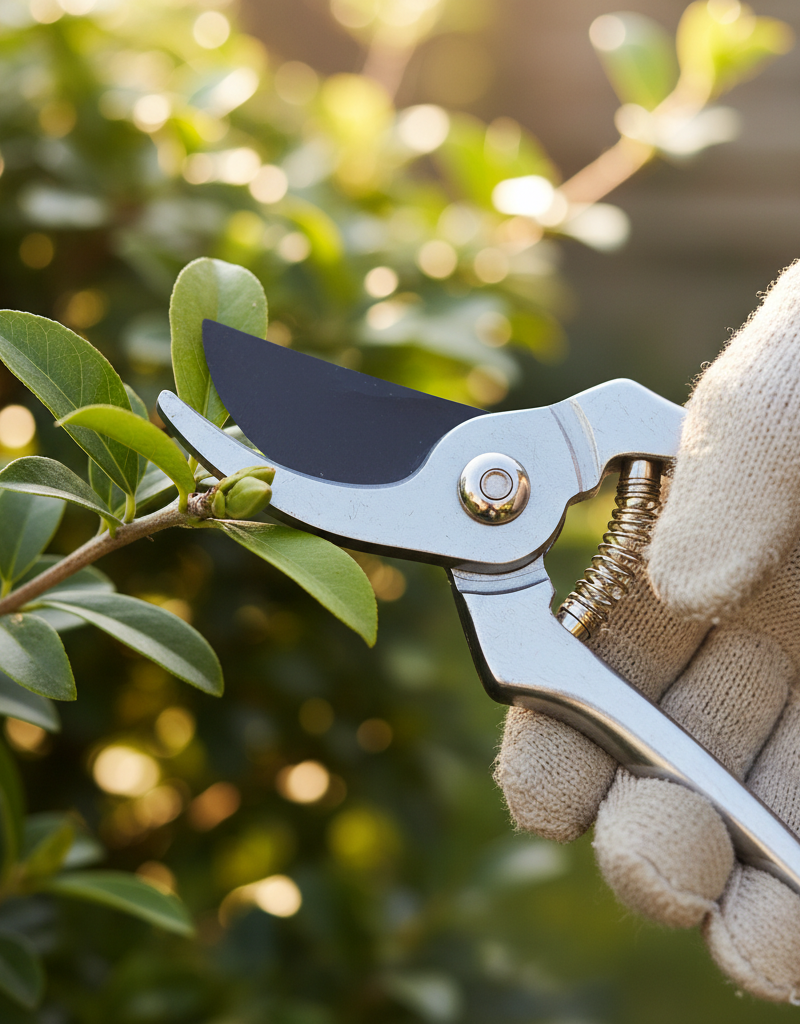
Using the right tool makes the job easier and is healthier for the plant. Use bypass pruners for stems up to 3/4 inch thick, loppers for branches up to 1.5 inches, and a sharp pruning saw for anything larger. Bypass tools, which have two curved blades that pass each other like scissors, make a cleaner cut than anvil tools, which can crush stems. Before you begin and between plants, sanitize your blades to prevent spreading disease.
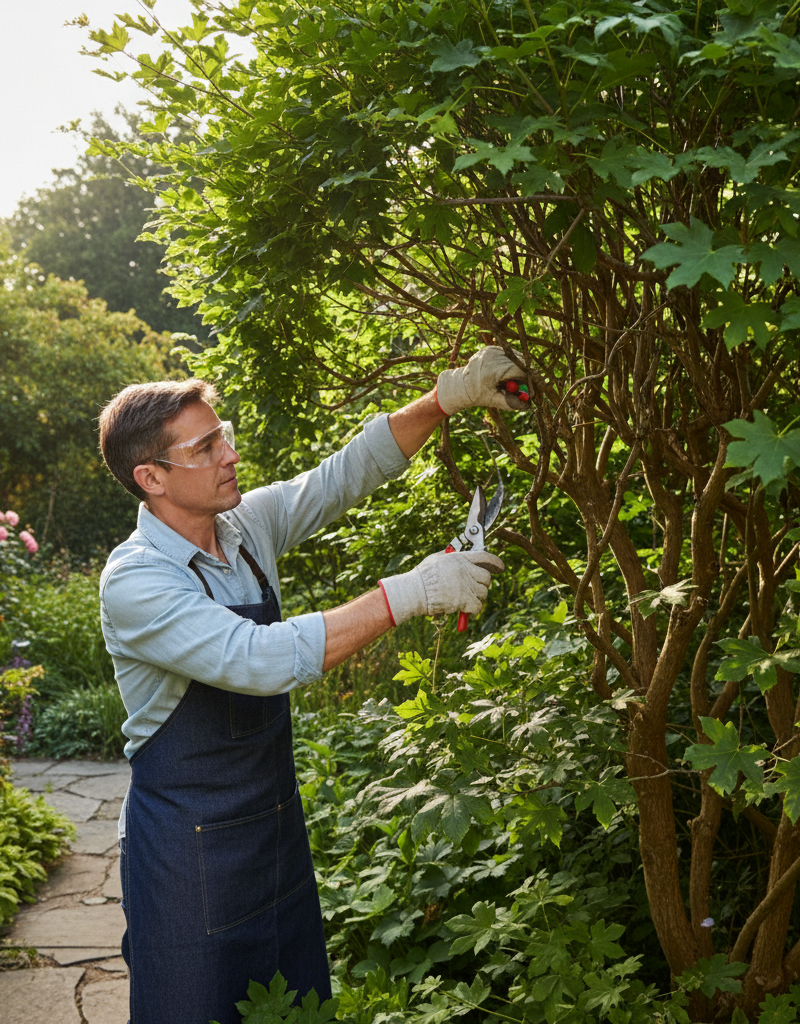
- Tools: Bypass pruners, bypass loppers, pruning saw, gloves, safety glasses.
- Sanitizing: Wipe blades thoroughly with a cloth soaked in 70% isopropyl alcohol or dip them for 60 seconds in a solution of 1 part bleach to 9 parts water, then rinse and dry to prevent corrosion.
3. Clear the Base and Assess the Structure — See what you're working with.
Before making any cuts, pull back any mulch, clear away weeds, and remove fallen leaves from around the base of the shrub. This exposes the crown, where all the main stems originate. Step back and examine the plant's overall architecture. Identify the oldest, thickest canes, which are often darker and have peeling bark. Note any branches that are crossing and rubbing, those growing back into the center, or any that are clearly dead (brittle, no green under the bark).
- If you can't see the base: The shrub is likely too dense. Your first thinning cuts (Step 5) will be aimed at opening up this area to view the structure.
4. Remove the Three D's: Dead, Damaged, and Diseased Wood — The universal first step for health.
This can be done at any time of year without harming the plant. Use your pruners or loppers to cut out any branch that is obviously dead, broken, or shows signs of disease like cankers, fungal growth, or discolored wood. Trace the damaged branch back to a point where it joins a healthy, larger branch or back to the main stem. Make your cut just outside the branch collar, leaving the slightly raised ring of tissue intact so the plant can heal properly.
- Tools: Bypass pruners, loppers.
- Disposal: Bag and discard diseased wood in the trash; do not compost it, as this can spread pathogens.
5. Begin Rejuvenation by Thinning Old Canes — Open up the core.
This is the key to taming an overgrown, multi-stemmed shrub. The goal is to remove roughly one-third of the oldest, thickest, and least productive stems, cutting them right down to the ground. This stimulates the plant to send up new, vigorous shoots from its base. This drastic step floods the plant's interior with light and air. For heavily overgrown shrubs, this is best done as a rolling process over three years.
- Year 1: Identify and remove one-third of the oldest canes at ground level.
- Year 2: Remove another one-third of the remaining old canes.
- Year 3: Remove the last of the original old canes. By this point, the shrub will be composed of healthy new growth from the past two years, plus one- and two-year-old stems.
6. Thin Out Crowded and Crossing Branches — Improve the framework.
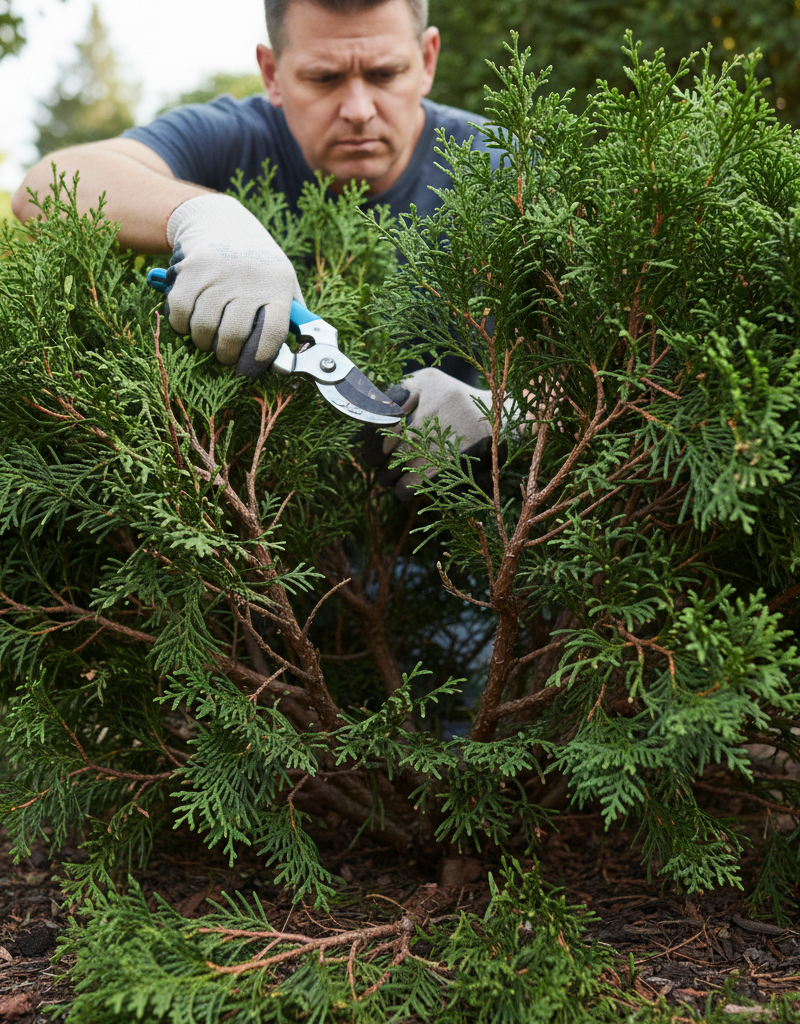
With the oldest canes removed, turn your attention to the remaining structure. Look for branches that are growing into the center of the shrub, rubbing against one another, or are growing too close together and competing for space. Using pruners or loppers, remove the weaker or more poorly placed of the two branches. Trace the unwanted branch back to its point of origin on a larger stem or to the main trunk and cut it off completely. These are called thinning cuts.
- Goal: Create space between branches so that a bird could fly through the shrub. This is a good measure of adequate air circulation.
7. Reduce Height and Width with Heading Cuts — Shape the shrub.
Now that the interior is thinned, you can reduce the overall size. Do this by making "heading cuts," which involve shortening individual branches. Do not simply shear the top like a hedge. Instead, follow a long branch down to a point where you find an outward-facing bud or a lateral (side) branch. Make your cut about 1/4 inch above that bud or side branch, angled slightly away from it. This directs subsequent new growth outward and downward, promoting a more open and natural shape.
- Safety: Step back frequently to look at the shrub from all sides, ensuring you are creating a balanced, natural form and not a flat-topped box.
8. Address Suckers and Water Sprouts — Remove unwanted growth.
Suckers are vigorous vertical shoots that grow directly from the root system or the very base of the shrub. Water sprouts are similar shoots that emerge vertically from main branches. Both are unproductive, divert energy from the main plant, and ruin its shape. Remove suckers by cutting them as flush to the ground or root as possible. For water sprouts, cut them flush with the branch from which they emerge.
9. Clean Up and Mulch — Finish the job.
Rake up all pruned branches and debris from around the plant. This is not just for appearances—it removes potential homes for pests and diseases. Once the area is clean, apply a 2- to 3-inch layer of organic compost or mulch around the base of the shrub, keeping it a few inches away from the stems to prevent rot. This helps conserve moisture, suppress weeds, and provide slow-release nutrients to the stressed plant.
- Watering: After a hard pruning, give the shrub a deep, thorough watering to help reduce stress and encourage recovery.
Common mistakes
- Shearing with Hedge Trimmers: Many DIYers treat an overgrown shrub like a formal hedge, shearing the exterior into a ball or box. This only encourages a dense outer layer of growth, which blocks light and air from the plant's interior, leading to a "dead zone" inside. Instead, use thinning and heading cuts on individual branches to reduce size while maintaining a natural form and healthy structure.
- Leaving Stubs or Making Flush Cuts: When shortening a branch, cutting too far from a bud or main stem leaves a dead stub that will decay and invite pests. Conversely, cutting too close and removing the raised "branch collar" creates a large wound the plant cannot easily heal. Always cut just outside the branch collar or about 1/4 inch above an outward-facing bud.
- Applying Wound Paint or Tar: This is an outdated practice that has been proven to be counterproductive. Sealing a pruning cut traps moisture and pathogens against the wood, hindering the plant's natural ability to compartmentalize the wound and form protective callus tissue. Let pruning cuts heal naturally in the open air.
- Pruning at the Wrong Time of Year: The most common mistake for flowering shrubs. Pruning a spring-blooming forsythia or lilac in the winter removes all the flower buds that formed on the previous year's wood. Always identify your shrub and its bloom cycle before making major cuts. If in doubt, prune right after it flowers.
- Removing Too Much at Once: In a panic over an overgrown shrub, it's tempting to cut it all back drastically. Removing more than one-third of a plant's total mass in a single season can induce severe stress, leading to weak growth, susceptibility to disease, or even killing the plant. The three-year rejuvenation plan is a safer, more sustainable approach.
Cost & time breakdown
The cost of pruning is primarily in tools if doing it yourself, or labor if hiring a professional. Prices vary based on your region and the complexity of the job.
| Task | DIY Cost | Pro Cost | Time (DIY) |
|---|---|---|---|
| Basic Hand Tools (Bypass Pruners & Loppers) | $50 - $120 | N/A | N/A |
| Quality Pruning Saw | $25 - $60 | N/A | N/A |
| Debris Disposal (Yard bags/pickup fee) | $10 - $25 | Included in quote | 1-2 hours |
| DIY Pruning (Single Medium Shrub) | Cost of tools | N/A | 1-3 hours |
| Professional Pruning (per shrub) | N/A | $75 - $250 | N/A |
| Professional Day Rate (Multiple Shrubs) | N/A | $500 - $900 | N/A |
When to call a pro
While pruning is a manageable DIY task, certain situations warrant calling a certified arborist or a professional landscape company. If the shrub is so large that it requires working from a ladder, especially with power tools, the risk of injury increases significantly. Professionals have the training and safety equipment for working at height. You should also call a pro if the shrub is situated near power lines; this is non-negotiable for safety.
If a large portion of the shrub appears dead or diseased and you cannot confidently determine if it is salvageable, an arborist can provide an expert diagnosis and a plan for rehabilitation or removal. For very old, valuable, or sentimentally important specimen plants, hiring a professional minimizes the risk of a fatal mistake. Finally, if the scope of work involves numerous large shrubs that will generate more debris than you can reasonably handle, or if you have physical limitations, hiring out the labor is the most practical choice. They have the chippers and hauling capacity to make the cleanup efficient.
Prevention & maintenance
- Prune Annually: The best way to prevent severe overgrowth is to perform light, targeted pruning every year. This involves removing a few older canes, thinning any crossing branches, and lightly shaping the plant. This 15-30 minute annual task is far easier than a multi-hour rejuvenation project every five years.
- Right Plant, Right Place: Prevention starts at planting. Research the mature size of a shrub before you buy it. Choosing a variety that naturally grows to the size and shape appropriate for the location eliminates the need for constant, aggressive pruning to keep it in bounds.
- Regularly Remove the 3 D's: Routinely inspect your shrubs for Dead, Damaged, and Diseased wood. Removing this material as soon as you spot it keeps the plant healthy and prevents small problems from spreading.
- Monitor Plant Health: Provide appropriate water, especially during dry spells, and use fertilizer sparingly. Over-fertilizing, particularly with high-nitrogen formulas, can cause rapid, weak, leafy growth that requires more frequent pruning and is more susceptible to pests. A healthy, properly nourished plant will better tolerate and recover from pruning.
- Maintain Sharp, Clean Tools: A dull blade crushes and tears plant tissue, creating ragged wounds that heal slowly and are entry points for disease. After each use, clean your pruners and loppers of sap and debris, and periodically sharpen the blades with a file or sharpening stone. This ensures you are always ready to make clean, healthy cuts.
Related Articles
Keep troubleshooting with these hand-picked guides from FixlyGuide:
- How to Prune Overgrown Shrubs for Health — Learn how to properly prune your overgrown shrubs to encourage healthy growth, improve their shape, and increase flowering without damaging…
- The #1 Pruning Mistake That Chokes Your Shrubs (And How to Fix It Right Now) — Discover the most common pruning error homeowners make and how to correct it for healthier, more vigorous shrub growth.
- The #1 Mistake Homeowners Make Pruning Trees (And How to Fix It) — Pruning trees at the wrong time can severely damage them, stunting growth and inviting pests. Learn the critical mistake to avoid.
- The Invisible War Beneath Your Sidewalk: 3 Ways Tree Roots Cause Havoc — Discover how tree roots cause sidewalk damage and learn actionable DIY and professional solutions to restore safety and appearance.
- The #1 Pruning Mistake Homeowners Make (and How to Fix It) — Many homeowners prune their trees at the wrong time, leading to weak growth, disease, or fewer flowers. Learn the right time to prune to en…
- How to Caulk Around a Bathroom Sink: A DIY Guide for a Watertight Seal — Learn how to properly caulk around your bathroom sink to prevent water damage and improve its appearance with this easy-to-follow DIY guide.
Should you do this yourself?
Answer five quick questions before you start. Safety outranks savings every time.
Your experience with work like this
How high do you have to work?
Does the job involve any of these?
Will it need a permit?
Specialty tools
Free and instant. Educational guidance only — not a quote, inspection, or professional diagnosis.
What should this project cost?
Enter your project details for a realistic cost range before you call anyone.
Cost depends heavily on which system turns out to be the source.
- Regional adjustment
- National average
- Labor share (typical)
- ~$1,620
- Quotes to collect
- 3 written estimates
Educational estimate based on national averages — not a binding quote. Always confirm with written local estimates.
Before you start
Check the difficulty, permits, and safety risk — then decide whether to call a pro.
- Estimate this projectGet a cost range for your scope and ZIP before you call anyone.Open
- Get local estimatesSend one request and compare written estimates from vetted pros.Open
Free, no signup required. Estimates are educational guidance, not a quote or an inspection.
Frequently asked questions
How do you prune an old overgrown shrub?+
For an old, overgrown shrub, start by removing all dead, damaged, or diseased branches. Then, gradually thin out about one-third of the oldest, thickest stems from the base of the plant over one to three years. This rejuvenates the plant by encouraging new growth from the base without shocking it completely.
Can I hard prune an overgrown shrub?+
Whether you can 'hard prune' an overgrown shrub depends on its species. Some deciduous shrubs respond well to harsh pruning (known as rejuvenation pruning) where they are cut back almost to the ground. Others, particularly evergreens and those that only grow on old wood, may not recover. Always research your specific shrub type before attempting hard pruning.
How much can I cut off an overgrown shrub?+
As a general rule, never remove more than one-third of the shrub's total mass in a single pruning season. Removing too much can stress the plant, making it susceptible to disease or even killing it. If more extensive pruning is needed, spread it out over several years.
What happens if you don't prune shrubs?+
If shrubs are not pruned, they can become excessively dense, leading to poor air circulation and light penetration into the plant's interior. This can result in dead spots, increased susceptibility to pests and diseases, reduced flowering, and an overall unhealthy and unruly appearance.
When is the best time to prune overgrown shrubs?+
The best time to prune depends on the shrub's flowering habits. Spring-flowering shrubs should be pruned immediately after they finish blooming. Summer and fall-flowering shrubs are best pruned in late winter or early spring before new growth begins. Always avoid pruning in late fall, as new growth stimulated by pruning can be damaged by winter frosts.
Discussion
Loading comments…