- What can this device detect?
- How will I learn about a problem?
- Will anything stop the water if I cannot respond?
Plumbing · Leak
| Project category | Plumbing |
|---|---|
| Problem type | Leak |
| Trade required | Plumbing |
| Urgency | Emergency — act now |
| Safety risk | High safety risk |
| DIY suitability | DIY for experienced homeowners |
| Cost category | Low cost |
| Typical timeline | Shut water off now; repair usually same or next day |
| Contractor type | Licensed plumber |
Repair option
Isolate at the shutoff, replace the failed component, and dry the cavity fully.
Replacement option
Repipe the run or the branch when corrosion is widespread.
Common causes
- Failed supply line or shutoff valve
- Worn washers, cartridges, or P-trap connections
- Pinhole corrosion in older copper
Relevant tools:emergency checklistdiy or hire a pro
Published November 9, 2026
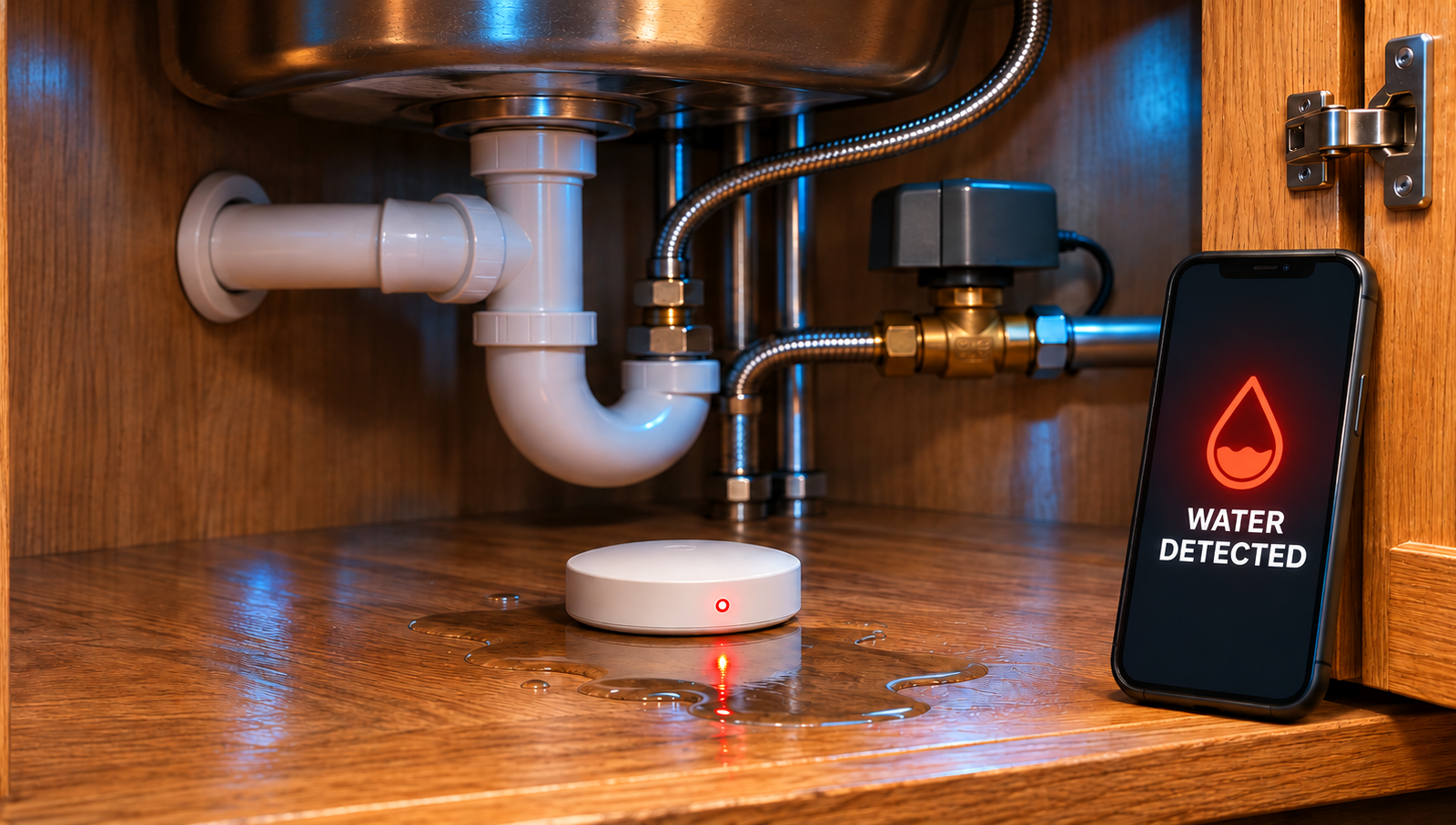
You're halfway through a weekend trip when your phone lights up: water detected near the washing machine.
That notification is useful. But one question suddenly matters more than anything else:
Is the water still running?
That is the difference homeowners need to understand before buying water leak detectors. Some devices sound an alarm. Others send a phone notification. Certain systems can also close a valve to stop water entering the home.
Those are different levels of protection, and the words "smart leak detector" do not automatically mean a product does all three.
If you want to help protect cabinets, flooring, and other parts of your home from plumbing leaks, start by understanding what a device detects, what happens after detection, and who responds when you are away.
Quick answer: What is the difference?
A water leak detector typically senses water at a particular location and sounds an alarm or sends an alert. A flow monitor watches water use or pressure changes to identify unusual conditions. An automatic water shutoff system can close a compatible valve when its detection rules call for it.
Some products combine these functions. Others require separate sensors, a hub, or a compatible shutoff device. EPA WaterSense distinguishes moisture detection from flow monitoring and notes that intervention capabilities vary by system. [1][2]
Before buying, answer three questions:
- What can this device detect?
- How will I learn about a problem?
- Will anything stop the water if I cannot respond?
1. A leak alarm and a shutoff system solve different problems
Imagine a small sensor sitting under your kitchen sink. A supply connection starts dripping, and water reaches the sensor's contacts. The alarm sounds.
If you are in the kitchen, that may give you an opportunity to act quickly. If you are out of town and the device only makes noise, nobody may hear it.
A connected sensor adds another possibility: a notification on your phone. That improves awareness, but you still need someone who can reach the house, locate the leak, and safely stop the water.
An automatic shutoff system adds a physical response. When the system recognizes a condition that triggers closure, it closes the water valve it controls.
Detection, notification, and shutoff are separate features. Treat them as separate lines on your shopping checklist rather than assuming they come together.
| Device type | What it does | What to confirm |
|---|---|---|
| Local water alarm | Detects water at its sensing contacts and sounds nearby | Whether someone can hear it and respond |
| Connected moisture sensor | Detects water locally and can send remote alerts | Network, hub, battery, and notification requirements |
| Flow or pressure monitor | Watches the plumbing supply for unusual patterns | Detection limits and which branches it monitors |
| Automatic shutoff system | Closes a valve when configured conditions are met | Compatible detection, installation, power, and operating requirements |
EPA's technical guidance describes these different technologies and notes that some systems combine them. [2]
2. Where should you place water leak detectors?
Start by walking through your home and identifying places where a leak could go unnoticed. Prioritize concealed plumbing, appliances that use water, and rooms you do not enter every day.
The important question is not simply "Where is there a pipe?" It is "Where would water travel if this connection started leaking?"
Under kitchen and bathroom sinks
Look at supply connections, shutoff valves, drain assemblies, and any water-using accessories. Place a compatible sensor where escaping water could reach its sensing contacts, following the manufacturer's instructions.
Avoid burying the sensor beneath cleaning supplies or placing it on a raised organizer when water would collect below it. Keep enough access to inspect and test it without emptying the entire cabinet.
Near the washing machine
Supply hoses and connections deserve attention, but a sensor only helps if water can reach it. A compatible remote probe may make sense where the main device would be hard to access.
Do not move a heavy appliance or strain its connections just to install a sensor. If access is difficult, include placement in a professional maintenance visit.
Near the water heater
Discuss the best location with the installer, particularly when a drain pan is present. The sensing area may need to be inside the pan to detect water there, but only if the product is suitable for that placement.
Do not block a drain opening, interfere with equipment clearances, or attach anything to a relief-valve discharge pipe. A sensor supplements maintenance; it does not correct an improperly installed water heater.
Near the dishwasher and refrigerator water line
These areas can be challenging because a small leak may stay hidden behind cabinetry or an appliance. A compatible sensing cable or remote probe can sometimes cover an area a standalone puck cannot reach.
Measure access first. A device wedged somewhere you cannot retrieve for battery replacement is likely to become a maintenance problem.
Near toilets and other vulnerable locations
Consider places where a supply leak could damage finishes or remain unnoticed, particularly upstairs or in seldom-used rooms. Keep sensors away from routine splashes that would repeatedly trigger nuisance alarms.
For every location, check the device's environmental rating. Indoor equipment is not automatically suitable for an outdoor valve box, wet crawl space, or freezing garage.
3. Understand what a sensor cannot see
A moisture sensor must encounter water at its sensing area. Water that travels in another direction, remains inside a wall, or collects beneath flooring may never reach it.
A flow monitor has different limitations. It observes the water passing through or measured at its installation point. A branch upstream of that point may be outside its coverage. Detection thresholds and operating modes also vary.
Ask the installer to draw a simple map showing the service entry, monitored piping, valve location, and any excluded branches. Include irrigation and outbuildings in that conversation when applicable.
Also remember that closing the domestic water supply cannot stop every source of water damage. Rain entering through the roof, groundwater intrusion, and a sewer backup require other solutions. Water already stored in pipes or an appliance can still escape after a supply valve closes.
These limitations do not make detection equipment useless. They explain why coverage and response planning matter as much as the product itself.
4. When does automatic water shutoff deserve a closer look?
Consider your ability to respond, not just the size of your home.
An automatic system may be especially worth discussing when the property is frequently unoccupied, nobody nearby can enter during an emergency, or a leak could affect several floors before it is noticed.
Compare two hypothetical households. In one, someone is usually home and the most vulnerable plumbing is easily accessible. In the other, the owners travel often and the laundry room is upstairs. The same alert-only device leaves those households with very different response challenges.
Ask yourself: If I received an alert right now, who could actually stop the water?
If the answer is unclear, that is a reason to investigate automatic intervention. It is not a guarantee that any particular product is appropriate for your plumbing.
5. Ask these questions before choosing a system
Does it actually shut off water?
Ask for the exact model and a written description of what is included. A sensor photographed beside a valve does not establish that both are part of the purchase.
Confirm whether you are buying an alarm, a monitor, a valve, or a complete compatible system.
What happens if Wi-Fi or the internet fails?
Ask separately about local alarms, automatic detection, valve operation, and remote notifications. They may not all have the same dependencies.
Request the manufacturer's documentation for the specific model. "It works offline" is incomplete unless you know which functions continue working.
What happens during a power outage?
Identify the power source for every component: sensor, hub, valve controller, and any equipment needed for notifications. Ask whether backup power is supported, what it powers, and how its condition is checked.
For example, Moen's published installation instructions specify power and connectivity requirements for its system. Those requirements illustrate why installation details must be checked by model rather than assumed across all products. [3]
What plumbing is compatible?
Pipe size, material, available clearance, pressure, and installation environment can affect suitability. Homes with wells or unusual layouts need a specific compatibility review.
Have a qualified installer determine the correct location. A domestic-water shutoff must not inadvertently disable fire protection. Moen's instructions, for example, prohibit installation on fire-suppression lines and specify placement after the sprinkler branch when applicable. [3]
How does it handle unusual but legitimate water use?
Ask how the system handles a long irrigation cycle, guests, water-softener regeneration, or another activity outside the household's ordinary routine. Find out whether a learning period or operating-mode adjustment is needed.
You want understandable settings and a clear explanation of how to investigate an unexpected shutdown.
How do you operate it manually?
Request a demonstration of the manufacturer-approved manual controls and emergency procedures. Household members should know where the valve is and what to do if their phones are unavailable.
What costs continue after installation?
Ask about optional or required subscriptions, replacement batteries, support arrangements, and future servicing. Confirm which features remain available without a paid plan.
Evaluate the system using the features you will actually maintain, not the longest marketing feature list.
6. Compare complete installed quotes
The device price is only one part of a project. Before comparing contractor estimates, make sure each contractor is quoting an equivalent result.
Request these items in writing:
- Exact equipment models and the number of sensors.
- Proposed valve location and monitored branches.
- Plumbing modifications and any required electrical work.
- Permits or inspections, where required.
- Setup, pairing, and household training.
- Testing of detection, notifications, and shutoff functions.
- Warranty terms and responsibility for future service.
- Recurring charges and optional accessories.
This turns an unclear comparison into a useful one. A lower quote that excludes setup and sensor placement may represent a smaller job, rather than a better price for the same work.
Some insurers offer incentives for qualifying leak protection. EPA mentions this as a potential benefit, but eligibility varies. Ask your insurer for written requirements before assuming a device will qualify. [4]
7. Test the complete response before relying on it
Installation is not finished merely because a device appears in an app.
Following the manufacturer's test procedure, confirm that each sensor responds, the correct people receive alerts, and any configured shutoff action works. Coordinate testing so an unexpected loss of water does not interrupt equipment or household activities.
Use clear location names such as "Upstairs hall bathroom sink." "Sensor 4" is much less helpful when someone unfamiliar with the house receives the notification.
Ask the installer to demonstrate how to acknowledge an alert, investigate its cause, and restore normal operation once the problem is resolved. Do not reopen the supply to an unresolved leak simply to silence an alarm.
Keep the instructions, model numbers, purchase date, and installer's contact information together. Add reminders for battery checks and manufacturer-recommended testing. EPA also recommends periodically checking installed leak-detection and flow-monitoring systems for proper operation. [5]
8. Build an alert plan your household can follow
Technology works better when someone has already decided what happens next.
Write a short response plan identifying the primary contact, backup contact, safe access arrangements, and plumber's number. Make sure everyone knows the location of the home's water shutoff — our guide to locating your home's water shutoff walks through it.
If an alert arrives while you are away, check the location and available device information, then contact the person designated to respond. If an installed system provides remote shutoff, use it according to its instructions when appropriate.
An automatic closure still needs investigation. It may have limited additional incoming water, but it has not repaired the failed connection or dried wet materials. If damage has already occurred, our overview of water damage repair costs explains what restoration work typically involves.
Do not enter standing water where electrical equipment may be energized. If the situation is unsafe or cannot be assessed safely, keep people clear and obtain professional assistance.
Frequently asked questions
Are water leak detectors worth considering without automatic shutoff?
Yes, when the alert can lead to a timely response. A basic sensor can improve awareness in an otherwise unmonitored cabinet or utility area. Its value depends on placement, maintenance, and whether someone can act.
Can one sensor protect the whole house?
A standalone moisture sensor detects water at its sensing location. A supply-line monitor can observe a broader plumbing area, but its coverage depends on installation and system capabilities. Neither should be treated as protection against every source of water damage.
Can I install water leak detectors myself?
Many standalone sensors are designed for homeowner setup. Follow the product instructions and verify alerts afterward. Equipment that requires cutting into water piping, electrical work, or complicated valve integration should be assessed by qualified professionals.
Will a leak detector find a running toilet?
A floor sensor will not ordinarily detect water passing internally from the toilet tank into the bowl. A compatible flow-monitoring system may recognize unusual usage, depending on its capabilities and settings. If that is the problem you are chasing, see why your toilet keeps running. Match the technology to the problem you want to detect.
Should I wait until I can afford a complete system?
You can build protection in stages. Start by locating the water shutoff, inspecting accessible connections, and placing suitable alarms at priority locations. If you later add automatic shutoff, check compatibility before assuming existing sensors will integrate.
Your next step: Find the gap in your protection
Walk through your home and choose three places where a plumbing leak could remain unnoticed. For each location, identify how it would be detected, who would receive the warning, and how the water would be stopped.
If any answer is missing, you have found a practical improvement to make.
Water leak detectors can provide useful warning. Automatic shutoff can add intervention. A maintained system, clear coverage, and an informed household make those features more useful together.
Sources
- EPA WaterSense, Leak Detection and Flow Monitoring Devices: https://www.epa.gov/watersense/leak-detection-and-flow-monitoring-devices
- EPA WaterSense, Leak Detection and Flow Monitoring Systems Technical Sheet: https://www.epa.gov/system/files/documents/2023-08/ws-homes-TRM-11-LeakDetectionandFlowMonitoringSystemsTechSheet.pdf
- Moen, Smart Water Shutoff & Monitor Installation Instructions, INS11955: https://assets.moen.com/shared/docs/instruction-sheets/ins11955.pdf
- EPA WaterSense, Know Your Flow and Curb Water Waste: https://www.epa.gov/system/files/documents/2026-02/ws-products-leak-flow-guide.pdf
- EPA WaterSense, Home Maintenance: https://www.epa.gov/watersense/home-maintenance
Repair or replace this system?
Plug in four numbers and see which choice holds up financially.
Free and instant. Educational guidance only — not a quote, inspection, or professional diagnosis.
Questions to ask before you sign
Ask every contractor the same questions and the cheapest bid stops looking cheapest. Check them off as you go — your progress is saved on this device.
Free, no signup. Bring this to every walkthrough so you compare bids on the same terms.
What should this project cost?
Enter your project details for a realistic cost range before you call anyone.
Common repairs run $150–$650; repipes and water-heater replacements reach $1,500–$4,500.
- Regional adjustment
- National average
- Labor share (typical)
- ~$754
- Quotes to collect
- 3 written estimates
Educational estimate based on national averages — not a binding quote. Always confirm with written local estimates.
Need Help With This Repair?
Find qualified contractors serving your area or describe your project to get connected with the right professional.
Handle this before it gets worse
First steps that limit damage, then a way to reach a qualified pro.
- Emergency repair checklistThe first steps that limit damage before a pro arrives.Open
- Get local estimatesSend one request and compare written estimates from vetted pros.Open
- Estimate this projectGet a cost range for your scope and ZIP before you call anyone.Open
Free, no signup required. Estimates are educational guidance, not a quote or an inspection.
Frequently asked questions
Are water leak detectors worth considering without automatic shutoff?+
Yes, when the alert can lead to a timely response. A basic sensor can improve awareness in an otherwise unmonitored cabinet or utility area. Its value depends on placement, maintenance, and whether someone can act.
Can one sensor protect the whole house?+
A standalone moisture sensor detects water at its sensing location. A supply-line monitor can observe a broader plumbing area, but its coverage depends on installation and system capabilities. Neither should be treated as protection against every source of water damage.
Can I install water leak detectors myself?+
Many standalone sensors are designed for homeowner setup. Follow the product instructions and verify alerts afterward. Equipment that requires cutting into water piping, electrical work, or complicated valve integration should be assessed by qualified professionals.
Will a leak detector find a running toilet?+
A floor sensor will not ordinarily detect water passing internally from the toilet tank into the bowl. A compatible flow-monitoring system may recognize unusual usage, depending on its capabilities and settings. Match the technology to the problem you want to detect.
Should I wait until I can afford a complete system?+
You can build protection in stages. Start by locating the water shutoff, inspecting accessible connections, and placing suitable alarms at priority locations. If you later add automatic shutoff, check compatibility before assuming existing sensors will integrate.

Discussion
Loading comments…