- Overloaded Circuit: Too many appliances or high-power devices drawing more current than the circuit is designed to handle. This is the most frequent cause.
- Short Circuit: A hot wire touches a neutral wire or another hot wire, creating a direct path for current and a sudden surge. Often caused by damaged appliance cords, faulty wiring, or loose connections.
- Faulty Appliance: An internal wiring issue or component failure within an appliance can cause it to draw excessive current or create a short/ground fault.
- Loose Wiring Connections: Connections in outlets, switches, or the electrical panel can become loose over time, creating resistance, heat, and eventually a fault.
- Arc Fault: Occurs when electricity jumps across a damaged or corroded conductor, creating sparks (arcing). Arc Fault Circuit Interrupters (AFCIs) are designed to detect these hazardous conditions.
Electrical · Breaker keeps tripping
| Project category | Electrical |
|---|---|
| Problem type | Breaker keeps tripping |
| Trade required | Electrical |
| Urgency | Urgent — within days |
| Safety risk | High safety risk |
| DIY suitability | Pro recommended |
| Cost category | Low cost |
| Typical timeline | Diagnosis in a single visit |
| Contractor type | Licensed electrician |
Repair option
Isolate the load, then repair the fault or replace the breaker.
Replacement option
New dedicated circuit when the load simply exceeds what the circuit was built for.
Common causes
- Genuine overload on a shared circuit
- Ground fault from moisture in an exterior box
- Failing breaker or a damaged appliance cord
Relevant tools:diy or hire a prodiy difficulty
Published May 27, 2026Last updated August 17, 2026
Tools & materials you'll need
Affiliate links- AmazonAppliance manual(s)If troubleshooting a specific appliance
As an Amazon Associate FixlyGuide earns from qualifying purchases — at no extra cost to you. Prices and availability are accurate as of publication and subject to change.
Quick Answer
A circuit breaker that repeatedly trips is a clear signal that something is wrong with your electrical system. While it often points to an overloaded circuit from too many devices drawing power, it can also indicate more serious issues like a short circuit or a ground fault. The key to fixing it is a methodical approach to diagnose the underlying cause, isolating variables one by one until the culprit is identified and addressed, ensuring safety and restoring consistent power.
The Problem
There's a distinct sound – a sharp click or thud – and then, silence. A section of your home goes dark. Your circuit breaker has tripped again. This isn't just an inconvenience; it's your electrical system's way of telling you there's a problem, and it's doing its job to prevent overheating, fires, or damage to appliances. Ignoring it or simply resetting the breaker without understanding the cause can be dangerous. A repeatedly tripping breaker means the circuit is consistently exceeding its safe operational limits, and without intervention, it will continue to interrupt your power, signal a deeper issue, or even put your home at risk if it fails to trip when needed.
How It Works
To understand why a breaker trips, it helps to know how it works. Inside your electrical panel, each circuit breaker is essentially a safety switch designed to protect a specific circuit in your home. These breakers are rated for a maximum amperage (e.g., 15 amps, 20 amps). Electrical current flows from the utility pole, through your main service panel, and out to various circuits via these breakers. When an appliance or device is plugged in and turned on, it draws current from the circuit. The breaker monitors this current flow.
Circuit breakers primarily protect against two main types of faults: overloads and short circuits/ground faults.
Overload: Imagine a highway designed for 15 cars per minute. If 25 cars try to use it, there's a jam. Similarly, an electrical circuit can only safely handle a certain amount of current. If you plug in too many high-power appliances (like a toaster, microwave, and coffee maker) into a single circuit, the total current draw exceeds the breaker's amperage rating. Inside the breaker, a bimetallic strip heats up from the excessive current. As it heats, it bends, eventually tripping a latch that disconnects the circuit, cutting power.
Short Circuit & Ground Fault: These are more serious. A short circuit occurs when a 'hot' (live) wire accidentally touches a 'neutral' wire, or another hot wire. This creates a low-resistance path, causing a sudden, massive surge of current – far more than an overload. A ground fault is similar, happening when a hot wire touches a grounded surface or wire (like a metal appliance casing). Both scenarios lead to an instantaneous, dramatic spike in current. For these, modern breakers often use an electromagnetic coil. The sudden surge of current creates a strong magnetic field that instantly trips a latch, disconnecting the circuit much faster than an overload trip. This rapid response is crucial to prevent electrical fires and reduce the risk of electrocution.
When a breaker trips, it moves to an 'off' or 'middle' position, indicating that it has interrupted the flow of electricity. It will not allow power to flow again until you manually reset it by pushing it completely to the 'off' position and then back to 'on'.
Step-by-Step Fix
Before you begin any electrical troubleshooting, always prioritize safety. Turn off any affected appliances and always be aware of the electrical panel itself.
Step 1 – Identify the Tripped Breaker
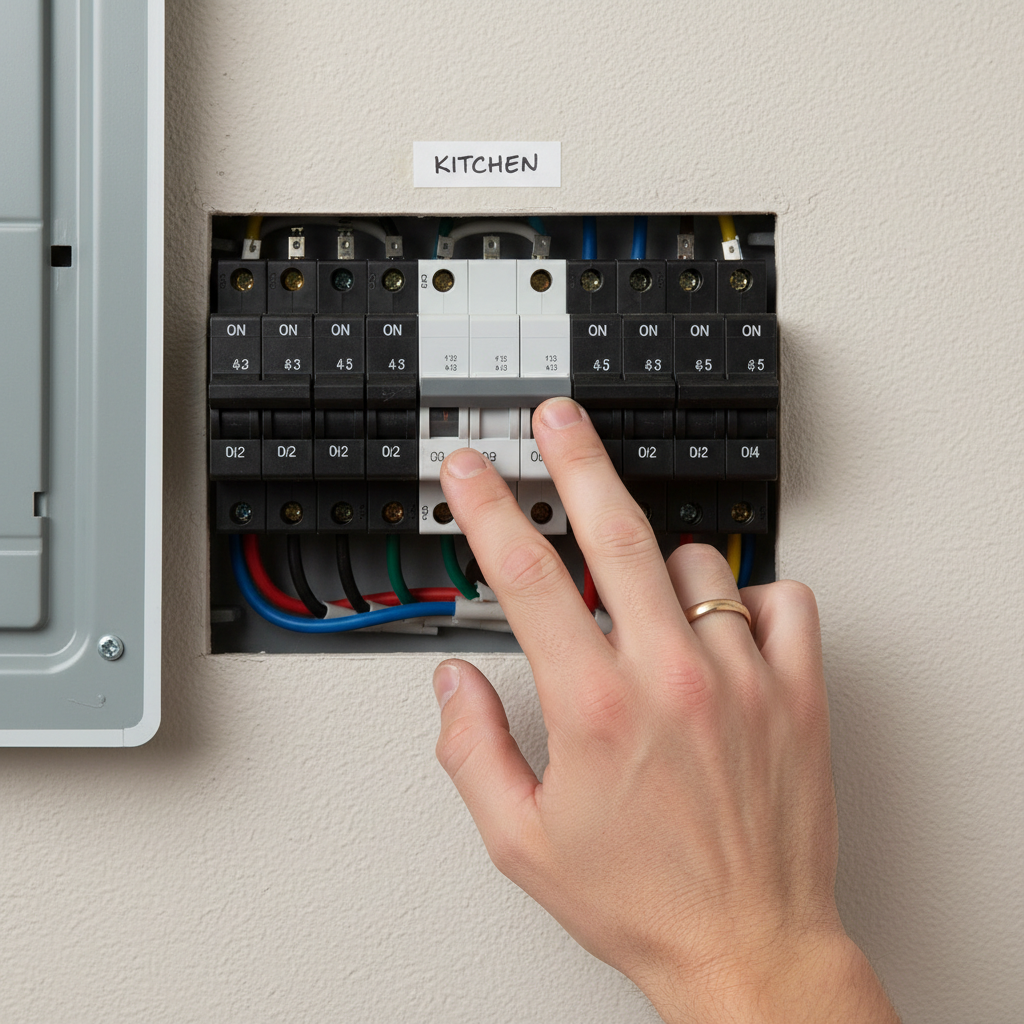
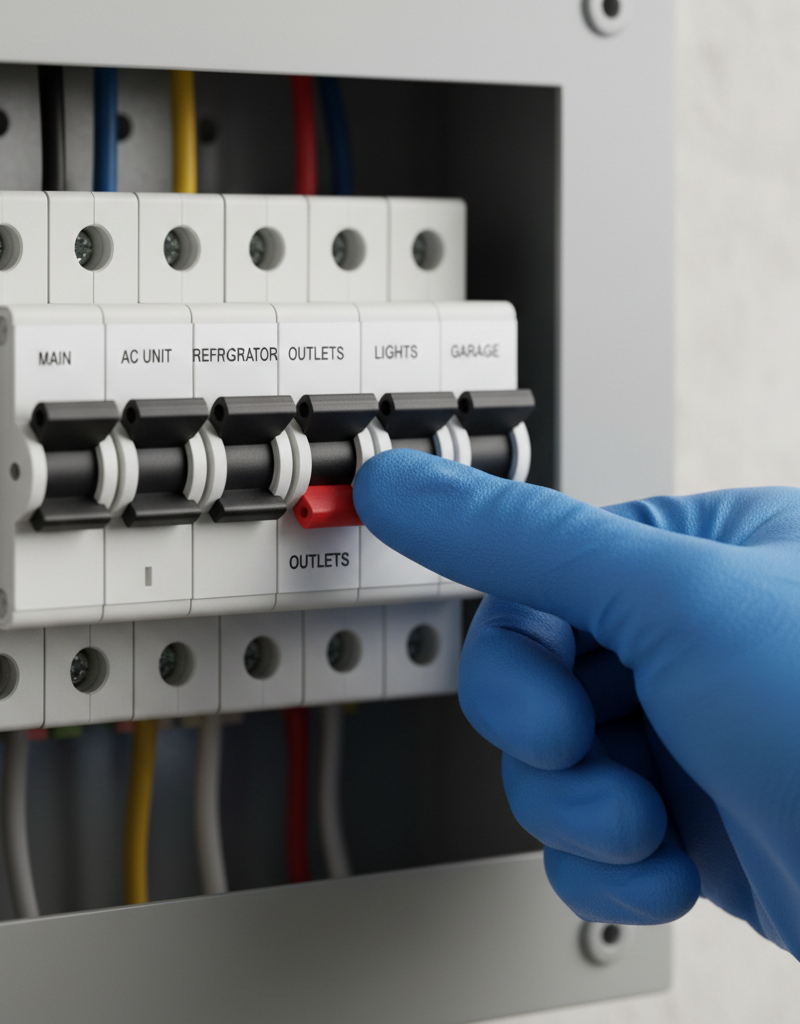
— Go to your electrical panel. Look for a breaker that is in the 'off' position or somewhere between 'on' and 'off'. Most modern breakers have a distinct tripped state, often halfway. This identifies the problematic circuit.
- Safety First: Never force a breaker that resists movement. If a breaker feels unusually hot or you smell burning, stop immediately and call an electrician.
Step 2 – Turn Off All Appliances on the Circuit
— Before attempting to reset the breaker, unplug or turn off every single device connected to that circuit. This includes lamps, computers, TVs, microwaves, refrigerators, chargers, and anything else drawing power. This is crucial for diagnostic purposes.
- Why this matters: If the breaker immediately trips again upon reset, even without any appliances turned on, it points to a more serious wiring issue rather than just an overload.
Step 3 – Reset the Breaker Properly
— Push the tripped breaker firmly to the full 'off' position. You should feel a distinct click. Then, push it firmly to the 'on' position. If it immediately trips again, do not force it or keep resetting it repeatedly. Something serious is wrong.
- Troubleshooting: If it trips immediately, even with nothing plugged in, suspect a wiring issue (short or ground fault) within the walls or outlets. Call a professional.
Step 4 – Identify Overloaded Circuit (If Breaker Holds)
— If the breaker holds after resetting with no appliances plugged in, you likely have an overload. Systematically plug in and turn on appliances one at a time. Start with the essential items. Once the breaker trips again, you've found the appliance (or combination of appliances) that pushes the circuit over its limit.
- Look for High-Draw Appliances: Appliances with heating elements (toasters, coffee makers, hair dryers, space heaters) and motor-driven appliances (blenders, vacuums) draw significant current. Avoid using multiple high-draw appliances on the same circuit simultaneously.
Step 5 – Investigate a Faulty Appliance (If Breaker Trips with One Item)
— If the breaker trips immediately when you plug in or turn on just one specific appliance, that appliance is likely the problem. It could have an internal short circuit or a ground fault. Unplug it immediately and do not use it again until it's inspected or repaired.
- Test the Appliance Elsewhere: If possible, plug the suspicious appliance into an outlet on a different circuit (e.g., in another room, being careful not to overload that new circuit). If it trips that circuit, the appliance is definitely the culprit.
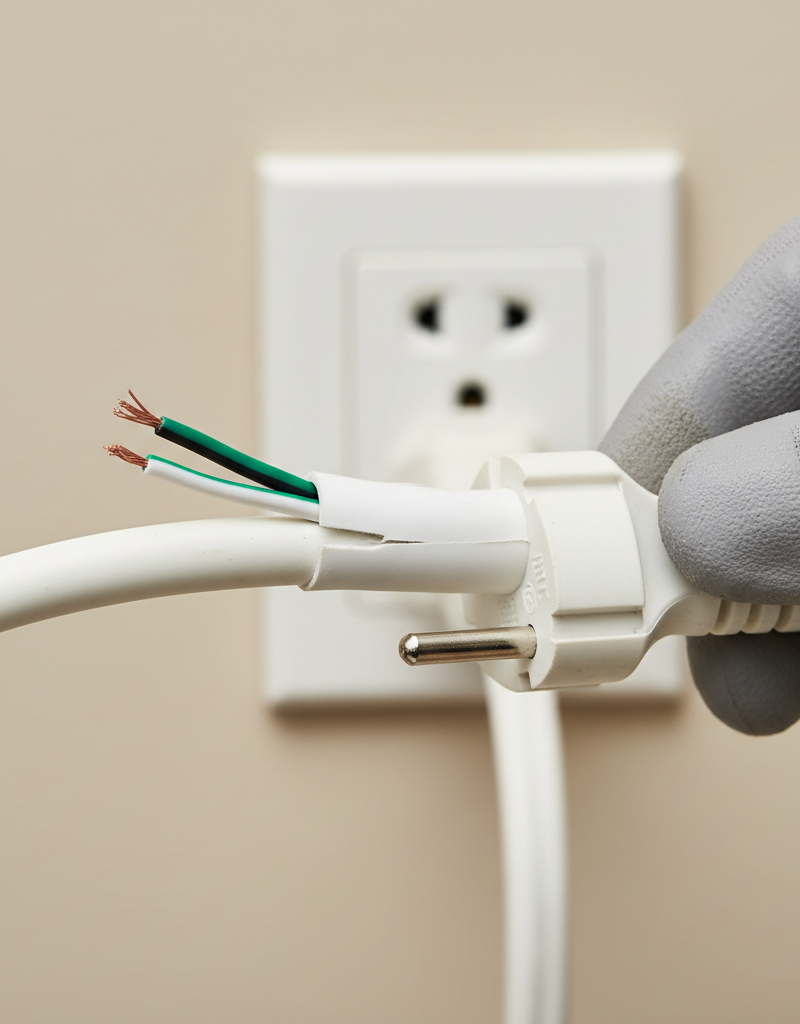
- Visual Inspection: Before testing, quickly inspect the appliance's cord for cuts, fraying, or damage. Damaged cords are a common source of shorts.
Step 6 – Check for Wiring Issues (If No Obvious Appliance Culprit)
— If you've eliminated overloads and individual faulty appliances, the problem might be in the wiring itself. This could be a loose connection in an outlet or switch, damaged insulation, or even a nail puncturing a wire in your wall. This is a more advanced diagnostic and often requires professional help.
- Look for Signs: Burnt smells, scorch marks on outlets or switch plates, or flickering lights on the circuit can indicate wiring problems. Never ignore these signs.
- GFCI Outlets: If the circuit contains GFCI (Ground Fault Circuit Interrupter) outlets and the breaker trips, and the GFCI also trips (has a reset button), it strongly suggests a ground fault somewhere downstream from that GFCI. Try resetting the GFCI first without touching the breaker.
Step 7 – Redistribute Load or Upgrade (Long-Term Solution)
— If you consistently overload a circuit, you have two options: redistribute your appliances to different circuits in your home, or, if redistribution isn't practical, consider a circuit upgrade. This involves adding new circuits to your panel, which is a job for a licensed electrician.
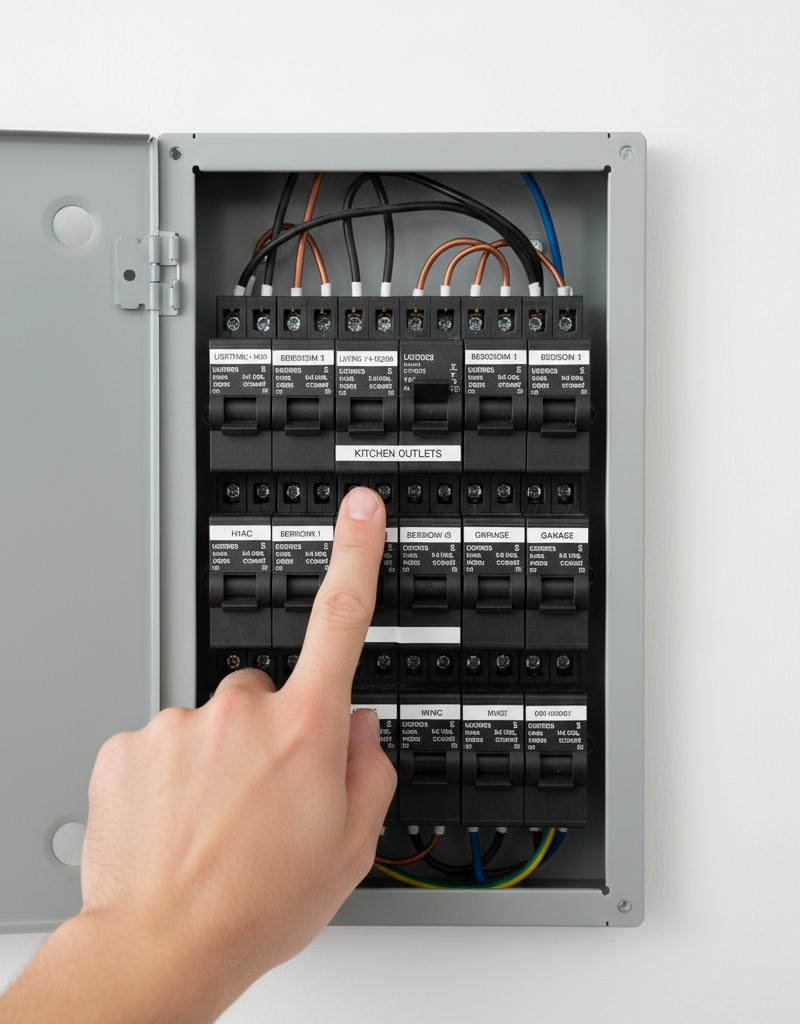
- Circuit Mapping: Take the time to map out which outlets and lights belong to which breaker. Label your electrical panel clearly. This makes future troubleshooting much easier.
Common Causes
- Overloaded Circuit: Too many appliances or high-power devices drawing more current than the circuit is designed to handle. This is the most frequent cause.
- Short Circuit: A hot wire touches a neutral wire or another hot wire, creating a direct path for current and a sudden surge. Often caused by damaged appliance cords, faulty wiring, or loose connections.
- Ground Fault: A hot wire touches a grounded surface or the ground wire, causing current to flow through an unintended path. Common in wet areas (kitchens, bathrooms) or with outdoor appliances. GFCI outlets are designed to trip rapidly for these.
- Faulty Appliance: An internal wiring issue or component failure within an appliance can cause it to draw excessive current or create a short/ground fault.
- Loose Wiring Connections: Connections in outlets, switches, or the electrical panel can become loose over time, creating resistance, heat, and eventually a fault.
- Arc Fault: Occurs when electricity jumps across a damaged or corroded conductor, creating sparks (arcing). Arc Fault Circuit Interrupters (AFCIs) are designed to detect these hazardous conditions.
- Worn-Out Breaker: While less common, breakers can wear out over decades of use and become overly sensitive or fail to hold the circuit properly. However, always rule out other causes first.
Common Mistakes
- Immediately Resetting the Breaker Without Investigation: The biggest mistake. Resetting a breaker repeatedly without finding the cause can severely damage wiring, lead to overheating, or mask a more dangerous problem.
- Ignoring the Smell of Burning Plastic/Electrical: If you smell anything burning or see smoke, immediately turn off the main breaker to your home if safe to do so, and call a professional. This is an emergency.
- Overloading Circuits with Power Strips: Power strips add outlets, but they don't add more capacity to the circuit. Plugging multiple high-draw appliances into a single power strip on one circuit will still cause an overload.
- Using Incorrect Light Bulbs: Using light bulbs with a wattage higher than the fixture is rated for can overload the fixture's wiring, causing it to overheat and potentially trip a breaker or, worse, cause a fire.
- DIY Electrical Work Beyond Your Skill: Attempting to replace breakers, outlets, or deep diagnose wiring issues without proper knowledge and tools is extremely dangerous and can lead to severe injury or fire.
- Not Mapping Out Your Circuits: Guessing which outlets belong to which breaker complicates troubleshooting and makes it harder to manage electrical loads effectively.
Cost & Time Breakdown
| Task | DIY Cost | Pro Cost | Time |
|---|---|---|---|
| Diagnose simple overload | $0 | $75–$150 | 15–30 minutes |
| Diagnose faulty appliance | $0 | $75–$150 | 20–45 minutes |
| Replace faulty outlet/switch | $10–$30 | $100–$250 | 30–60 minutes |
| Replace a single breaker | $15–$50 | $150–$300 | 1–2 hours |
| Extensive wiring diagnosis | N/A | $150–$500+ | 2–4 hours+ |
| Add new dedicated circuit | N/A | $300–$800+ | 4–8 hours+ |
Tips & Prevention
- Label Your Electrical Panel: Clearly label each breaker with the areas/outlets it controls. This is invaluable for quick troubleshooting and load management.
- Perform a Load Audit: Understand which high-power appliances are on which circuits. Try to distribute them evenly where possible. Avoid running multiple high-draw items (microwave, toaster, coffee maker, hair dryer, space heater) simultaneously on what you know is a single circuit.
- Regular Visual Inspections: Periodically check appliance cords for damage, fraying, or exposed wires. Look for discolored or warm outlets/switch plates, which can indicate overheating.
- Use Surge Protectors Wisely: Surge protectors protect devices from power surges, but they do not prevent circuit overloads. Be mindful of total draw when using them.
- Consider Dedicated Circuits: For high-power appliances like refrigerators, washing machines, dryers, microwaves, and window AC units, a dedicated circuit is often recommended or required by code. This prevents them from tripping shared circuits.
- Upgrade Old Wiring/Panel: If your home has very old wiring (e.g., knob-and-tube) or an outdated electrical panel with fuses, frequent tripping can be a sign that your electrical system isn't up to modern demands and needs a professional assessment or upgrade.
When to Call a Professional
While diagnosing a simple overload is well within a homeowner's ability, certain situations absolutely warrant a call to a licensed electrician. If your circuit breaker trips immediately upon reset, even without any appliances plugged in, it points to a serious wiring issue like a short circuit or ground fault within the walls, which can be dangerous to diagnose yourself. Any burning smells, scorch marks, buzzing sounds from the electrical panel, or if the breaker feels hot to the touch, signal an immediate and severe problem requiring professional intervention. Furthermore, if you've systematically eliminated overloads and faulty appliances but the breaker continues to trip intermittently, there might be a subtle wiring fault or a failing breaker that an experienced electrician can pinpoint and safely repair. Never tamper with the main electrical panel beyond resetting a single breaker, especially if you're unsure about the cause or safety.
Related Articles
Keep troubleshooting with these hand-picked guides from FixlyGuide:
- The Hidden Reason Your Circuit Breaker Keeps Tripping (It's Not Always an Overload) — Discover the often-overlooked causes behind a frequently tripping circuit breaker and learn how to diagnose and fix them safely.
- The Hidden Reason Your Circuit Breaker Keeps Tripping (It's Not Always an Overload) — Discover the often-overlooked electrical issues that cause circuit breakers to trip repeatedly, and how to accurately diagnose and fix them.
- The Hidden Reason Your GFCI Won't Reset (And It's Not Always a Faulty Outlet) — A GFCI outlet that won't reset usually indicates an underlying electrical issue, most commonly a ground fault or overloaded circuit, not al…
- The Hidden Reason Your Extension Cord Keeps Tripping the Breaker (and What to Do) — Discover why your extension cord might be tripping a circuit breaker and learn how to diagnose and fix common electrical issues safely.
- The Hidden Reason Your Circuit Breaker Keeps Tripping (It's Not Always an Overload) — Discover the often-overlooked culprits behind a frequently tripping circuit breaker and learn how to diagnose and fix the most common issue…
- The Hidden Reason Your GFCI Trips (It's Not Always a Faulty Outlet) — A continuously tripping GFCI outlet is a critical safety warning, often indicating moisture, a faulty appliance, or a wiring problem that r…
Should you do this yourself?
Answer five quick questions before you start. Safety outranks savings every time.
Your experience with work like this
How high do you have to work?
Does the job involve any of these?
Will it need a permit?
Specialty tools
Free and instant. Educational guidance only — not a quote, inspection, or professional diagnosis.
What should this project cost?
Enter your project details for a realistic cost range before you call anyone.
Outlet and switch work usually $150–$400; panel upgrades commonly $1,800–$4,200.
- Regional adjustment
- National average
- Labor share (typical)
- ~$709
- Quotes to collect
- 3 written estimates
Educational estimate based on national averages — not a binding quote. Always confirm with written local estimates.
Fixly Project Decision Box
- DIY difficulty
- Professional Recommended
- Estimated time
- Diagnosis 1–2 hours
- Cost level
- Moderate
Main tools / materials
- Non-contact voltage tester
- Outlet tester
- Flashlight
When to stop and call a pro
- Burning smell, scorch marks, or a warm outlet or switch plate
- A breaker that trips again right after being reset
- Any work inside the service panel
- Aluminum wiring or cloth-insulated wiring
Need professional help?
Talk to a Licensed ElectricianBefore you start
Check the difficulty, permits, and safety risk — then decide whether to call a pro.
- Estimate this projectGet a cost range for your scope and ZIP before you call anyone.Open
- Get local estimatesSend one request and compare written estimates from vetted pros.Open
Free, no signup required. Estimates are educational guidance, not a quote or an inspection.
Frequently asked questions
What's the difference between an overloaded circuit and a short circuit?+
An overloaded circuit happens when too many devices draw more power than the circuit's safe capacity, causing internal heat to trip the breaker. A short circuit is a sudden, massive surge of current caused by a direct, unintended connection between live wires or a live wire and a neutral wire, tripping the breaker almost instantly due to an electromagnetic response. Short circuits are generally more dangerous.
Can a bad appliance cause a circuit breaker to trip?+
Yes, absolutely. A faulty appliance with internal wiring damage, a motor problem, or a component failure can create a short circuit or draw excessive current, causing the breaker to trip. If a breaker consistently trips when you plug in or turn on one specific appliance, that appliance is very likely the culprit.
Is it safe to keep resetting a tripped breaker?+
It is NOT safe to repeatedly reset a tripping breaker without investigating the cause. While a one-time trip due to a temporary overload might be harmless, continuous tripping indicates an ongoing problem. Repeatedly resetting it without addressing the underlying issue can damage your electrical system, create fire hazards, or cause the breaker itself to fail when it's needed most.
How can I tell which outlets are on which circuit?+
The easiest way is to turn off a breaker and then go through your home, checking which lights and outlets no longer have power. You can use a lamp, a radio, or a dedicated circuit tester for outlets. Label your electrical panel as you go so you have a clear map for future reference.
When should I definitely call a professional electrician?+
You should call a licensed electrician immediately if a breaker trips instantly upon reset (even with no appliances plugged in), if you smell burning, see smoke or scorch marks, hear buzzing from the panel, or if a breaker feels hot to the touch. Any persistent tripping after you've ruled out simple overloads or faulty appliances also warrants professional inspection due to potential wiring issues.
Discussion
Loading comments…