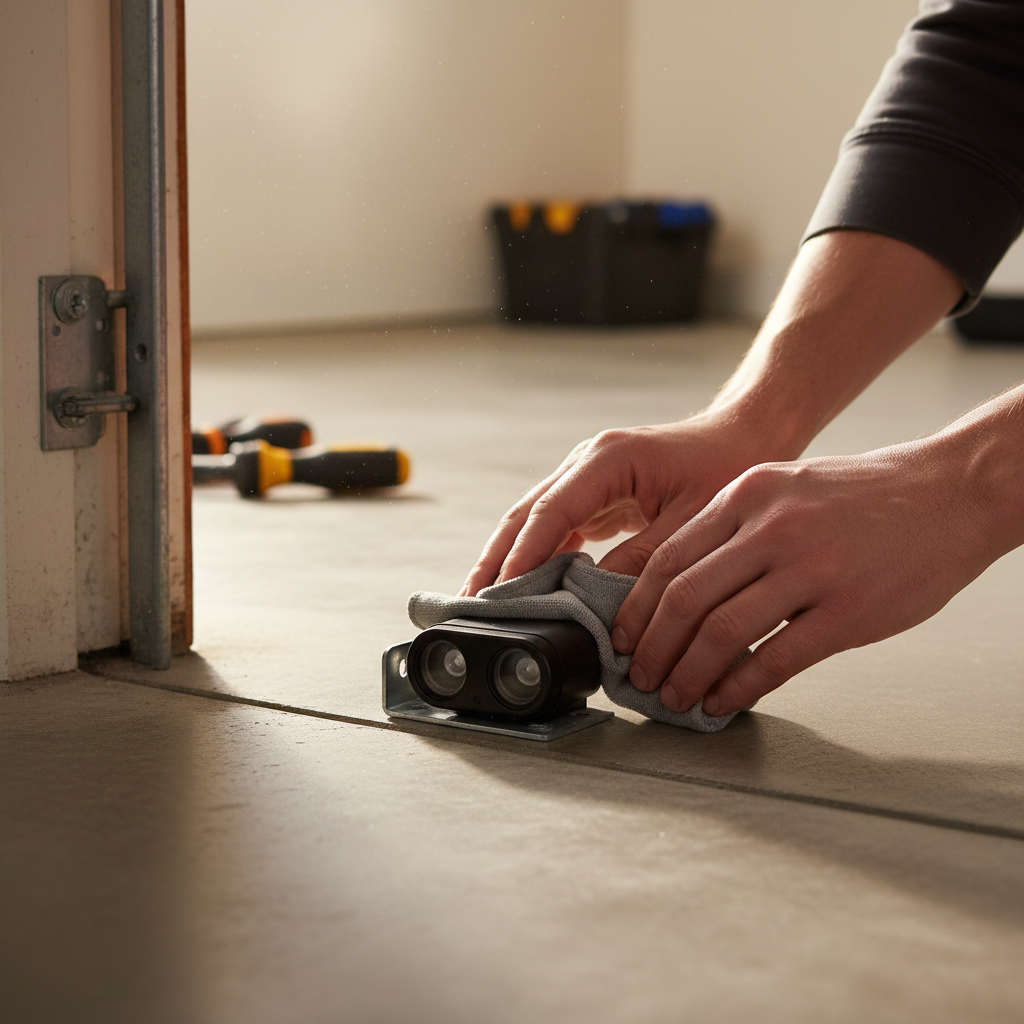
- Inspection: Look for a steady green light on one sensor and a steady amber/red light on the other. If one or both lights are flashing, off, or dim, it indicates a problem.
- Action: Gently clean the lenses of both sensors with a soft, damp cloth. Spiderwebs, dust, or even a leaf can block the beam.
- Action: Check for any objects, even small ones, directly in the path of the beam (e.g., a garden tool, a child's toy, pet food bowls). Remove them.
- Action: If they are misaligned, gently nudge each sensor until both indicator lights glow steadily. There are often wing nuts or screws that allow for minor adjustments. Visually align them so they point directly at each other.
- If this doesn't work: The wiring to the sensors might be damaged. Inspect the low-voltage wires running from the sensors back to the opener unit for cuts, pinches, or loose connections. Secure any loose wires.
General remodeling · Renovation planning
| Project category | General remodeling |
|---|---|
| Problem type | Renovation planning |
| Trade required | General contracting |
| Urgency | Planned project |
| Safety risk | Low safety risk |
| DIY suitability | Pro recommended |
| Cost category | Major investment |
| Typical timeline | Design and permitting often 2–4 months before work starts |
| Contractor type | General contractor |
Repair option
Phase the work and fix the building envelope first.
Replacement option
Full renovation with permits, design, and a general contractor.
Common causes
- Space no longer fits how the household lives
- Resale preparation
- Deferred maintenance stacking up
Relevant tools:project cost estimatorcompare quoteshome improvement material prices
Published July 8, 2026Last updated August 17, 2026
Tools & materials you'll need
Affiliate links- AmazonSilicone-based garage door lubricantoptional, for tracks/rollers
As an Amazon Associate FixlyGuide earns from qualifying purchases — at no extra cost to you. Prices and availability are accurate as of publication and subject to change.
Quick Answer
Experiencing a garage door that refuses to close all the way can be frustrating, especially when you're in a hurry. Most often, the culprit is one of three things: misaligned safety sensors, an obstruction in the door's path or eyes, or incorrect 'down' travel limit settings. Fortunately, these are usually straightforward to diagnose and fix yourself with minimal tools and a bit of patience. By carefully inspecting the sensors, clearing the tracks, and making small adjustments to the opener's settings, you can likely restore your garage door's proper function and security.
The Problem
Your garage door is a marvel of counterbalanced engineering, designed for both convenience and security. When it begins to reverse or stop prematurely during closure, it signals an interruption in its normal operating cycle. This isn't just an inconvenience; an unclosed garage door poses a significant security risk to your home and belongings, and in some cases, it can even be a safety hazard if the sensors aren't functioning correctly.
The problem manifests in several ways: the door might start to close and then immediately reverse, stop several inches or feet off the ground, or act erratically as if something is in its way. While it might seem like a major malfunction, more often than not, the underlying cause is minor and easily remedied at home. Understanding how the system works is the first step to a successful repair.
How It Works
To properly diagnose why your garage door isn't closing, it helps to understand the basic components and how they interact. A typical residential garage door system consists of the door itself, the tracks it runs on, springs (torsion or extension) that counterbalance its weight, and the automatic opener unit.
The garage door opener's primary job is to lift and lower the door. It does this via a motor that drives a trolley along a rail, which is connected to the door. The opener has internal controls that dictate how far the door opens and closes – these are called 'travel limits'. There are separate settings for the 'up' limit (fully open) and the 'down' limit (fully closed).
Crucially, all modern garage door openers are equipped with safety features to prevent accidents. The most prominent of these are the photoelectric safety sensors, typically located about 4-6 inches above the garage floor on either side of the door opening. These sensors project an invisible infrared beam across the doorway. If this beam is broken while the door is closing, the opener will automatically reverse the door to its fully open position, preventing it from crushing an object, pet, or person.
Another safety mechanism is the force setting. This dictates how much resistance the opener will tolerate before it automatically reverses. If the door encounters too much resistance during closure (e.g., hitting a stack of boxes or a child's toy), the force setting will trigger a reversal, protecting both the obstruction and the opener's motor.
When your door stops midway or reverses, it's almost always one of these safety mechanisms or the travel limit settings being activated, or a physical obstruction interfering with the door's movement along its tracks. The key is to systematically check each potential cause, starting with the most common and easiest to fix.
Step-by-Step Fix
Safety Note: Always unplug your garage door opener before performing any work that requires touching the track, springs, or electrical components, unless specifically instructed otherwise for diagnostics. Wear safety glasses when working with springs or power tools.
1. Check the Safety Sensors – Verify alignment and clear obstructions.
- The Problem: Misaligned or obstructed safety sensors are the most common reason a garage door won't close. The two small units, usually found near the bottom of the garage door tracks, transmit an infrared beam between them. If the beam is broken or misaligned, the door won't close to prevent it from crushing an object.
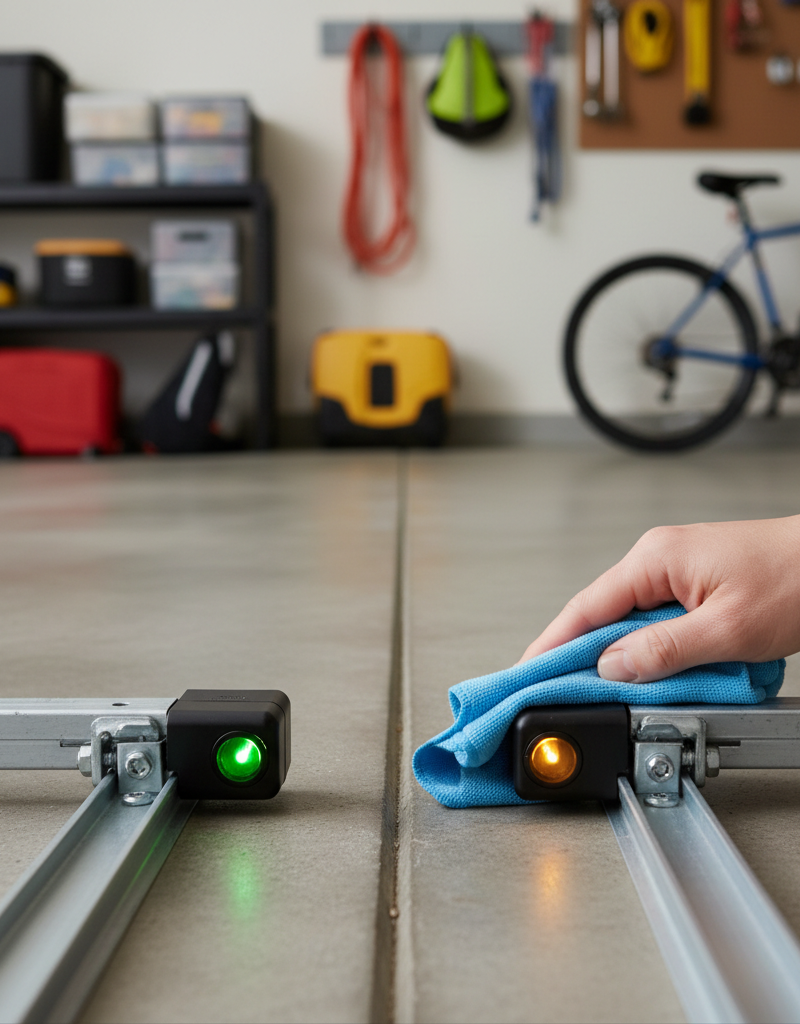
- Inspection: Look for a steady green light on one sensor and a steady amber/red light on the other. If one or both lights are flashing, off, or dim, it indicates a problem.
- Action: Gently clean the lenses of both sensors with a soft, damp cloth. Spiderwebs, dust, or even a leaf can block the beam.
- Action: Check for any objects, even small ones, directly in the path of the beam (e.g., a garden tool, a child's toy, pet food bowls). Remove them.
- Action: If they are misaligned, gently nudge each sensor until both indicator lights glow steadily. There are often wing nuts or screws that allow for minor adjustments. Visually align them so they point directly at each other.
- If this doesn't work: The wiring to the sensors might be damaged. Inspect the low-voltage wires running from the sensors back to the opener unit for cuts, pinches, or loose connections. Secure any loose wires.
2. Inspect the Door Tracks and Rollers – Ensure smooth, unobstructed movement.
- The Problem: Debris or damage in the tracks can cause the door to bind, triggering the opener's safety reversal system or simply preventing it from moving freely.
- Inspection: Stand inside your garage with the door open. Visually inspect both vertical and horizontal tracks for any signs of obstruction, dents, or bends.
- Action: Remove any accumulated dirt, pebbles, or other debris from inside the tracks. Use a shop-vac or a broom.
- Action: Check the rollers. Are any of them stuck, broken, or out of the track? Gently try to move them by hand. If a roller is stuck, apply a silicone-based lubricant.
- Action: Look for bent or crimped sections of the track. Small bends can sometimes be carefully tapped out with a rubber mallet and a block of wood. For significant damage, track sections may need replacement by a professional.
- If this doesn't work: The track mounting brackets might be loose, causing the track to flex. Tighten any loose bolts or screws securing the tracks to the garage wall or ceiling.
3. Adjust the Down Travel Limit – Tell the opener when to stop closing.
- The Problem: The 'down' travel limit setting tells your garage door opener precisely where to stop the door when it closes. If this limit is set too high, the door will stop before reaching the floor, leaving a gap.
- Location: On the back or side of the opener motor unit, you'll typically find two adjustment screws or buttons labeled 'Up Travel' and 'Down Travel', or sometimes 'Limit' with arrows. Consult your opener's manual for exact locations and adjustment methods. Most modern openers use up/down arrows or dials. Older models use screws that are turned with a flathead screwdriver.
- Action (Electronic Adjustments): If your opener has electronic buttons, press the 'down' limit button and then use the arrow buttons to move the door down slightly; press 'set' or 'enter' to save. Refer to your manual, as the exact sequence varies by brand.
- Action (Screw Adjustments): For screw-based adjustments, a general rule is to turn the 'down' limit screw clockwise in small increments (e.g., 1/4 turn) to increase the down travel (make the door go further down) or counter-clockwise to decrease it. After each adjustment, fully open and then fully close the door to test the new setting. Repeat until the door closes snugly against the floor without reversing.
- Caution: Adjust in very small increments. Overtightening the down limit can cause the door to 'slam' into the floor or reverse due to excessive force, potentially damaging the opener or the door.
- If this doesn't work: The sensitivity (force) setting might be too low. See Step 4.
4. Adjust the Down Force Sensitivity – Determine how much resistance the door encounters.
- The Problem: If the door closes most of the way and then reverses, but there's no visible obstruction and the travel limits seem correct, the 'down' force sensitivity might be set too low. This means the opener thinks it's hitting something even when it's just making normal contact with the floor seal.
- Location: Similar to travel limits, force adjustments are usually located on the opener motor unit, often as dials or screws labeled 'Force' or 'Sensitivity' with 'Up' and 'Down' settings. Again, consult your manual.
- Action (Electronic Adjustments): Follow your manual's instructions for adjusting down force. This often involves a test cycle where the opener
Related Articles
Keep troubleshooting with these hand-picked guides from FixlyGuide:
- The 3 Hidden Reasons Your Garage Door Stops Mid-Close (And the $0 Fix) — Your garage door stopping mid-close is usually a sign of misaligned safety sensors, a blocked path, or incorrect travel limits, all fixable…
- The 3 Hidden Reasons Your Garage Door Won't Close (And The 10-Minute Fix) — A garage door that won't close all the way is a common, frustrating issue often stemming from simple obstructions or sensor misalignment.
- The 3 Hidden Reasons Your Garage Door Won't Fully Close (And The Easy Fixes) — Before you call a pro, troubleshoot the common reasons your garage door won't close all the way, from misaligned sensors to travel limit se…
- The 3 Hidden Reasons Your Garage Door Won't Close (And How to Fix Each) — A garage door that won't close completely is a common, frustrating issue often caused by simple sensor obstructions, misalignments, or trav…
- The 3 Hidden Reasons Your Garage Door Won't Close (And The 10-Minute Fix) — A garage door that won't close completely is a common, frustrating, and often simple problem to fix with basic tools and a few minutes of y…
- The 4 Hidden Reasons Your Entire Home Has Low Water Pressure (And the Easy Fixes) — Low water pressure throughout your entire home can be a frustrating and often misunderstood problem, with several common culprits. Learn to…
Should you do this yourself?
Answer five quick questions before you start. Safety outranks savings every time.
Your experience with work like this
How high do you have to work?
Does the job involve any of these?
Will it need a permit?
Specialty tools
Free and instant. Educational guidance only — not a quote, inspection, or professional diagnosis.
What should this project cost?
Enter your project details for a realistic cost range before you call anyone.
Cost depends heavily on which system turns out to be the source.
- Regional adjustment
- National average
- Labor share (typical)
- ~$1,620
- Quotes to collect
- 3 written estimates
Educational estimate based on national averages — not a binding quote. Always confirm with written local estimates.
Recommended for DIYers & woodworkers
Sponsored
The Top 20 Tools for Workshops of Any Budget
No stationary machines or power tools required — plus 3 fundamental tools that can't be bought at any price.
Get the free guide
Ted's Woodworking — The #1 Woodworking Resource
Detailed instructions, dimensioned drawings, materials & cutting lists, and 3D schematics for every skill level.
See the plansSponsored: links above are affiliate links. FixlyGuide may earn a commission on qualifying purchases — at no extra cost to you.
Frequently asked questions
Why does my garage door stop and go back up when closing?+
This almost always indicates that the safety sensors at the bottom of the garage door opening have detected an obstruction or are misaligned. Clean the lenses, check for objects in the path, and ensure both sensors' indicator lights are steady.
How do I reset my garage door opener's travel limits?+
The process varies by brand, but generally involves locating the 'travel limit' adjustment screws or buttons on the opener motor unit. You'll typically adjust the 'down' limit in small increments, testing after each adjustment, until the door closes fully but doesn't strain or reverse.
Can cold weather affect my garage door closing?+
Yes, cold weather can stiffen rollers, tracks, and the bottom seal, increasing friction. This extra resistance can sometimes trigger the opener's safety reversal, making it seem like an obstruction. Lubricating moving parts can help.
What if my garage door closes, then immediately opens again?+
This is often a sign that the 'down' travel limit setting is too low, causing the door to hit the floor with too much force and then reverse as if it's hit an obstruction. Adjust the 'down' travel limit up in small increments until the door closes gently and remains closed.

Discussion
Loading comments…