- Fibrous Foods: Celery stalks, onion skins, corn husks, artichoke leaves — this stuff doesn’t break down easy. It wraps around the impellers and makes a mess, or just clogs the drain over time. Think string in a blender.
- Grease and Fat Buildup: Pouring grease down the drain is plumbing trouble waiting to happen. It cools, hardens, coats the disposal and pipes, and makes it harder for the impellers to move. Then it catches other junk. Lovely.
- Overloading: Stuffing too much food into the disposal at once, especially hard stuff, can overwhelm the motor and jam it up.
HVAC · Strange noises
| Project category | HVAC |
|---|---|
| Problem type | Strange noises |
| Trade required | HVAC |
| Urgency | Soon — within weeks |
| Safety risk | Moderate safety risk |
| DIY suitability | Pro recommended |
| Cost category | Moderate cost |
| Typical timeline | Schedule within days — noises rarely resolve on their own |
| Contractor type | Licensed HVAC technician |
Repair option
Motor, bearing, or wheel replacement before it takes out other parts.
Replacement option
Replacement when the compressor or heat exchanger is the source.
Common causes
- Failing blower or fan motor bearings
- Loose blower wheel or debris in the cabinet
- Delayed gas ignition causing a boom on startup
Relevant tools:diy or hire a prorepair or replace
Published August 24, 2026Last updated August 24, 2026
Tools & materials you'll need
Affiliate linksNo materials required.
As an Amazon Associate FixlyGuide earns from qualifying purchases — at no extra cost to you. Prices and availability are accurate as of publication and subject to change.
Quick Answer
Alright, so you’ve got that annoying hum coming from under the sink, but nothing’s actually grinding? I know that sound. Nine times out of ten, it means your disposal’s motor is trying its darnedest, but something’s blocking the impellers – those little spinning teeth – from doing their job. Could be a spoon, a chicken bone, or just a stubborn chunk of produce that got wedged in there. Don’t panic, and for the love of all things plumbing, don’t stick your hand down there. A simple Allen wrench and a reset button are usually all it takes to get the thing spinning again.
The Problem
You flick the switch, you hear that familiar hum, and then… nothing. Or maybe it’s that low, strained growl, but no spinning. That’s your garbage disposal telling you it’s jammed. The motor’s getting power, but it can’t turn the grinding plate because something’s in the way. Same idea as trying to pedal a bike with a stick caught in the spokes. If you leave it humming, that motor keeps fighting, overheats, and eventually burns itself out. I’ve seen homeowners keep hammering away at a jam like it’s gonna magically fix itself. No dice. We’re gonna clear the jam, reset the system, and get you back to rinsing plates without turning it into a whole weekend project.
How It Works
Let’s crack it open for a second so you know what’s happening down there. A garbage disposal isn’t some magic black hole; it’s actually pretty straightforward. You’ve got a motor at the bottom, and that motor spins a plate inside the grinding chamber. On that plate, you’ve got little swiveling lugs, or impellers, that sling food waste against a stationary grind ring with a bunch of sharp-edged holes. It’s not a blender with blades, like people like to think — it’s more like a cheese grater on steroids. Water flushes the finely ground particles down through those holes and into your drain line.
When a foreign object — say, a cherry pit, a metal bottle cap, or a tiny piece of silverware — gets wedged between those impellers and the grind ring, everything locks up. The motor still tries to spin, drawing power, but it can’t push through the obstruction. So it hums. Then, if it keeps struggling, a thermal overload protector built into the motor trips. That’s a safety switch, like a little circuit breaker, and it’s there so the motor doesn’t cook itself. Once it trips, the motor shuts down until you reset it. Knowing that is half the battle, because you’re dealing with both the jam and the tripped protector.
Step-by-Step Fix
Alright, let’s get that disposal unstuck. Take your time and do it in order; safety first, always.
-
Cut the Power – Absolute first step. Before you even think about reaching under that sink, flip the wall switch to the disposal to "off." Then head to your electrical panel — that breaker box on the wall — and find the breaker for the kitchen or disposal circuit. Flip that one off, too. Double-check it. I can’t say this enough; I had a green apprentice once think the wall switch was enough. It wasn’t. He got a rude wake-up. Make sure the power’s dead.
- Safety: Never, ever put your hand in a disposal, even if you think the power’s off. That’s how you lose a finger.
-
Look for the Culprit – Inspect the grinding chamber. Grab a flashlight and peek down into the drain opening. See anything obvious? A spoon? A bottle cap? Use tongs or pliers to carefully pull out anything you can see. If something’s sitting right there, don’t go fishing with your fingers. Pliers, tongs, even a magnet if it’s metal — those are your friends.
-
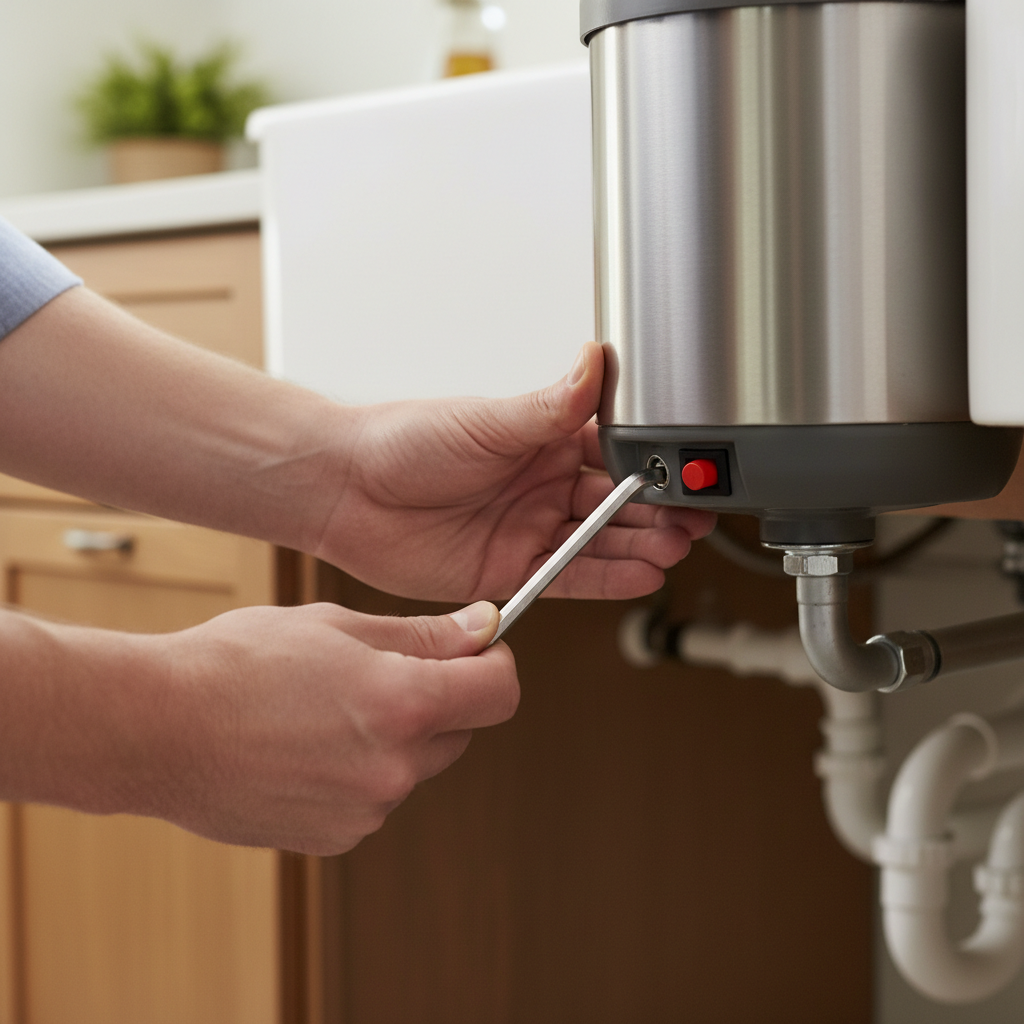
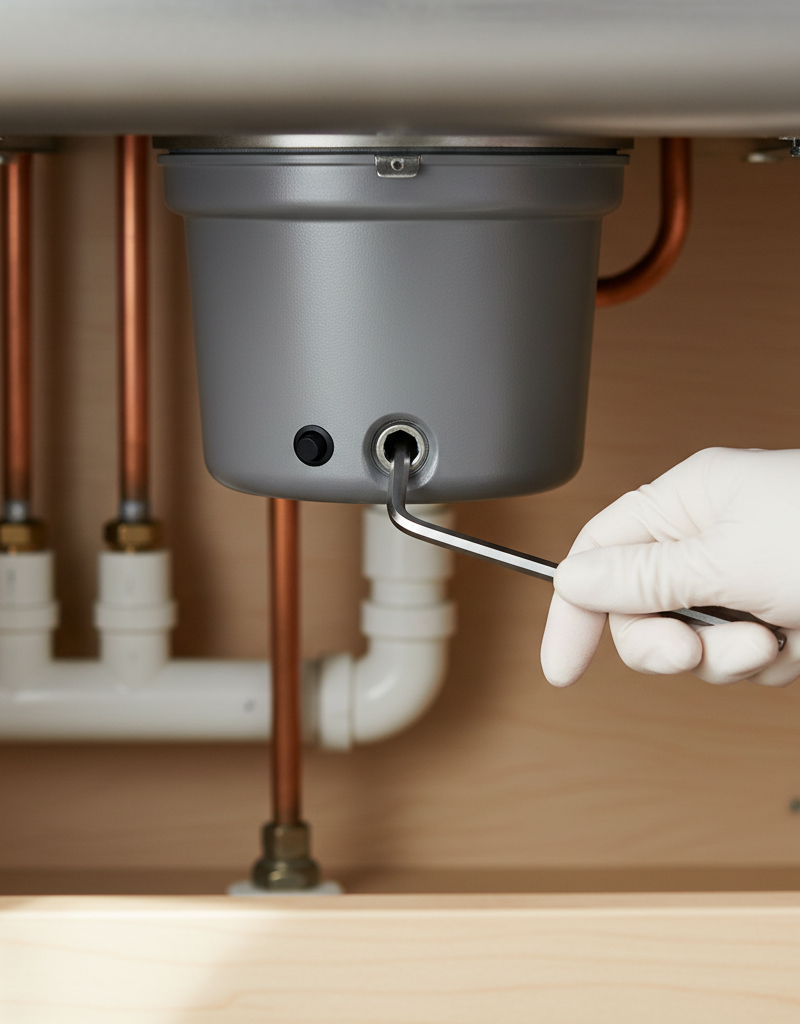
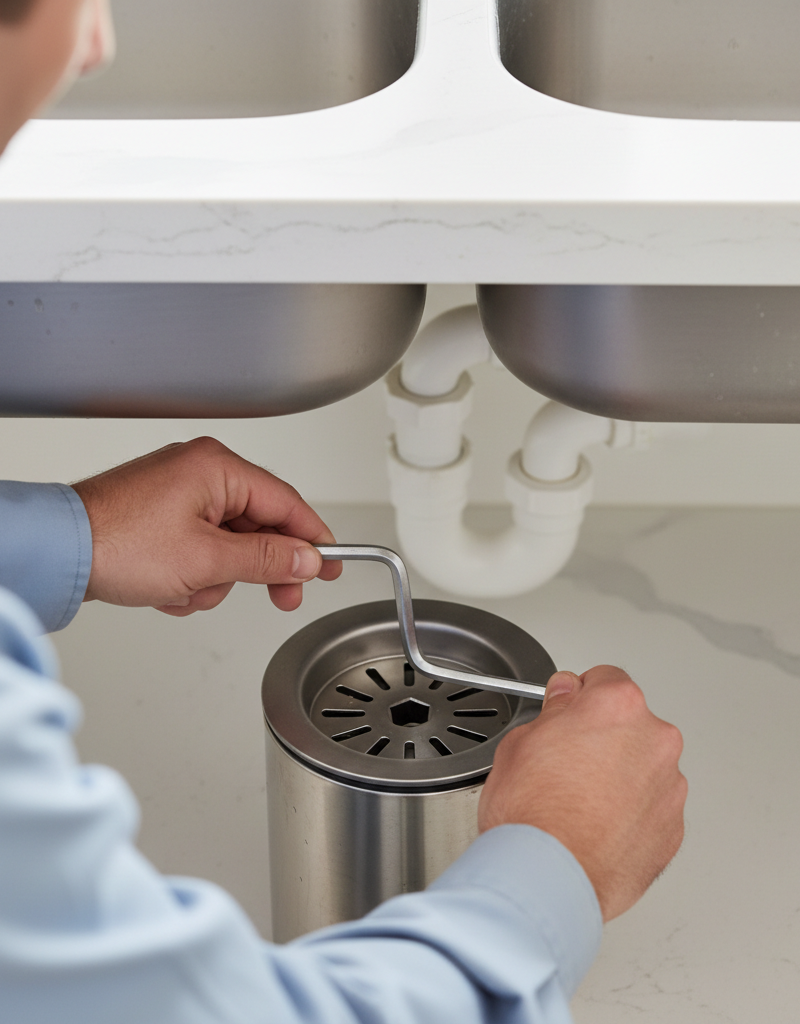
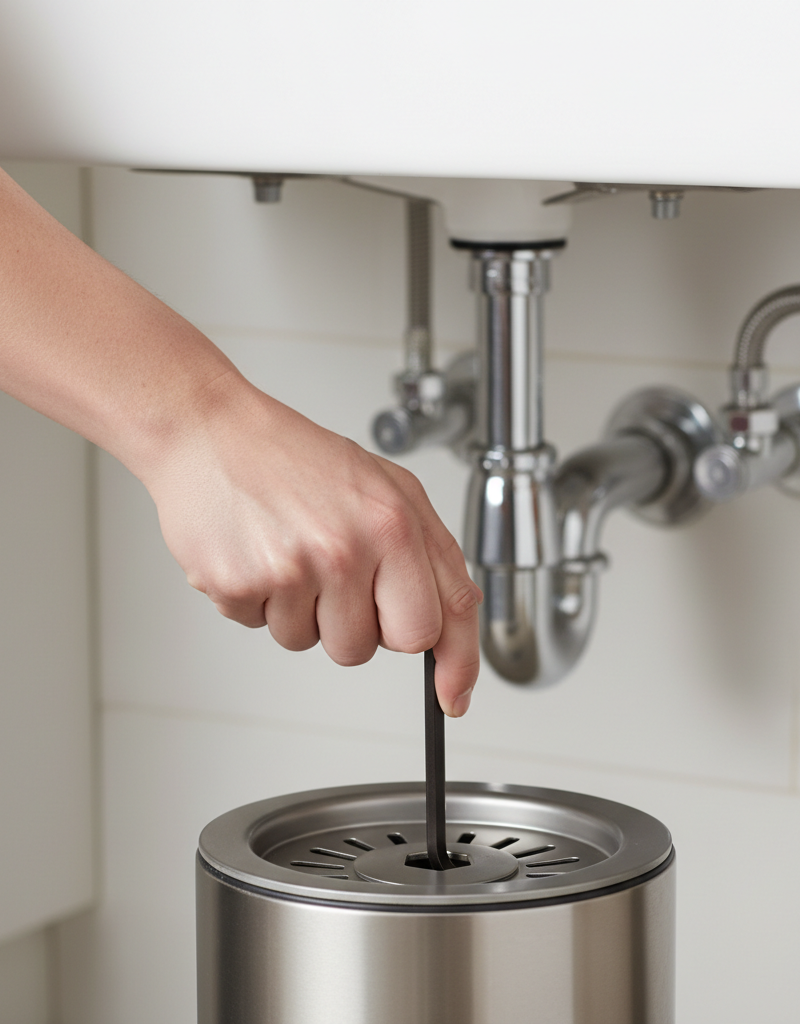
Spin the Impellers Manually – Break the jam. If you can’t see anything, or if you’ve already pulled out the obvious junk and it still won’t spin, it’s Allen wrench time. Look at the very bottom center of the disposal unit — you’ll see a hexagonal hole. That’s the manual crank point. Grab the right size Allen wrench (usually 1/4 inch, but check your disposal’s manual; mine’s usually a 1/4 inch, and I keep one on my truck for exactly this kind of call). Stick the wrench in that hole and work it back and forth with some muscle. You should feel resistance at first as you break the jam. Keep wiggling it until it turns freely, maybe a full rotation or two. Sometimes you’ll even hear a clunk when the obstruction lets go.
- Tip: If you don’t have the exact Allen wrench, some disposals come with one taped to the unit or tucked in a little envelope. If not, a 1/4-inch hex key set from any hardware store will do the trick.
-
Reset the Overload Protector – Restore power to the motor. Once the jam’s cleared, find the small red or black button on the bottom of the disposal, usually near the Allen wrench port. That’s the thermal overload reset button. Push it firmly. You should feel a click. If it pops right back out, the motor’s still too hot, or there’s still something binding it. Let it cool off for 5-10 minutes, then try spinning the impellers again with the Allen wrench and hit the reset button once more.
- If it keeps tripping: You’re probably looking at a deeper electrical problem or a motor that’s giving up. That’s the point where you stop messing around and call a pro.
-
Test the Disposal – Careful restart. Go back to the electrical panel and flip the breaker back on. Then at the sink, turn on a moderate stream of cold water. Make sure it’s cold — it helps flush food and keeps the motor cooler. Now flip the wall switch for the disposal. It should spin up smooth. Let it run for 10-15 seconds with the water on so you know everything’s moving like it should. If it hums again, shut it off right away and go back to step 1.
-
Run Water to Flush – Clear any remaining debris. Even after a good test, I always tell folks to let cold water run for another 30 seconds to a minute after grinding. That way any loosened bits get flushed on out of there and don’t sneak back in to cause another jam.
Common Causes
- Foreign Objects: Biggest offender, no question. Silverware, bottle caps, small bones, twist ties, fruit pits, even a sponge or dishcloth that fell in by accident. Back in '08, I pulled a little toy car out of a disposal in a house in Chandler, Arizona. Kid thought it was hilarious. Parents? Not so much.
- Fibrous Foods: Celery stalks, onion skins, corn husks, artichoke leaves — this stuff doesn’t break down easy. It wraps around the impellers and makes a mess, or just clogs the drain over time. Think string in a blender.
- Grease and Fat Buildup: Pouring grease down the drain is plumbing trouble waiting to happen. It cools, hardens, coats the disposal and pipes, and makes it harder for the impellers to move. Then it catches other junk. Lovely.
- Overloading: Stuffing too much food into the disposal at once, especially hard stuff, can overwhelm the motor and jam it up.
- Motor Issues: Less common, but it happens. The motor can fail, or the bearings can seize. If you’ve cleared everything and the reset button won’t stay in, or it just gives you a weak hum without the impellers turning even with the Allen wrench, that thing’s toast. At that point, replacement’s usually the move.
Common Mistakes
- Using Hot Water: Always run cold water with your disposal. Hot water can melt grease and fat, let it slide farther down the pipes, and then it hardens into a bigger clog. Cold water helps keep fats solid enough to get chopped up and flushed out easier.
- Ignoring the Hum: That hum means the motor’s fighting. Let it sit there humming too long and you’ll burn the motor out, turning a simple jam into a full replacement job.
- Sticking Your Hand In: I know I said it already, but I’m saying it again. Even with the power off, those grinding parts can bite you. Use tongs or pliers.
- Using Chemical Drain Cleaners: Never pour chemical drain cleaners down your disposal. They can eat away at rubber seals and plastic parts, which means leaks and a bigger headache than the original jam. And half the time, they won’t touch a real food blockage anyway.
- Not Using the Allen Wrench: Some folks just keep mashing the reset button. That button’s for the motor, not the jam. You’ve got to free the impellers by hand.
- Failing to Flush Adequately: Running the disposal for a couple seconds isn’t enough. Always run cold water for 15-30 seconds after the grinding noise stops so all the loose food gets flushed out of the unit and down the drainpipe.
Cost & Time Breakdown
Here
Related Articles
Keep troubleshooting with these hand-picked guides from FixlyGuide:
- The 30-Second Trick When Your Garbage Disposal Hums (But Won't Spin) — When your garbage disposal hums but refuses to spin, it's usually a simple fix involving a jammed flywheel, easily remedied with basic tool…
- The One Trick Plumbers Use When Your Garbage Disposal Hums But Won't Spin — When your garbage disposal hums but the blades aren't spinning, it's usually a simple jam that you can fix in minutes with common household…
- The One Trick Plumbers Use When Your Garbage Disposal Hums (But Won't Spin) — When your garbage disposal hums but refuses to spin, it's usually a simple jam that you can fix in minutes with a common household tool.
- The 30-Second Fix for a Humming Garbage Disposal (Plumbers Don't Want You to Know) — Before you call a plumber, try these simple steps to unjam a humming garbage disposal in under a minute and save yourself a service call.
- The 5-Minute Trick to Fix a Kitchen Sink Sprayer's Weak Stream — A weak kitchen sink sprayer can be frustrating, but often a simple cleaning or adjustment can restore full pressure in minutes.
- The $5 Part That Stops Your Dryer From Heating (And How to Replace It in 30 Minutes) — A dryer that tumbles but doesn't heat often points to a blown thermal fuse, a simple and inexpensive fix most homeowners can do themselves.
Should you do this yourself?
Answer five quick questions before you start. Safety outranks savings every time.
Your experience with work like this
How high do you have to work?
Does the job involve any of these?
Will it need a permit?
Specialty tools
Free and instant. Educational guidance only — not a quote, inspection, or professional diagnosis.
What should this project cost?
Enter your project details for a realistic cost range before you call anyone.
Common repairs run $150–$650; repipes and water-heater replacements reach $1,500–$4,500.
- Regional adjustment
- National average
- Labor share (typical)
- ~$754
- Quotes to collect
- 3 written estimates
Educational estimate based on national averages — not a binding quote. Always confirm with written local estimates.
Before you start
Check the difficulty, permits, and safety risk — then decide whether to call a pro.
- Estimate this projectGet a cost range for your scope and ZIP before you call anyone.Open
- Get local estimatesSend one request and compare written estimates from vetted pros.Open
Free, no signup required. Estimates are educational guidance, not a quote or an inspection.
Get the print-ready PDF of this guide
A clean, ad-free, printable version you can keep on your phone or pin to the workshop wall. Free with a FixlyGuide account.
- Print-optimized layout
- Tools, materials & every step included
- Saved to your account
Frequently asked questions
Why does my garbage disposal hum but not spin?+
A humming sound with no spinning means the motor is receiving power but the grinding plates are obstructed. A foreign object is typically wedged between the impellers and the grind ring, preventing rotation.
What is the small hole at the bottom of my garbage disposal for?+
That hexagonal hole at the bottom is the manual reset port. You insert an Allen wrench (usually 1/4 inch) into it to manually turn the impellers and dislodge any jams.
What size Allen wrench do I need for a garbage disposal?+
Most standard garbage disposals, like InSinkErator models, use a 1/4-inch Allen wrench (or hex key) to manually clear jams. It's a good idea to check your specific model's manual if you're unsure.
Where is the reset button on a garbage disposal?+
The reset button is usually a small red or black button located on the bottom of the disposal unit, often near the center. It's a thermal overload protector that trips when the motor overheats from struggling against a jam.
What if my garbage disposal hums and the reset button keeps tripping?+
If the reset button immediately trips again after being pushed, it usually means the motor is still overheated, there's a stubborn jam you haven't fully cleared, or the motor itself is failing. Allow it to cool for 5-10 minutes and try clearing the jam again thoroughly before attempting to reset.
Can I use chemical drain cleaner in my garbage disposal?+
Absolutely not. Chemical drain cleaners can corrode the rubber and plastic components inside your disposal, leading to leaks and costly damage. They are also rarely effective for food-based jams and can create dangerous fumes.
How can I prevent my garbage disposal from jamming?+
Avoid putting fibrous foods (celery, corn husks), large bones, grease, or non-food items down the disposal. Always run a strong stream of cold water before, during, and for 15-30 seconds after grinding to flush everything through.
When should I call a professional for a humming garbage disposal?+
If you've tried manually clearing the jam with an Allen wrench, reset the overload button, and the disposal still just hums or the button keeps tripping, it's time to call a pro. This suggests a motor issue, electrical problem, or a jam that's impossible to clear safely yourself.
How long do garbage disposals typically last?+
A good quality garbage disposal can last anywhere from 8 to 15 years, depending on usage, maintenance, and the quality of the unit. Regular proper use and avoiding jams can extend its lifespan significantly.
Is it normal for the disposal to make a humming noise when off?+
No, if your disposal is humming when the wall switch is off, it indicates a wiring issue or a faulty switch that's sending a trickle of power to the motor. This is an electrical problem and requires immediate attention from a licensed electrician to avoid fire hazards.
Discussion
Loading comments…