- The 1 Common Mistake That Makes Drywall Patches Obvious (And How to Fix It) — Learn the common pitfall in drywall repair that leaves unsightly patches and how to achieve a seamless, invisible fix every time.
- The 15-Minute Drywall Patch Secret (No Mudding Skills Required) — Discover how to quickly and easily patch a small hole in drywall using a simple method that doesn't require advanced mudding skills.
- The 4-Inch Drywall Hole Fix: Why Spackle Alone Always Fails — Fix a small drywall hole (up to 4 inches) properly with a simple patch kit and avoid common mistakes that lead to visible repairs.
- The 15-Minute Drywall Hole Fix Plumbers Don't Want You to Know — Discover the surprisingly simple, super-fast method for patching small drywall holes that avoids messy muds and sanding.
- The 1 Common Drywall Patching Mistake (and The Right Way to Fix a Hole) — Discover the biggest mistake homeowners make when patching drywall holes and learn the correct, long-lasting method for seamless repairs.
General remodeling · Renovation planning
| Project category | General remodeling |
|---|---|
| Problem type | Renovation planning |
| Trade required | General contracting |
| Urgency | Planned project |
| Safety risk | Low safety risk |
| DIY suitability | Pro recommended |
| Cost category | Major investment |
| Typical timeline | Design and permitting often 2–4 months before work starts |
| Contractor type | General contractor |
Repair option
Phase the work and fix the building envelope first.
Replacement option
Full renovation with permits, design, and a general contractor.
Common causes
- Space no longer fits how the household lives
- Resale preparation
- Deferred maintenance stacking up
Relevant tools:project cost estimatorcompare quoteshome improvement material prices
Published June 25, 2026Last updated August 17, 2026
Tools & materials you'll need
Affiliate linksAs an Amazon Associate FixlyGuide earns from qualifying purchases — at no extra cost to you. Prices and availability are accurate as of publication and subject to change.
Quick Answer
Patching a small drywall hole successfully hinges on creating a completely seamless transition between the new patch material and the existing wall. The single most common mistake homeowners make is failing to adequately feather the edges of the joint compound, resulting in a noticeable bump or depression. By properly sanding and applying thin, successive layers of compound, you can achieve an invisible repair that blends perfectly with your wall.
The Problem
Small holes in drywall are an inevitable part of homeownership, whether from rogue picture hangers, door handles, or accidental impacts. While seemingly minor, an improperly repaired small hole can stand out like a sore thumb, even after painting. The challenge isn't just filling the void, but making the repair disappear completely. Many DIY attempts result in a visible 'halo' or bulge around the patched area, a tell-tale sign of a rushed or incomplete job. This problem often stems from applying too much compound at once, or not adequately blending the edges into the existing wall surface, leaving an unprofessional finish that detracts from your home's appearance.
How It Works
Drywall, also known as gypsum board, is essentially a sheet of gypsum plaster pressed between two sheets of heavy paper. When a small hole occurs, you're dealing with a void in this gypsum core and often torn paper around the edges. The goal of patching is to fill this void and replicate the flat, smooth surface of the original drywall.
The process typically involves a few key steps. First, you need to create a stable base for your patch. For smaller holes (up to about 2-3 inches), a mesh patch or a simple backer board often suffices. This provides something for the joint compound (colloquially known as 'mud') to adhere to and creates structural integrity. Joint compound itself is a gypsum-based product, similar to the core of the drywall, but in a puttiesc form. It dries hard and can be sanded smooth.
Once the patch is in place, you apply layers of joint compound. The crucial aspect here is not just filling the hole, but feathering the compound. Feathering means extending each successive layer of compound slightly beyond the previous one, tapering it off to an almost paper-thin edge. This gradual slope ensures there are no abrupt changes in elevation. Imagine trying to blend a ramp into a flat surface – you wouldn't want a sudden drop-off. Properly feathered compound allows light to reflect evenly across the patched area, preventing shadows or highlights that reveal the repair. When sanded smooth and primed, the new surface mimics the original drywall, ready for an invisible paint job.
Step-by-Step Fix
1. Prepare the Area – Clean and trim around the hole to create a stable base for the patch.
First, remove any loose debris, paper, or jagged edges around the hole using a utility knife. The goal is to create a relatively clean, stable perimeter. Push any inward-protruding paper flaps back into the wall. For very small holes (pencil-eraser size), you might just need to slightly bevel the edges with your knife. For holes up to 2-3 inches, ensure the surrounding drywall is firm and not crumbling. A clean, prepared surface is crucial for good adhesion.
- Safety Note: Always wear gloves when handling sharp tools like a utility knife. Work in a well-lit area.
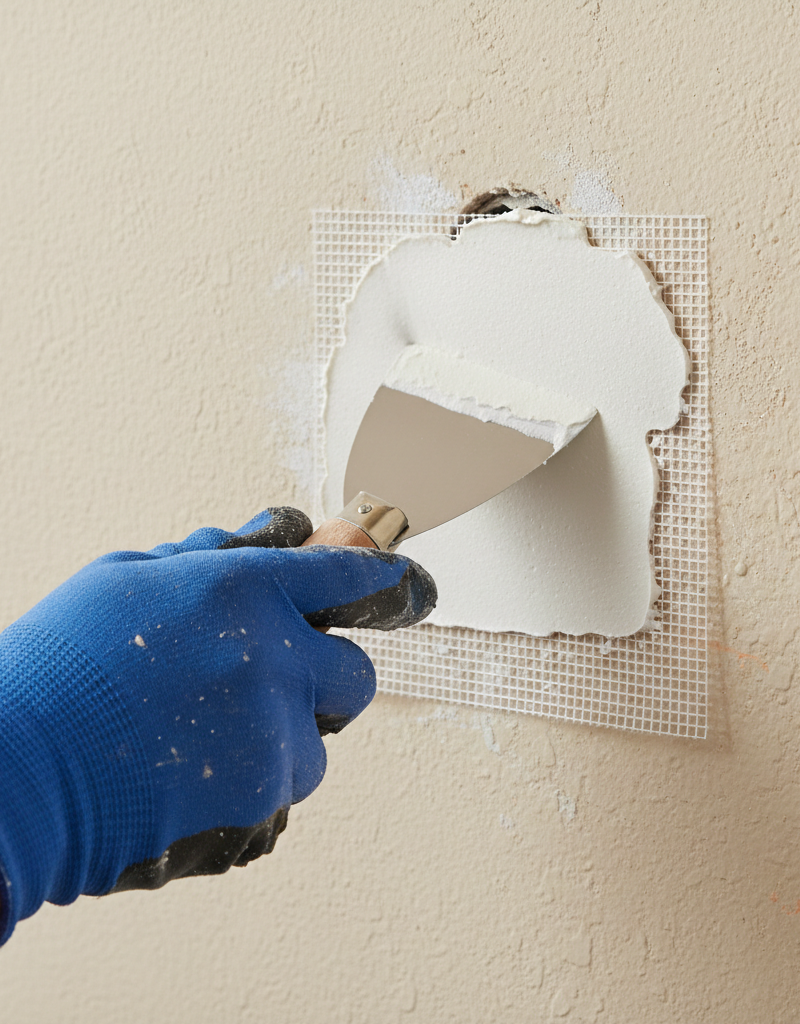
2. Apply the Self-Adhesive Mesh Patch – Place the patch squarely over the hole, ensuring good adhesion.
For holes up to 6 inches, a self-adhesive fiberglass mesh patch is often the easiest solution. Peel the backing off the patch and center it directly over the hole. Press firmly, smoothing it out from the center outwards to ensure it adheres completely to the wall. Make sure there are no wrinkles or air bubbles. The mesh provides the necessary reinforcement and a surface for the joint compound to cling to.
- If your hole is larger than 6 inches: A mesh patch alone isn’t sufficient. You’ll need to cut a piece of drywall to fit the hole and possibly add wood backing. This is a more involved repair and might be best handled by a professional if you’re not comfortable with advanced drywall techniques.
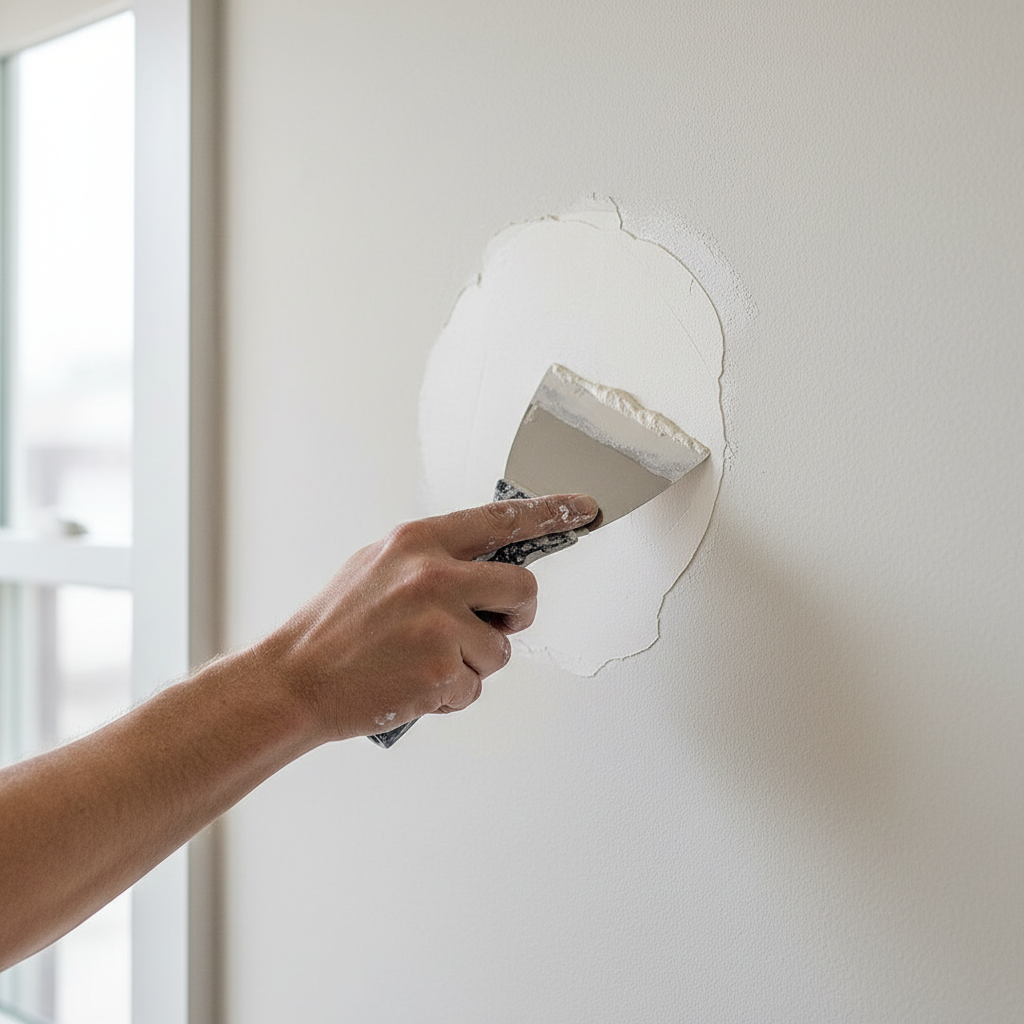
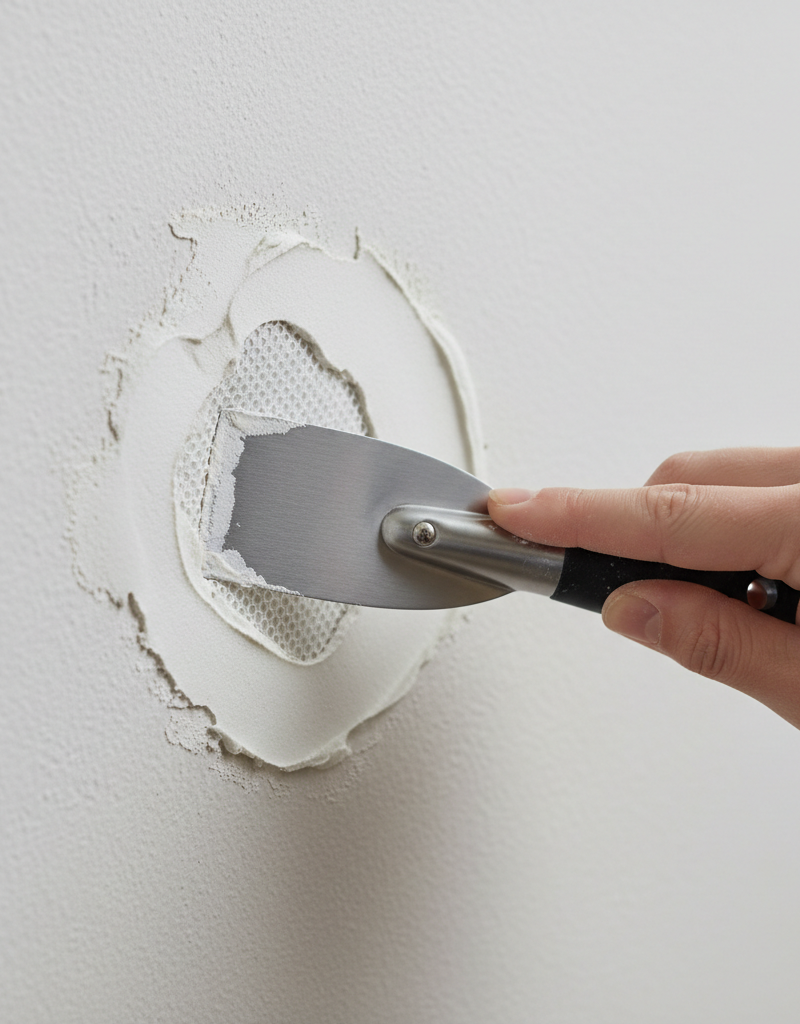
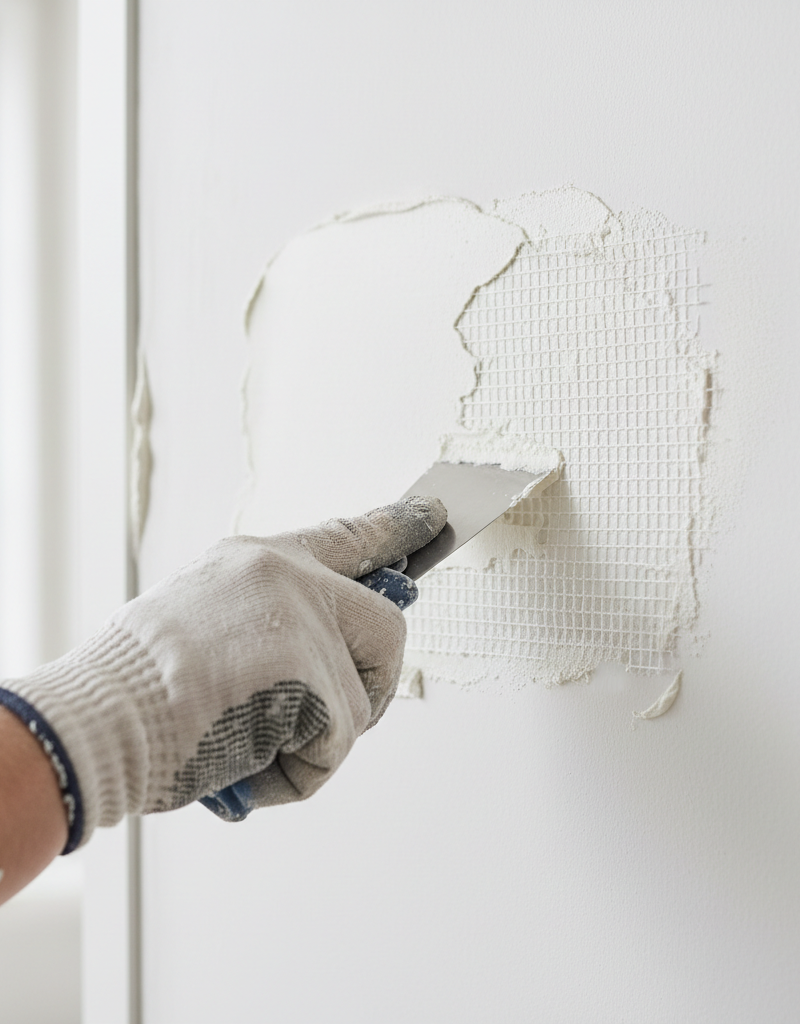
3. Apply the First Coat of Joint Compound – Carefully fill the mesh and begin feathering the edges.
Using a 6-inch drywall knife, scoop a small amount of all-purpose joint compound onto your hawk or mud pan. Apply a thin, even layer of compound over the entire mesh patch, working from the center outwards. The goal of this first coat is to fill the mesh and completely cover it, pushing the compound firmly into the mesh to bond it to the wall. Extend the compound about 2-3 inches beyond the edges of the mesh patch, starting to feather the edges by applying less pressure and holding the knife at a shallower angle as you move away from the center. This creates a gradual slope.
- Tool Tip: A joint compound hawk can make it much easier to manage and apply mud.
4. Let it Dry and Lightly Sand – Ensure the first coat is completely dry before smoothing.
Allow the first coat of joint compound to dry completely. This can take anywhere from 4 to 24 hours, depending on humidity and the thickness of the application. The compound will change color (usually from bright white to an off-white or yellowish hue) when dry. Once dry, use a fine-grit sanding sponge (120-150 grit) or sandpaper wrapped around a sanding block to very lightly sand the patched area. The goal here is to knock down any high spots and smooth out ridges, not to remove the compound. Feel the surface with your hand – it should feel smooth to the touch. Remove all sanding dust with a damp cloth.
- Safety Note: Always wear a dust mask or respirator when sanding drywall compound. The dust is fine and can irritate your lungs.
5. Apply the Second Coat of Joint Compound – Extend the patch further and refine the feathering.
With a 10-inch drywall knife, apply a second, slightly wider coat of joint compound. This coat should extend 2-4 inches beyond the edges of your first coat. The key to an invisible patch is thin, well-feathered coats. Apply the compound evenly, always working from the center out, and pay close attention to the edges. Hold your knife at a very shallow angle (almost parallel to the wall) as you pull away from the patch to create an extremely smooth, tapered edge. This feathering is what makes the patch truly disappear.
6. Let it Dry and Sand Smooth – Thoroughly dry and meticulously sand the second coat for a seamless finish.
Allow the second coat to dry completely, again checking for color change as an indicator. Once dry, use your fine-grit sanding sponge (150-220 grit) and carefully sand the entire patched area. This is where you create the final, truly seamless blend. Work in circular motions, then linear motions, and frequently feel the surface with your fingertips to detect any remaining high spots or ridges. The goal is to make it impossible to tell where the patch ends and the original wall begins. Wipe away all dust with a damp cloth.
7. Apply a Third, Skim Coat (Optional but Recommended) – For perfection, apply one final, ultra-thin coat.
For the most invisible repair, especially if you have textured walls or want an absolutely flawless finish, apply a very thin, almost translucent 'skim coat' over the entire patched area. Use your 10-inch knife, holding it at an even shallower angle (almost flat against the wall), and apply the compound barely thick enough to cover the previous coat. This step fills any microscopic imperfections and further refines the feathering. Let it dry and perform one final, very light sanding with a 220-grit sanding sponge.
8. Prime the Patch – Prepare the patched area for painting.
Before painting, apply a high-quality, stain-blocking, or drywall specific primer to the entire patched area, extending slightly beyond the edges of your compound. Primer ensures that the new compound absorbs paint evenly with the surrounding wall, preventing
Related Articles
Keep troubleshooting with these hand-picked guides from FixlyGuide:
- The 1 Common Mistake That Makes Drywall Patches Obvious (And How to Fix It) — Learn the common pitfall in drywall repair that leaves unsightly patches and how to achieve a seamless, invisible fix every time.
- The 15-Minute Drywall Patch Secret (No Mudding Skills Required) — Discover how to quickly and easily patch a small hole in drywall using a simple method that doesn't require advanced mudding skills.
- The 4-Inch Drywall Hole Fix: Why Spackle Alone Always Fails — Fix a small drywall hole (up to 4 inches) properly with a simple patch kit and avoid common mistakes that lead to visible repairs.
- The 15-Minute Drywall Hole Fix Plumbers Don't Want You to Know — Discover the surprisingly simple, super-fast method for patching small drywall holes that avoids messy muds and sanding.
- The 1 Common Drywall Patching Mistake (and The Right Way to Fix a Hole) — Discover the biggest mistake homeowners make when patching drywall holes and learn the correct, long-lasting method for seamless repairs.
- The #1 Mistake Homeowners Make When Caulking a Bathroom Sink (And How to Fix It) — Discover the most common caulk mistake homeowners make around bathroom sinks and follow simple steps to achieve a lasting, watertight seal.
Should you do this yourself?
Answer five quick questions before you start. Safety outranks savings every time.
Your experience with work like this
How high do you have to work?
Does the job involve any of these?
Will it need a permit?
Specialty tools
Free and instant. Educational guidance only — not a quote, inspection, or professional diagnosis.
What should this project cost?
Enter your project details for a realistic cost range before you call anyone.
Cost depends heavily on which system turns out to be the source.
- Regional adjustment
- National average
- Labor share (typical)
- ~$1,620
- Quotes to collect
- 3 written estimates
Educational estimate based on national averages — not a binding quote. Always confirm with written local estimates.
Before you start
Check the difficulty, permits, and safety risk — then decide whether to call a pro.
- Estimate this projectGet a cost range for your scope and ZIP before you call anyone.Open
- Get local estimatesSend one request and compare written estimates from vetted pros.Open
Free, no signup required. Estimates are educational guidance, not a quote or an inspection.
Recommended for DIYers & woodworkers
Sponsored
The Top 20 Tools for Workshops of Any Budget
No stationary machines or power tools required — plus 3 fundamental tools that can't be bought at any price.
Get the free guide
Ted's Woodworking — The #1 Woodworking Resource
Detailed instructions, dimensioned drawings, materials & cutting lists, and 3D schematics for every skill level.
See the plansSponsored: links above are affiliate links. FixlyGuide may earn a commission on qualifying purchases — at no extra cost to you.
Frequently asked questions
How do you patch a small hole in drywall without it showing?+
The key to an invisible patch is proper feathering of the joint compound. Apply multiple thin coats, extending each layer slightly further than the last, and sand meticulously smooth. This creates a gradual transition that blends seamlessly with the existing wall, preventing noticeable edges or bulges after painting.
Can I use toothpaste to fill small nail holes?+
While toothpaste can temporarily fill very tiny nail holes as a cosmetic fix, it’s not a durable solution. It can shrink, crack, and isn't designed to hold paint well. For a long-lasting repair, use spackle or lightweight joint compound.
How long does joint compound take to dry?+
The drying time for joint compound varies significantly based on thickness, humidity, and temperature. Thin coats can dry in 4-8 hours, but thicker applications or high humidity might require 24 hours or more. Always ensure each coat is completely dry before sanding or applying the next layer.
What kind of joint compound is best for small patches?+
For small drywall patches, an 'all-purpose' or 'lightweight all-purpose' joint compound is ideal. Lightweight varieties are easier to sand. You can buy it pre-mixed in small tubs, which is convenient for minor repairs.
Discussion
Loading comments…