- Kitchen Faucet Low Pressure? 10 Steps to Restore Weak Flow — Kitchen pull-out faucet suddenly lost water pressure? Learn how to clear clogged aerator screens, flush internal check valves, and fix unde…
- Kitchen Faucet Leaking Under the Sink When Sprayer Runs? 5 Causes and the Step-by-Step Fix — Fix that hidden water leak under your kitchen sink. Step-by-step diagnostic and repair instructions for leaking pull-out hoses, bad O-rings…
- Bathroom Faucet Handle Stuck? 12 Steps to Free It Without Breaking the Stem — Stuck bathroom faucet handle won't budge? Learn how to safely dissolve hard water scale, use a handle puller, and rebuild the valve cartrid…
- The 5-Minute Trick to Stop a Dripping Single-Handle Faucet (No Plumber Needed) — A persistent drip from your single-handle faucet is usually caused by a worn-out cartridge, a repair you can typically complete yourself in…
- Pipes Bang When Faucet Shuts Off? 5 Causes of Water Hammer and How to Silence It — Stop that loud pipe bang when you turn off the faucet. Clear waterlogged air chambers, secure rattling lines, and install mini arrestors in…
Plumbing · Leak
| Project category | Plumbing |
|---|---|
| Problem type | Leak |
| Trade required | Plumbing |
| Urgency | Emergency — act now |
| Safety risk | High safety risk |
| DIY suitability | DIY for experienced homeowners |
| Cost category | Low cost |
| Typical timeline | Shut water off now; repair usually same or next day |
| Contractor type | Licensed plumber |
Repair option
Isolate at the shutoff, replace the failed component, and dry the cavity fully.
Replacement option
Repipe the run or the branch when corrosion is widespread.
Common causes
- Failed supply line or shutoff valve
- Worn washers, cartridges, or P-trap connections
- Pinhole corrosion in older copper
Relevant tools:emergency checklistdiy or hire a pro
Published November 9, 2026Last updated November 9, 2026
Tools & materials you'll need
Affiliate links- AmazonNylon zip ties1 pack · 8-inch or 11-inch ties to bundle clear space under sink
- AmazonDistilled white vinegar1 cup · to dissolve mineral scale on docking collar
- AmazonMicrofiber cleaning cloth2
- AmazonUniversal clamp-on faucet hose counterweight1 · optional, if factory weight is missing or inadequate
As an Amazon Associate FixlyGuide earns from qualifying purchases — at no extra cost to you. Prices and availability are accurate as of publication and subject to change.
Quick Answer
If your pull-out or pull-down kitchen faucet won't retract, the trouble's almost always under the sink. Nine times out of ten, that counterweight clamped on the braided hose has hung up on an angle stop valve, supply line, or drain pipe, or somebody set the weight too high on the hose loop. Crawl under there with a flashlight, clear the hose's path, and slide the lead or cast-iron weight to about 2 to 3 inches above the bottom curve of the hose slack loop.
The Problem
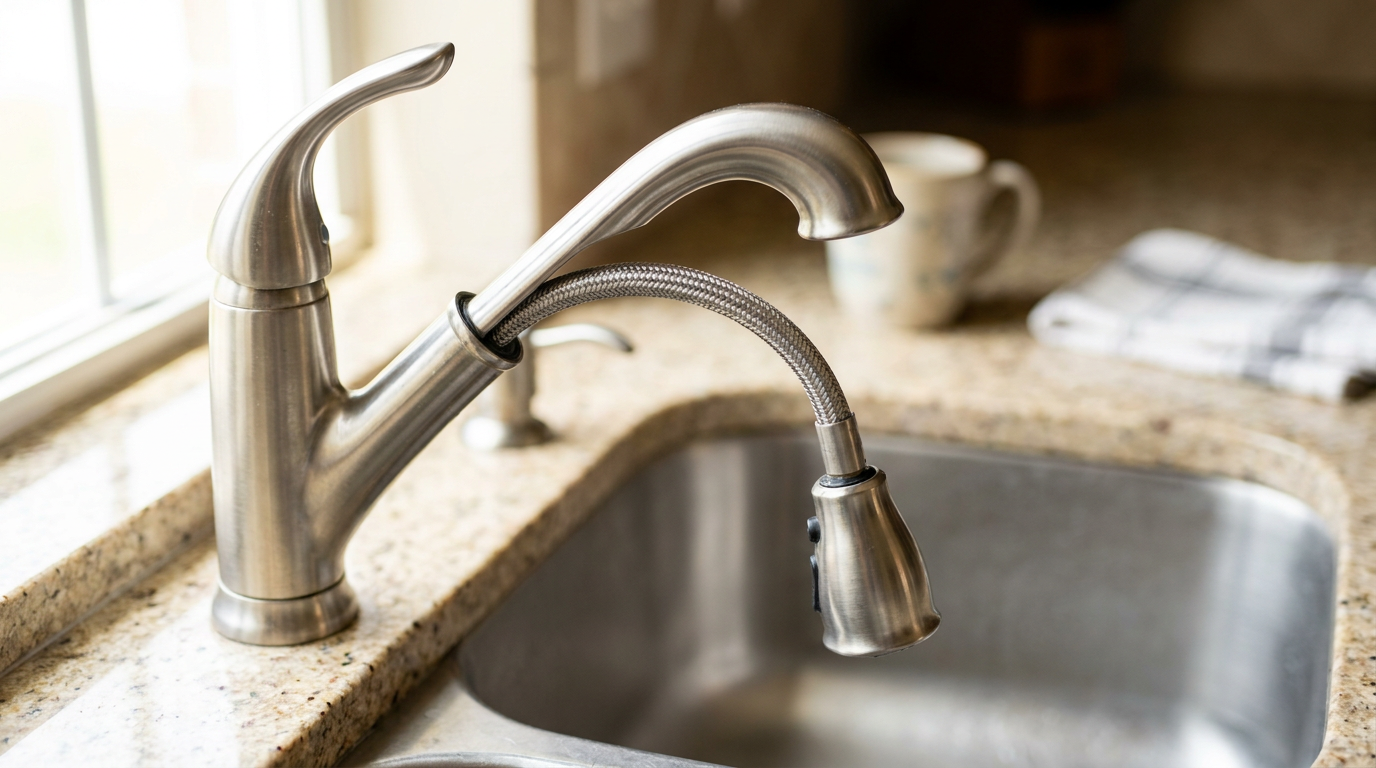
A kitchen faucet spray wand that hangs 3 inches out of the spout looks sloppy and makes the sink a pain to use. You push the wand back into the spout neck, let go, and it just slides right back down into the basin. Or worse, you yank the sprayer out to rinse a roasting pan, and it binds hard with that ugly metallic scrape, giving you no more than 6 inches of reach.
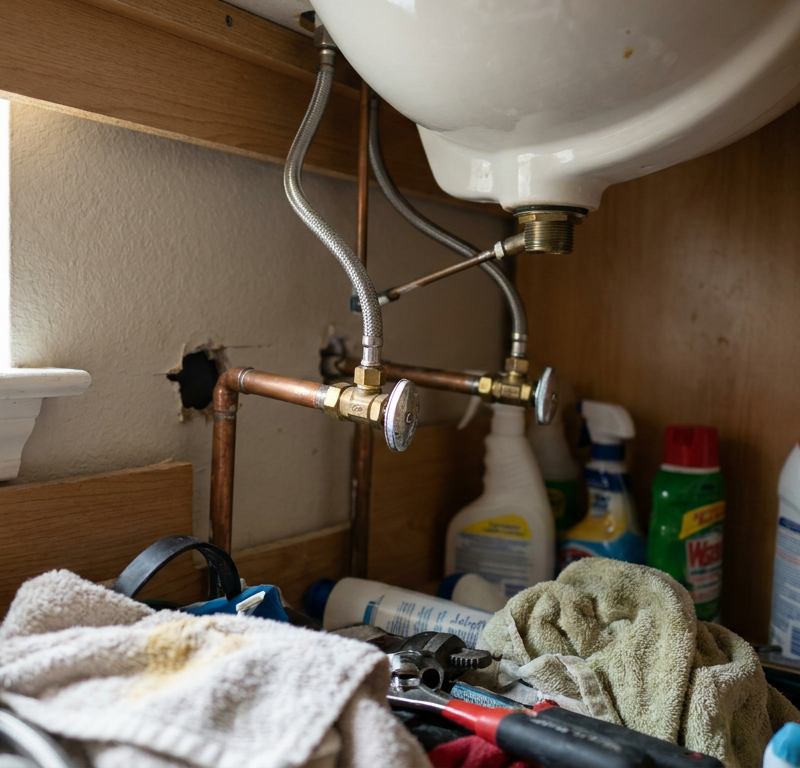
Most homeowners figure the spring or some little motor inside the faucet gave up. Nope. Pull-down and pull-out faucets don't use springs or motors to suck that hose back inside the brass spout body. They depend on gravity and clean mechanical clearance inside a dark, crowded cabinet stuffed with plastic drain pipes, supply lines, shutoff valves, and dishwasher drain hoses. If anything slows that hose down, the spray head sags. Simple as that.
How It Works
To chase this one down, you need a clear picture of how a pull-down or pull-out faucet actually works. Water comes into the kitchen faucet through hot and cold flexible supply lines hooked to the shutoff valves (angle stops) at the back wall. Inside the faucet body, a mixing valve or cartridge blends the water to whatever temperature you set. Instead of dumping straight out of a fixed spout, that mixed water gets routed back down into a center outlet nipple under the deck.
A long, flexible spray hose—typically 48 to 60 inches of nylon-braided or stainless-steel-jacketed tubing—connects to that center outlet with a quick-connect clipping mechanism. From that low point, the hose loops down toward the cabinet floor like a giant "U", loops back up through the faucet deck opening, runs inside the hollow spout neck, and feeds right into the base of the detachable spray head.
A heavy, split-shell iron or lead weight (usually weighing between 8 and 15 ounces) gets clamped right onto the upward-traveling side of that hose loop. When you pull the spray wand down into the sink basin, you're physically pulling that loop upward and dragging the weight toward the bottom of the sink. When you let go, gravity pulls the weight back toward the cabinet floor. That drop yanks the hose loop down with it, pulling the spray head back up and snapping it into the faucet collar. If that weight smacks into an obstacle, or if the hose rubs a rough cabinet edge, gravity loses. Plain and simple.
I pulled a kitchen faucet apart in Frisco last month that had exactly this leak-free-but-stuck issue—the weight was wedged behind a P-trap like it had been planted there on purpose. Took me longer to move the bottle of bleach than to fix the faucet.
Step-by-Step Fix
Before you start buying parts or calling in a plumber, walk through this physical inspection. You can fix almost every pull-down retraction failure in under 30 minutes with basic household tools.
-
Clear the Under-Sink Cabinet Completely — Pull every dish soap bottle, caddy, scrub brush, and recycling bin out of the base cabinet. You need full visual and physical access to the whole depth and height of the space under the sink bowl. Shine a high-lumen work light straight up along the back wall so you can actually see the plumbing mess.
- Tools needed: High-output LED work light or headlamp.
- What to watch for: Pooled water or damp cabinet flooring that points to an active leak, not just a snag.
-
Locate the Hose Path and Test the Movement — Get on your back under the cabinet while someone else pulls the spray wand out at the sink and then lets it go. Watch the braided hose loop move up and down in real time so you can spot the exact hang-up point.
- Key check: Is the hose catching on the brass angle stop handles, hanging on the P-trap, or wedging behind the dishwasher drain hose?
- If alone: Grab the bottom of the hose loop under the sink and gently pull down while looking up at the faucet shank to feel where it binds.
-
Untangle External Line Snags — If the flexible hose is hooked around the shutoff valves or wrapped around the 1-1/2-inch PVC sink drain lines, untangle it by hand. Zip-tie your rigid copper or PEX supply lines and electrical cords (like the ones going to a garbage disposal) neatly against the back wall or side cabinet wall so you've got a clean, open 8-inch-wide vertical chute for the hose.
- Tools needed: Heavy-duty nylon zip ties (8-inch or 11-inch) and wire snips.
- Safety: Don't crank down hard or sharply kink flexible braided water supply lines while tying them off—you'll fatigue the inner EPDM rubber core.
-
Inspect and Reposition the Counterweight — Find the counterweight clamped onto the braided hose. For the weight to do its job, it needs to sit on the hose segment that travels up toward the faucet spout, about 2 to 3 inches above the bottom curve of the slack loop when the wand is docked.
- Adjustment: Loosen the two Phillips screws holding the clamshell weight together (or pop open the plastic retaining collar on newer Moen and Delta models). Slide the weight 2 to 4 inches higher or lower on the hose and test the return travel.
- Pro rule: If the weight hits the cabinet floor before the wand seats all the way back in the spout, move it higher up the hose, closer to the spray head side.
-
Examine the Hose for Kinks or Fraying — Run your fingers along the full length of the flexible braided hose, from the quick-connect fitting up into the faucet neck. Feel for flattened spots, sharp 90-degree kinks, or unraveled nylon strands that drag inside the spout.
- If the hose is kinked: Shut off the hot and cold angle stops, relieve water pressure by opening the faucet handle, and disconnect the quick-connect fitting under the sink. Work the kink out by hand under warm water, or replace the hose if the inner rubber tube's crushed.
-
Clean the Hose Exterior — Kitchen sink cabinets collect sticky residue from dish soap drips, grease, and cleaning chemicals that build up on the braided hose over time. Spray a microfiber cloth with warm water and mild liquid dish soap, then wipe the whole length of the hose to get rid of the grime that's causing friction against the guide collar.
- Pro tip: Don't use petroleum-based lubricants or WD-40 on a braided hose; they pull in dust, chew up rubber parts, and turn into a sticky mess fast.
-
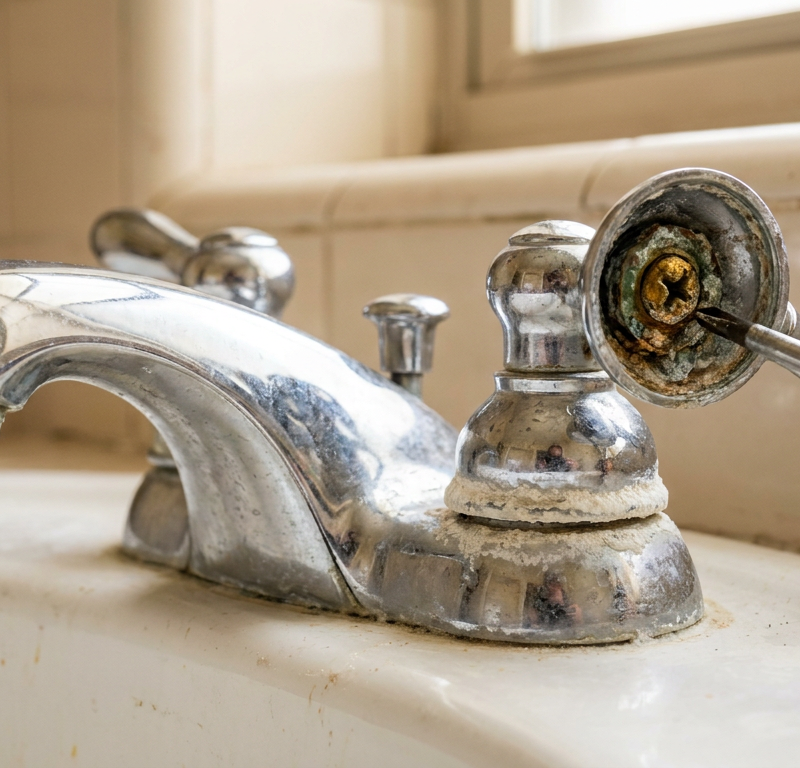
Check the Spout Docking Collar and Guide Bushing — Take a close look at the plastic ring (the guide bushing) inside the tip of the faucet spout where the spray head nests. Mineral deposits and hard water scale build up there, and then the wand catches on the lip instead of seating flush.
- Cleaning: Dip an old toothbrush into distilled white vinegar and scrub the inner rim of the spout collar well to break down calcium and magnesium crust.
- Inspection: Check whether the guide bushing is split or knocked out of line. If it's broken, order an OEM replacement bushing from the faucet maker.
-
Inspect the Magnetic Docking System (If Equipped) — A lot of newer faucets (like Delta MagnaTite or Kohler DockNetik) use rare-earth magnets inside the wand and spout collar to hold the head shut. Check both contact surfaces for metal shavings, iron silt from well water, or lime buildup that's messing with the magnetic seal.
- The fix: Wipe the magnetic contact faces clean with a damp cloth; if the internal magnet's cracked or lost its pull from age or a good whack, replace the wand docking kit.
-
Add Secondary Counterweight Mass (If Necessary) — If your hose moves freely without snagging but still doesn't have enough pull to seat the wand tight against the spout, the factory counterweight may just be too light for your setup, especially on deep undermount sinks.
- Action: Clamp an auxiliary 4-ounce to 8-ounce universal sink hose weight beside the existing weight, or install a snap-on secondary weight.
- Verification: Test the wand travel; it should retract smoothly with a firm, solid clunk without snapping back so hard that it rattles your supply lines.
-
Test Full Travel and Recheck Clearance — Pull the spray wand out to its maximum extension at least five times, swinging the faucet neck from the far-left basin to the far-right basin. Watch underneath to make sure the counterweight swings through its full vertical arc without clipping the drain trap, supply stops, or garbage disposal housing.
- Final check: Turn the water on to maximum hot (typically 120°F) and run the sprayer for 60 seconds to make sure heat expansion in the rubber hose doesn't cause new sagging or sticking.
Common Causes
| Cause | Where It Happens | Observable Symptom | Easy Fix? |
|---|---|---|---|
| Plumbing Obstruction Snag | Cabinet interior below sink | Hose stops dead midway; clunking sound against pipes | Yes (zip-tie lines clear) |
| Weight Positioned Too Low | Braided hose loop | Weight rests on cabinet floor before wand is fully seated | Yes (shift weight up 2–4 inches) |
| Kinked or Frayed Braided Hose | Inside faucet neck or loop | Rough friction, metallic grinding, wand sticks halfway | Moderate (straighten or replace hose) |
| Hard Water Scale at Docking Lip | Spout tip / plastic bushing | Wand retracts 95% but leaves a 1/4-inch visible gap | Yes (vinegar scrub) |
| Cabinet Clutter Interference | Base cabinet floor | Hose movement is sluggish, catches intermittently | Yes (clear cabinet floor) |
| Failed Hose Guide Bushing | Inside faucet spout neck | Wand pulls out stiffly; black plastic shavings visible | Moderate (replace bushing) |
Common Mistakes
- Mounting the counterweight on the wrong side of the hose loop. Homeowners do this all the time. They'll clamp the weight onto the stationary supply side of the hose—the side clipped to the center water outlet—instead of the moving side that runs up through the spout neck. When it's on the wrong side, the weight sits there while you pull the wand, doing zero retracting work. Put it on the hose segment that drops down from the faucet body. That's the side that matters.
- Spraying silicone or WD-40 down the spout neck. It feels like a quick fix, sure, but liquid aerosol lubricants down the faucet spout usually make things worse. Petroleum distillates chew up synthetic seals, rot internal EPDM rubber liners, and grab dust and hair until you've got a gummy paste jammed inside the hose.
- Overweighting the hose to compensate for snags. People try to force the hose down against an obstruction with heavy lead weights or whatever scrap hardware they can find. Bad move. Too much downward tension—anything over 20 to 25 ounces—strains the plastic guide bushing, tears quick-connect O-rings, and can snap the hose fitting right off the mixing shank.
- Ignoring a twisted hose during quick-connect installation. During install or reconnection, DIYers twist the hose while snapping the collet into place. That loads torsional spring tension into the braided line, and then the hose wants to loop sideways into pipes instead of hanging in a straight vertical teardrop. No dice.
- Failing to check garbage disposal clearance. Folks line the hose up with the cabinet empty, then forget the garbage disposal body takes up a big chunk of room on one side. If the hose loop drops behind the disposal motor, it'll hang up on the reset button, power cord, or discharge elbow every time the spout swings left.
Cost & Time Breakdown
| Task | DIY Cost | Pro Cost | Time |
|---|---|---|---|
| Clearing Cabinet & Relocating Weight | $0 | $125–$225 | 15–20 minutes |
| Securing Lines with Conduit/Zip-Ties | $5–$10 | $150–$250 | 20–30 minutes |
| Replacing Spout Guide Bushing | $8–$18 | $150–$275 | 30–45 minutes |
| Replacing Braided Spray Hose Assembly | $25–$65 | $175–$325 | 45–60 minutes |
| Full Faucet Replacement (If Corroded) | $120–$350 | $350–$650 | 1.5–2.5 hours |
Tips & Prevention
- Install a hose guide bracket or shield. If your under-sink space is cramped with a big double-bowl sink, water filter setup, and garbage disposal, put in a plastic sink hose guide—sometimes sold as a hose caddy or funnel. It mounts to the cabinet wall or back pipe and gives the weight a dedicated, low-friction channel.
- Perform a quarterly hose wipe-down. Every three months when you're cleaning out under the kitchen sink, take a damp rag with a drop of dish soap and wipe the braided hose so sticky residue and dust don't build up and start adding drag.
- Check the weight screws annually. Clamshell weights that use two Phillips screws can work loose from the constant up-and-down vibration of daily sink use. Tighten them once a year so the weight doesn't slide down to the bottom curve.
- Train household members not to overextend the hose. Pull-out hoses are made to extend between 14 and 20 inches from the spout collar. Yank the wand past its natural stop and you'll strain the crimp connections and bend the hose over the rim of the guide, which leaves a permanent kink.
- Watch for calcium rings around the wand seam. In hard water areas like North Texas, mineral crust builds up fast at the seam where the wand clicks into the spout. A two-minute soak with a vinegar-soaked rag once a month keeps the docking surfaces sliding like they should.
When to Call a Professional
Most pull-down faucet retraction problems can be handled with basic clearing, cleaning, and weight adjustments. But some situations are plumber territory:
If you crawl under the sink and find the braided hose has sprung a pinhole leak that's spraying water inside your cabinet wall, shut off the angle stops right away and call a pro if you can't get an exact OEM replacement line.
Also, if your faucet is older than 10 to 15 years and the mounting shank, retaining nut, or copper supply risers have corroded into a solid mass of green verdigris and rust, trying to disconnect anything can twist and shear the household supply pipes behind the drywall. If loosening the assembly might break old copper lines or you can't free the rusted connection points with standard basin wrenches, hand the job off before you turn a small repair into major water damage in the kitchen subfloor.
Frequently Asked Questions
Why does my pull-down kitchen faucet dangle and not snap back into place?
Your faucet spray wand dangles because the mechanical counterweight clamped onto the hose under the sink is either hanging on an obstruction (like shutoff valves, drain pipes, or storage boxes) or it's clamped in the wrong spot on the hose loop. If the weight sits on the cabinet floor before the wand reaches the spout, it can't pull that last inch into the dock.
Where should the weight be placed on a pull-out faucet hose?
The counterweight should go on the section of braided hose that moves up toward the faucet spout, about 2 to 3 inches above the bottom of the loop when the spray wand is fully docked. That gives the weight enough drop distance to pull the hose all the way down without slamming into the cabinet floor.
Can I just add more weight to make the faucet retract faster?
You can add a small secondary weight (4 to 8 ounces) if your faucet has a long reach or a deep sink bowl, but don't load it up with too much. Once you go over 20 to 25 ounces of total weight, you start straining the plastic guide bushing, risking a quick-connect separation, and making the wand stiff to pull out.
Why does my faucet hose make a loud scraping noise when I pull it out?
A loud scraping or grinding noise usually means the braided nylon or metal jacket on the hose is rubbing against the sharp edge of the sink mounting shank, or the plastic guide bushing inside the spout neck is cracked, worn through, or missing. Check the mouth of the spout for a busted plastic ring, and look under the sink for frayed wire strands.
How do I stop my faucet hose from catching on the shutoff valves under the sink?
The easiest fix is to clear the path by strapping your water supply lines, drain lines, and disposal cords back against the cabinet wall with nylon zip ties or plastic pipe clamps. You can also slide a length of split foam pipe insulation over your angle stop valves and supply lines so the hose rides over soft foam instead of hooking on valve handles.
Can I spray lubricant like WD-40 on the faucet hose to help it slide?
No, don't spray WD-40, silicone spray, or grease on a braided faucet hose. The solvents in aerosol lubricants break down the inner rubber tubing and synthetic fibers, and the sticky residue grabs dust, hair, and grit inside the cabinet, which turns into an abrasive paste and makes the sticking worse.
What is the difference between a pull-out and a pull-down kitchen faucet?
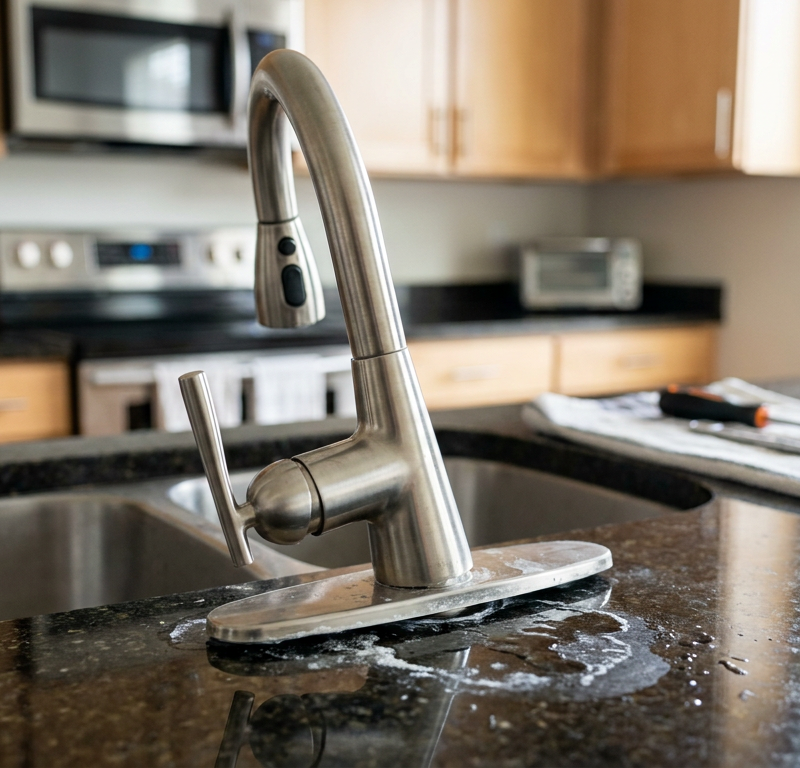
A pull-down faucet has a high-arc, "gooseneck" spout where the spray head points straight down into the sink bowl and pulls down toward the drain. A pull-out faucet usually has a shorter, straighter spout that angles up at 45 degrees, where the spray head pulls straight out toward you. Both use the same basic counterweight and hose-loop retraction setup underneath the sink.
Why won't my magnetic docking faucet stay locked in?
Magnetic docking faucets (like Delta MagnaTite or Kohler DockNetik) fail to stay locked if iron sediment, mineral scale, or metal shavings have coated the magnetic ring inside the spout collar and stopped direct contact. Clean both surfaces with white vinegar and a microfiber rag. If the magnet's fractured or the internal plastic clip has snapped, you'll need to replace the docking ring assembly.
Related Articles
Keep troubleshooting with these hand-picked guides from FixlyGuide:
- Kitchen Faucet Low Pressure? 10 Steps to Restore Weak Flow — Kitchen pull-out faucet suddenly lost water pressure? Learn how to clear clogged aerator screens, flush internal check valves, and fix unde…
- Kitchen Faucet Leaking Under the Sink When Sprayer Runs? 5 Causes and the Step-by-Step Fix — Fix that hidden water leak under your kitchen sink. Step-by-step diagnostic and repair instructions for leaking pull-out hoses, bad O-rings…
- Bathroom Faucet Handle Stuck? 12 Steps to Free It Without Breaking the Stem — Stuck bathroom faucet handle won't budge? Learn how to safely dissolve hard water scale, use a handle puller, and rebuild the valve cartrid…
- The 5-Minute Trick to Stop a Dripping Single-Handle Faucet (No Plumber Needed) — A persistent drip from your single-handle faucet is usually caused by a worn-out cartridge, a repair you can typically complete yourself in…
- Pipes Bang When Faucet Shuts Off? 5 Causes of Water Hammer and How to Silence It — Stop that loud pipe bang when you turn off the faucet. Clear waterlogged air chambers, secure rattling lines, and install mini arrestors in…
- HRV or ERV Not Working? 11 Steps to Fix Stale Air and Poor Ventilation — Is your HRV or ERV blowing stale, dusty air or leaving windows fogged up? Here is how to clean the core, unblock intake hoods, and balance…
Should you do this yourself?
Answer five quick questions before you start. Safety outranks savings every time.
Your experience with work like this
How high do you have to work?
Does the job involve any of these?
Will it need a permit?
Specialty tools
Free and instant. Educational guidance only — not a quote, inspection, or professional diagnosis.
What should this project cost?
Enter your project details for a realistic cost range before you call anyone.
Common repairs run $150–$650; repipes and water-heater replacements reach $1,500–$4,500.
- Regional adjustment
- National average
- Labor share (typical)
- ~$754
- Quotes to collect
- 3 written estimates
Educational estimate based on national averages — not a binding quote. Always confirm with written local estimates.
Fixly Project Decision Box
- DIY difficulty
- Moderate
- Estimated time
- 30 minutes – half a day
- Cost level
- Moderate
Main tools / materials
- Adjustable wrench
- Plunger or drain auger
- Bucket and towels
- Thread tape
When to stop and call a pro
- Water you cannot shut off at the fixture or main
- Sewage backing up into more than one fixture
- Water near electrical panels or outlets
- Gas water heater work beyond relighting a pilot
Need professional help?
Get a Licensed PlumberGet the print-ready PDF of this guide
A clean, ad-free, printable version you can keep on your phone or pin to the workshop wall. Free with a FixlyGuide account.
- Print-optimized layout
- Tools, materials & every step included
- Saved to your account
Frequently asked questions
Why does my pull-down kitchen faucet dangle and not snap back into place?+
Your faucet spray wand dangles because the mechanical counterweight clamped onto the hose beneath your sink is either hanging up on an obstruction (like shutoff valves, drain pipes, or storage boxes) or it is clamped in the wrong position along the hose loop. When the counterweight rests on the cabinet floor before the wand fully reaches the spout, it cannot pull the head that final inch into the dock.
Where should the weight be placed on a pull-out faucet hose?+
The counterweight should be installed on the segment of the braided hose that moves up toward the faucet spout, positioned roughly 2 to 3 inches above the bottom of the loop when the spray wand is completely docked. This ensures the weight has sufficient vertical drop distance to pull the hose completely down without striking the floor of your cabinet.
Can I just add more weight to make the faucet retract faster?+
You can add a small secondary weight (4 to 8 ounces) if your faucet has a particularly long reach or a deep sink bowl, but you should never overload it with excessive weight. Adding more than 20 to 25 ounces of total weight strains the internal plastic guide bushing, can cause the spray hose to separate from its quick-connect crimp, and makes pulling the wand out uncomfortably stiff.
Why does my faucet hose make a loud scraping noise when I pull it out?+
A loud scraping or grinding noise usually indicates that the braided nylon or metal jacket on the hose is rubbing against the sharp edge of the sink mounting shank, or that the internal plastic guide bushing inside the spout neck is cracked, worn through, or missing. Check the mouth of the spout for a broken plastic ring, and inspect the hose underneath for frayed wire strands.
How do I stop my faucet hose from catching on the shutoff valves under the sink?+
The simplest fix is to clear the path by strapping your water supply lines, drain lines, and disposal cords back against the cabinet wall using nylon zip ties or plastic pipe clamps. You can also slip a length of split foam pipe insulation over your angle stop valves and supply lines so the hose glides over soft foam rather than hooking on valve handles.
Can I spray lubricant like WD-40 on the faucet hose to help it slide?+
No, you should never spray WD-40, silicone spray, or grease on a braided faucet hose. Solvents in aerosol lubricants break down the inner rubber tubing and synthetic fibers, and the sticky residue attracts dust, hair, and grit inside your cabinet, which quickly turns into an abrasive paste that makes the sticking problem significantly worse.
What is the difference between a pull-out and a pull-down kitchen faucet?+
A pull-down faucet features a high-arc, "gooseneck" spout where the spray head points directly downward into the sink bowl, pulling down toward the drain. A pull-out faucet typically has a shorter, straighter spout that angles upward at 45 degrees, where the spray head pulls out directly toward you. Both use identical counterweight and hose-loop retraction systems underneath the sink.
Why won't my magnetic docking faucet stay locked in?+
Magnetic docking faucets (like Delta MagnaTite or Kohler DockNetik) fail to stay locked if iron sediment, mineral scale, or metal shavings have coated the magnetic ring inside the spout collar, preventing direct physical contact. Clean both surfaces with white vinegar and a microfiber rag. If the magnet has fractured or the internal plastic clip has snapped, you will need to replace the docking ring assembly.
Discussion
Loading comments…