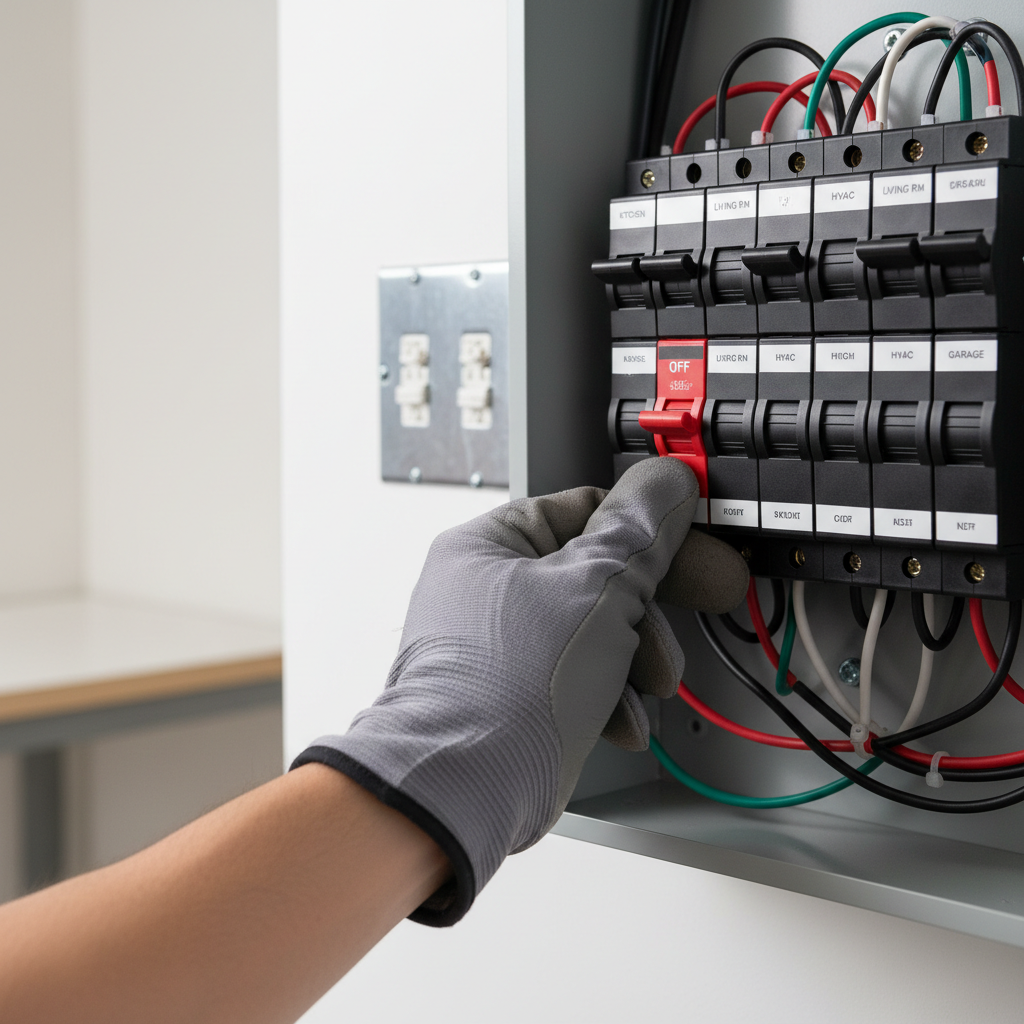
- Calculate Your Circuit's Maximum Load — Understand the math behind an overload. Your circuit's capacity in watts is its amperage multiplied by the voltage (typically 120V in the US).
- 15-Amp Circuit: 15A x 120V = 1800 Watts
- 20-Amp Circuit: 20A x 120V = 2400 Watts
Electrical · Breaker keeps tripping
| Project category | Electrical |
|---|---|
| Problem type | Breaker keeps tripping |
| Trade required | Electrical |
| Urgency | Urgent — within days |
| Safety risk | High safety risk |
| DIY suitability | Pro recommended |
| Cost category | Low cost |
| Typical timeline | Diagnosis in a single visit |
| Contractor type | Licensed electrician |
Repair option
Isolate the load, then repair the fault or replace the breaker.
Replacement option
New dedicated circuit when the load simply exceeds what the circuit was built for.
Common causes
- Genuine overload on a shared circuit
- Ground fault from moisture in an exterior box
- Failing breaker or a damaged appliance cord
Relevant tools:diy or hire a prodiy difficulty
Published April 17, 2026Last updated August 17, 2026
How it works
A circuit breaker is the primary safety device for an electrical circuit. It is designed to automatically interrupt the flow of electricity when it detects a dangerous condition, preventing wires from overheating and causing a fire. A standard thermal-magnetic breaker protects against two distinct faults. First, a thermal trip responds to a gradual overload. When a circuit consistently draws more amperage than it is rated for—for example, 17 amps on a 15-amp circuit—a bimetallic strip inside the breaker heats up, bends, and eventually trips the switch. This is a slow-acting mechanism designed to tolerate brief, harmless current spikes, like a motor starting up.
The second type is a magnetic trip, which responds instantly to a short circuit. A short circuit creates a massive, near-instantaneous surge of current. This surge flows through a coil inside the breaker, generating a strong magnetic field that immediately forces the internal contacts apart, cutting power. This rapid response is critical for preventing the explosive energy of a direct short.
In a modern home, you may also have Arc-Fault Circuit Interrupter (AFCI) breakers, which add a third layer of protection. They use electronics to detect the unique electrical signature of a dangerous arc—a common cause of electrical fires from damaged wiring or loose connections—and will trip even if the current draw is not high enough to trigger a thermal or magnetic trip. When a breaker for a single room trips repeatedly, it is doing its job, signaling one of these three conditions: an overload, a short circuit, or a hazardous arc.
Step-by-Step Fix
The following diagnostic process is a systematic way to isolate the cause of a tripping breaker. It is designed to move from the most likely and easiest-to-solve issues (overloads, faulty appliances) to more complex ones.
- Safety Precaution: This guide involves resetting breakers and inspecting plugged-in devices. It does not involve opening outlets, switches, or the electrical panel itself. If at any point you smell burning plastic, hear buzzing from the panel, or a breaker trips instantly with nothing plugged into the circuit, stop immediately and call a qualified electrician.
-
Document the Context of the Trip — Before touching anything, take note of what was happening when the breaker tripped. What appliances were running in the room? Were any high-power devices like a space heater, vacuum cleaner, or hair dryer just turned on? Was there a lightning storm? Intermittent problems are the hardest to solve, and this information provides crucial clues. If the breaker trips sporadically, keeping a small log can help identify a pattern related to a specific device or combination of devices.
-
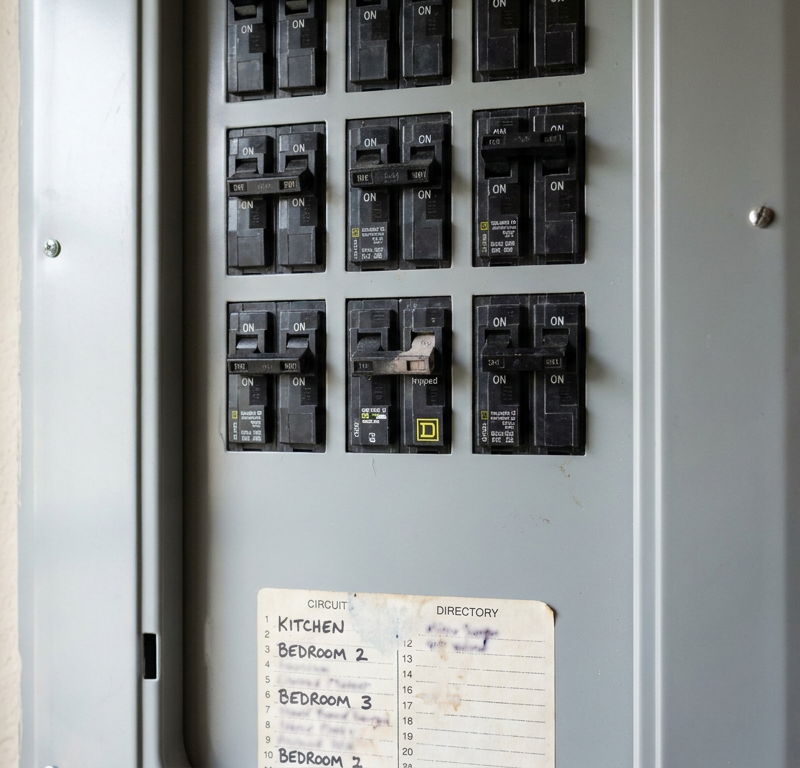
Inspect the Breaker at the Panel — Locate your main electrical panel and open the cover. The tripped breaker will be in the 'OFF' position or, more commonly, shifted to a middle position between 'ON' and 'OFF'. Note the amperage rating printed on the switch (usually '15' or '20'). Also, identify the breaker type. A standard breaker has only the toggle switch. A GFCI or AFCI breaker will have an additional 'TEST' button. Some AFCI breakers also have diagnostic LEDs that can indicate the cause of the last trip. Gently touch the side of the breaker; if it feels noticeably warm or hot compared to its neighbors, this can indicate a failing breaker or a poor connection at the bus bar, which requires professional service.
-
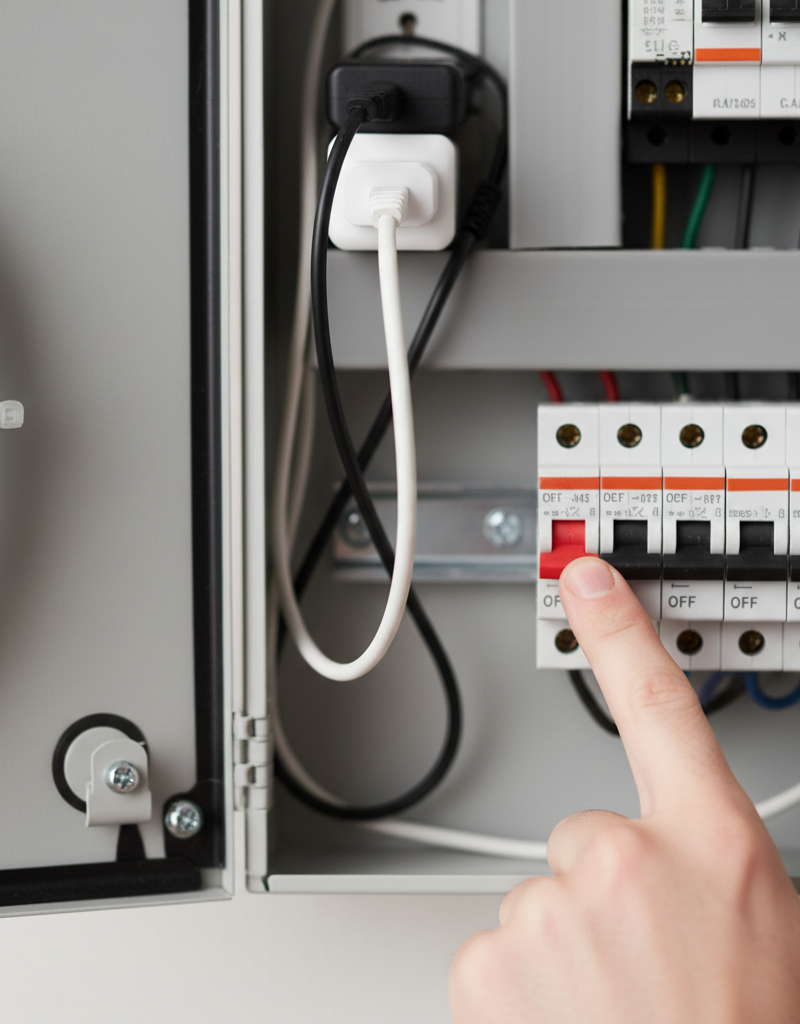
Perform a Full Circuit Unload — Go to the affected room and unplug everything from every outlet controlled by that circuit. Do not simply turn devices off; physically remove the plug from the wall. This includes lamps, televisions, computers, chargers, power strips, and any other connected electronics. Do not forget items that may be out of sight, such as a plugged-in air freshener behind a couch or a cable box in a media cabinet. This step is critical to ensure you are starting your diagnosis with a completely empty circuit.
-
Reset the Circuit Breaker Correctly — Return to the electrical panel. To properly reset a tripped breaker, you must first push the handle firmly to the full 'OFF' position until it clicks. This re-engages the internal mechanism. Then, flip the handle back to the 'ON' position.
- If the breaker trips immediately: If it snaps back to the 'OFF' or middle position with a loud click before you even plug anything in, you have a "hard short" or a serious ground fault in the circuit's permanent wiring (e.g., in an outlet, switch, or junction box within the walls). Do not attempt to reset it again. This is a hazardous situation that requires a professional electrician.
-
Isolate a Short Circuit in an Appliance — Assuming the breaker stayed on in the previous step, return to the room. Begin plugging in devices and turning them on, one at a time. After plugging in each item, wait at least one to two minutes before proceeding to the next. If you plug in a specific device—say, a floor lamp—and the breaker trips instantly, you have found the culprit. That appliance has an internal short circuit. Unplug it, label it as faulty, and do not use it again until it is repaired or replaced.
-
Identify a Circuit Overload — If no single appliance trips the breaker, you likely have an overload condition. An overload trip is often slower and may only occur after several devices have been running for a few minutes. Start by plugging in and turning on essential, low-power items. Then, turn on a single high-wattage device (e.g., a 1500-watt space heater). If the breaker holds, the circuit can handle that load. Now, try turning on a second high-wattage device on the same circuit (e.g., a 1000-watt vacuum cleaner). If the breaker trips after a short time, you have confirmed a circuit overload.
-
Calculate Your Circuit's Maximum Load — Understand the math behind an overload. Your circuit's capacity in watts is its amperage multiplied by the voltage (typically 120V in the US).
- 15-Amp Circuit: 15A x 120V = 1800 Watts
- 20-Amp Circuit: 20A x 120V = 2400 Watts Look at the labels on your appliances to find their wattage rating. Add up the wattage of all devices you intend to use simultaneously. If the total exceeds your circuit's capacity, you must redistribute the load. For example, a 1500W heater and an 800W microwave running at the same time total 2300W, which will always trip a 15A (1800W) circuit.
-
Rebalance the Electrical Load — The solution to an overload is to move high-draw appliances to outlets on different circuits. Use a lamp or a simple outlet tester to determine which other outlets in your home are on separate circuits from the one that is tripping. The goal is to avoid running more than one high-wattage device (typically anything over 1000 watts) on a single 15A or 20A circuit at the same time.
-
Inspect All Cords, Plugs, and Power Strips — With everything still unplugged, perform a detailed visual and physical inspection. Check every power cord for cracks, brittleness, fraying, or chew marks from pets. Examine the prongs on the plugs for scorch marks or melted plastic. Inspect any power strips, as they are a frequent point of failure. A cheap, worn-out power strip can develop internal shorts or overloads that will trip your main breaker.
-
Consider Nuisance Tripping on AFCI/GFCI Breakers — If you have an AFCI or GFCI breaker, sometimes older appliances, devices with brushed motors (like vacuums or power tools), or fluorescent light ballasts can create electrical "noise" that the breaker misinterprets as a fault. This is known as nuisance tripping. To test this, you can try (for diagnostic purposes only) running the suspect appliance on a different circuit protected by a standard breaker. If it runs fine there but trips the AFCI/GFCI breaker, the appliance may be incompatible.
Common mistakes
-
Repeatedly Resetting the Breaker. Flipping a breaker back on without investigating the cause is dangerous. Each time you force power back into a faulty circuit, you are allowing the underlying problem (overload or short) to generate intense heat, which can damage wiring insulation, destroy appliances, and create a significant fire hazard. If a breaker trips, it must be investigated before being reset more than once for diagnostics.
-
Replacing a Breaker with a Higher Amperage Model. A homeowner might be tempted to "solve" a 15-amp overload problem by swapping the 15A breaker for a 20A model. This is one of the most hazardous electrical modifications possible. Circuit wiring is sized specifically for the breaker's rating; 15-amp circuits use 14-gauge wire, while 20-amp circuits require thicker 12-gauge wire. Putting a 20A breaker on 14-gauge wire allows the wires to draw a dangerous 20 amps, causing them to overheat like a toaster element inside your walls long before the breaker trips, virtually guaranteeing a fire.
-
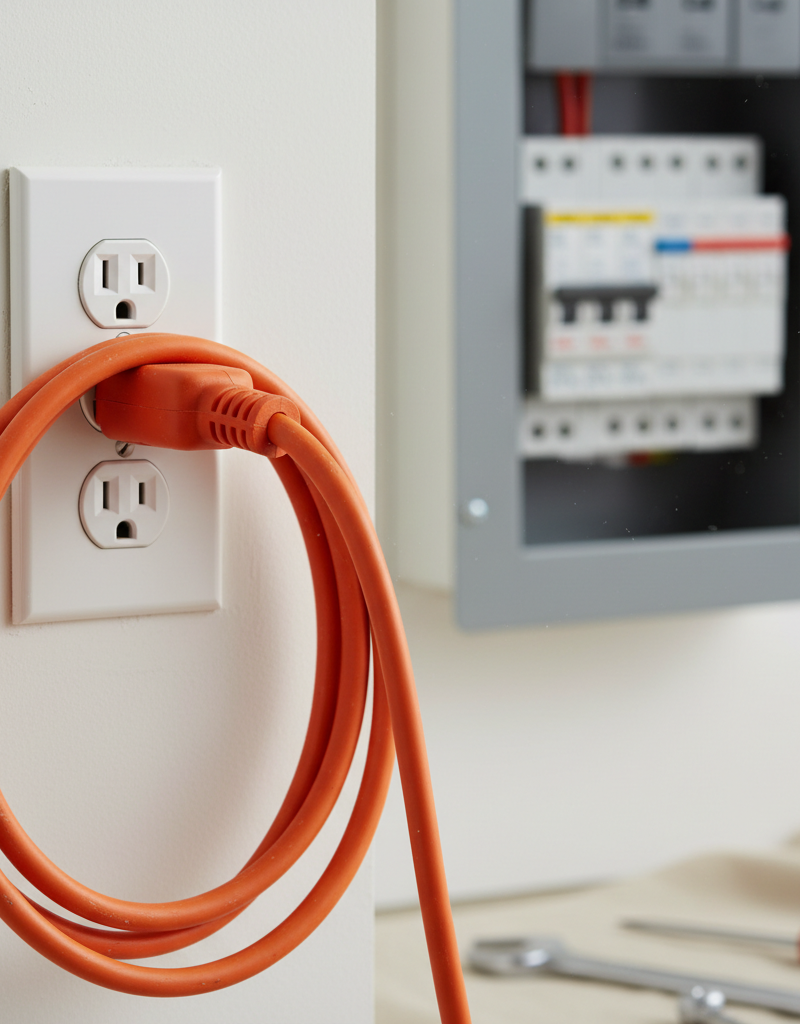
Using Extension Cords as a Permanent Solution. When an outlet is inconveniently located, it's common to use an extension cord. However, for high-wattage appliances like space heaters or air conditioners, this is unsafe. Standard household extension cords are often not thick enough (a lower gauge number means a thicker wire) to handle the sustained current, causing the cord itself to overheat. They are a temporary solution only.
-
Ignoring a Faulty GFCI or AFCI Breaker. These safety breakers can wear out over time. If an AFCI or GFCI breaker trips with no load and a visual inspection of the room's wiring and devices shows no issues, the breaker itself may be faulty or overly sensitive. Ignoring it or assuming it's always a wiring problem can lead to a loss of protection or continued nuisance trips.
-
Confusing a Tripped GFCI Outlet for a Tripped Breaker. Many rooms, especially those near water sources, have power supplied through a GFCI receptacle. This outlet protects itself and all other "downstream" outlets on the same circuit. It can trip and cut power to multiple outlets in the room without tripping the breaker in the main panel. Always check for a tripped GFCI outlet (press the "RESET" button) in the affected room before assuming the problem is at the panel.
Cost & time breakdown
This table outlines the potential costs and time investment for diagnosing and fixing a tripping circuit breaker, from simple DIY tasks to professional intervention.
| Task | DIY Cost | Pro Cost | Time |
|---|---|---|---|
| Circuit Diagnosis & Load Balancing | $0–$25 (for an outlet tester) | $100–$200 (for service call) | 30–90 minutes |
| Replacing a Faulty Appliance Power Cord | $10–$20 (for a replacement cord) | N/A | 30 minutes |
| Replacing a Standard 15A Receptacle | $3–$10 (for receptacle & tester) | $125–$250 (includes service call) | 20–30 minutes |
| Replacing a Worn Power Strip | $15–$50 (for a quality surge protector) | N/A | 5 minutes |
| Replacing a Standard 15A/20A Breaker | $10–$20 (for the breaker) | $150–$275 | 1–2 hours (pro) |
| Replacing an AFCI/GFCI Breaker | $40–$70 (for the breaker) | $200–$400 | 1–2 hours (pro) |
When to call a pro
While many causes of a tripping breaker are user-correctable, certain symptoms indicate a problem beyond the scope of a typical DIY fix. Contact a licensed electrician immediately if you encounter any of the following:
- The breaker trips instantly even when every single device on the circuit is unplugged. This points to a dead short within the home's wiring.
- You smell burning plastic, ozone, or smoke from the electrical panel, an outlet, or a switch. This signals active overheating and an imminent fire risk.
- The body of the circuit breaker is hot to the touch, not just slightly warm. This indicates a bad internal connection or a poor connection to the panel's bus bar, requiring immediate professional attention.
- You see any blackening or scorch marks on or around the outlets, or on the metal bus bars inside the electrical panel.
- You hear buzzing, sizzling, or crackling sounds from the panel or any outlet.
- The lights flicker or dim significantly when a large appliance turns on, which can indicate a widespread issue like a loose neutral connection.
- After performing all the diagnostic steps, you cannot identify the cause of the trip.
Working inside a main electrical panel is extremely dangerous. It contains live components that can deliver a fatal shock even when the main breaker is off. Breaker replacement and internal wiring diagnostics should always be left to a professional.
Prevention & maintenance
Proactive habits and routine checks can prevent most nuisance trips and enhance the safety of your electrical system.
-
Map and Label Your Electrical Panel. Take an hour to create an accurate and detailed directory of your circuits. Work with a partner: one person turns breakers off and on while the other uses a simple lamp or outlet tester to identify which outlets, lights, and fixed appliances are on each circuit. A clear label helps you quickly understand what is being affected and makes load balancing easier.
-
Strategically Distribute High-Wattage Loads. Know which appliances in your home draw significant power (over 1000 watts), including space heaters, hair dryers, microwaves, toasters, coffee makers, and vacuums. Make a conscious effort to run only one of these items on a single circuit at a time. If you use a space heater in a room, plug it into an outlet that does not share a circuit with your computer and entertainment center.
-
Test GFCI and AFCI Devices Monthly. Both GFCI/AFCI outlets and breakers have a "TEST" button. Once a month, press this button. The power should cut off immediately. Then press "RESET" (or cycle the breaker) to restore power. This ensures the safety mechanism is still functional. If the test fails, the device must be replaced.
-
Periodically Inspect Electrical Cords and Outlets. As you clean or move furniture, make it a habit to look at power cords. Check for cracking, fraying, or any signs of damage. When you plug something in, it should fit snugly. A loose plug can lead to poor contact and arcing. If an outlet feels loose and fails to grip plugs, its internal contacts are worn, and it should be replaced.
-
Invest in a Plug-In Watt Meter. For under $30, a watt meter is an invaluable diagnostic tool. It plugs into the wall, and you plug your appliance into it. It will tell you exactly how many watts the device is drawing in real-time. This removes all guesswork from calculating circuit loads and can help you identify an appliance that is drawing more power than it should be, indicating an impending failure.
Related Articles
Keep troubleshooting with these hand-picked guides from FixlyGuide:
- Extension Cord Keeps Tripping Breaker? Easy Fixes for Homeowners — An extension cord tripping a breaker usually indicates an overloaded circuit or a faulty cord/appliance, a problem often solvable with simp…
- Why Your Circuit Breaker Keeps Tripping: A DIY Guide — A tripping circuit breaker is a common household problem, often indicating an overloaded circuit or a short circuit. This guide helps you d…
- That tripped breaker? 80% miss the hidden cause. — A tripping circuit breaker is a common household problem, often indicating an overloaded circuit or a short circuit. Understanding the caus…
- GFCI Outlet Won't Reset? Fix It With These Simple Steps — A GFCI outlet that won't reset usually indicates a tripped circuit, a ground fault, or a faulty outlet. Learn how to diagnose and fix the p…
- The 3 Hidden Reasons Your Circuit Breaker Keeps Tripping (And How to Stop It) — Uncover the surprising culprits behind repeatedly tripping circuit breakers and learn practical, actionable steps to diagnose and resolve t…
- The Hidden Reason Your GFCI Trips (It’s Not Always a Bad Outlet) — A tripping GFCI outlet is a safety mechanism doing its job, often indicating a problem like moisture, a faulty appliance, or a wiring issue…
Should you do this yourself?
Answer five quick questions before you start. Safety outranks savings every time.
Your experience with work like this
How high do you have to work?
Does the job involve any of these?
Will it need a permit?
Specialty tools
Free and instant. Educational guidance only — not a quote, inspection, or professional diagnosis.
What should this project cost?
Enter your project details for a realistic cost range before you call anyone.
Outlet and switch work usually $150–$400; panel upgrades commonly $1,800–$4,200.
- Regional adjustment
- National average
- Labor share (typical)
- ~$709
- Quotes to collect
- 3 written estimates
Educational estimate based on national averages — not a binding quote. Always confirm with written local estimates.
Fixly Project Decision Box
- DIY difficulty
- Professional Recommended
- Estimated time
- Diagnosis 1–2 hours
- Cost level
- Moderate
Main tools / materials
- Non-contact voltage tester
- Outlet tester
- Flashlight
When to stop and call a pro
- Burning smell, scorch marks, or a warm outlet or switch plate
- A breaker that trips again right after being reset
- Any work inside the service panel
- Aluminum wiring or cloth-insulated wiring
Need professional help?
Talk to a Licensed ElectricianBefore you start
Check the difficulty, permits, and safety risk — then decide whether to call a pro.
- Estimate this projectGet a cost range for your scope and ZIP before you call anyone.Open
- Get local estimatesSend one request and compare written estimates from vetted pros.Open
Free, no signup required. Estimates are educational guidance, not a quote or an inspection.
Get the print-ready PDF of this guide
A clean, ad-free, printable version you can keep on your phone or pin to the workshop wall. Free with a FixlyGuide account.
- Print-optimized layout
- Tools, materials & every step included
- Saved to your account
Frequently asked questions
How do I know if my circuit is overloaded?+
An overloaded circuit is indicated by a breaker tripping when multiple high-wattage appliances are running simultaneously on the same circuit, or when a new appliance causes the trip in an otherwise functioning circuit.
Can a bad outlet cause a breaker to trip?+
Yes, a damaged or faulty outlet with loose connections or internal wiring issues can create a short circuit, leading to the breaker tripping.
Is it dangerous if my circuit breaker keeps tripping?+
Yes, frequent circuit breaker trips indicate an underlying electrical problem that needs attention. It's dangerous because it could signify an overloaded circuit, which can lead to overheating, wire damage, and potentially an electrical fire if not addressed.
How do I reset a tripped circuit breaker?+
To reset a tripped circuit breaker, first, locate your electrical panel. Find the breaker that is in the 'off' position or midway between 'on' and 'off.' Firmly push it to the full 'off' position, then push it back to the full 'on' position.
Should I call an electrician for a constantly tripping breaker?+
You should call an electrician if the breaker trips immediately after resetting it with nothing plugged in, if there's a burning smell, scorched outlets, or if you've tried troubleshooting and the problem persists. It's always best to call a professional if you're unsure or uncomfortable.
Discussion
Loading comments…