- The 1 Mistake Killing Your Lawn's Clover—And 3 Secrets to Get Rid of It for Good — Discover the common mistake homeowners make when trying to eliminate clover and learn three effective, grass-safe strategies to remove it p…
- The Surprising pH Secret Every Green Lawn Shares (And How to Unlock Yours) — Discover how to simply and accurately test your lawn soil pH at home to unlock a greener, healthier lawn without expensive guesswork.
- The 1 Mistake Killing Your Lawn's Clover—and the Easy fix That Spares Your Grass — Discover the most common mistake homeowners make when trying to eliminate clover, and learn how to remove it effectively without harming yo…
Landscaping · Deck or fence project
| Project category | Landscaping |
|---|---|
| Problem type | Deck or fence project |
| Trade required | Landscaping |
| Urgency | Planned project |
| Safety risk | Moderate safety risk |
| DIY suitability | DIY for experienced homeowners |
| Cost category | High cost |
| Typical timeline | Most builds 3–10 days depending on size |
| Contractor type | Landscaping contractor |
Repair option
Replace failed boards, posts, and hardware; reseal the surface.
Replacement option
Rebuild when framing or the ledger connection is unsafe.
Common causes
- Rot at posts and ledger
- Storm damage
- Adding outdoor living space
Relevant tools:home improvement material pricesproject cost estimator
Published April 21, 2026Last updated August 17, 2026
Tools & materials you'll need
Affiliate linksAs an Amazon Associate FixlyGuide earns from qualifying purchases — at no extra cost to you. Prices and availability are accurate as of publication and subject to change.
How it works
Lawn grubs are the c-shaped, white-bodied larvae of various scarab beetles, most commonly Japanese beetles, European chafers, and May/June bugs. Understanding their life cycle is the key to effective control. In mid-summer, typically June and July, adult beetles emerge, feed on landscape plants, mate, and lay their eggs in the top layers of sunny, well-irrigated turf soil.
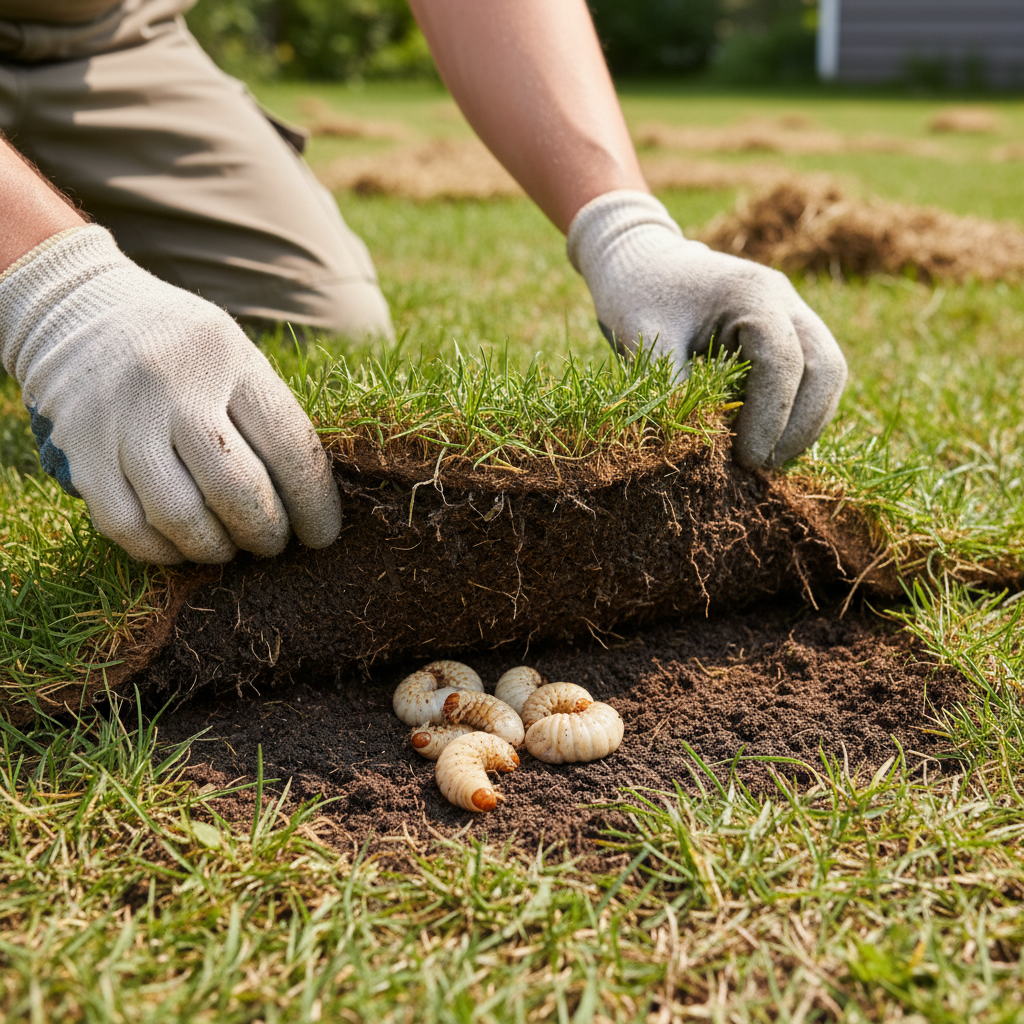
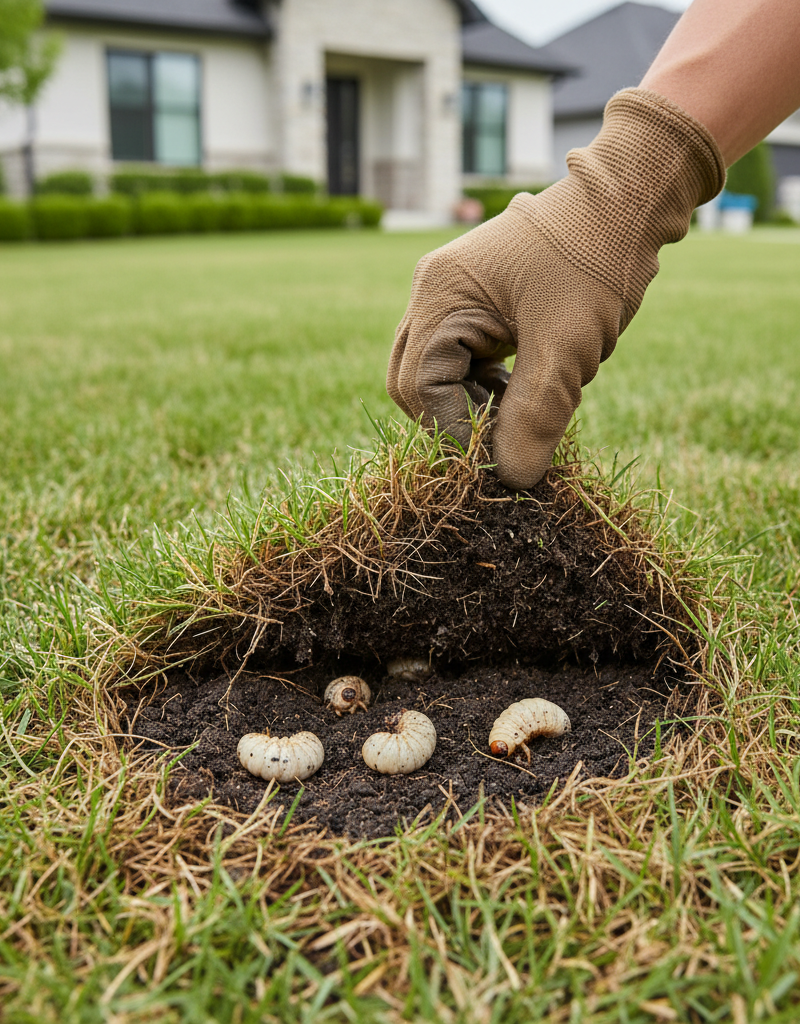
Within a few weeks, these eggs hatch into small, first-instar grubs. From approximately early August through October, these young grubs feed voraciously on the root system of your grass. This is the period of most significant damage, as the feeding severs the turf's connection to water and nutrients, causing large, irregular patches to yellow, brown, and die. The turf may feel spongy and, in severe cases, can be rolled back like a piece of carpet because the anchoring roots have been destroyed.
As soil temperatures drop in late fall, the now larger, third-instar grubs burrow deeper into the soil profile to overwinter below the frost line. The following spring, as the soil warms, they migrate back up to the root zone for a brief, less-intensive feeding period before they pupate. In early summer, they emerge as adult beetles, completing the one-year cycle and beginning it anew. Control strategies work by interrupting this cycle, targeting the grubs when they are small, actively feeding near the surface, and most vulnerable to treatments.
Step-by-Step Fix
-
Conduct a Thorough Damage Assessment — Before reaching for a treatment, confirm the damage is from grubs. Look for irregular brown patches of turf that do not recover with watering. Walk across the affected areas; a spongy or bouncy feeling underfoot is a primary indicator. Also, look for secondary damage, such as small, conical holes in the lawn from skunks, raccoons, armadillos, or birds digging for the grubs. This animal activity is often the first visible sign of an infestation.
-
Confirm Grub Density with a Sod Test — Use a flat spade or lawn edger to cut a 1-foot square flap of sod, approximately 3-4 inches deep, on three sides. Perform this test at the edge of a damaged area, where green turf meets brown. Carefully fold or roll back the sod flap and visually inspect the soil and root zone. Systematically count the number of C-shaped white grubs you see.
- Threshold: An average of five or fewer grubs per square foot is generally not a cause for alarm, as a healthy lawn can sustain this level of feeding. An average of 10 or more grubs per square foot indicates a damaging infestation that warrants treatment. Repeat this test in several locations to get a reliable average.
-
Select the Appropriate Treatment Method — Your choice depends on the time of year and your management philosophy. For an active infestation discovered in late summer or fall, a curative product is required.
- Curative Chemical Insecticides: These are fast-acting poisons that kill existing grubs within days. Look for products containing the active ingredients Trichlorfon (e.g., Bayer Advanced 24 Hour Grub Killer Plus) or Carbaryl (e.g., Sevin Lawn Insecticide). These have a short residual life and are designed to solve an immediate problem.
- Biological Control (Beneficial Nematodes): For an organic approach, use beneficial nematodes, specifically the species Heterorhabditis bacteriophora (Hb). These are microscopic worms that actively hunt, enter, and kill grubs by releasing a symbiotic bacterium. They are completely safe for humans, pets, and pollinators but require specific application conditions to be effective.
-
Verify Optimal Application Timing — Timing is the single most critical factor for success. Curative treatments (both chemical and nematode) are most effective when applied from early August through early October. During this window, grubs are young, small, and actively feeding in the top few inches of soil, making them easy and vulnerable targets. Applying curative products in the spring is largely ineffective; the grubs are too large, have stopped feeding in preparation for pupation, and are more resistant to insecticides.
-
Prepare the Lawn for Application — Proper preparation ensures the treatment can reach the soil where grubs live. First, mow your lawn to a normal height of 2.5 to 3 inches. If your lawn has a thatch layer thicker than 1/2 inch (a spongy mat of dead organic material above the soil line), it must be removed. A heavy thatch layer will bind with the insecticide and prevent it from reaching the soil. Rent a power rake or vertical mower to dethatch the lawn before treatment.
-
Calibrate Your Application Equipment — Do not guess at application rates. Over-application can damage your lawn and the environment, while under-application will fail to control the grubs.
- For Granular Spreaders: Check the product bag for the recommended spreader setting for your specific model (e.g., Scotts, Earthway). To verify, measure a 1,000 sq. ft. test area. Weigh the correct amount of product for this area, place it in the hopper, apply it, and check if you used the entire amount within the test area. Adjust the setting as needed.
- For Liquid Sprayers: Ensure you know the output of your hose-end or pump sprayer. A simple method is to spray plain water into a bucket for one minute to measure its flow rate, then calculate how quickly you need to walk to cover a given area.
-
Apply the Grub Control Product — Follow all safety precautions on the product label, including wearing gloves, long sleeves, and eye protection.
- Granular Application: To ensure even coverage and prevent striping, set your spreader to half the recommended rate and apply the product in two perpendicular passes (e.g., one pass north-to-south, the second east-to-west). Walk at a steady, consistent pace.
- Liquid/Nematode Application: Mix the concentrate according to label directions. Apply evenly across the lawn, spraying to wet the grass blades. When applying beneficial nematodes, do so in the early morning or evening, or on an overcast day, as UV radiation from direct sunlight can kill them. Pre-wetting the lawn helps them survive.
-
Water the Treatment into the Soil Immediately — This step is mandatory and non-negotiable for almost all grub control products. The goal is to wash the active ingredient off the grass blades and down into the soil's root zone. Immediately after application, irrigate the treated area with at least 0.5 inches of water.
- Measurement: To ensure you've applied enough water, place several empty tuna cans or similar flat-bottomed containers on the lawn before you start watering. Stop when the cans are half-full.
-
Initiate Lawn Repair and Recovery — Killing the grubs stops further damage, but it does not repair what has already been done. In the fall, vigorously rake the dead, brown patches to remove the dead turf and expose the soil. Overseed these bare spots with a high-quality grass seed appropriate for your region. Apply a starter fertilizer high in phosphorus to encourage strong root development.
-
Maintain Consistent Moisture for New Seed — The newly seeded areas must be kept consistently moist until the grass is established. This may require light watering once or twice a day for the first two to three weeks. Avoid creating puddles or runoff. Once the new grass reaches mowing height, you can return to a normal, deep-and-infrequent watering schedule.
-
Monitor and Plan for Future Prevention — Two to three weeks after treatment, perform another sod test to confirm the grubs have been eliminated. To prevent a recurring infestation, plan to apply a preventative grub control product next year. Products containing Chlorantraniliprole are best applied in spring (April-May), while those with Imidacloprid or Thiamethoxam are best applied in early summer (June-July). Mark your calendar to break the grub life cycle for good.
Common mistakes
- Misdiagnosing the Problem: Many homeowners attribute irregular brown patches to drought stress or fungal disease, then waste time and money on incorrect treatments like fungicides or excessive watering. The spongy feel of the turf and visible damage from digging animals are key differentiators. Instead: Always perform the 1-foot square sod test in suspect areas to confirm the presence and density of grubs before taking any action.
- Applying Treatments at the Wrong Time: This is the most frequent cause of failure. Applying a curative insecticide in the spring is ineffective because the large, pre-pupal grubs are not feeding and are highly tolerant. Applying a preventative too late in the summer after grubs are already large is equally futile. Instead: Reserve curative products for active infestations from August to early October. Apply preventative products from late spring to mid-summer, timed to intercept the next generation of grubs as they hatch.
- Failing to Water In the Product: Scattering granular insecticide over the lawn and hoping for rain is a recipe for failure. The product remains on the grass blades and thatch, never reaching the grubs in the soil below. Instead: Immediately after applying any granular grub control (and most liquids), irrigate the lawn with 0.5 to 1 inch of water to drive the active ingredient into the root zone where it can work.
- Ignoring the Thatch Layer: Applying grub control over a thatch layer thicker than 1/2 inch is like trying to water a plant through a plastic sheet. The thatch binds with the pesticide, neutralizing it before it can penetrate the soil. Instead: Measure your thatch layer. If it's excessive, rent a power rake or hire a service to dethatch your lawn prior to treatment for maximum effectiveness.
- Using a One-Size-Fits-All Approach: Grabbing a general insect killer off the shelf may not work. Many surface-level insecticides are not formulated to penetrate soil and will have no effect on grubs. Similarly, using milky spore disease for a quick fix is a mistake; it is only effective against Japanese beetle grubs and can take several years to establish in the soil. Instead: Read the product label carefully. Ensure it is specifically labeled for "grubs" or "subsurface insects" and use the right active ingredient for your situation (curative vs. preventative).
- Neglecting Post-Treatment Repair: Killing the grubs is only half the battle. The dead patches of turf will not recover on their own and provide a perfect environment for weed seeds to germinate. Instead: After confirming the grubs are gone, aggressively rake out the dead turf, loosen the soil, and overseed with quality grass seed. This re-establishes a dense, healthy lawn that can better resist future stressors.
Cost & time breakdown
(Estimates are for a typical 5,000 sq. ft. lawn and can vary by region and product choice.)
| Task | DIY cost | Pro cost | Time |
|---|---|---|---|
| Lawn Inspection & Grub Counting | $0 | $75 - $125 (as a standalone diagnostic visit) | 30-60 minutes |
| Curative Chemical Application | $30 - $70 (granules or liquid concentrate) | $175 - $350 | 1-2 hours |
| Beneficial Nematode Application | $40 - $80 (nematodes, sprayer) | $250 - $450 | 1-2 hours |
| Pre-Treatment Lawn Dethatching | $80 - $120 (power rake rental for half-day) | $200 - $400 | 2-4 hours |
| Raking & Overseeding Damaged Areas | $60 - $120 (seed, starter fertilizer, tools) | $300 - $600+ | 2-4 hours |
| Annual Preventative Application | $25 - $50 (preventative granules) | $125 - $250 | 1 hour |
When to call a pro
While treating for grubs is often a manageable DIY project, there are clear situations where professional help is the better choice. If the grub damage is extensive, covering more than a third of your lawn, a professional lawn care company will have the commercial-grade equipment and products to treat the large area efficiently and effectively. If you have attempted to treat the problem yourself one or more times without success, a pro can provide a more accurate diagnosis. They can determine if the failure was due to incorrect timing, wrong product choice, an impenetrable thatch layer, or a secondary lawn disease compounding the issue.
For homeowners with very large properties (over 10,000 sq. ft.), achieving even and accurate application with DIY spreaders is challenging; professionals use calibrated, high-volume equipment to guarantee results. Furthermore, if you are uncomfortable handling, mixing, and applying chemical pesticides, or if you have concerns about safety around children and pets, hiring a licensed and insured professional provides peace of mind. Finally, for chronically recurring grub problems, a pro can design a comprehensive Integrated Pest Management (IPM) program that includes preventative treatments, soil health improvements, and cultural practices to break the cycle for good.
Prevention & maintenance
- Build a Resilient Lawn: The best defense is a dense, healthy turf. Mow your grass high, at 3 to 4 inches. Taller grass develops deeper, more robust root systems that can tolerate some grub feeding and its blades shade the soil, creating a cooler, less hospitable environment for egg-laying beetles.
- Apply a Preventative Grub Killer: For lawns with a history of grub damage, a preventative application is the most reliable strategy. Apply a product containing Chlorantraniliprole in the spring (April-May) or one with Imidacloprid in early summer (June-July). These products create a protective zone in the soil that kills the new generation of grubs as soon as they hatch.
- Water Deeply and Infrequently: Water your lawn to a depth of 6-8 inches only once or twice a week. This encourages deep root growth. In contrast, light, daily watering keeps the top layer of soil constantly moist, creating a perfect nursery for beetle eggs and young grubs. Letting the soil surface dry out between waterings makes it less attractive to egg-laying females.
- Monitor Adult Beetle Activity: In early to mid-summer, observe the number of adult beetles (Japanese beetles, chafers) on your property. A high population feeding on your roses, linden trees, and other landscape plants is a direct warning sign that a large number of eggs are likely being laid in your turf.
- Dethatch and Aerate Regularly: A thatch layer over 1/2-inch thick prevents water and treatments from reaching the soil. Dethatch in the fall as needed. Annual core aeration relieves soil compaction, improves drainage, and allows grass roots to grow deeper, making the lawn more drought- and grub-tolerant.
- Incorporate Beneficial Nematodes Proactively: Even if you don't have a current infestation, applying beneficial nematodes in late summer or early fall can build a standing army of grub predators in your soil. This natural, organic approach can significantly reduce the severity of future grub populations.
Related Articles
Keep troubleshooting with these hand-picked guides from FixlyGuide:
- The #1 Mistake Killing Your Lawn's Clover—And 3 Secrets to Get Rid of It for Good — Discover the common mistake homeowners make when trying to eliminate clover and learn three effective, grass-safe strategies to remove it p…
- The Surprising pH Secret Every Green Lawn Shares (And How to Unlock Yours) — Discover how to simply and accurately test your lawn soil pH at home to unlock a greener, healthier lawn without expensive guesswork.
- The #1 Mistake Killing Your Lawn's Clover—and the Easy fix That Spares Your Grass — Discover the most common mistake homeowners make when trying to eliminate clover, and learn how to remove it effectively without harming yo…
- [Th
Should you do this yourself?
Answer five quick questions before you start. Safety outranks savings every time.
Your experience with work like this
How high do you have to work?
Does the job involve any of these?
Will it need a permit?
Specialty tools
Free and instant. Educational guidance only — not a quote, inspection, or professional diagnosis.
What should this project cost?
Enter your project details for a realistic cost range before you call anyone.
Cost depends heavily on which system turns out to be the source.
- Regional adjustment
- National average
- Labor share (typical)
- ~$1,620
- Quotes to collect
- 3 written estimates
Educational estimate based on national averages — not a binding quote. Always confirm with written local estimates.
Before you start
Check the difficulty, permits, and safety risk — then decide whether to call a pro.
- Estimate this projectGet a cost range for your scope and ZIP before you call anyone.Open
- Get local estimatesSend one request and compare written estimates from vetted pros.Open
Free, no signup required. Estimates are educational guidance, not a quote or an inspection.
Get the print-ready PDF of this guide
A clean, ad-free, printable version you can keep on your phone or pin to the workshop wall. Free with a FixlyGuide account.
- Print-optimized layout
- Tools, materials & every step included
- Saved to your account
Frequently asked questions
How do I know if I have grubs?+
Look for irregular brown patches that peel back easily like a carpet, or an increase in animals digging in your yard. Dig up a small section of turf and look for C-shaped white larvae (grubs) underneath. More than 5-10 per square foot indicates a problem.
When is the best time to treat for grubs?+
The most effective time to treat for grubs is in late summer to early fall (August to October) when they are young, actively feeding near the surface, and most vulnerable to insecticides or nematodes.
Are beneficial nematodes safe for pets and children?+
Yes, beneficial nematodes are a natural, organic pest control method that is safe for people, pets, and beneficial insects like bees and butterflies, as they specifically target grubs and other soil-dwelling pests.
Can I prevent grubs from coming back?+
Yes, maintaining a healthy lawn with proper watering and fertilization makes it more resistant to grub damage. You can also apply preventative grub control products in the spring, which target newly hatched grubs later in the season.

Discussion
Loading comments…