
- The 1 Mistake Killing Your Lawn's Grass (and 3 Simple Fixes) — Patchy grass can ruin your lawn's appearance, but often the cause is a common mistake that's easy to correct with the right approach.
- The 1 Timing Mistake That Makes Pre-Emergents Useless (And How to Fix It) — Applying pre-emergent weed control at the wrong time is the most common reason for failure, leading to wasted product and persistent weeds.
- The 1 Mowing Mistake That Leaves Your Lawn Brown and Patchy — Discover the most common mowing mistake homeowners make that leads to unhealthy, patchy grass and how to fix it for a vibrant lawn.
- The 1 Lawn Aeration Mistake Most Homeowners Make (And When to REALLY Do It) — Discover the crucial mistake many homeowners make with lawn aeration and learn the optimal timing for a thriving, healthy lawn.
- The 1 Pre-Emergent Mistake Wrecking Your Weed Control (And How to Fix It) — Applying pre-emergent at the wrong time is the most common mistake, leading to ineffective weed control and wasted effort for homeowners.
Landscaping · Deck or fence project
| Project category | Landscaping |
|---|---|
| Problem type | Deck or fence project |
| Trade required | Landscaping |
| Urgency | Planned project |
| Safety risk | Moderate safety risk |
| DIY suitability | DIY for experienced homeowners |
| Cost category | High cost |
| Typical timeline | Most builds 3–10 days depending on size |
| Contractor type | Landscaping contractor |
Repair option
Replace failed boards, posts, and hardware; reseal the surface.
Replacement option
Rebuild when framing or the ledger connection is unsafe.
Common causes
- Rot at posts and ledger
- Storm damage
- Adding outdoor living space
Relevant tools:home improvement material pricesproject cost estimator
Published June 25, 2026Last updated August 17, 2026
Tools & materials you'll need
Affiliate linksAs an Amazon Associate FixlyGuide earns from qualifying purchases — at no extra cost to you. Prices and availability are accurate as of publication and subject to change.
Quick Answer
The most common and costly mistake homeowners make with lawn fertilization isn't the product they choose, but when they apply it. Timing is everything because it aligns with your grass's natural growth cycles. For cool-season grasses (like fescue, rye, bluegrass), the optimal times are a heavy application in early to mid-fall and a lighter touch in early spring. For warm-season grasses (like Zoysia, Bermuda, St. Augustine), late spring and early summer are prime, with a follow-up in late summer. Misjudging these windows can lead to wasted product, weed proliferation, and even damage to your turf.
The Problem
Every homeowner dreams of a lush, vibrant green lawn. Yet, many struggle to achieve it, often finding their efforts with fertilizer yield disappointing results – yellowing patches, excessive weed growth, or grass that simply doesn't thrive. The core of this frustration often lies in a fundamental misunderstanding of turfgrass biology and, consequently, improper timing of fertilization. Applying fertilizer when your grass isn't actively growing can stress the plant, encourage weed competition, or simply wash away nutrients before they can be absorbed, leading to wasted money and a less-than-ideal lawn.
Imagine feeding a hungry person, but only when they're asleep. That's essentially what happens when you fertilize at the wrong time. If the grass isn't in an active growth phase, its roots aren't efficiently taking up nutrients. This common oversight not only fails to deliver the desired aesthetic results but can also weaken the lawn's natural defenses against disease, pests, and environmental stressors like drought. The problem isn't usually the will to have a healthy lawn, but the know-how to support its specific biological needs throughout the year.
How It Works
To understand proper fertilization timing, you first need to grasp how your lawn grass grows. Grass plants, like all plants, require essential nutrients – primarily nitrogen (N), phosphorus (P), and potassium (K) – absorbed through their roots. However, grass doesn't grow uniformly year-round; it has distinct growth cycles dictated by temperature and light.
There are two main categories of turfgrass: cool-season and warm-season. Their names tell you everything about their preferred growing temperatures.
Cool-season grasses (Kentucky Bluegrass, Perennial Ryegrass, Tall Fescue, Fine Fescue) thrive in cooler temperatures, typically between 60°F and 75°F (15°C and 24°C). Their most vigorous growth periods are in the spring and, crucially, in the fall. During the hot summer months, these grasses often go dormant or slow their growth significantly to conserve energy and survive the heat. Fertilizing heavily during this summer dormancy is inefficient and can even burn the grass.
Warm-season grasses (Bermudagrass, Zoysiagrass, St. Augustinegrass, Centipedegrass) prefer warmer temperatures, optimally between 80°F and 95°F (27°C and 35°C). Their peak growth occurs from late spring through summer. They go dormant and often turn brown during cooler fall and winter months. Applying fertilizer during their winter dormancy is a complete waste and can harm the lawn.
When you apply fertilizer, you're providing these essential nutrients that fuel photosynthesis, root development, and blade growth. Applying it when the grass is actively growing ensures direct uptake into the plant's vascular system, strengthening roots, promoting lush green blades, and increasing its resilience. If applied during dormancy, the nutrients are largely unused, prone to leaching into groundwater, or become food for weeds that might be more active at that particular temperature.
Step-by-Step Fix
1. Identify Your Grass Type – Cool-season or warm-season?
This is the absolute first step. Look closely at your grass blades or consult a local extension office if unsure. Blades that are fine, dark green, and often bunch-forming might be fescue or rye (cool-season). Wider, coarser blades that spread via stolons or rhizomes are often warm-season like St. Augustine or Bermuda.
- If you're unsure: Take a small sample to your local garden center or cooperative extension office for identification. They can usually tell you on the spot.
2. Perform a Soil Test – Understand your soil's needs.
Before applying any fertilizer, a soil test provides a baseline of your soil's pH and existing nutrient levels. This prevents over-fertilization of certain nutrients and ensures you're applying what's truly needed. Kits are available at garden centers or through your local extension office for $15-$30.
- Pro Tip: Soil tests are usually good for 3-5 years. Follow the instructions precisely for collecting soil samples to get accurate results.
3. Choose the Right Fertilizer – Match N-P-K to your soil test.
Based on your soil test, select a fertilizer with an appropriate N-P-K ratio. Nitrogen (N) promotes leafy growth, Phosphorus (P) aids root development, and Potassium (K) boosts overall plant health and stress resistance. Your soil test will usually recommend a specific ratio.
- Example: A soil test might recommend a balanced 10-10-10 or a high-nitrogen 20-5-10 product, depending on deficiencies.
- Safety Note: Always read and follow the manufacturer's instructions for application rates and safety precautions. Wear gloves and eye protection.
4. For Cool-Season Grasses: Fall Application (Heaviest) – The most crucial feeding.
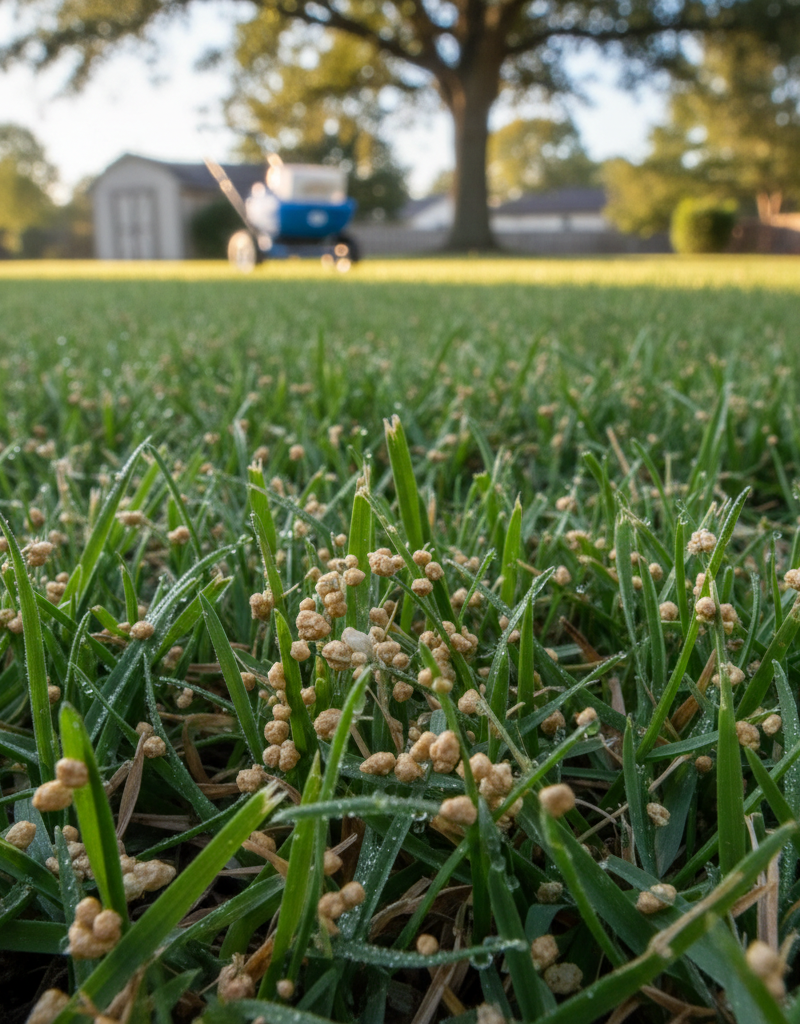
Apply a slow-release granular fertilizer with a higher nitrogen content (e.g., 20-5-10 or 24-0-12) between late August and early October, when daytime temperatures consistently hold below 70°F (21°C) and nighttime temperatures are in the 50s°F (10-15°C). This allows the grass to store energy for winter and promotes strong root growth for spring.
- Why it works: Roots are growing vigorously, storing carbohydrates for winter survival and a strong spring green-up.
- If you miss this window: It's better to wait until early spring than to fertilize too late in cold weather when the grass is dormant.
5. For Cool-Season Grasses: Spring Application (Lighter) – A gentle boost.
Apply a lighter dose of fertilizer in early spring (March-April), once active growth begins and after the last hard frost. Use a product with balanced nutrients (e.g., 10-10-10) or slightly higher nitrogen. Avoid heavy spring applications, as this can lead to excessive top growth at the expense of root development later in the season.
- Caution: If you're also applying a crabgrass pre-emergent, choose an all-in-one product or make sure your fertilizer won't interfere with the pre-emergent's efficacy.
6. For Warm-Season Grasses: Late Spring Application (First Feed) – Awakening from dormancy.
Your first warm-season application should be in late spring (April-May) when the grass has fully greened up and daytime temperatures are consistently above 70°F (21°C). Use a complete fertilizer (e.g., 16-4-8 or 15-0-15) with an emphasis on nitrogen to encourage strong blade growth.
- Timing Cue: Often coincides with the time you need to start mowing regularly after winter dormancy.
7. For Warm-Season Grasses: Summer Application (Follow-up) – Sustaining growth.
Apply a second, slightly lighter application in mid-summer (June-July). This helps sustain growth during peak heat and high activity. Use a similar fertilizer ratio as your late spring application. Avoid fertilizing warm-season grasses too late in the fall, as this can promote tender new growth that is susceptible to winter damage.
- Considerations: If your summer is extremely hot and dry, and your lawn is under stress, consider delaying or skipping this application to avoid burning.
8. Apply Evenly with a Spreader – Preventing burned spots and missed areas.
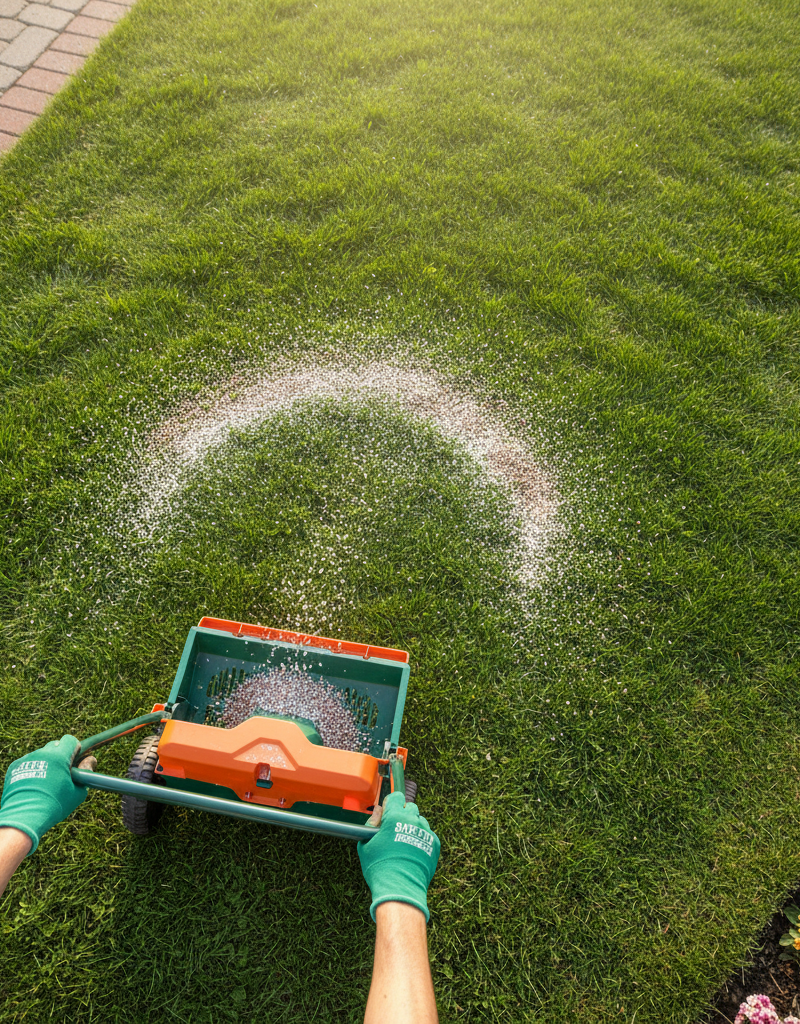
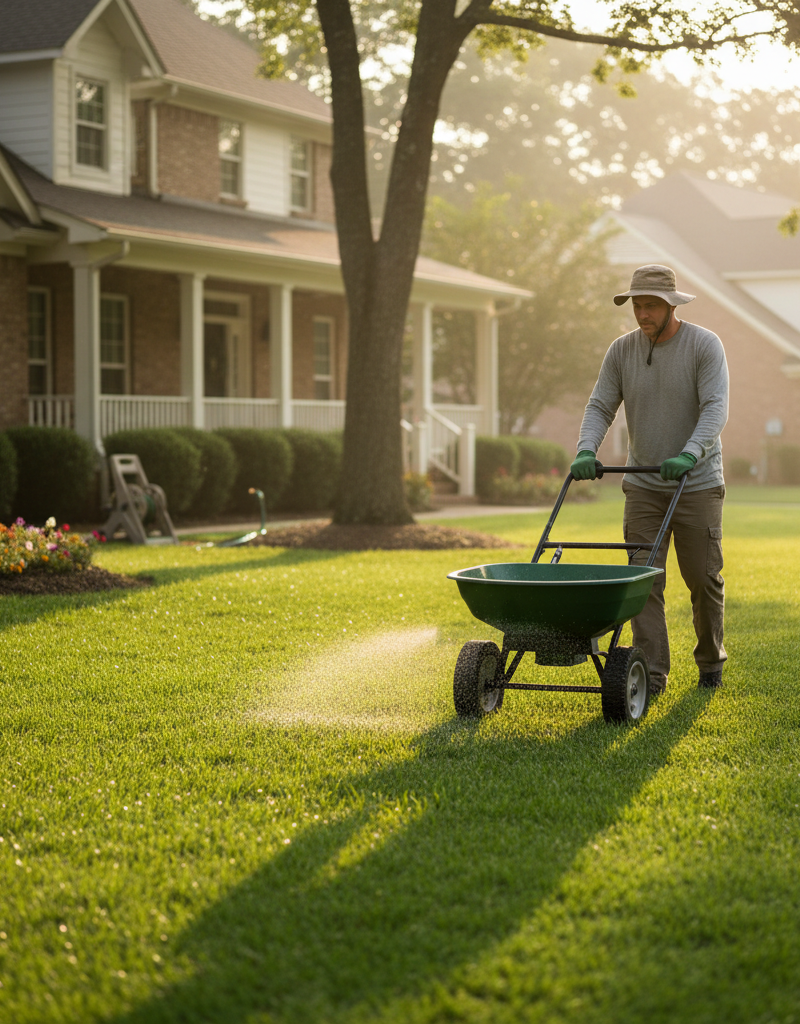
Use a broadcast or drop spreader for even application. Calibrate your spreader according to the fertilizer bag's instructions for your specific model. Overlapping slightly helps prevent striping, but avoid heavy overlapping to prevent over-fertilization.
- Spreader selection: Broadcast spreaders cover wider areas faster; drop spreaders offer more precision but require more passes.
- Maintenance: Clean your spreader after each use to prevent corrosion and ensure proper function.
9. Water In (If Granular) – Activate the fertilizer.
After applying granular fertilizer, lightly water your lawn. This washes the fertilizer off the blades and down to the soil, where it can begin to dissolve and be absorbed by the roots. Do not overwater and cause runoff.
- Exception: Some weed-and-feed products require the lawn to be slightly damp to help the herbicide stick to the weed leaves. Always check the product label.
10. Monitor and Adjust – Ongoing observation.
Observe your lawn's response over the following weeks. Adjust future applications as needed based on color, growth rate, and any signs of stress or nutrient deficiency. Keep a log of your applications, including dates and products used.
- If your lawn shows signs of burning (brown stripes/patches): You may have over-applied fertilizer in those areas. Water heavily to try and dilute it.
- If growth is still weak or yellowish: Your soil may have other deficiencies, or the timing still needs refinement.
Common Causes
- Guessing Your Grass Type: Applying a cool-season schedule to warm-season grass, or vice-versa, directly counteracts its natural growth cycle. For example, fertilizing warm-season grasses heavily in early spring before they've truly emerged from dormancy is ineffective.
- Skipping a Soil Test: Without a soil test, you're fertilizing blindly. You might be applying nutrients your soil already has in abundance (wasting money and potentially harming the environment) or missing critical deficiencies.
- Ignoring Temperature Cues: Fertilizing when temperatures are too hot or too cold means the grass roots aren't actively absorbing nutrients, leading to runoff, burning, or simply wasted product.
- **Over-reliance on
Related Articles
Keep troubleshooting with these hand-picked guides from FixlyGuide:
- The #1 Mistake Killing Your Lawn's Grass (and 3 Simple Fixes) — Patchy grass can ruin your lawn's appearance, but often the cause is a common mistake that's easy to correct with the right approach.
- The #1 Timing Mistake That Makes Pre-Emergents Useless (And How to Fix It) — Applying pre-emergent weed control at the wrong time is the most common reason for failure, leading to wasted product and persistent weeds.
- The #1 Mowing Mistake That Leaves Your Lawn Brown and Patchy — Discover the most common mowing mistake homeowners make that leads to unhealthy, patchy grass and how to fix it for a vibrant lawn.
- The #1 Lawn Aeration Mistake Most Homeowners Make (And When to REALLY Do It) — Discover the crucial mistake many homeowners make with lawn aeration and learn the optimal timing for a thriving, healthy lawn.
- The #1 Pre-Emergent Mistake Wrecking Your Weed Control (And How to Fix It) — Applying pre-emergent at the wrong time is the most common mistake, leading to ineffective weed control and wasted effort for homeowners.
- The 3 Hidden Mistakes That Make Your Deck Sealer Fail (And How to Fix Them) — Properly sealing your wood deck protects it from the elements, but common mistakes often lead to early failure. Learn how to reseal your de…
What should this project cost?
Enter your project details for a realistic cost range before you call anyone.
Cost depends heavily on which system turns out to be the source.
- Regional adjustment
- National average
- Labor share (typical)
- ~$1,620
- Quotes to collect
- 3 written estimates
Educational estimate based on national averages — not a binding quote. Always confirm with written local estimates.
Frequently asked questions
How often should I fertilize my lawn?+
For most lawns, 2-4 applications per year are sufficient, depending on your grass type and desired results. Cool-season lawns generally benefit from a heavy fall and lighter spring application. Warm-season lawns typically need applications in late spring and mid-summer. A soil test will help determine specific needs.
What happens if I fertilize my lawn at the wrong time?+
Fertilizing at the wrong time can lead to wasted product if the grass isn't actively growing, encourage weed growth, or even burn and damage the lawn. It also means the nutrients aren't effectively absorbed, resulting in a less healthy and vibrant lawn.
Should I water my lawn after fertilizing?+
Yes, it's generally recommended to lightly water your lawn after applying granular fertilizer. This helps move the nutrients off the grass blades and down into the soil where they can be absorbed by the roots. Always check the specific product instructions.
How do I know if my grass is cool-season or warm-season?+
Cool-season grasses (fescue, rye, bluegrass) are typically lush in spring and fall, often going dormant in hot summers. Warm-season grasses (Bermuda, Zoysia, St. Augustine) thrive in summer heat and typically turn brown during cooler fall and winter months. Examining blade shape and growth patterns can also help identify them.
Can I fertilize my lawn in summer?+
It depends on your grass type. Cool-season grasses are often dormant or stressed in summer, so heavy fertilization is usually avoided. Warm-season grasses, however, are in their prime growth phase during summer and can benefit from a mid-summer application. Always check the weather for extreme heat or drought before applying.
Discussion
Loading comments…