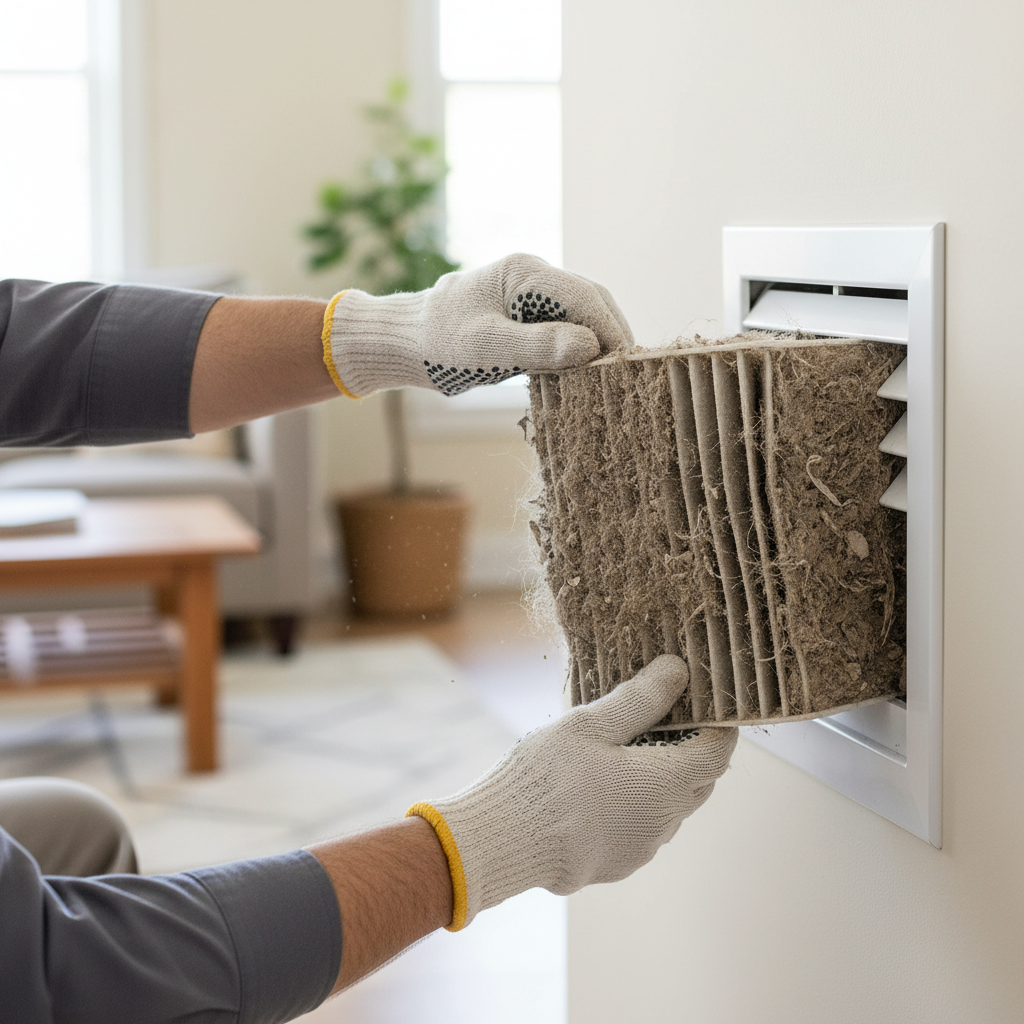
- Replace Air Filters Regularly: Mark your calendar. Standard 1-inch filters should be changed every 1-3 months. Thicker 4-5 inch media filters can last 6-12 months. This is the single most important maintenance task.
- Clear the Condensate Line Seasonally: Twice a year, in the spring and fall, pour a cup of distilled white vinegar down the condensate line access port to prevent the buildup of algae and sludge that cause clogs.
- Maintain Outdoor Unit Clearance: Keep a two-foot clear zone around your outdoor condenser unit. Regularly trim back shrubs, weeds, and overhanging branches. Never stack items against the unit or cover it during operation.
- Use Exhaust Fans: Run your bathroom exhaust fan during and for 15-20 minutes after every shower. Use the range hood exhaust fan when cooking, especially when boiling water, to vent moisture directly outside.
- Monitor Your Home's Seal: Periodically check weatherstripping on doors and caulking around windows for signs of cracking or deterioration. A well-sealed home envelope is your first line of defense against outdoor humidity.
Plumbing · Clog
| Project category | Plumbing |
|---|---|
| Problem type | Clog |
| Trade required | Plumbing |
| Urgency | Soon — within weeks |
| Safety risk | Low safety risk |
| DIY suitability | DIY friendly |
| Cost category | Low cost |
| Typical timeline | Same-day DIY attempt; pro visit within a day or two |
| Contractor type | Licensed plumber |
Repair option
Plunger, hand auger, or trap cleanout before chemicals.
Replacement option
Line replacement when clogs return in the same spot repeatedly.
Common causes
- Hair and soap buildup in the trap
- Grease cooling in the branch line
- Flushed wipes or foreign objects
Relevant tools:diy difficultydiy or hire a pro
Published April 20, 2026Last updated August 17, 2026
Tools & materials you'll need
Affiliate linksAs an Amazon Associate FixlyGuide earns from qualifying purchases — at no extra cost to you. Prices and availability are accurate as of publication and subject to change.
How it works
An air conditioner's primary job is cooling, but its secondary, equally critical function is dehumidification. These two processes are intrinsically linked within the refrigeration cycle. Your AC unit operates like a heat pump, moving thermal energy from inside your home to the outside. This starts when warm, moist indoor air is pulled through the return ducts and passes over the frigid evaporator coil, located in the indoor air handler.
This coil contains cold liquid refrigerant that absorbs heat from the air. As the air rapidly cools, it drops below its dew point—the temperature at which water vapor condenses into liquid water. This condensation process effectively "squeezes" moisture out of the air. The collected water drips from the evaporator coil's fins into a condensate collection pan. From there, it flows through a PVC drain line, typically exiting outside near the foundation of your house. The now cooler and, importantly, drier air is then pushed back into your home through the supply ducts. For this dehumidification to be effective, the AC system must run for a sufficient length of time during each cooling cycle. Short, frequent cycles may cool the air to the set temperature but won't run long enough to remove a significant amount of water vapor, leaving the air feeling clammy.
Step-by-Step Fix
1. Confirm the Humidity Level — Take a Baseline Reading
Before making adjustments, objectively measure your home's relative humidity (RH) to confirm there is a problem. The ideal indoor RH is between 40% and 50%. Consistently higher levels indicate a performance issue.
- Tools: Digital hygrometer.
- Action: Place a hygrometer in a central area of your home, away from windows, bathrooms, or the kitchen. Allow it to acclimate for at least 30 minutes before taking a reading. Note the reading alongside the current outdoor humidity for context.
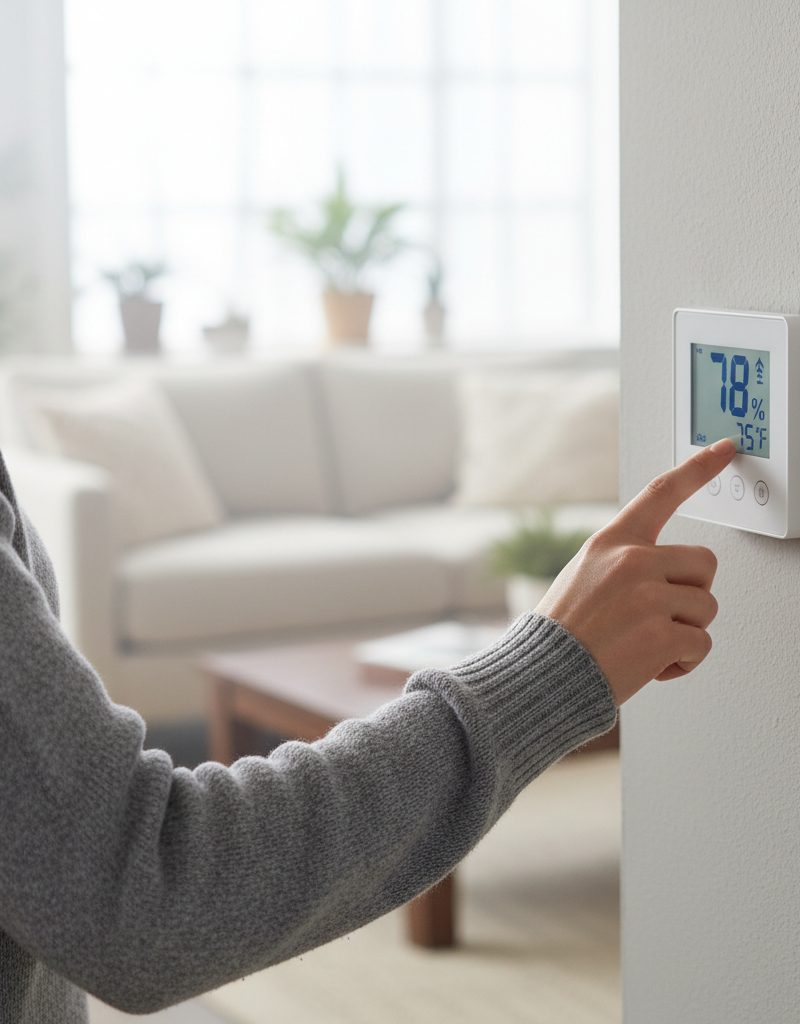
2. Inspect the Thermostat Fan Setting — Verify "AUTO" Operation
A common and easily fixed cause of high humidity is an incorrect fan setting. If the thermostat's fan is set to "ON" instead of "AUTO," it will run continuously, even when the AC's cooling cycle (and thus, dehumidification process) is off. This blows air across the wet evaporator coil, re-evaporating the collected moisture and pushing it right back into your home.
- Location: Your primary wall thermostat.
- Action: Check the fan switch. Ensure it is set to "AUTO." On this setting, the blower fan will only run when the system is actively cooling, allowing collected moisture to drain away properly.
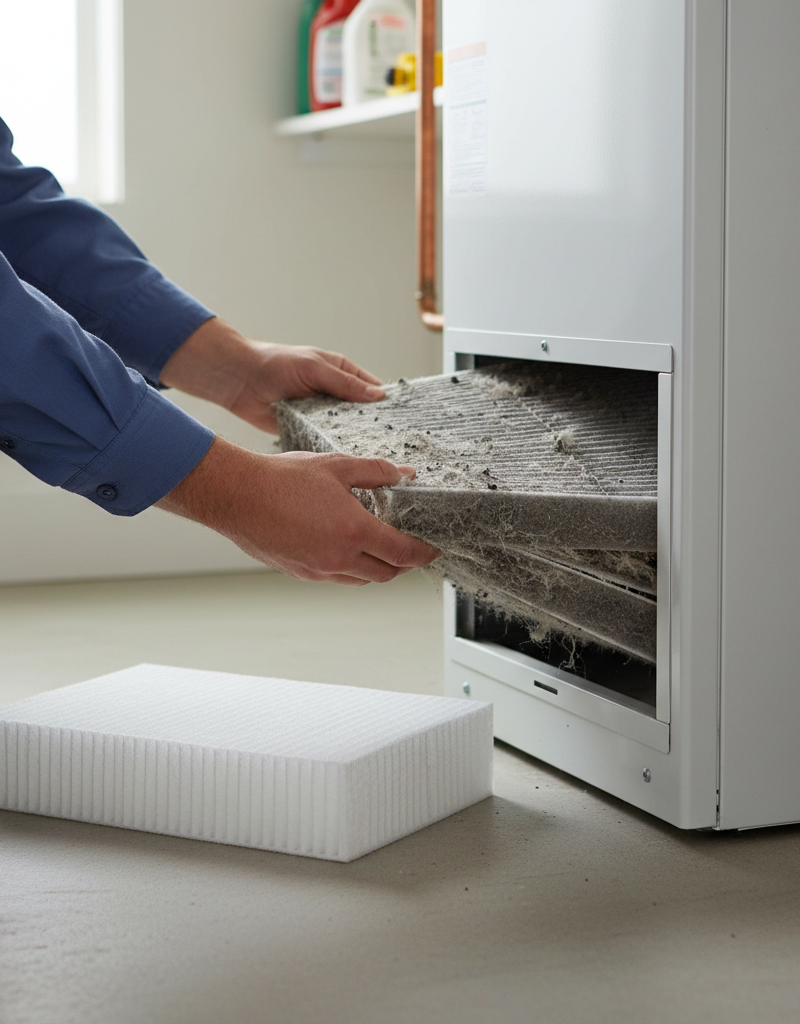
3. Change the Air Filter — Restore Proper Airflow
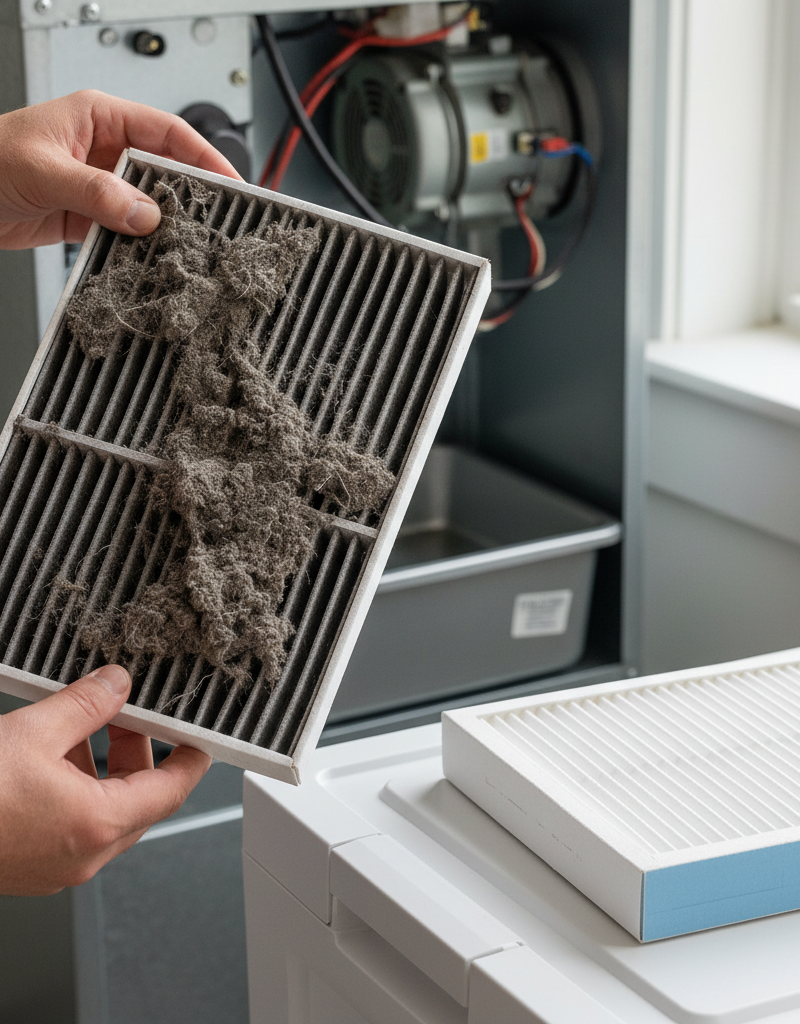
A dirty, clogged air filter is the most frequent culprit behind poor AC performance. It severely restricts the volume of air passing over the evaporator coil. Insufficient airflow means less air is being dehumidified, and it can cause the coil to get too cold and freeze, completely stopping moisture removal.
- Tools: New air filter of the correct size and MERV rating.
- Action: Turn off the AC system at the thermostat. Locate the filter slot, usually in the return air grille or the air handler cabinet. Slide out the old filter and inspect it; if it's opaque with dust, it's overdue for a change. Slide in the new filter, ensuring the airflow arrows point toward the air handler.
4. Clear the Condensate Drain Line — Ensure Proper Drainage
The moisture removed from your air must have a clear path out of your home. Over time, algae, mold, and sludge can build up and clog the condensate drain line. When this happens, water backs up into the drain pan, and a safety float switch may shut down your AC or, worse, the pan could overflow, causing water damage.
- Tools: Wet/dry vacuum, distilled white vinegar, funnel.
- Safety: Turn off all power to the air handler at the circuit breaker before working.
- Action: Locate the PVC drain line exit outside your home. Use a wet/dry vacuum to suction out any blockage for 1-2 minutes. Then, find the T-shaped vent or access cap on the drain line near your indoor unit. Remove the cap and slowly pour one cup of distilled white vinegar down the line to kill any remaining biological growth. Wait 30-60 minutes, then flush with a quart of warm water.
5. Inspect the Evaporator Coil for Ice — Check for Freezing
Ice buildup on the evaporator coil is a clear sign of a problem, usually restricted airflow (see Step 3) or low refrigerant levels. A frozen coil cannot function; air cannot pass through it to be cooled or dehumidified.
- Safety: Shut off power to the air handler at the breaker.
- Action: Open the access panel to the evaporator coil on your indoor unit. If you see ice or frost, do not attempt to chip or scape it off. To thaw it, leave the power off and wait several hours, or you can turn the power back on and run the system in "FAN ONLY" mode (not "COOL") to circulate room-temperature air over the coil and speed up melting. Place towels below the unit to catch dripping water. Once thawed, proceed to the next step.
- If this doesn't work: If the coil refreezes after you've thawed it and replaced the air filter, it strongly indicates a refrigerant leak that requires a professional.
6. Clean the Evaporator Coil — Remove Insulating Grime
Even if it's not frozen, a dirty evaporator coil will underperform. A blanket of dust and grime acts as an insulator, reducing the coil's ability to absorb heat and condense moisture. This forces the system to run longer and less efficiently.
- Tools: No-rinse evaporator coil spray cleaner, soft-bristled brush, spray bottle with water.
- Safety: Ensure power to the unit is off at the breaker.
- Action: With the access panel open and the coil fully thawed and dry, gently brush away any loose debris with a soft brush, moving in the same direction as the metal fins to avoid bending them. Next, thoroughly spray the coil from top to bottom with the no-rinse foaming cleaner. The foam will expand, lift dirt from between the fins, and then liquefy, draining into the condensate pan.
7. Clean the Outdoor Condenser Unit — Improve Heat Exchange
The outdoor unit's job is to release the heat collected from inside your home. If its fins are clogged with dirt, grass clippings, or cottonwood seeds, it cannot dissipate heat effectively. This raises the pressure and temperature inside the system, reducing cooling and dehumidification efficiency.
- Tools: Garden hose with a spray nozzle, work gloves.
- Safety: Turn off power to the outdoor unit via the exterior disconnect box (usually a metal box on the wall near the unit) and at the main circuit breaker.
- Action: Clear away any leaves, branches, or weeds within a two-foot radius of the unit. Set your hose nozzle to a gentle spray, not a high-pressure jet. Gently spray the condenser fins from the outside, angling the water from top to bottom to wash dirt out, not drive it deeper into the unit.
8. Check for Air Leaks in Ductwork and Home Envelope — Stop Humid Air Intrusion
Your AC may be working perfectly, but if your home is poorly sealed, it's fighting a losing battle. Leaky ducts can pull in humid, unconditioned air from attics, crawl spaces, or wall cavities. Gaps around windows and doors allow humid outdoor air to infiltrate your living space, adding to the AC's workload.
- Tools: HVAC mastic sealant or foil tape, caulk, weatherstripping, incense stick.
- Action: Visually inspect accessible ductwork in your attic or basement for tears, gaps, or disconnected joints. Seal any leaks with mastic sealant or UL 181-rated foil tape. On a calm day, light an incense stick and hold it near windows, doors, and electrical outlets. If the smoke wavers or is drawn inward, you have an air leak that should be sealed with caulk or weatherstripping.
9. Evaluate System Run Time — Identify Short-Cycling
An oversized air conditioner is a common and serious problem. The unit cools the space so quickly that it shuts off before it has had a chance to run long enough to remove adequate moisture. If your AC runs for less than 10 minutes per cycle on a hot day, it is likely oversized.
- Action: Time a few cooling cycles on a warm afternoon. If the cycles are consistently short and the house feels clammy despite being cool, the unit is probably too large. This is not a DIY fix and often requires professional system replacement or an auxiliary dehumidifier.
Common mistakes
- Setting the Thermostat Fan to "ON". This is the most common user error. It guarantees that any moisture your AC works hard to remove will be re-evaporated and blown back into your house as soon as the compressor shuts off. Always use the "AUTO" setting.
- Using Bleach in the Condensate Line. While effective at killing algae, chlorine bleach can degrade PVC pipe over time, making it brittle. It can also produce noxious fumes. Distilled white vinegar is a safer and equally effective alternative for routine maintenance.
- Forcibly Scraping Ice from Coils. Trying to remove ice with a sharp tool is extremely risky. The aluminum fins and copper tubing of the evaporator coil are delicate. A puncture will cause an expensive refrigerant leak, requiring a professional repair and recharge. Always thaw ice with air circulation.
- Installing an Air Filter with Too High a MERV Rating. While high-MERV (Minimum Efficiency Reporting Value) filters are better at capturing small particles, they are also more restrictive to airflow. Installing a filter your system's fan wasn't designed for can choke the unit, leading to the same problems as a dirty filter. Stick to the manufacturer's recommended MERV range (typically 7-12).
- Power Washing the Condenser Fins. Using a high-pressure water stream on the outdoor unit's fins will bend and flatten them. This blocks airflow just as effectively as dirt and is very difficult to repair. Use only a gentle spray from a garden hose.
- Ignoring Duct Leaks. Homeowners often focus on the AC unit itself and forget the delivery system. Leaky return ducts can pull hot, humid, and dirty air from an attic or crawlspace, overwhelming the system and compromising indoor air quality.
Cost & time breakdown
| Task | DIY Cost | Pro Cost | Time |
|---|---|---|---|
| Air Filter Replacement | $15 - $50 | $75 - $150 (as part of a call) | 10 minutes |
| Condensate Line Cleaning | $10 (vinegar) | $100 - $250 | 1 hour |
| Evaporator Coil Cleaning | $20 - $40 (cleaner, brush) | $150 - $400 | 1 - 2 hours |
| Outdoor Condenser Cleaning | $0 | $100 - $300 | 30 minutes |
| Professional HVAC Tune-Up | N/A | $100 - $300 | 1 - 2 hours |
| Duct Sealing (accessible areas) | $30 - $60 (mastic, tape) | $500 - $2,000+ (for full system) | 2 - 4 hours |
When to call a pro
While many causes of high humidity are manageable for a DIYer, several signs indicate the problem requires professional expertise. If you have performed the basic maintenance steps—changing the filter, cleaning the coils and drain line—and the issue persists, it's time to call an HVAC technician. The most critical red flag is a suspected refrigerant leak. Signs include a hissing sound from the unit, oily residue around refrigerant lines, or a system that runs but doesn't cool at all. Handling refrigerant requires EPA certification and specialized equipment.
You should also call a professional if the evaporator coil repeatedly freezes over despite a clean filter and good airflow. This points toward a systemic issue like a refrigerant charge imbalance or a faulty metering device. Any electrical problems, such as a constantly tripping breaker, humming or buzzing noises from contactors or capacitors, or a burning smell, demand immediate professional attention to avoid fire hazards and component damage. Finally, if you've determined your system is short-cycling, a professional is needed to perform a Manual J load calculation to confirm if the unit is oversized and recommend solutions, such as replacement or installing a whole-home dehumidifier.
Prevention & maintenance
- Replace Air Filters Regularly: Mark your calendar. Standard 1-inch filters should be changed every 1-3 months. Thicker 4-5 inch media filters can last 6-12 months. This is the single most important maintenance task.
- Annual Professional Tune-Up: Schedule an inspection with a qualified HVAC technician every spring before the cooling season begins. They will check refrigerant levels, clean and test components, and spot potential problems before they lead to failure.
- Clear the Condensate Line Seasonally: Twice a year, in the spring and fall, pour a cup of distilled white vinegar down the condensate line access port to prevent the buildup of algae and sludge that cause clogs.
- Maintain Outdoor Unit Clearance: Keep a two-foot clear zone around your outdoor condenser unit. Regularly trim back shrubs, weeds, and overhanging branches. Never stack items against the unit or cover it during operation.
- Use Exhaust Fans: Run your bathroom exhaust fan during and for 15-20 minutes after every shower. Use the range hood exhaust fan when cooking, especially when boiling water, to vent moisture directly outside.
- Monitor Your Home's Seal: Periodically check weatherstripping on doors and caulking around windows for signs of cracking or deterioration. A well-sealed home envelope is your first line of defense against outdoor humidity.
Related Articles
Keep troubleshooting with these hand-picked guides from FixlyGuide:
- The Secret Reason Your AC Makes Humidity Worse (And How to Fix It) — Discover why your air conditioner might be adding to your home
- Oven Not Heating to Correct Temperature? How to Diagnose and Fix — An oven that doesn't heat to the correct temperature can ruin meals. This guide helps you diagnose common issues like a faulty igniter or h…
- Your Thermostat Isn't Broken — It's These 3 Culprits — If your thermostat isn't hitting the mark, it could be a simple fix. Learn how to troubleshoot common issues and get your home comfortable…
- The Hidden Reason Your Furnace Short Cycles — And Why Most Homeowners Get It Wrong — Furnace short cycling, characterized by frequent on-off cycles, often points to a few common issues, most of which are surprisingly easy fo…
- Dryer Not Heating: Fix a Tripped Thermal Fuse Fast — Is your electric dryer running but not heating? This guide walks you through safely diagnosing and replacing a tripped thermal fuse, a comm…
- Why Your Dishwasher Leaves Dishes Wet (And How to Fix It) — If your dishwasher leaves dishes wet after a cycle, it's a common and frustrating problem often caused by issues with rinse
Should you do this yourself?
Answer five quick questions before you start. Safety outranks savings every time.
Your experience with work like this
How high do you have to work?
Does the job involve any of these?
Will it need a permit?
Specialty tools
Free and instant. Educational guidance only — not a quote, inspection, or professional diagnosis.
Estimate your own project cost
National averages are a starting point. Enter your details for a range that fits your house.
HVAC replacement cost
- Equipment$2,200 – $3,800
- Installation labor$1,200 – $2,500
Always insist on a Manual J load calculation — sq-ft sizing is only a rough check. Federal heat-pump rebates may reduce cost significantly.
Educational estimate only — always confirm with written local bids.
What should this project cost?
Enter your project details for a realistic cost range before you call anyone.
Service calls and common repairs run $150–$900; full system replacement typically $6,000–$12,000.
- Regional adjustment
- National average
- Labor share (typical)
- ~$1,935
- Quotes to collect
- 3 written estimates
Educational estimate based on national averages — not a binding quote. Always confirm with written local estimates.
Fixly Project Decision Box
- DIY difficulty
- Advanced
- Estimated time
- Homeowner checks 20–30 minutes
- Cost level
- Moderate
Main tools / materials
- Clean air filter
- Garden hose for condenser coils
- Shop vac for the condensate line
When to stop and call a pro
- Burning smell, smoke, or a tripping breaker
- Refrigerant lines iced over or hissing
- Any work inside the sealed refrigerant circuit (EPA-licensed only)
- Gas smell near a furnace — leave and call the utility
Need professional help?
Find an HVAC Pro Near YouBefore you start
Check the difficulty, permits, and safety risk — then decide whether to call a pro.
Free, no signup required. Estimates are educational guidance, not a quote or an inspection.
Frequently asked questions
How does AC remove humidity?+
Your air conditioner cools the air by passing it over cold evaporator coils. As the warm, humid air contacts these cold surfaces, moisture condenses out of the air, similar to how water droplets form on a cold glass. This condensed water is then drained away, effectively removing humidity from your home.
How often should I change my AC filter?+
Most manufacturers recommend changing your AC filter every 1 to 3 months, depending on factors like pet ownership, allergies, and the number of people in your household. A dirty filter restricts airflow and reduces your AC's ability to remove humidity.
Can an old AC unit cause high humidity?+
Yes, older AC units can become less efficient at removing humidity over time. Their components may wear out, leading to reduced cooling capacity and less effective moisture removal. If your unit is very old, it might be time to consider an upgrade.
Should I run a dehumidifier with my AC?+
In most cases, a properly functioning AC unit should handle humidity sufficiently. However, if your home still feels excessively humid after addressing common AC issues, or if you live in a particularly humid climate, running a separate dehumidifier can provide additional comfort and moisture control. It's often a sign that your AC might be oversized or not cycling long enough.
Discussion
Loading comments…