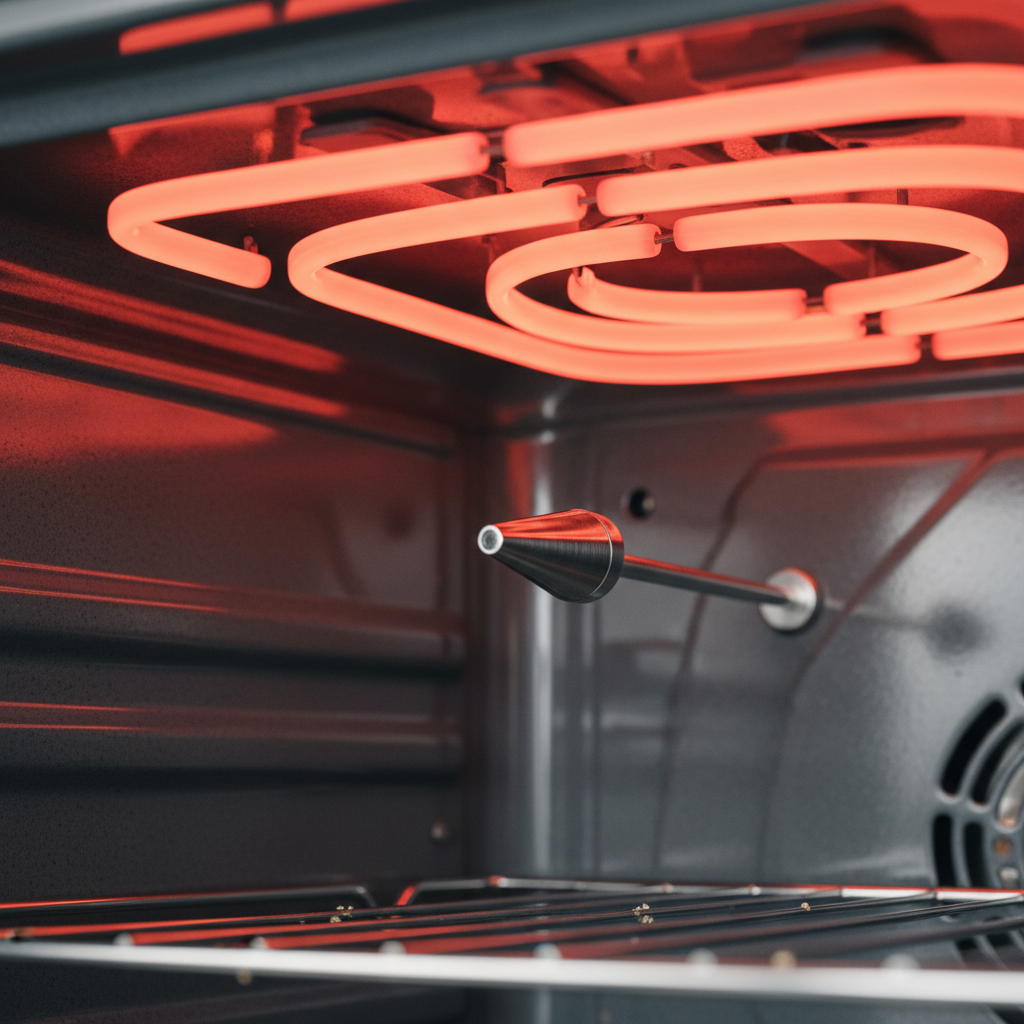
- Annual Temperature Calibration Check. Once a year, place a quality oven thermometer in your preheated oven to verify its accuracy. If it's off by more than 15°F, perform a recalibration as described in your owner's manual.
- Gentle Cleaning Practices. When cleaning the oven interior, avoid spraying cleaners directly onto the heating elements or the temperature sensor. Be gentle around the sensor probe; never use it as a hook to hang rags.
- Clean Spills Immediately. Food and grease that spill onto the bake element can burn into it, causing hot spots that degrade the metal sheath and lead to burnout. Clean spills after the oven has cooled.
- Inspect the Door Gasket Biannually. Every six months, perform a quick visual inspection of the door gasket for signs of wear, tear, or brittleness. A good seal is critical for energy efficiency and temperature accuracy.
- Close the Oven Door Gently. Slamming the oven door can damage the door hinges and the gasket over time, compromising the oven's seal and causing heat loss.
HVAC · High energy usage
| Project category | HVAC |
|---|---|
| Problem type | High energy usage |
| Trade required | HVAC |
| Urgency | Planned project |
| Safety risk | Low safety risk |
| DIY suitability | DIY for experienced homeowners |
| Cost category | High cost |
| Typical timeline | Assessment within weeks; replacement planned off-season |
| Contractor type | Licensed HVAC technician |
Repair option
Duct sealing, insulation, and a tune-up before touching the equipment.
Replacement option
High-efficiency replacement sized by a load calculation, not a rule of thumb.
Common causes
- Aging, low-efficiency equipment
- Leaking ducts losing conditioned air
- Insufficient attic insulation
- Oversized system short-cycling
Relevant tools:project cost estimatorrepair or replace
Published April 17, 2026Last updated August 17, 2026
How it works
Understanding how your oven heats is the first step in diagnosing a temperature problem. The process differs significantly between electric and gas models.
An electric oven uses a simple circuit. The electronic control board (EOC) acts as the brain. When you set a temperature, the EOC sends 240 volts of alternating current (AC) to a specific heating element—the bake element at the bottom for baking or the broil element at the top for broiling. Inside the oven cavity is a temperature sensor, a thermistor whose electrical resistance changes in a predictable way as it gets hotter. The EOC constantly monitors this resistance to read the oven's current temperature. Once the set temperature is reached, the EOC cuts power to the heating element. As the oven cools, the sensor's resistance changes, signaling the EOC to send power again. This on-and-off cycling maintains the average target temperature.
A gas oven operates on a principle of electrically controlled gas flow. The EOC sends 120 volts AC to an igniter, typically a silicon carbide bar located next to the main gas burner. This igniter heats up to approximately 1800°F, glowing bright orange. As it heats, it must draw a specific electrical current, usually between 3.2 and 3.6 amps. This amperage acts as a safety signal, causing a bi-metal switch in the gas safety valve to open and release gas. The hot igniter immediately ignites the gas, creating a flame that heats the oven. The same type of temperature sensor used in electric ovens monitors the heat and signals the EOC to cycle the burner off and on to maintain temperature.
Step-by-Step Fix
Follow these steps methodically to isolate and resolve the cause of your oven's inaccurate temperature.
- Safety First: Before any inspection or repair, ensure your safety. For an electric oven, turn off the corresponding double-pole breaker in your main electrical panel. For a gas oven, unplug the appliance from its 120V outlet and turn off the gas supply using the dedicated shut-off valve, typically located behind the oven.
-
Verify the Temperature Independently — Do not assume the oven's display is correct. Place a reliable, stand-alone oven thermometer on the center rack. Set your oven to bake at 350°F. Allow it to preheat for a full 20 minutes, then check the reading on the independent thermometer without opening the door for more than a second. If it is within 15-20°F of the set temperature, your oven may simply need recalibration. If the difference is significant (50°F or more), proceed with hardware diagnosis.
-
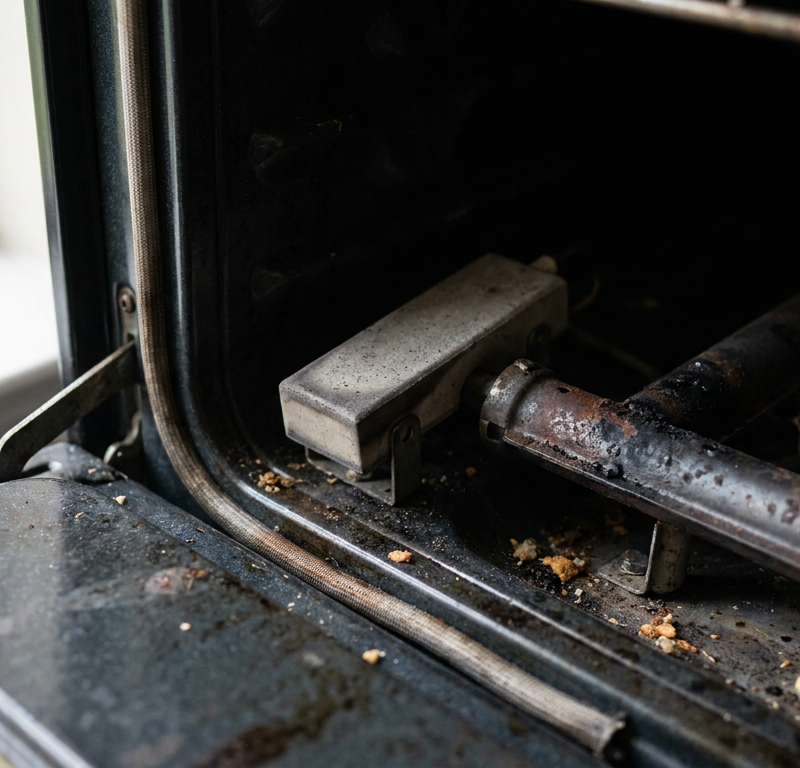
Inspect the Door Gasket — A faulty seal is a common and often overlooked cause of heat loss. Open the oven door and visually inspect the woven or rubber gasket around its perimeter. Look for any tears, cracks, brittle sections, or areas that are visibly compressed or loose. With the oven on (if safe to do so), you can carefully run your hand around the edge of the closed door to feel for escaping hot air. A damaged gasket cannot be repaired and must be replaced.
-
Visually Inspect Electric Heating Elements — If you have an electric oven, the elements are a primary suspect. With the power off, open the door and look closely at the bake element (at the bottom) and the broil element (at the top). Search for visible signs of failure, such as blisters, bulges, cracks, or a complete break in the element's metal sheath. Any visible damage confirms the element is faulty and requires replacement.
-
Test Electric Element Continuity with a Multimeter — A visual inspection may not reveal an internal break. With the oven power disconnected, remove the screws holding the suspect element to the back wall of the oven. Gently pull it forward a few inches to expose the wire terminals. Disconnect the wires. Set your multimeter to the lowest setting for ohms of resistance (Ω). Touch one probe to each of the element's terminals.
- Expected Result: A healthy bake or broil element should show a resistance reading, typically between 10 and 40 ohms.
- If This Fails: If the meter reads "OL," "I," or infinity, it indicates a break in the internal wiring (no continuity), and the element is bad. If it reads zero, it has a dead short. In either case, it must be replaced.
-
Replace the Faulty Electric Heating Element — Purchase an OEM-certified replacement element using your oven's model number. Carefully connect the wires to the terminals on the new element—they are typically simple slip-on connectors. Ensure the connections are snug. Gently slide the new element back into place, taking care not to pinch the wires, and secure it with its mounting screws. Reconnect power and test.
-
Observe the Gas Oven Igniter Operation — For gas ovens, the igniter is the most common failure point. Remove the oven's bottom panel to view the burner and igniter assembly. Restore power to the oven (but keep the gas off for now if you are simply observing). Set the oven to bake and watch the igniter.
- Expected Result: A healthy igniter will begin to glow, reaching a bright, yellowish-orange color within 30 to 90 seconds. You should then hear a "whoosh" as the gas valve opens and ignition occurs.
- If This Fails: If the igniter glows a dull red but never gets bright orange and the gas never ignites, it is weak and cannot draw enough current. If it fails to glow at all, it has completely failed. Turn off the oven.
-
Replace the Gas Oven Igniter — Disconnect power and turn off the gas supply. Disconnect the wiring harness connecting the old igniter to the oven's wiring; this is often a plastic or ceramic quick-connector. Remove the screws holding the igniter's mounting bracket. Install the new igniter.
- Critical Note: New igniters are extremely fragile. Handle it by its metal bracket only; do not touch the dark gray silicon carbide element with your bare hands, as skin oils can cause it to fail prematurely.
- Secure the new igniter in place, reconnect the wiring harness, and carefully replace the oven's bottom panel.
-
Test the Oven Temperature Sensor — This sensor is the oven's thermometer, and if it fails, it will send incorrect information to the control board. It's a thin metal probe, usually 4-8 inches long, located inside the oven cavity near the top back or side wall. With the power disconnected, remove the screw(s) holding it. Gently pull it into the oven to expose its wire connector and unplug it. Set your multimeter to measure resistance (Ω).
- Expected Result: At room temperature (around 70°F), most oven sensors should have a resistance of approximately 1080-1100 ohms. This value must increase steadily as the sensor is heated.
- If This Fails: If the reading is significantly different (e.g., less than 1000 or more than 1200 ohms) or if the multimeter reads "OL" (open circuit), the sensor is faulty and needs to be replaced.
-
Replace the Temperature Sensor — The replacement process is straightforward. After disconnecting the wiring from the old sensor, connect the new one. Guide the probe back through the hole in the oven wall and secure it with its mounting screw(s). Ensure the probe is not touching the oven walls.
-
Consider an Oven Recalibration — If your oven is consistently off by a small, uniform amount (e.g., always 25°F cooler than the set point), it may not be a faulty part but a calibration issue. Most modern electronic ovens have a calibration function. Consult your owner's manual for the specific button sequence required to enter calibration mode. This typically allows you to adjust the oven's temperature reading by up to +/- 35°F.
Common mistakes
Avoiding these common errors will make your repair safer, faster, and more effective.
- Forgetting to Disconnect Power. This is the most dangerous DIY mistake. Always trip the breaker for an electric oven or unplug a gas oven before touching any internal components. Confirm the power is off with a non-contact voltage tester.
- Misdiagnosing the Issue by Guessing. Do not start buying parts without testing. Replacing a perfectly good heating element will not fix a problem caused by a faulty temperature sensor. Use a multimeter to confirm which component has failed before spending money.
- Buying the Wrong Part. Appliance parts are highly model-specific. A heating element that looks similar may have a different wattage or mounting configuration. Always use the full model and serial number from the tag on your oven (often found on the frame behind the door or drawer) to order the exact part.
- Mishandling a New Gas Oven Igniter. The silicon carbide element on a "Glo-Bar" igniter is exceptionally brittle. Touching it with bare hands leaves oils that create hot spots, causing it to burn out quickly. Always handle the new part by its metal or ceramic base.
- Incorrectly Testing Resistance. When using a multimeter to test continuity or resistance, ensure the probes make firm, clean contact with the metal terminals. Corrosion or debris can give a false "open loop" (OL) reading. Also, double-check that your multimeter is set to Ohms (Ω), not Volts (V) or Amps (A).
- Ignoring a Faulty Door Gasket. A worn-out door seal can cause temperature to drop by 50°F or more. Many DIYers chase complex electrical issues when the problem is simply heat escaping through the door. Always inspect the gasket early in your diagnosis.
Cost & time breakdown
Costs are estimates and can vary based on your oven's brand, model, and your location. Professional costs include the part and typical labor charges.
| Task | DIY Cost (Part Only) | Pro Cost (Parts & Labor) | DIY Time |
|---|---|---|---|
| Replace Electric Bake Element | $30 - $90 | $150 - $250 | 30 minutes |
| Replace Gas Oven Igniter | $40 - $120 | $180 - $300 | 45 minutes |
| Replace Temperature Sensor | $20 - $60 | $140 - $220 | 20 minutes |
| Replace Oven Door Gasket | $25 - $75 | $120 - $200 | 15 minutes |
| Professional Diagnostic Visit | N/A | $100 - $150 | N/A |
When to call a pro
While many temperature issues are DIY-friendly, certain symptoms warrant professional service. Do not attempt a repair if you encounter any of the following:
- You smell gas. If you smell natural gas at any point, especially if it persists and is not accompanied by ignition, do not proceed. Immediately turn off the gas supply, ventilate the area, and call your gas utility company and a qualified appliance repair technician.
- The problem is the control board. If the digital display is blank, displaying error codes (like F1, F2, etc.), behaving erratically, or failing to respond to button presses, the issue is likely the Electronic Oven Control (EOC). Diagnosing and replacing a control board is complex and expensive, and a misdiagnosis can be costly.
- You see active sparking or short circuits. If you see sparks from wiring (not the normal spark of a spark igniter) or find melted wire insulation, there is a serious electrical fault that needs expert diagnosis to prevent a fire hazard.
- Multiple components seem to have failed. If you test the heating element, sensor, and igniter and they all seem faulty, or if replacing a confirmed-bad part doesn't solve the problem, there could be an underlying wiring or control board issue that a professional can trace more effectively.
- You are uncomfortable working with electricity or gas. There is no shame in deferring to an expert. Safety is the top priority. If testing with a multimeter or handling gas fittings is outside your comfort zone, call a professional.
Prevention & maintenance
A few routine checks can extend the life of your oven's components and prevent temperature-related failures.
- Annual Temperature Calibration Check. Once a year, place a quality oven thermometer in your preheated oven to verify its accuracy. If it's off by more than 15°F, perform a recalibration as described in your owner's manual.
- Gentle Cleaning Practices. When cleaning the oven interior, avoid spraying cleaners directly onto the heating elements or the temperature sensor. Be gentle around the sensor probe; never use it as a hook to hang rags.
- Use the Self-Clean Cycle Sparingly. The extreme heat of a self-clean cycle (often reaching 900°F) is the single most common cause of premature failure in electronic control boards, sensors, and heating elements. Manual cleaning is safer for the oven’s components.
- Clean Spills Immediately. Food and grease that spill onto the bake element can burn into it, causing hot spots that degrade the metal sheath and lead to burnout. Clean spills after the oven has cooled.
- Inspect the Door Gasket Biannually. Every six months, perform a quick visual inspection of the door gasket for signs of wear, tear, or brittleness. A good seal is critical for energy efficiency and temperature accuracy.
- Close the Oven Door Gently. Slamming the oven door can damage the door hinges and the gasket over time, compromising the oven's seal and causing heat loss.
Related Articles
Keep troubleshooting with these hand-picked guides from FixlyGuide:
- The Secret Reason Your Oven Fails to Heat (It's NOT Always the Element) — Discover why your oven isn't reaching its set temperature, from common part failures to overlooked calibration issues, and how to fix it.
- Why Your Thermostat Lies: The Real Reason Your Home Won't Hit the Set Temperature — Discover why your thermostat struggles to reach the set temperature and learn actionable steps to diagnose and fix common HVAC issues.
- Dryer Not Heating: Fix a Tripped Thermal Fuse Fast — Is your electric dryer running but not heating? This guide walks you through safely diagnosing and replacing a tripped thermal fuse, a comm…
- Why Your House is Humid Despite AC & How to Fix It — Even with your AC running, high indoor humidity can make your home uncomfortable. Often, common issues like oversized units or clogged filt…
- The Hidden Reason Your Furnace Short Cycles — And Why Most Homeowners Get It Wrong — Furnace short cycling, characterized by frequent on-off cycles, often points to a few common issues, most of which are surprisingly easy fo…
- The 7 Mistakes That Ruin a Perfect Paint Job (and How to Fix Them) — Painting a room like a pro isn't just about technique—it's about avoiding common pitfalls that lead to streaks, drips, and uneven finishes.…
Should you do this yourself?
Answer five quick questions before you start. Safety outranks savings every time.
Your experience with work like this
How high do you have to work?
Does the job involve any of these?
Will it need a permit?
Specialty tools
Free and instant. Educational guidance only — not a quote, inspection, or professional diagnosis.
Estimate your own project cost
National averages are a starting point. Enter your details for a range that fits your house.
HVAC replacement cost
- Equipment$2,200 – $3,800
- Installation labor$1,200 – $2,500
Always insist on a Manual J load calculation — sq-ft sizing is only a rough check. Federal heat-pump rebates may reduce cost significantly.
Educational estimate only — always confirm with written local bids.
What should this project cost?
Enter your project details for a realistic cost range before you call anyone.
Service calls and common repairs run $150–$900; full system replacement typically $6,000–$12,000.
- Regional adjustment
- National average
- Labor share (typical)
- ~$1,935
- Quotes to collect
- 3 written estimates
Educational estimate based on national averages — not a binding quote. Always confirm with written local estimates.
Fixly Project Decision Box
- DIY difficulty
- Advanced
- Estimated time
- Homeowner checks 20–30 minutes
- Cost level
- Moderate
Main tools / materials
- Clean air filter
- Garden hose for condenser coils
- Shop vac for the condensate line
When to stop and call a pro
- Burning smell, smoke, or a tripping breaker
- Refrigerant lines iced over or hissing
- Any work inside the sealed refrigerant circuit (EPA-licensed only)
- Gas smell near a furnace — leave and call the utility
Need professional help?
Find an HVAC Pro Near YouBefore you start
Check the difficulty, permits, and safety risk — then decide whether to call a pro.
Free, no signup required. Estimates are educational guidance, not a quote or an inspection.
Get the print-ready PDF of this guide
A clean, ad-free, printable version you can keep on your phone or pin to the workshop wall. Free with a FixlyGuide account.
- Print-optimized layout
- Tools, materials & every step included
- Saved to your account
Frequently asked questions
Why is my electric oven not getting hot enough?+
The most common reason an electric oven isn't getting hot enough is a faulty bake or broil heating element. Visually inspect them for breakage or lack of glow, and test them for continuity with a multimeter.
How do I know if my gas oven igniter is bad?+
A bad gas oven igniter will usually glow faintly or not at all, or it will glow but not get hot enough to ignite the gas within a minute or two. You won't hear the 'whoosh' of the gas igniting.
Can a faulty temperature sensor affect oven heating?+
Yes, a faulty temperature sensor can send incorrect readings to the oven's control board, causing the oven to overheat or underheat. You can test its resistance with a multimeter.

Discussion
Loading comments…