- Roof age relative to material lifespan is the single strongest signal.
- Two or more repairs in three years usually means you are renting time, not buying it.
- Active interior water entry or a sagging roofline is an urgent issue, not a planning decision.
- Insurance often pays for storm-caused replacement that it will not pay for on a worn-out roof.
- A written inspection report — with photos — is what turns a guess into a decision.
Roofing · Aging roof
| Project category | Roofing |
|---|---|
| Problem type | Aging roof |
| Trade required | Roofing |
| Urgency | Planned project |
| Safety risk | Low safety risk |
| DIY suitability | Pro recommended |
| Cost category | High cost |
| Typical timeline | Plan 4–12 weeks ahead for scheduling and material lead time |
| Contractor type | Licensed roofing contractor |
Repair option
Maintenance repairs to buy a season or two while you budget.
Replacement option
Planned replacement, which is almost always cheaper than a leak-driven emergency.
Common causes
- Normal weathering past the shingle service life
- Poor attic ventilation cooking the shingles from below
- Repeated repairs on the same slopes
Relevant tools:repair or replace roofproject cost estimatorhome improvement material prices
Published August 3, 2026Last updated August 17, 2026
Quick Answer
Repair usually makes sense when the roof is under about 15 years old, the damage is confined to one area, and you have not paid for repeated repairs. Replacement usually wins when the roof is near the end of its service life, leaks keep coming back, or damage is spread across several slopes. If you are unsure, a professional inspection costs far less than guessing wrong.
Cost Snapshot
| Path | Typical 2026 range |
|---|---|
| Small targeted repair | $350–$1,200 |
| Moderate repair (multiple areas, flashing, decking patch) | $1,200–$4,000 |
| Full replacement, asphalt shingle | $9,000–$22,000 |
| Full replacement, metal or tile | $20,000–$60,000+ |
Ranges are national averages last reviewed 2026-08-03. Local labor, roof pitch, storey count, and material availability move these numbers, so always confirm with written local estimates.
Key Takeaways
- Roof age relative to material lifespan is the single strongest signal.
- Two or more repairs in three years usually means you are renting time, not buying it.
- Active interior water entry or a sagging roofline is an urgent issue, not a planning decision.
- Insurance often pays for storm-caused replacement that it will not pay for on a worn-out roof.
- A written inspection report — with photos — is what turns a guess into a decision.
Safety Warning
Do not climb onto a wet, steep, storm-damaged, or sagging roof. Most homeowner roof injuries happen on the ladder, not the roof. Inspect from the ground with binoculars, from inside the attic with a flashlight, or hire a professional.
DIY Difficulty
Assessment: beginner (ground-level and attic checks). Repairs: advanced — shingle, flashing, and decking work affects the waterproofing system and often voids material warranties if done incorrectly. Replacement: professional only.
When to Call a Roofer
Call promptly if you see water inside the home, daylight through roof boards, sagging, exposed decking, or damage after a hail or wind event. Call within a few weeks for granule loss, curling shingles, damaged flashing, or a roof over 15 years old that you have never had inspected.
When Repair May Be Enough
A repair is a reasonable bet when all of these are true:
- The roof is comfortably inside its expected service life.
- Damage is isolated — one slope, one penetration, one flashing detail.
- The deck underneath is dry and solid.
- You have not paid for the same problem twice.
- The shingles still lie flat, hold their granules, and stay flexible.
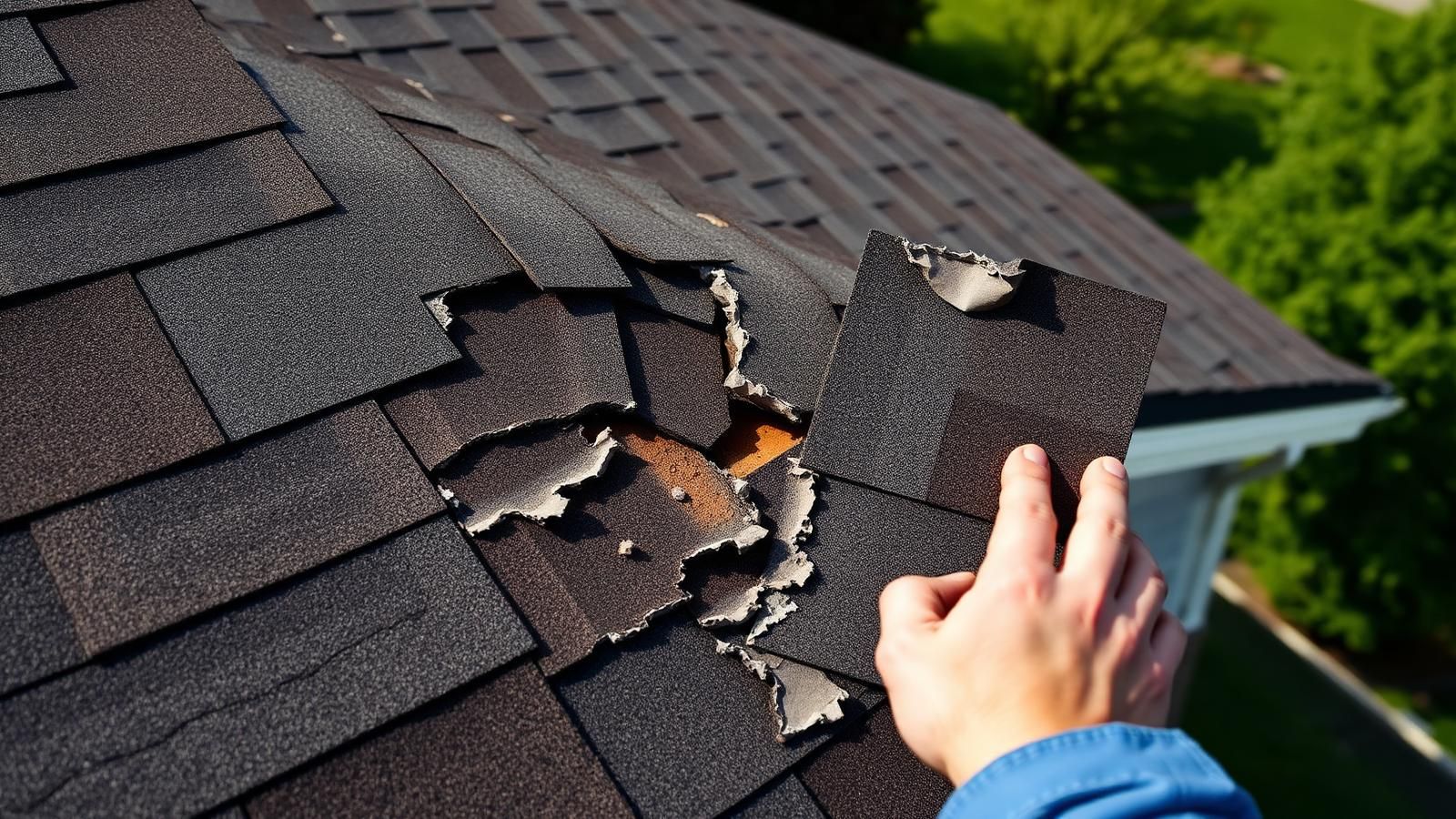
Typical good repair candidates include a handful of shingles blown off in a wind event, a cracked pipe boot, failed chimney or step flashing, a popped nail head, or a small area of storm impact. These are localised failures of a system that is otherwise still doing its job.
When Replacement Makes More Financial Sense
Replacement generally wins when:
- The roof is within five years of the end of its material lifespan.
- You have had two or more repairs in the past three years.
- Leaks appear in more than one location.
- Granule loss is widespread — bare, shiny patches across whole slopes.
- The decking is soft, delaminated, or spongy underfoot.
- Repair quotes exceed roughly 30% of a replacement quote.
The arithmetic is simple: three $900 repairs on a 22-year-old roof is $2,700 spent on an asset with no remaining life. That money is gone. The same money applied to a replacement buys 25 more years and, usually, a transferable warranty that shows up in the home's resale value.
Roof Age by Material
| Material | Typical service life | Start planning at |
|---|---|---|
| 3-tab asphalt shingle | 15–20 years | 13 years |
| Architectural asphalt shingle | 22–30 years | 18 years |
| Wood shake | 20–30 years | 18 years |
| Standing-seam metal | 40–60 years | 35 years |
| Concrete or clay tile | 40–75 years | 35 years |
| Slate | 60–150 years | inspection-driven |
| Flat / low-slope membrane (TPO, EPDM, modified bitumen) | 15–30 years | 13 years |
Heat, hail, and UV exposure shorten every number in that table. In hot southern climates — including Dallas–Fort Worth — asphalt shingle roofs routinely reach the repair-or-replace conversation three to five years earlier than the manufacturer's rating suggests.
Repair History: The Signal Most Homeowners Ignore
One repair is an event. Two repairs is a pattern. Three repairs is a roof telling you it has stopped being watertight as a system. Pull your records before you get quotes — the dates and dollar amounts of past work are the most persuasive evidence you will bring to the decision, and a good roofer will ask for them.
Leak Severity
Not all leaks are equal:
- Stain only, dry to the touch: historical or slow. Investigate, do not panic.
- Damp stain that grows after rain: an active path. Repair promptly.
- Dripping water during rain: the deck and insulation are already wet. Urgent.
- Multiple leak points: the underlayment is likely compromised across the roof. Replacement territory.
Storm Damage
Storm damage changes the calculation because someone else may pay for it. Hail bruises the shingle mat without always breaking the surface, so damage is frequently invisible from the ground while dramatically shortening the roof's remaining life. Wind lifts and creases shingles that then look fine but no longer seal.
If a significant hail or wind event has hit your area:
- Document the date and the storm.
- Photograph what you can safely see, including gutters, downspouts, screens, and soft metals like vents — dents there corroborate roof damage.
- Get an inspection before your policy's claim window closes.
- Do not sign a contract that assigns your claim benefits to a contractor without reading it carefully.
Structural Warning Signs
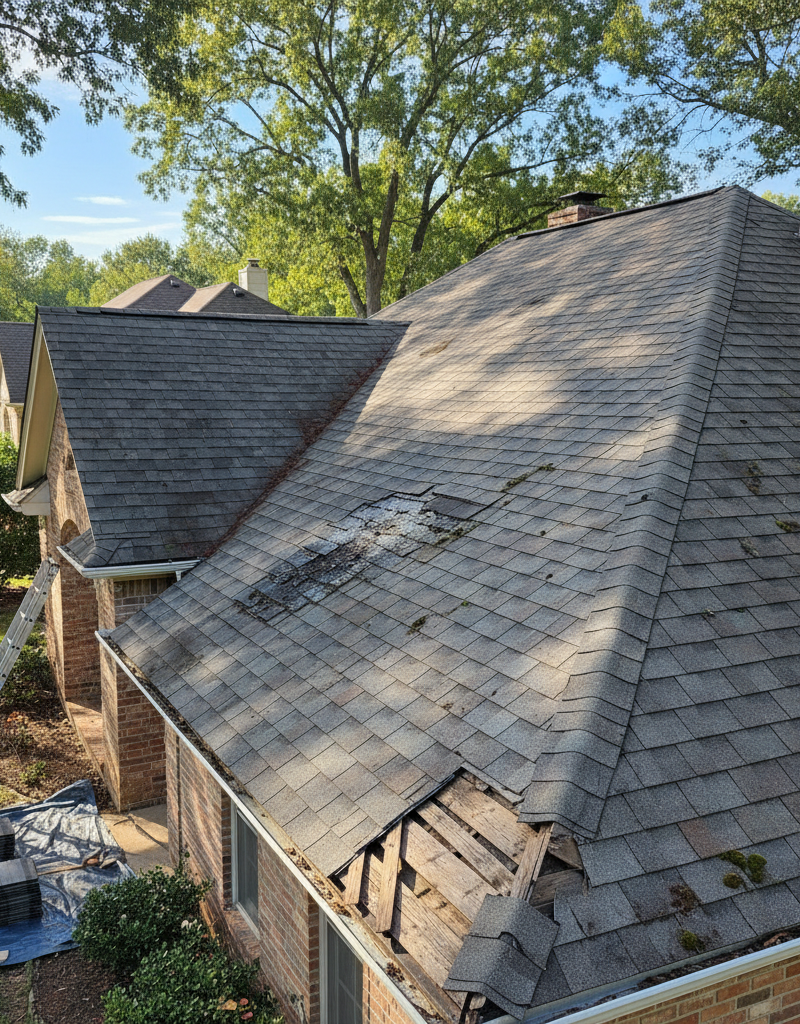
Stop the repair-versus-replace debate and get a professional out promptly if you see a sagging or wavy roofline, a ceiling that bulges or feels soft, exposed roof decking, daylight through roof boards, or water near electrical fixtures. These indicate the structure or the safety of the home is involved, not just the covering.
Repair vs. Replacement Comparison
| Factor | Repair | Replacement |
|---|---|---|
| Upfront cost | Low | High |
| Cost per remaining year | High on an old roof | Low |
| Disruption | Hours | 1–3 days |
| Warranty | Workmanship only, often 1–2 years | Material + workmanship, often 25 years+ |
| Insurance involvement | Rare | Common after storms |
| Resale impact | Minimal | Documented, often significant |
| Best when | Young roof, isolated damage | Aged roof, repeated or widespread damage |
Questions to Ask a Roofer
- Are you licensed and insured here, and can I see the certificates?
- What is the remaining life you would put on this roof, and what are you basing that on?
- Can I see photos of the specific damage you are quoting?
- Is the decking sound? What is your per-sheet price if you find rot?
- What underlayment, ice-and-water shield, and ventilation are included?
- What exactly does the warranty cover, and is it transferable?
- Who pulls the permit?
- What is the payment schedule, and how long is this quote valid?
Insurance Considerations
Insurers generally pay for sudden, accidental damage — hail, wind, a fallen limb. They generally do not pay for wear, age, poor maintenance, or manufacturing defects. Two policy details decide most claims: whether you have replacement-cost value or actual-cash-value coverage, and whether you carry a separate wind/hail deductible. Read both before you file, and get your own inspection so you can evaluate the adjuster's findings rather than simply accept them.
Get Local Estimates
Get three written estimates on the same scope. Compare the line items, not the bottom line — underlayment, flashing replacement, decking allowance, ventilation, disposal, and warranty terms are where quotes genuinely differ.
Repair or replace your roof?
Plug in four numbers and see which choice holds up financially.
Free and instant. Educational guidance only — not a quote, inspection, or professional diagnosis.
Estimate your own project cost
National averages are a starting point. Enter your details for a range that fits your house.
Roof replacement cost
- Per square (installed)$604 – $866
Add $500–$2,500 if decking is rotten and needs replacement. Storm damage may be covered by insurance.
Educational estimate only — always confirm with written local bids.
What should this project cost?
Enter your project details for a realistic cost range before you call anyone.
Spot repairs commonly run $400–$1,800; full replacement typically $9,000–$18,000 for an average home.
- Regional adjustment
- National average
- Labor share (typical)
- ~$2,948
- Quotes to collect
- 3 written estimates
Educational estimate based on national averages — not a binding quote. Always confirm with written local estimates.
Fixly Project Decision Box
- DIY difficulty
- Professional Recommended
- Estimated time
- Inspection 1–2 hours · repairs 1–3 days
- Cost level
- High
Main tools / materials
- Binoculars for a ground-level look
- Flashlight for attic checks
- Moisture meter
- Roofing cement (temporary patch only)
When to stop and call a pro
- Active leak near lights, fans, or any wiring
- Sagging, bulging, or water-filled ceiling
- Steep, wet, or two-story roof — do not climb it
- Storm or hail damage you plan to claim on insurance
Need professional help?
Free roof assessment first — no phone calls until you ask for them.
Get Local Roofing HelpDecide what your roof needs
Two minutes of questions turns "something is wrong up there" into a clear next step.
- Compare contractor quotesScore up to four bids on price, warranty, licensing, and timeline.Open
- Get local estimatesSend one request and compare written estimates from vetted pros.Open
Free, no signup required. Estimates are educational guidance, not a quote or an inspection.
Frequently asked questions
Is it cheaper to repair or replace a roof?+
A repair is always cheaper today — $350 to $4,000 versus $9,000 to $22,000 for an asphalt shingle replacement. The better measure is cost per remaining year. Three $900 repairs on a 22-year-old roof buys nothing durable, while the same money toward a replacement buys 25 years and a transferable warranty. As a rule of thumb, if a repair quote exceeds about 30% of a replacement quote on an aging roof, price the replacement.
At what age should a roof be replaced?+
3-tab asphalt shingles typically last 15–20 years, architectural shingles 22–30, wood shake 20–30, metal 40–60, tile 40–75 and slate 60 or more. Heat, hail and UV exposure shorten all of these, so in hot or hail-prone climates plan for the shorter end of each range and get an inspection about five years before the expected end of life.
How many roof repairs are too many?+
Two or more repairs in three years usually signals that the roof is failing as a system rather than in one spot. At that point money spent on further patching is generally money spent on an asset with little remaining life.
Will insurance pay to replace my roof?+
Insurers generally cover sudden, accidental damage such as hail, wind or a fallen limb, and generally do not cover wear, age or poor maintenance. Whether you have replacement-cost or actual-cash-value coverage, and whether you carry a separate wind/hail deductible, decides most of the outcome. Get your own documented inspection so you can evaluate the adjuster findings.
Can I put a new roof over the old one?+
Many codes allow a second layer over one existing layer of asphalt shingles, and it saves on tear-off. It also hides decking problems, adds weight, shortens the new roof life and can complicate future insurance claims. Most roofers recommend a full tear-off when the budget allows.

Discussion
Loading comments…