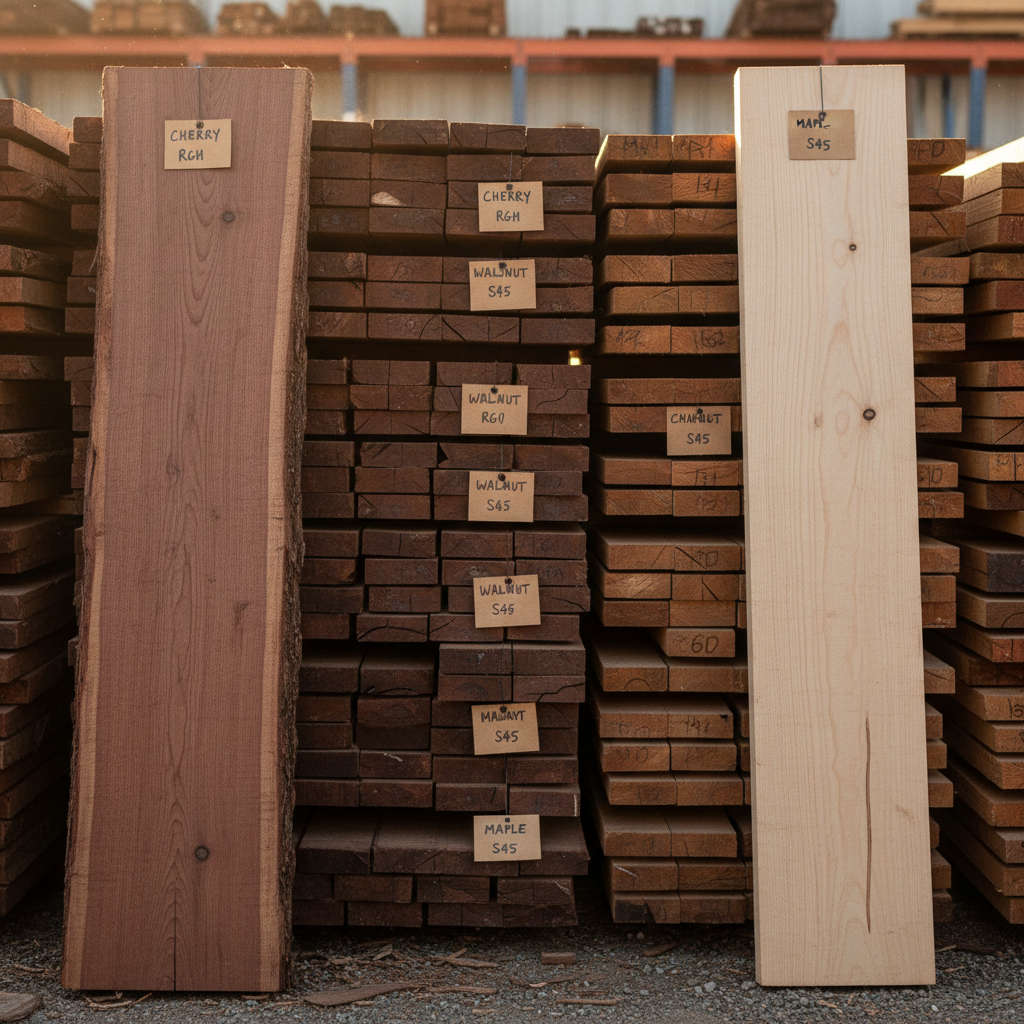
- S4S (surfaced four sides) lumber is the ready-to-use option from big-box stores, smooth on all four sides.
- The choice between rough, S2S, and S4S lumber directly impacts your project's cost, quality, and the time you spend in the shop.
- To understand the difference, you need to visualize the milling process.
- Let's walk through the process of milling a rough-sawn board into a usable, "four-square" piece, ready for your project.
General remodeling · Renovation planning
| Project category | General remodeling |
|---|---|
| Problem type | Renovation planning |
| Trade required | General contracting |
| Urgency | Planned project |
| Safety risk | Low safety risk |
| DIY suitability | Pro recommended |
| Cost category | Major investment |
| Typical timeline | Design and permitting often 2–4 months before work starts |
| Contractor type | General contractor |
Repair option
Phase the work and fix the building envelope first.
Replacement option
Full renovation with permits, design, and a general contractor.
Common causes
- Space no longer fits how the household lives
- Resale preparation
- Deferred maintenance stacking up
Relevant tools:project cost estimatorcompare quoteshome improvement material prices
Published June 9, 2026Last updated August 17, 2026
The shop list for this build
Hand-picked tools & materials — shop on Amazon, ships fast.
Power tools
· The heavy hitters — buy once, use for decades.- Shop on AmazonJointer
Why it's here: 6-inch or 8-inch stationary model recommended
- Shop on AmazonThickness Planer
Why it's here: 12-inch or 13-inch model is sufficient for most hobbyists
- Shop on AmazonTable Saw
Why it's here: With a quality rip blade
- Shop on AmazonMiter Saw or Crosscut Sled
Why it's here: For cutting boards to length
- Shop on AmazonRandom Orbit Sander
Why it's here: For final surface preparation
- Shop on AmazonDust Collector
Why it's here: Crucial for health and shop cleanliness
Hand tools & jigs
· Layout, joinery, and the everyday workbench essentials.- Shop on AmazonDigital Calipers
Why it's here: For precise thickness measurements
- Shop on AmazonMachinist's Square
Why it's here: For checking 90-degree angles
- Shop on AmazonPush Blocks and Push Sticks
Why it's here: Essential for safely using jointers and table saws
Materials & hardware
· Lumber, fasteners, glue, abrasives — the consumables.- Shop on AmazonWalnut or similar hardwood· 20 board feet
Why it's here: Example quantity for a small project.
Finishes & coatings
· Stains, dyes, top-coats, and prep products.- Shop on AmazonSandpaper (120, 180, 220 grit)
Why it's here: For progressing through grits to get a smooth finish
Quick Answer
S4S (surfaced four sides) lumber is the ready-to-use option from big-box stores, smooth on all four sides. S2S (surfaced two sides) has two flat and parallel faces but rough edges, requiring you to joint and rip the edges yourself. Rough-sawn lumber is completely unmilled, straight from the sawmill. For a typical small project requiring 20 board feet of walnut, choosing S2S over S4S can save you approximately $40-$50.
Why This Matters
The choice between rough, S2S, and S4S lumber directly impacts your project's cost, quality, and the time you spend in the shop. A simple-looking rack of 4/4 walnut at a big-box store might cost $14 per board foot for S4S, while the same material in S2S form at a hardwood dealer could be $11 per board foot. Rough-sawn could be as low as $9 per board foot. For a small bookshelf requiring 20 board feet, that's a $40-$100 saving right off the bat. Beyond cost, myeloid from S2S or rough stock gives you ultimate control over the final dimensions, ensuring perfectly square, flat, and true boards—a level of precision pre-milled S4S lumber rarely offers. This is a crucial step in fine woodworking, where a deviation of 1/32" can create visible gaps and imperfections. Understanding these lumber grades explained is not just about saving money; it's about gaining control over your craft.
How It Works
To understand the difference, you need to visualize the milling process. It all starts with a log, which is sawn into rough slabs. These are then kiln-dried.
-
Rough-Sawn Lumber: This is the most basic form. The boards are cut and dried, but that's it. They have rough, uneven surfaces with visible saw marks. The thickness can be inconsistent, and the boards are often warped or cupped from the drying process. This is the cheapest option because it has undergone the least processing. You are responsible for flattening the faces and squaring the edges, a process called "milling."
-
S2S (Surfaced Two Sides): The dealer takes rough lumber and runs it through a planer to flatten and smooth the two wide faces. The thickness is now consistent (e.g., a "1-inch" board is typically milled to 13/16" or 7/8"). However, the edges remain rough and are not necessarily straight or square to the faces. This is a great middle ground, saving you the most labor-intensive step of face-jointing and planing.
-
S4S (Surfaced Four Sides): This lumber has been processed on all four sides. It’s been face-jointed, planed to thickness, rip-jointed on one edge, and then ripped to a final width on the other. This is the material you find at stores like Home Depot or Lowe's. It's convenient and ready to be cut to length. The trade-off is the high cost and the fact that it's often not perfectly square. Mass production milling can be imprecise, and wood can move during shipping and storage.
Your wood lumber selection process at the yard is where the project truly begins. For S4S, you hunt for the straightest board. For S2S and rough lumber, you're looking at the grain and potential defects, knowing you will be the one to straighten it.
Step-by-Step: From Rough to Ready
Let's walk through the process of milling a rough-sawn board into a usable, "four-square" piece, ready for your project. This demonstrates the work involved when you opt for buying rough lumber.
Step 1: Assess the Board (5 mins)
Lay the rough board on a flat surface (like your table saw top). Identify any twist, bow, or cup. Mark the high spots with chalk. Use a straightedge to check for flatness. This initial assessment helps you plan your milling strategy to minimize waste.
Step 2: First Face Jointing (10 mins)
Set your jointer to remove about 1/32" of material. Place the board on the jointer with the concave side ("cup down"). This prevents the board from rocking. Run the board over the jointer until one face is perfectly flat. Use push blocks for safety. Check your progress with a straightedge. This is the most critical step for achieving a true reference surface.
Step 3: Planing to Thickness (10 mins)
Take the board to your thickness planer. Place the freshly jointed face down on the planer bed. Plane the opposite face in small increments (no more than 1/16" per pass) until it's flat and parallel to the first face. Measure the thickness at several points with a caliper to ensure uniformity. For a target of 3/4", you might plane down to 13/16", leaving a little room for sanding.
Step 4: First Edge Jointing (5 mins)
Now that the faces are flat and parallel, you need to create a straight, 90-degree edge. Press the flat face firmly against the jointer's fence. Run the board across the jointer until one edge is smooth and perfectly square to the face. Check this with a machinist's square.
Step 5: Ripping to Width (5 mins)
Move to the table saw. Place the newly jointed edge against the rip fence. Set your desired width and rip the opposite edge. Use a push stick and ensure the blade is at a perfect 90-degree angle to the table. This guarantees the second edge is parallel to the first and square to the faces.
Step 6: Crosscutting to Length (5 mins)
Finally, use a miter saw or a crosscut sled on your table saw to cut the board to its final length. Using a stop block ensures multiple pieces are cut to the exact same length.
Step 7: Final Sanding (10 mins)
The milled board is now four-square but will have slight mill marks. Start sanding with 120-grit sandpaper on an orbital sander to remove these marks, then progress to 180-grit and finally 220-grit for a finish-ready surface.
Step 8: Check for Square (2 mins)
Before you start assembly, double-check all your work. Use a reliable square to confirm the corners are 90 degrees and a caliper to verify consistent thickness and width.
Common Mistakes
- Buying S4S for Fine Furniture: Relying on S4S for high-end projects often leads to disappointment. The wood a is rarely perfectly square, and the internal stresses can be released when you cut it, causing it to warp. You pay a premium for a product that you will likely have to re-mill anyway.
- Skipping the Jointer for Rough Lumber: Trying to flatten a rough board with only a thickness planer is a recipe for disaster. A planer makes the top face parallel to the bottom face; it does not create a flat face. If you feed a warped board in, you will get a thinner warped board out. You must create one flat reference face on the jointer first.
- Taking Too Much Off at Once: Being aggressive with the planer or jointer to save time can cause tear-out (chipping of the grain) and can put unnecessary strain on your tools. Slow and steady wins the race. Aim for 1/32" to 1/16" passes.
- Ignoring Grain Direction: When using a jointer or planer, pay attention to the grain direction. Feeding a board "against the grain" can cause severe tear-out. Look at the edge of the board; the grain should be sloping "downhill" as it goes into the cutterhead.
- Not Accounting for Wood Movement: Don't mill all your stock to its final, final dimension at the very beginning of a long project. Mill it slightly oversized, let it sit and acclimate in your shop for a day or two, and then take the final light passes. This allows the wood to stabilize after the stresses of milling.
Cost & Time Breakdown
This table illustrates the cost and time implications for a hypothetical small table project requiring 20 board feet of Walnut.
| Item | S4S Lumber | S2S Lumber | Rough-Sawn Lumber |
|---|---|---|---|
| Lumber Cost | $14/bf * 20 bf = $280 | $11/bf * 20 bf = $220 | $9/bf * 20 bf = $180 |
| Milling Time | 15 minutes (sanding) | 1.5 hours (edge jointing, ripping) | 3 hours (face jointing, planing, edge jointing, ripping) |
| Waste Factor | ~5% (only from cuts) | ~15% (edges + cuts) | ~25-30% (surface, edges, cuts) |
| Total Cost | $280 | $220 | $180 |
| Net Savings | - | $60 vs S4S | $100 vs S4S |
Tips & Pro Notes
- The "Board Foot" Explained: A board foot is a unit of volume, not length. It's 144 cubic inches of wood (12" x 12" x 1"). Rough lumber is sold by the board foot. S4S lumber is often sold by the linear foot, which hides the true cost. Always do the math to convert to board feet for a true comparison.
- Jointing without a Jointer: If you don't have a jointer, you can make a jointer sled for your planer to flatten the first face. For the edges, you can use a straight-line rip jig on your table saw.
- Talk to the Yard Staff: The employees at a dedicated hardwood lumberyard are a wealth of information. Tell them about your project and your tools. They can help you with your wood lumber selection and can often offer advice on how to best work a particular species.
- Safety First, Always: Milling lumber involves powerful tools. Use eye and ear protection. Use push sticks and blocks—your fingers should never get close to the blades. A good dust collection system is not a luxury; it's a necessity for your health.
When to Upgrade Tools
Your ability to efficiently process rough-sawn or S2S lumber is directly tied to the quality of your milling tools. If you find yourself consistently buying rough lumber, it's time to invest.
- From Benchtop to Stationary Jointer: A 6-inch benchtop jointer is a good start, but you'll quickly find its short bed length makes it difficult to flatten boards longer than 4 feet. Upgrading to a stationary 6-inch or 8-inch jointer with a long cast-iron bed (50"+) is the single biggest upgrade you can make for milling. This will cost you $800 - $1,500 used or new.
- The Power of a Helical Cutterhead: If you work with figured woods or species prone to tear-out, upgrading your planer and jointer to helical or spiral cutterheads is a game-changer. Instead of 2-4 long knives, these heads use dozens of small carbide cutters arranged in a spiral. The cut is shearing and much cleaner, virtually eliminating tear-out. This is a $400-$800 upgrade per machine.
- Dial Indicator for Precision: A magnetic dial indicator ($30) is an invaluable tool for setting up your jointer and planer knives perfectly. Precise knife height is critical for avoiding snipe (a deeper cut at the beginning or end of a board) and getting a smooth finish.
Repair or replace this system?
Plug in four numbers and see which choice holds up financially.
Free and instant. Educational guidance only — not a quote, inspection, or professional diagnosis.
Questions to ask before you sign
Ask every contractor the same questions and the cheapest bid stops looking cheapest. Check them off as you go — your progress is saved on this device.
Free, no signup. Bring this to every walkthrough so you compare bids on the same terms.
What should this project cost?
Enter your project details for a realistic cost range before you call anyone.
Cost depends heavily on which system turns out to be the source.
- Regional adjustment
- National average
- Labor share (typical)
- ~$1,620
- Quotes to collect
- 3 written estimates
Educational estimate based on national averages — not a binding quote. Always confirm with written local estimates.
Repair or replace?
Run the age, cost ratio, and repair history through the calculator before you commit.
- Estimate this projectGet a cost range for your scope and ZIP before you call anyone.Open
- Get local estimatesSend one request and compare written estimates from vetted pros.Open
Free, no signup required. Estimates are educational guidance, not a quote or an inspection.
Recommended for DIYers & woodworkers
Sponsored
The Top 20 Tools for Workshops of Any Budget
No stationary machines or power tools required — plus 3 fundamental tools that can't be bought at any price.
Get the free guide
Ted's Woodworking — The #1 Woodworking Resource
Detailed instructions, dimensioned drawings, materials & cutting lists, and 3D schematics for every skill level.
See the plansSponsored: links above are affiliate links. FixlyGuide may earn a commission on qualifying purchases — at no extra cost to you.
Frequently asked questions
What does S2S mean in lumber?+
S2S stands for 'Surfaced Two Sides.' It means the two widest faces of the board have been run through a planer to make them flat, smooth, and parallel to each other. The two edges, however, are left rough and are not necessarily straight or square to the faces.
Is S4S lumber perfectly straight and square?+
Not usually. While S4S (Surfaced Four Sides) is milled to be square, the process of mass production, shipping, and storage can cause the wood to move. It's often close, but for fine woodworking, you will likely need to re-mill it to get perfectly flat faces and 90-degree corners.
How much cheaper is rough-sawn lumber?+
Rough-sawn lumber can be significantly cheaper than S4S lumber. The exact amount varies by species and location, but it's common to see a 30-50% price difference. For example, walnut might be $14/board foot for S4S, but only $9/board foot for rough-sawn.
Can I process rough lumber without a jointer and planer?+
It is very difficult. You can use hand planes, which is how it was done for centuries, but this requires significant skill and time. You can also build jigs for a planer and table saw to simulate the functions of a jointer, but these are less efficient and precise than dedicated machines. If you plan to work with rough lumber regularly, a jointer and planer are essential investments.
Discussion
Loading comments…