- Calculate the Joint Area: 0.75 inches 48 inches = 36 square inches.
- Find the Required PSI: Hard maple is a high-density hardwood, so let's aim for 250 PSI.
- Calculate Total Force: 36 sq. in. 250 PSI = 9,000 lbs of total force needed along that seam.
General remodeling · Renovation planning
| Project category | General remodeling |
|---|---|
| Problem type | Renovation planning |
| Trade required | General contracting |
| Urgency | Planned project |
| Safety risk | Low safety risk |
| DIY suitability | Pro recommended |
| Cost category | Major investment |
| Typical timeline | Design and permitting often 2–4 months before work starts |
| Contractor type | General contractor |
Repair option
Phase the work and fix the building envelope first.
Replacement option
Full renovation with permits, design, and a general contractor.
Common causes
- Space no longer fits how the household lives
- Resale preparation
- Deferred maintenance stacking up
Relevant tools:project cost estimatorcompare quoteshome improvement material prices
Published June 9, 2026Last updated August 17, 2026
The shop list for this build
Hand-picked tools & materials — shop on Amazon, ships fast.
Power tools
· The heavy hitters — buy once, use for decades.- Shop on AmazonJointer· 1
Why it's here: Essential for creating perfectly square and flat edges.
- Shop on AmazonThickness Planer· 1
Why it's here: To ensure all boards are a uniform thickness.
- Shop on AmazonDust Collector or Respirator· 1
Why it's here: Highly recommended when using a jointer and planer.
Hand tools & jigs
· Layout, joinery, and the everyday workbench essentials.- Shop on AmazonParallel or F-Style Clamps· 4-8
Why it's here: Enough to space every 8-10 inches along the joint.
- Shop on AmazonSafety Glasses· 1
Why it's here: Mandatory for all milling and clamping operations.
- Shop on AmazonStraightedge· 1
Why it's here: For checking panel flatness during glue-up.
- Shop on AmazonChisel or Scraper· 1
Why it's here: For removing gelled glue squeeze-out.
- Shop on AmazonSilicone Glue Brush or Roller· 1
Why it's here: Optional, for evenly spreading glue.
Materials & hardware
· Lumber, fasteners, glue, abrasives — the consumables.- Shop on AmazonPVA Wood Glue (Titebond II or similar)· 1
Why it's here: Titebond II is recommended for its water resistance.
- Shop on AmazonHardwood or Softwood boards· As needed
Why it's here: Milled flat and straight.
You've spent hours milling lumber, selecting the perfect grain, and now it's time for the main event: edge gluing boards to create a tabletop. You spread the glue, arrange your clamps, and tighten them down. After 24 hours, you unclamp a beautiful, seamless panel. Then, a week later, you hear it. A faint crack. A fine line appears, telegraphing through your finish. Your perfect wood glue joint has failed.
The immediate impulse is to blame the glue. Maybe it was a bad batch? Maybe that popular brand is all hype? The truth is far less convenient: the glue is almost never the problem. The problem is pressure. Or more accurately, a fundamental misunderstanding of what clamping pressure is trying to achieve. Get this right, and you’ll create joints that are literally stronger than the wood itself.
Quick Answer
Your wood glue joints are failing from improper clamping pressure, insufficient glue coverage, poor surface preparation, or exceeding the glue's open time. The key is applying the correct Pounds per Square Inch (PSI) for the wood species: 100–150 PSI for softwoods like pine, 175–250 PSI for hardwoods like maple or oak. Too much pressure starves the joint of glue; too little prevents a proper bond. Achieving this requires perfectly milled, flat edges from a jointer, an appropriate number of clamps (spaced 8-10" apart), and tightening them just enough to see a row of small, consistent glue beads squeeze out along the joint line.
Why This Matters
A good glue joint isn't just about adhesion; it's about cohesion and mechanical bonding. Modern PVA (polyvinyl acetate) glues work by having their polymer chains penetrate the wood fibers of both mating surfaces. As the water in the glue is absorbed into the wood or evaporates, these chains are drawn tightly together, locking the two boards into a single, continuous piece. A properly executed joint using a quality PVA glue creates a bond with a shear strength between 3,600 and 4,000 PSI. The wood itself—even hard maple—will typically shear at around 2,000-2,300 PSI. This is the origin of the famous saying: "the joint is stronger than the wood."
When you don't apply enough clamping pressure, the glue can't bridge microscopic gaps between the boards, and the polymers don't get forced into intimate contact with the wood fibers. The result is a weak, "under-pressured" joint that can easily pop under stress or with seasonal wood movement.
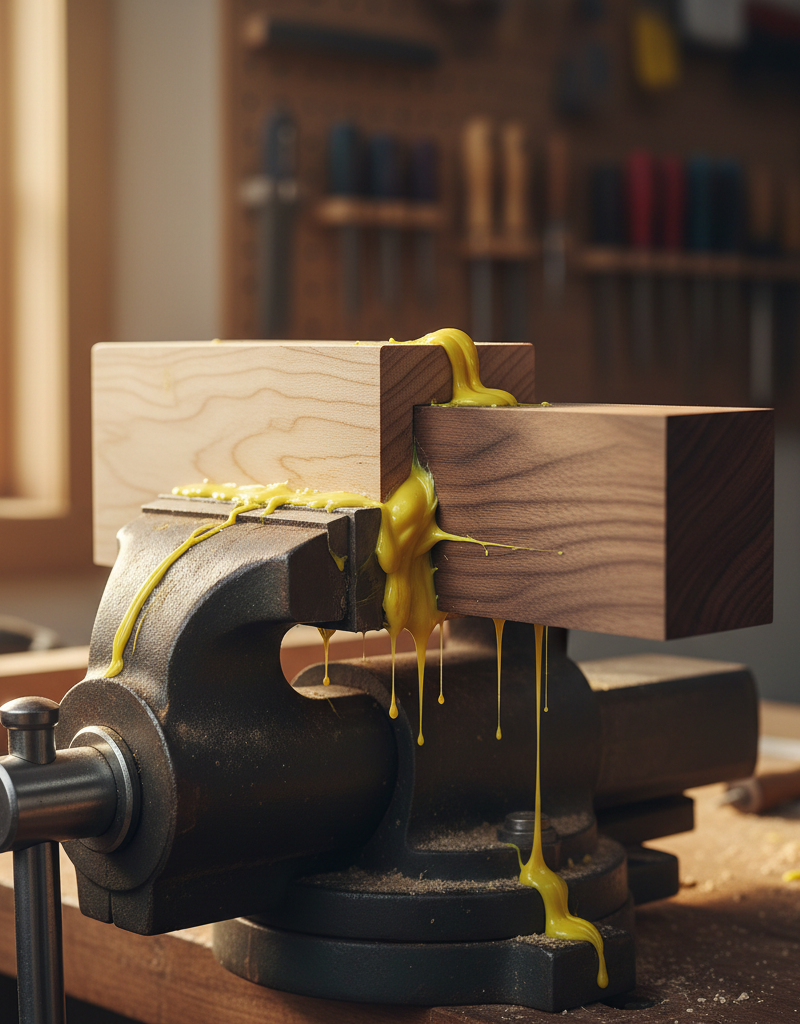
Conversely, when you apply too much pressure—a far more common mistake for beginners who think "tighter is better"—you squeeze nearly all the glue out of the joint. You create what’s called a "starved joint." Without a sufficient layer of glue, there aren't enough polymers to form a strong film, and the bond fails. Your goal is not to bring the wood into direct, raw contact, but to hold the two surfaces in intimate contact with a microscopic layer of glue between them.
Understanding this principle is the difference between a project that lasts a year and one that lasts a lifetime. The PVA glue strength is a given; your job is to create the ideal conditions for it to work.
How It Works: The Clamping Pressure Chart
The key to success is applying the correct pressure, measured in Pounds per Square Inch (PSI). This number varies based on the density of the wood you are using. Harder woods are less compressible and require more force to close the joint and properly wet the fibers.
| Wood Type | PSI Range | Example Species |
|---|---|---|
| Softwoods | 100 - 150 PSI | Pine, Fir, Cedar, Poplar |
| Medium-Density Hardwoods | 175 - 250 PSI | Cherry, Walnut, Soft Maple |
| High-Density Hardwoods | 250 - 350 PSI | Hard Maple, Oak, Ash, Hickory, Exotics |
So how do you translate this chart into tightening your clamps? You need to do a little math. The force required is determined by the surface area of your glue line.
Total Force Needed (lbs) = Joint Area (sq. in.) x Required PSI
Let's say you're edge gluing boards for a tabletop. The boards are 3/4" (0.75") thick and 48" long. You're using hard maple.
- Calculate the Joint Area: 0.75 inches * 48 inches = 36 square inches.
- Find the Required PSI: Hard maple is a high-density hardwood, so let's aim for 250 PSI.
- Calculate Total Force: 36 sq. in. * 250 PSI = 9,000 lbs of total force needed along that seam.
Now, you need to know how much force your clamps provide. This is an approximation, but a useful one:
- Light-duty F-style clamps: 300-600 lbs
- Heavy-duty F-style clamps / Bar clamps: 600-1,200 lbs
- Parallel Jaw Clamps (e.g., Bessey, Jet): 1,000-1,700 lbs
Continuing our example, if you're using heavy-duty F-style clamps that provide about 1,000 lbs each, you would need 9,000 lbs / 1,000 lbs/clamp = 9 clamps for that single 48" joint! This is why proper woodworking clamping often looks like a forest of clamps. A more practical approach is to focus on proper spacing (a clamp every 8-10 inches) and tightening to the feel of a proper squeeze-out, using the math as a sanity check.
Step-by-Step: The Perfect Edge Gluing Process
-
Safety First: Before you even touch a board, put on your safety glasses. A jointer and planer eject chips at high velocity. If you are creating significant dust, wear a respirator. Good dust collection is essential for air quality.
-
Perfectly Flat & Square Edges: This is the most critical step. A tablesaw cut is not good enough. You need to use a jointer to create one perfectly flat face, then one perfectly square (90°) edge relative to that face. Run all your boards through the planer to get a uniform thickness. When you dry-fit two boards together on a flat surface, they should meet perfectly along their entire length. Hold them up to a light; you should see no gaps.
-
Dry Fit, Arrange, and Mark: Arrange your boards on your workbench to find the most pleasing grain pattern. Once you have your layout, use a pencil to draw a large triangle (a "carpenter's triangle") across the panel. This simple mark ensures you can quickly reassemble the boards in the correct order and orientation during the hectic glue-up.
-
Prepare Clamps and Cauls: Lay out your clamps, alternating them above and below the panel location. This alternating pressure prevents the panel from bowing into a "U" shape. Also, prepare cauls—stiff, straight scraps of wood (a 2x2 with packing tape on one face works great) that you'll place across the top and bottom of your panel, perpendicular to the glue lines. Clamps will go over the cauls to ensure the boards stay flat and aligned.
-
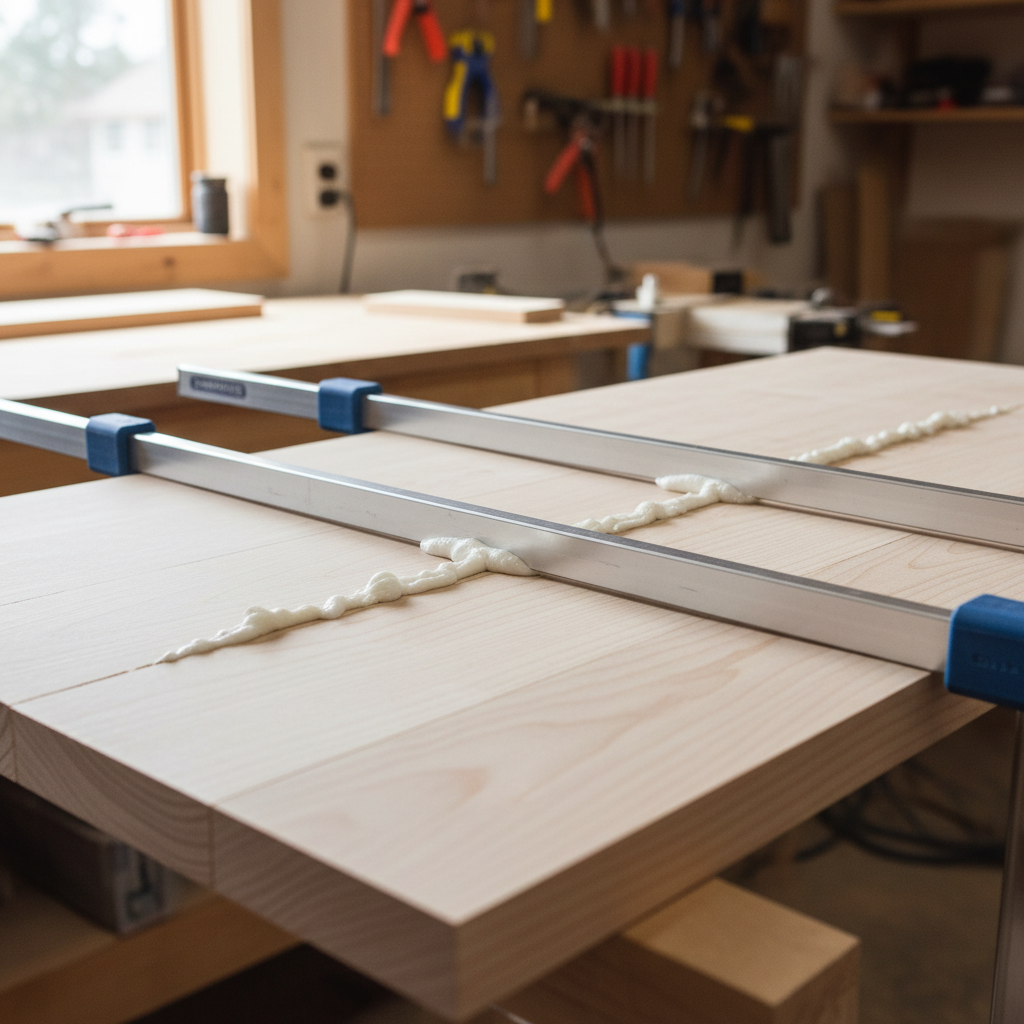
Apply the Glue: Using a quality PVA glue like Titebond II (for its water resistance, ideal for tabletops), apply a continuous bead to the edge of one board in each joint. The bead should be about 1/16" (1.5mm) in diameter. Use a silicone glue brush, a small roller, or even your finger to spread the glue into a thin, even film that covers the entire edge surface.
-
Assemble and Get Initial Squeeze-Out: Bring the boards together. As you push them into place, you should immediately see a line of tiny, uniform glue beads forming along the joint seam. This is the single best indicator that you applied the right amount of glue. No beads means you used too little. A river of glue means you used way too much and will be cleaning for ages.
-
Position Clamps and Cauls: Place your panel onto the lower clamps. Place your top cauls across the panel, directly over the clamp locations. The clamps should be about 2 inches in from each end and spaced approximately 8-10 inches apart in between.
-
Apply Clamping Pressure: Begin to tighten the middle clamp first, then work your way out, alternating sides. Do not crank them down with all your might. Tighten them until the joint line is fully closed and the squeeze-out beads are consistent and about 1/8" tall. For a typical F-clamp, this feels like hand-tight, then a final quarter-turn. For a powerful parallel clamp, it's just snug. Over-tightening is your enemy.
-
Check for Flatness: Place a straightedge across the panel after applying pressure. If the panel is bowing, you may have uneven pressure. Use the cauls (clamped at their ends) to help force the boards into alignment. This is their primary job.
-
Manage Squeeze-out: Wait about 20-30 minutes for the glue to transition from liquid to a semi-solid, gel-like state. At this point, it won't stick to your tool. Use a sharp chisel or a paint scraper held at a low angle to gently peel the squeeze-out from the surface. This is far easier and cleaner than letting it harden completely.
-
Patience is a Virtue (Cure Time): The bottle might say "clamp for 30 minutes," but that's the bare minimum under ideal conditions. For a large panel under significant stress, leave it clamped for at least 4-6 hours. Do not perform any stressful operations like planing or heavy sanding for a full 24 hours. This allows the glue to reach its maximum PVA glue strength.
Common Mistakes
- The "Tighter is Better" Fallacy: Creating starved joints by applying gorilla-like force. Remember, your goal is 200 PSI, not 2,000.
- Trusting a Tablesaw Edge: A saw blade can leave tiny scallops and is rarely perfectly 90°. This creates minute gaps that the glue cannot reliably fill, leading to a weak joint.
- Exceeding Open Time: Fumbling with clamps for too long while the glue skins over. Titebond II has about a 5-minute open time. Have everything ready before the glue comes out.
- Forgetting to Alternate Clamps: This results in a cupped panel that will cause endless frustration during flattening.
- Impatience: Unclamping after an hour and running the panel through a planer. The joint is still weak and can creep or fail under the stress of the planer knives.
Cost & Time Breakdown
| Item | Cost Estimate | Time Estimate |
|---|---|---|
| Materials | ||
| PVA Wood Glue (16oz) | $8 - $12 | N/A |
| Scrap wood for cauls | $0 - $5 | 15 minutes to prep |
| Tools | ||
| 4-6 Bar or Parallel Clamps | $120 - $300 (if purchased new) | N/A |
| Jointer / Planer Access | Varies (workshop membership, etc.) | N/A |
| Labor | ||
| Milling & Preparation | N/A | 1-2 hours |
| Glue-up & Clamping | N/A | 30-45 minutes |
| Curing | N/A | 24 hours |
Tips & Pro Notes
- Safety Gear: Always wear eye protection during machining and clamping. Glue can squirt out unexpectedly. Ensure good ventilation when applying finishes, especially oil-based varnishes or lacquers.
- The Power of Cauls: Don't skip cauls. Place a piece of packing tape or paste wax on the side facing the wood to prevent them from being glued to your panel.
- Oily Woods: For naturally oily woods like teak, rosewood, or cocobolo, joint the edges and then wipe them with an acetone-soaked rag just minutes before applying the glue. This removes the surface oils that can inhibit adhesion.
- The Salt Trick: For boards that are extra slippery during clamping, you can sprinkle a tiny pinch of regular table salt onto the wet glue. The grains of salt act as an abrasive, preventing the boards from sliding under pressure. Use this sparingly.
When to Upgrade Tools
Your journey into better woodworking clamping will likely follow a familiar path. You start with what you have, but eventually, you hit a ceiling where the tool, not your skill, is the limiting factor.
-
From F-Style to Parallel Clamps: You can get by with F-style clamps, but once you use a true parallel jaw clamp (like a Bessey K-Body or Jet Parallel Clamp), you'll never go back for panel glue-ups. Their jaws remain perfectly parallel under immense force, they don't "walk" as you tighten them, and they apply pressure much more evenly. A good 24" F-clamp costs $20-$25; a comparable parallel clamp costs $50-$60. The investment pays off in flat, perfect panels.
-
From Hand Tools to a Jointer: If you are consistently making furniture and large panels, a powered jointer is a game-changing investment. While you can get a perfect edge with a hand plane, it takes immense skill and time. A 6-inch or 8-inch jointer provides repeatable, perfect edges in seconds. A benchtop 6-inch jointer starts around $400-$500, while larger floor-standing models can be $1,000+.
What should this project cost?
Enter your project details for a realistic cost range before you call anyone.
Cost depends heavily on which system turns out to be the source.
- Regional adjustment
- National average
- Labor share (typical)
- ~$1,620
- Quotes to collect
- 3 written estimates
Educational estimate based on national averages — not a binding quote. Always confirm with written local estimates.
Get the print-ready PDF of this guide
A clean, ad-free, printable version you can keep on your phone or pin to the workshop wall. Free with a FixlyGuide account.
- Print-optimized layout
- Tools, materials & every step included
- Saved to your account
Recommended for DIYers & woodworkers
Sponsored
The Top 20 Tools for Workshops of Any Budget
No stationary machines or power tools required — plus 3 fundamental tools that can't be bought at any price.
Get the free guide
Ted's Woodworking — The #1 Woodworking Resource
Detailed instructions, dimensioned drawings, materials & cutting lists, and 3D schematics for every skill level.
See the plansSponsored: links above are affiliate links. FixlyGuide may earn a commission on qualifying purchases — at no extra cost to you.
Frequently asked questions
Is more glue better for a stronger wood glue joint?+
No. The ideal amount of glue results in a thin, even squeeze-out of small beads along the entire joint. Too much glue is messy and wasteful, while too little creates a weak, glue-starved bond.
Can I use just a tablesaw to prepare my boards for edge gluing?+
It is not recommended for high-quality joints. A tablesaw blade can leave slight burnishing, score marks, or a non-perfect 90-degree cut, all of which weaken the final bond. A jointer is the proper tool for creating perfectly flat and square edges.
How strong is a properly made wood glue joint?+
A joint made with modern PVA glue is stronger than the wood itself. In stress tests, the wood fibers surrounding the glue line will tear and fail before the actual glue bond does. This is contingent on proper surface prep and clamping pressure.
What's the difference between Titebond I, II, and III?+
Titebond I is a high-quality interior glue. Titebond II is water-resistant, making it ideal for projects like cutting boards or kitchen tables that may be exposed to moisture. Titebond III is waterproof (after fully curing) and has a longer open time, making it suitable for complex assemblies or exterior projects.
Discussion
Loading comments…