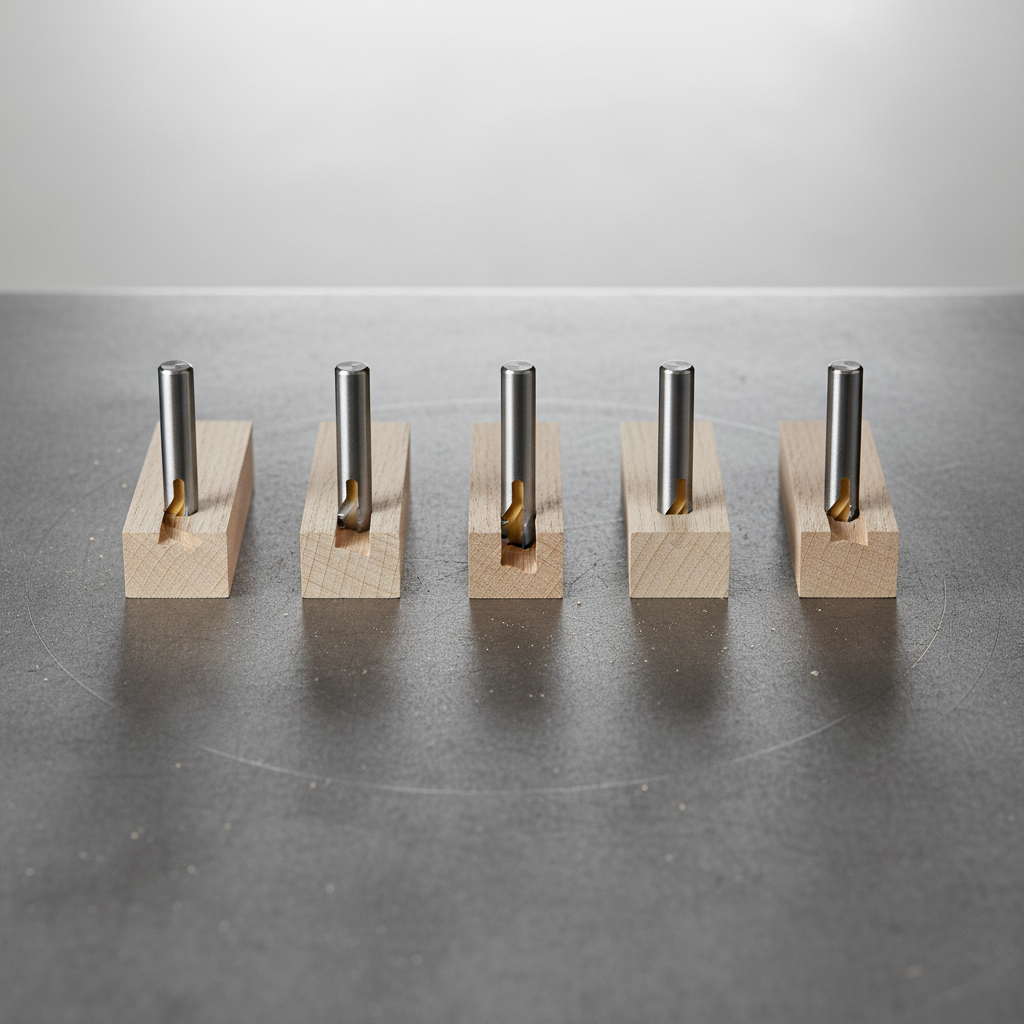
- Safety First & PPE: Before plugging anything in, put on your safety glasses. Have ear protection and a dust mask ready. Ensure the router's power switch is OFF.
- Bit Selection & Inspection: Choose your profile. Inspect the carbide cutters for any nicks or built-up resin. Check that the guide bearing spins freely. A stuck bearing will rub and burn your workpiece.
- Set Router Speed: Consult your router's manual or a speed chart. A good rule of thumb: 1-inch diameter or less: 20-24k RPM. 1 to 2-inch diameter: 16-20k RPM. 2 to 3-inch diameter: 12-16k RPM. Larger ogee and cove bits need slower speeds.
- Run a Test Cut: NEVER skip this step. Use a piece of scrap from your project. Run a 6-inch section and inspect the result. Is the profile centered? Any burning? Is the surface smooth? Adjust height, speed, or your feed rate as necessary.
- Execute the Cut: Turn on the router. Using push pads or push blocks to keep your hands safe, feed the workpiece smoothly and consistently from right to left. Apply steady pressure inward against the fence and downward against the table.
General remodeling · Renovation planning
| Project category | General remodeling |
|---|---|
| Problem type | Renovation planning |
| Trade required | General contracting |
| Urgency | Planned project |
| Safety risk | Low safety risk |
| DIY suitability | Pro recommended |
| Cost category | Major investment |
| Typical timeline | Design and permitting often 2–4 months before work starts |
| Contractor type | General contractor |
Repair option
Phase the work and fix the building envelope first.
Replacement option
Full renovation with permits, design, and a general contractor.
Common causes
- Space no longer fits how the household lives
- Resale preparation
- Deferred maintenance stacking up
Relevant tools:project cost estimatorcompare quoteshome improvement material prices
Published June 9, 2026Last updated August 17, 2026
The shop list for this build
Hand-picked tools & materials — shop on Amazon, ships fast.
Power tools
· The heavy hitters — buy once, use for decades.- Shop on AmazonRouter (variable speed)
Why it's here: A 2.25HP model is a versatile starting point.
- Shop on AmazonRouter Table
Why it's here: Essential for safety and accuracy with edge profiles.
- Shop on AmazonDust Mask or Respirator· 1
Why it's here: MDF and other materials release harmful dust.
Hand tools & jigs
· Layout, joinery, and the everyday workbench essentials.- Shop on AmazonSafety Glasses· 1
Why it's here: Non-negotiable.
- Shop on AmazonEar Protection· 1
Why it's here: Routers are extremely loud.
- Shop on AmazonPush Blocks· 2
Why it's here: Keeps hands safe and provides even pressure.
Materials & hardware
· Lumber, fasteners, glue, abrasives — the consumables.- Shop on AmazonRouter Bit Set· 1
Why it's here: Containing at least a Roundover, Chamfer, Ogee, and Cove bit.
- Shop on AmazonScrap Wood· Several pieces
Why it's here: For test cuts. Must be the same thickness as your project piece.
Quick Answer
The four most essential router edge profiles for any beginner are the Roundover (for softening edges), the Chamfer (for creating clean, modern bevels), the Roman Ogee (for classic, decorative curves), and the Cove (for concave, sophisticated scoops). Mastering these four profiles—and understanding how to use them safely and effectively—will handle 90% of your decorative edge work and dramatically elevate the quality of your projects.
Why This Matters
Look at any piece of high-end furniture. Notice the edges. They aren't sharp and square; they have a deliberate shape. That shape, called an edge profile, is the dividing line between a project that looks "homemade" and one that appears "hand-crafted." Adding a thoughtful profile does more than just look good. It adds tactile quality, making a tabletop pleasant to the touch. Functionally, it "breaks" a sharp edge, making it far more durable and resistant to chipping and splintering. A simple 1/4" roundover on a child's toy or a bookshelf isn't just an aesthetic choice—it’s a practical and safety-conscious one. Understanding and utilizing basic router edge profiles is a fundamental skill that provides a massive return on investment, instantly boosting the professionalism of your work with minimal effort.
How It Works: Wood Router Basics
A router bit is a simple tool: a steel shank with carbide cutters brazed onto it. For edge profiles, the key feature is the pilot bearing. This small, sealed ball bearing is a fixed diameter (usually 1/2") and is designed to ride along the edge of your workpiece. As you push the wood against the router bit, the bearing follows the contours of your material, ensuring the cutting edges remove a consistent amount of wood, perfectly replicating the bit's shape along the entire edge.
The effectiveness of this operation depends on a few key factors:
- Bit Quality: High-quality bits use C3 or C4 grade micro-grain carbide, which holds a sharp edge longer. They are precision-balanced to reduce vibration and are ground to a finer finish, resulting in a cleaner cut.
- Router Speed: The outer edge of a large-diameter bit travels much faster than that of a small-diameter bit at the same RPM. Large bits, like a 2" diameter panel-raising bit, must be spun at slower speeds (10,000-12,000 RPM) to prevent overheating and ensure safety. Small bits, like a 1/8" roundover router bit, can be run at higher speeds (18,000-22,000 RPM) for a smoother finish.
- Feed Rate: The speed at which you push the wood past the bit is critical. Too slow, and the wood burns. Too fast, and you get "chatter" or scalloping marks.
Working on a router table is the safest and most accurate way to machine edge profiles. The table provides a large, stable surface to support the workpiece, and the fence gives you a consistent reference point, ensuring the profile is perfectly straight.
The Core Four: Essential Router Edge Profiles
Don't get overwhelmed by catalogs showing hundreds of bits. Start with these four and you'll be able to handle almost any design you can imagine.
1. The Roundover: The Workhorse
If you buy only one bit, make it a roundover. This bit simply rounds a sharp corner. It's available in various radii, with 1/8", 1/4", 3/8", and 1/2" being the most common.
- Use Cases: A 1/8" radius is perfect for subtly softening the edges of picture frames or small boxes. A 1/4" radius is an all-around star, ideal for tabletops, shelves, and cabinet doors. Larger 1/2" radii create a bold, bullnose-like effect on thick countertops or stair treads.
- Technical Note: A roundover bit can be converted to a beading bit by slightly raising it, exposing a small "quirk" or step at the bottom of the cut. This adds an extra line of shadow and detail.
2. The Chamfer: The Modern Edge
Where the roundover is soft, the chamfer (or bevel) is crisp. It cuts a clean, 45-degree angle. The width of the chamfer is determined by the bit's depth of cut.
- Use Cases: Chamfers are hallmarks of Shaker, Mission, and modern furniture design. A small 1/16" chamfer is a great way to break an edge without visually softening it. A larger 1/4" or 3/8" chamfer makes a bold design statement on table legs or posts.
- Technical Note: By adjusting the height, you control the width of the flat face. Raising the bit creates a wider chamfer. Always use test pieces to dial in the perfect width before cutting your project piece.
3. The Roman Ogee: The Classic Curve
This is your go-to for traditional, decorative flair. The S-shaped curve of an ogee instantly adds elegance and visual weight. This is the profile you see on classic mantelpieces, bracket feet, and high-end tabletops.
- Use Cases: Essential for creating ogee edge molding. Use it on the edge of a thick tabletop to make it look more refined. It's also commonly used on the lids of decorative boxes or as part of a built-up crown molding.
- Technical Note: Ogee bits are often larger and remove more material. It is critical to use a variable-speed router and slow it down to 12,000-16,000 RPM. It’s also wise to make the cut in two or three progressively deeper passes to reduce strain on the router and prevent burning or tear-out.
4. The Cove: The Inverse Roundover
A cove bit cuts a concave quarter-circle. It’s the inward-curving cousin of the outward-curving roundover.
- Use Cases: It's perfect for creating a decorative scoop under a tabletop edge, making it appear thinner and lighter. It is also used to create simple, elegant baseboards or as a component in more complex molding buildups. You can also use it to create finger pulls on drawer fronts.
- Technical Note: Like an ogee, a large cove bit removes a lot of material. Taking multiple passes is the key to a clean result. A 1/2" shank bit is highly recommended for any cove bit with a radius larger than 3/8" for added stability and safety.
Step-by-Step: Routing a Perfect Edge Profile on a Router Table
- Safety First & PPE: Before plugging anything in, put on your safety glasses. Have ear protection and a dust mask ready. Ensure the router's power switch is OFF.
- Bit Selection & Inspection: Choose your profile. Inspect the carbide cutters for any nicks or built-up resin. Check that the guide bearing spins freely. A stuck bearing will rub and burn your workpiece.
- Install the Bit: Unplug the router. Insert the bit into the collet until it bottoms out, then raise it about 1/8". This prevents the bit from getting stuck and ensures the collet gets a full grip on the shank. Securely tighten the collet with the wrenches.
- Set the Bit Height: Use a setup block or a small steel rule to adjust the bit height. For a roundover, you typically want the bottom of the curve to be flush with the table. For an ogee, you'll adjust the height to determine how much of the flat "fillet" is revealed. Make a note of the setting for future reference.
- Position the Fence: Adjust the router table fence so its face is perfectly co-planar with the guide bearing on the bit. A straightedge held against the fence should just touch the bearing. This ensures your workpiece is supported both before and after the cut.
- Set Router Speed: Consult your router's manual or a speed chart. A good rule of thumb: 1-inch diameter or less: 20-24k RPM. 1 to 2-inch diameter: 16-20k RPM. 2 to 3-inch diameter: 12-16k RPM. Larger ogee and cove bits need slower speeds.
- Run a Test Cut: NEVER skip this step. Use a piece of scrap from your project. Run a 6-inch section and inspect the result. Is the profile centered? Any burning? Is the surface smooth? Adjust height, speed, or your feed rate as necessary.
- Mind Your Feed Direction: On a router table, the bit spins counter-clockwise (when viewed from above). You must feed your workpiece from RIGHT to LEFT. This pushes the wood against the bit's rotation, giving you a controlled, safe cut. Feeding from left to right is a "climb cut," which can be extremely dangerous as the bit can grab the wood and pull it from your hands.
- Execute the Cut: Turn on the router. Using push pads or push blocks to keep your hands safe, feed the workpiece smoothly and consistently from right to left. Apply steady pressure inward against the fence and downward against the table.
- Manage Grain Direction: To minimize tear-out, always rout the end grain of a board first. Then, rout the long-grain edges. Any tear-out that occurs on the end grain pass will be cleaned up when you rout the long grain edges.
Common Mistakes to Avoid
- Burn Marks: Caused by pausing during a cut, a slow feed rate, or a dull/dirty bit. The fix is a consistent feed rate and clean, sharp bits. Use a brass brush and a bit-cleaning solution to remove baked-on resin.
- Tear-Out: The wood fibers chip and tear instead of shearing cleanly. This is common in woods with reversing grain like curly maple. The solution is to take lighter passes, use a "climb cut" only as an advanced, cautious technique, or use a sacrificial backer board on the trailing edge of your cuts.
- Chatter or Ripples: These scalloped marks are usually caused by feeding the wood too quickly or router bit vibration. Slow your feed rate. If it persists, ensure your bit is tight in the collet and that the collet is clean.
- Misaligned Profile: Getting a small ridge or step at the top or bottom of your profile means the bit height is wrong. Use test cuts to dial it in perfectly before touching your final workpiece.
Cost & Time Breakdown
Your investment in bits will directly correlate with the quality of your finished product.
| Item | Cost (Low) | Cost (High) | Notes |
|---|---|---|---|
| Single Quality Bit | $30 | $55 | A 1/2" shank Freud, Whiteside, or Amana bit. |
| Beginner Bit Set | $50 | $150 | Look for sets from reputable brands. Avoid cheap 50-piece sets. |
| Setup & Practice Time | 15 Mins | 30 Mins | Time to install bit, set fence, and run test cuts. |
| Milling Time (per project) | 5 Mins | 20 Mins | Time to rout all four edges of a 2'x4' tabletop. |
Tips & Pro Notes
- Buy Quality, Buy Once: A single $40 bit from a top-tier brand (Freud, Whiteside, Amana, CMT) will produce cleaner results and last infinitely longer than a dozen no-name bits from a bargain bin. Start with a 1/4" Roundover and a Roman Ogee with 1/2" shanks.
- 1/2" Shanks are Superior: Whenever possible, buy bits with 1/2" shanks instead of 1/4". The increased mass reduces vibration ("chatter"), and the greater surface area for the collet to grip is safer.
- Multiple Passes are Key: For large profiles like a big ogee or cove, don't try to remove all the material at once. Set the bit for a shallow cut first, then make a second or even third pass at the final depth. This reduces stress on your router motor and all but eliminates burning.
- Listen to the Router: A smooth whirring sound is good. A chattering, screaming, or laboring sound means you're either feeding too fast, cutting too deep, or your bit is dull.
When to Upgrade Tools
Your journey with wood router basics an edge profiling will likely follow a natural progression:
- From a "20-Bits-for-$20" Set to Individual Bits: You'll quickly realize that you only use 3-4 profiles from a massive cheap set. Your first upgrade should be to buy high-quality versions of the bits you use most. The difference in cut quality is immediately obvious.
- From a Handheld Router to a Router Table: While you can use a handheld router with a bearing bit, a router table provides far superior control, accuracy, and safety, especially for smaller workpieces. Your first "table" can even be a piece of 3/4" MDF with the router bolted underneath.
- From a Basic Table to a Full System: A dedicated router table with a cast-iron or phenolic top, a micro-adjustable fence, and built-in dust collection is a game-changer. It turns routing from a chore into a precision operation and is essential for safely using large-diameter bits and achieving repeatable, professional results.
What should this project cost?
Enter your project details for a realistic cost range before you call anyone.
Cost depends heavily on which system turns out to be the source.
- Regional adjustment
- National average
- Labor share (typical)
- ~$1,620
- Quotes to collect
- 3 written estimates
Educational estimate based on national averages — not a binding quote. Always confirm with written local estimates.
Get the print-ready PDF of this guide
A clean, ad-free, printable version you can keep on your phone or pin to the workshop wall. Free with a FixlyGuide account.
- Print-optimized layout
- Tools, materials & every step included
- Saved to your account
Recommended for DIYers & woodworkers
Sponsored
The Top 20 Tools for Workshops of Any Budget
No stationary machines or power tools required — plus 3 fundamental tools that can't be bought at any price.
Get the free guide
Ted's Woodworking — The #1 Woodworking Resource
Detailed instructions, dimensioned drawings, materials & cutting lists, and 3D schematics for every skill level.
See the plansSponsored: links above are affiliate links. FixlyGuide may earn a commission on qualifying purchases — at no extra cost to you.
Frequently asked questions
What speed should I run my router at for edge profiles?+
It depends on the bit diameter. For small bits (under 1" diameter) like a 1/4" roundover, use a high speed (18,000-22,000 RPM). For larger bits (1" to 2.5" diameter) like a Roman Ogee, slow the router down to 12,000-16,000 RPM to prevent burning and ensure safety.
How do I stop getting burn marks when using my router?+
Burn marks are caused by three things: a dull bit, a dirty bit with resin buildup, or moving the wood too slowly. First, clean your bit with a brass brush and citrus-based cleaner. If it's still burning, increase your feed rate. If that doesn't work, your bit is likely dull and needs to be sharpened or replaced.
What's the difference between a roundover and a cove router bit?+
A roundover bit cuts an outward, convex curve, rounding off a sharp corner. A cove bit cuts an inward, concave curve, scooping material out. Think of it this way: a roundover creates a 'hill,' and a cove creates a 'valley.'
Why is a 1/2" shank router bit better than a 1/4" shank?+
A 1/2" shank has four times the mass of a 1/4" shank. This increased mass significantly reduces bit vibration (chatter), leading to a smoother cut. It is also stronger and less likely to bend or break under the stress of heavy cuts, making it a much safer choice for bits with a cutting diameter over 1".

Discussion
Loading comments…