- Eye Protection: Always wear safety glasses. A stray wood chip or a slip of the chisel can happen in an instant.
- Dust Collection: Even with hand tools, sawdust is a concern. Work in a well-ventilated area. If you use a coping saw or do any sanding, a simple dust mask (N95) is a smart precaution.
- Secure Workpiece: Ensure your workpiece is firmly clamped to the bench before you bring a saw or chisel to it. A shifting board is the primary cause of inaccurate cuts and dangerous slips.
General remodeling · Renovation planning
| Project category | General remodeling |
|---|---|
| Problem type | Renovation planning |
| Trade required | General contracting |
| Urgency | Planned project |
| Safety risk | Low safety risk |
| DIY suitability | Pro recommended |
| Cost category | Major investment |
| Typical timeline | Design and permitting often 2–4 months before work starts |
| Contractor type | General contractor |
Repair option
Phase the work and fix the building envelope first.
Replacement option
Full renovation with permits, design, and a general contractor.
Common causes
- Space no longer fits how the household lives
- Resale preparation
- Deferred maintenance stacking up
Relevant tools:project cost estimatorcompare quoteshome improvement material prices
Published June 9, 2026Last updated August 17, 2026
The shop list for this build
Hand-picked tools & materials — shop on Amazon, ships fast.
Power tools
· The heavy hitters — buy once, use for decades.- Shop on AmazonDovetail Saw
Why it's here: A fine-toothed backsaw with minimal set.
- Shop on AmazonCoping Saw
Why it's here: For quickly removing the bulk of the waste.
Hand tools & jigs
· Layout, joinery, and the everyday workbench essentials.- Shop on AmazonMarking Gauge
Why it's here: A wheel or pin gauge for scribing baselines.
- Shop on AmazonMarking Knife
Why it's here: A thin, sharp blade is crucial for accurate layout.
- Shop on AmazonBevel Gauge or Dovetail Marker
Why it's here: To lay out consistent angles (1:8 ratio recommended).
- Shop on AmazonBench Chisels· Set of 4
Why it's here: Must be sharpened to a razor's edge. 1/4", 1/2", 3/4", 1" sizes are a good start.
- Shop on AmazonMallet
Why it's here: A wooden or dead-blow mallet for striking chisels.
- Shop on AmazonClamps· At least 2
Why it's here: F-style or parallel clamps for glue-up.
- Shop on AmazonCombination Square
Why it's here: For checking squareness of stock and assembly.
Materials & hardware
· Lumber, fasteners, glue, abrasives — the consumables.- Shop on AmazonHardwood (Poplar, Cherry, or Walnut)· 2 board feet
Why it's here: Use 3/4" thick stock, milled flat and square.
- Shop on AmazonWood Glue
Why it's here: Any quality PVA wood glue like Titebond I or II.
- Shop on AmazonSandpaper
Why it's here: Grits from 120 to 220 for finishing.
'''
Quick Answer
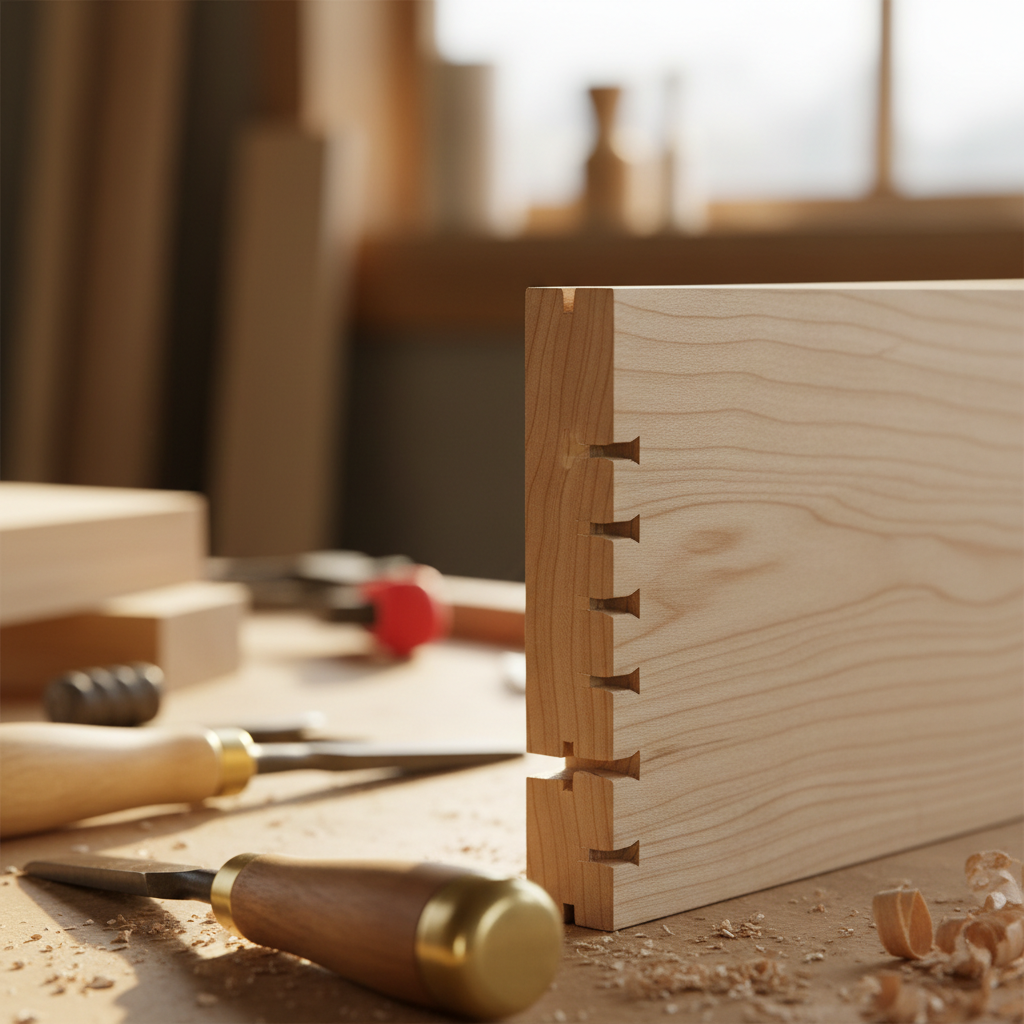
The hand-cut through dovetail is a hallmark of fine woodworking, creating a visually stunning and incredibly strong mechanical joint by interlocking a series of "pins" on one board with "tails" on another. It impresses woodworkers because it requires precision, patience, and skill to execute by hand, showcasing a mastery of tools and technique. Unlike joints that are screwed or nailed, its strength comes entirely from the interlocking geometry of the wood itself, making it a pure and celebrated form of dovetail joint woodworking.
Why This Matters
In a world of pocket holes, biscuits, and metal fasteners, why bother with a joint that takes hours to cut by hand? The answer lies in durability, beauty, and the pursuit of the craft. A well-executed dovetail joint is self-locking; the angled tails and pins make it impossible for the boards to be pulled apart in one direction. This is why it has been the gold standard for high-stress applications, particularly drawer joinery, for hundreds of years. When you pull open a high-quality drawer, the joint you see on the side is almost always a dovetail.
But beyond its mechanical strength, the hand cut dovetail is a statement. It tells a story of care and intention. It shows that the maker chose the slower, more difficult path not out of necessity, but out of a commitment to quality. For a beginner, cutting your first tight-fitting dovetail is a rite of passage. For a seasoned woodworker, it remains a meditative practice and a signature of their work. It’s a non-verbal communication that says, "I took the time to do this right."
How It Works
The genius of the dovetail is its elegant use of wood mechanics. The joint consists of two parts cut into the ends of the boards to be joined:
- Tails: Trapezoidal-shaped projections that are wider on their outside face. These are typically cut on the board that will be the front and back of a box or drawer.
- Pins: These are the negative space of the tails, cut into the corresponding board. They are narrower on the outside face and wider on the inside, perfectly fitting between the tails.
When the joint is assembled, the angled faces of the tails and pins wedge against each other. Any force that tries to pull the joint apart (like yanking a drawer open) only serves to seat the joint more tightly. When glue is added, it’s not just sticking faces together; it’s locking in this mechanical advantage, creating a bond that is, in almost all cases, stronger than the wood itself. The direction of the pins and tails is a visual cue: on a drawer, the tails are always visible on the drawer side, making the drawer front a solid, uninterrupted piece of wood.
Safety First
Working with sharp hand tools requires focus and respect.
- Eye Protection: Always wear safety glasses. A stray wood chip or a slip of the chisel can happen in an instant.
- Sharp Tool Discipline: A sharp chisel is a safe chisel, but it demands respect. Always cut away from your body. Keep both hands behind the cutting edge at all times. When not in use, place chisels flat on the bench or in a rack—never leave them with the cutting edge up. A falling chisel has no conscience.
- Dust Collection: Even with hand tools, sawdust is a concern. Work in a well-ventilated area. If you use a coping saw or do any sanding, a simple dust mask (N95) is a smart precaution.
- Secure Workpiece: Ensure your workpiece is firmly clamped to the bench before you bring a saw or chisel to it. A shifting board is the primary cause of inaccurate cuts and dangerous slips.
Step-by-Step: Cutting Your First Through Dovetail
This guide will walk you through creating a single corner joint. We will cut the tails first, a common and forgiving method for beginners. We'll use a 1:8 slope, standard for hardwoods.
Step 1: Mill and Square Your Stock Your joinery is only as accurate as your wood. Both boards must be flat, with parallel faces, and one edge jointed straight and square. For this exercise, use two pieces of 3/4" thick poplar or pine, about 4" wide and 8" long.
Step 2: Mark the Baselines Set a marking gauge to the exact thickness of your boards—in this case, 3/4". Scribe a line all the way around the end of both boards. This line, called the baseline, is the absolute limit of your cuts. It defines the depth of the joint and is the most critical reference line you will make.
Step 3: Lay Out the Tails On the end grain of one board (the "tail board"), mark two small lines about 1/4" from each edge. These are your "half-pins" and provide a shoulder. Now, decide how many tails you want. For a 4" board, two tails (and three pins) is a good look. Use a divider to space out the tails evenly. Set a bevel gauge or a dovetail marker to a 1:8 ratio. Use this and a sharp marking knife to lay out your tails from your divider marks to the baseline.
Step 4: Cut the Tails Secure the tail board vertically in a vise. Take your dovetail saw, a fine-toothed backsaw designed for this job. You must cut on the waste side of your marked lines. The rule is "split the line," leaving half the knife mark. Your saw should angle down to the baseline. Don't try to cut perfectly to the line on the first go. Stop about 1/16" shy and then creep up to it. Saw down precisely to your scribed baseline. Do not go past it.
Step 5: Chop Out the Waste With the tail cuts complete, you need to remove the material between them. A coping saw can quickly remove the bulk of the waste. Stay about 1/8" away from your baseline. Now, the chisel work begins. Firmly clamp the board flat on your bench. Using a chisel slightly narrower than the waste area, place the flat back of the chisel on your scribed baseline. Make a series of light taps with a mallet to establish a "knife wall." Then, from the end-grain side, chop down vertically towards the middle of the board. Flip the board and repeat from the other side. This two-sided approach prevents blowing out the back face. Finally, bring the chisel back to your baseline and pare perfectly flat.
Step 6: Transfer Tails to the Pin Board The moment of truth. Place the pin board vertically in your vise. Take your finished tail board and rest it perfectly on top of the pin board’s end grain, ensuring the inside faces of both boards are touching and their edges are perfectly flush. Use a clamp to hold it steady. With an exceptionally sharp marking knife, trace the shape of the tails onto the pin board. This creates a perfect, custom layout for your pins.
Step 7: Cut the Pins Take the pin board out of the vise and draw your pin lines down from the knife marks to the baseline. The key here is the opposite of cutting tails: you must saw just outside your knife marks, leaving the knife mark on the pin itself. Preserving this line is the secret to a joint so tight it squeaks. Again, saw down vertically, stopping precisely at the baseline.
Step 8: Chop the Pin Waste This is similar to chopping the tail waste, but the spaces are smaller. Use sharp chisels and a confident but controlled mallet strike. Establish your baseline wall first, then chop out the waste from both sides to avoid splintering. For beginner dovetails, this is often the most challenging step. Take your time.
Step 9: Test Fit and Adjust Ease the two boards together. It should be a snug fit. You should be able to push it most of the way together with hand pressure. Do not hammer it home on the first try. If it feels too tight, stop. Look for crushed fibers or shiny spots, which indicate a high spot. Use a wide, sharp chisel to pare a paper-thin shaving from the inside face of a pin. Try the fit again. Repeat until the joint slides together with a few firm taps from a mallet.
Step 10: Glue-Up and Assembly Disassemble the joint. Apply a thin, even layer of wood glue to all the angled faces of either the pins or the tails (not both, that’s too much). Reassemble the joint, tapping it home with a mallet (use a sacrificial block of wood to protect your project). Use clamps to apply gentle pressure and check that the assembly is perfectly square (90 degrees). Wipe away glue squeeze-out with a damp cloth.
Common Mistakes
- Inaccurate Marking: Using a thick pencil instead of a sharp knife or marking gauge. Your joinery will only ever be as good as your layout lines.
- Cutting on the Wrong Side of the Line: This is the most common error. The mantra is: "For tails, remove the waste; for pins, preserve the line."
- Sawing Past the Baseline: This severs the wood fibers at the shoulder of the joint, creating a visible gap. It cannot be fixed.
- Poorly Prepared Stock: Trying to cut dovetails on boards that aren’t perfectly flat and square is an exercise in pure frustration.
- Using Dull Tools: Dull chisels crush wood fibers instead of slicing them, leading to a bruised, sloppy fit. Your chisels should be sharp enough to shave with.
Cost & Time Breakdown
| Item | Estimate | Notes |
|---|---|---|
| Time | 4-6 Hours | This is for a first-timer cutting a single corner. Speed comes with practice. |
| Wood Cost | $20 - $50 | For a few board feet of clear Poplar or Cherry to practice on. |
| Tool Investment | $300 - $800+ | The initial investment in quality hand tools is the main "cost." |
Tips & Pro Notes
- The Blue Tape Trick: For easier visual transfer, apply blue painter's tape to the pin board. When you scribe the tails, the knife will cut through the tape, leaving a perfectly clear, high-contrast line to follow with your saw.
- 1:6 vs. 1:8: The slope of the dovetail is a matter of aesthetics and wood type. A 1:6 ratio is steeper and often used for softer woods, while a 1:8 ratio is shallower and considered standard for hardwoods like oak, walnut, or cherry.
- Cut One Joint at a Time: When making a box or a drawer with four corners, don't try to batch-process all the tails and then all the pins. Cut and fit one corner completely before moving to the next. This isolates your mistakes and allows you to adjust your process.
When to Upgrade Tools
You can start with a modest investment. A vintage Disston backsaw, a set of Narex chisels, and a basic Stanley marking gauge can be had for under $200 and will serve you well.
When you find yourself reaching for these tools constantly, consider an upgrade. A premium dovetail saw from Lie-Nielsen or Veritas ($250+) will have less set, a thinner kerf, and perfect balance, making it easier to follow a line. A wheel marking gauge ($45) is easier to control than a traditional pin gauge. A set of premium carbon steel Japanese chisels ($400+/set) will hold an edge significantly longer, meaning less time sharpening and more time cutting perfect joinery. '''
What should this project cost?
Enter your project details for a realistic cost range before you call anyone.
Cost depends heavily on which system turns out to be the source.
- Regional adjustment
- National average
- Labor share (typical)
- ~$1,620
- Quotes to collect
- 3 written estimates
Educational estimate based on national averages — not a binding quote. Always confirm with written local estimates.
Recommended for DIYers & woodworkers
Sponsored
The Top 20 Tools for Workshops of Any Budget
No stationary machines or power tools required — plus 3 fundamental tools that can't be bought at any price.
Get the free guide
Ted's Woodworking — The #1 Woodworking Resource
Detailed instructions, dimensioned drawings, materials & cutting lists, and 3D schematics for every skill level.
See the plansSponsored: links above are affiliate links. FixlyGuide may earn a commission on qualifying purchases — at no extra cost to you.
Frequently asked questions
What's the best wood for beginner dovetails?+
Clear (knot-free) poplar is the ideal choice. It's affordable, widely available, and has a straight grain that is soft enough to be forgiving with a chisel but firm enough to hold a crisp line. Avoid very soft woods like pine, which can crush easily, and very hard woods like oak, which can be difficult to chisel for a beginner.
What's the difference between through dovetails and half-blind dovetails?+
A through dovetail, as described in this article, shows the end grain of both the pins and tails on both sides of the corner. It's extremely strong and visually striking. A half-blind dovetail is designed so the joinery is only visible from one side; the other side appears as a solid piece of wood. This is typically used for attaching a drawer front, so you don't see the joinery from the face of the drawer.
Can I cut dovetails with a Japanese pull saw?+
Absolutely. Many woodworkers prefer Japanese pull saws (Dozuki) for cutting dovetails. They have very thin blades that remove less material, and the pull-stroke action can help some users cut a straighter line. The choice between a Western push saw and a Japanese pull saw is entirely a matter of personal preference and what feels more natural to you.
How sharp do my chisels really need to be?+
Impossibly sharp, and then a little sharper. A truly sharp chisel should be able to effortlessly shave a thin slice from end grain without crushing the fibers. You should be able to hold it up to a light and see zero nicks or flat spots on the cutting edge. A common test is to see if it will shave hair off your arm—if it can't do that, it's not sharp enough for clean dovetail work. Investing in a good sharpening system (like diamond stones or water stones) is as important as the chisels themselves.
Discussion
Loading comments…