- 4x Legs @ 3.5" x 3.5" x 31.5"
- 4x Short Stretchers (upper & lower) @ 1.5" x 3.5" x 17"
- 2x Long Stretchers (upper & lower) @ 1.5" x 3.5" x 47"
General remodeling · Renovation planning
| Project category | General remodeling |
|---|---|
| Problem type | Renovation planning |
| Trade required | General contracting |
| Urgency | Planned project |
| Safety risk | Low safety risk |
| DIY suitability | Pro recommended |
| Cost category | Major investment |
| Typical timeline | Design and permitting often 2–4 months before work starts |
| Contractor type | General contractor |
Repair option
Phase the work and fix the building envelope first.
Replacement option
Full renovation with permits, design, and a general contractor.
Common causes
- Space no longer fits how the household lives
- Resale preparation
- Deferred maintenance stacking up
Relevant tools:project cost estimatorcompare quoteshome improvement material prices
Published June 9, 2026Last updated August 17, 2026
The shop list for this build
Hand-picked tools & materials — shop on Amazon, ships fast.
Power tools
· The heavy hitters — buy once, use for decades.- Shop on AmazonTable Saw (recommended) or Circular Saw
- Shop on AmazonDrill/Driver
- Shop on AmazonRandom Orbit Sander
- Shop on AmazonPlunge Router
Why it's here: With a 1"+ flattening bit.
Hand tools & jigs
· Layout, joinery, and the everyday workbench essentials.- Shop on AmazonSafety Glasses
Why it's here: Required at all times.
- Shop on AmazonHearing Protection
Why it's here: Required when using power tools.
- Shop on AmazonPipe or Parallel Clamps· 5+
Why it's here: The more the better for the top lamination.
- Shop on AmazonTape Measure
- Shop on AmazonFraming Square
Materials & hardware
· Lumber, fasteners, glue, abrasives — the consumables.- Shop on Amazon2x10 or 2x12 Lumber (Douglas Fir or SYP)· 30 linear feet
- Shop on Amazon4x4 Post (Douglas Fir or SYP)· 16 linear feet
- Shop on Amazon2x4 Lumber (Douglas Fir or SYP)· 32 linear feet
Quick Answer
Yes, you can build a heavy, durable hardwood workbench for under $200 in a weekend by laminating inexpensive construction-grade 2x10 or 2x12 lumber for the top and using 4x4s and 2x4s for a simple, sturdy base. The key is careful material selection and a simple, strong assembly process.
Why This Matters
A wobbly, unstable workbench isn't just frustrating; it's dangerous. Accurate cuts require a stable reference surface. Powerful tools require a heavy, immovable mass to work against. Your workbench is not just a table—it's the foundation of your entire workshop, the most important tool you can own. A proper hardwood workbench build provides a dead-flat surface for assemblies, a heavy base that absorbs vibrations and hand-tool forces, and a versatile platform for mounting vises and dogs. For any beginner woodworking project, a solid bench is the difference between fighting your work and enjoying the craft. Commercial "hardwood" benches in this weight class can cost $800-$1,500. By using high-quality construction lumber—specifically Douglas Fir or Southern Yellow Pine—we can achieve 90% of the performance for less than 20% of the cost.
How It Works
The magic of this design lies in its mass and simple, robust joinery. The bench has two main components: the top and the base.
The Top: The top is a thick slab created by laminating standard 2x10 or 2x12 lumber. We'll rip the rounded factory edges off these boards, turn them on their edge, and glue them together face-to-face. This process, known as a "laminated top," creates an incredibly dense, stable, and heavy slab. A typical 2.5-inch thick, 24" x 60" top made this way will weigh over 100 pounds. It's this mass that resists movement, absorbs the impact of a mallet, and provides a solid foundation. We select 2x10s or 2x12s because the wood quality is often significantly higher than in standard 2x4s, with fewer knots and straighter grain.
The Base: The base is a simple post-and-stretcher frame built from 4x4 and 2x4 lumber. The strength comes from well-executed joinery. While traditional benches use complex mortise and tenon joints, our design uses a sturdy and much faster-to-cut half-lap joint. These joints provide massive glue surfaces and mechanical resistance to racking forces. The legs are tied together by lower and upper stretchers, forming two rigid leg assemblies. A long stretcher connects these two assemblies, completing the base. The top is then attached to the base in a way that allows for seasonal wood movement, preventing the top from cracking or warping.
This project is the perfect weekend woodworking project because the tasks can be broken down into manageable steps: milling and glue-up on day one, base construction and assembly on day two.
Downloadable Cut List
This cut list assumes a finished bench size of 24" deep x 60" long x 34" high. Adjust dimensions to fit your space and height.
For the Top (from 3x 2x10s, 10 feet long):
- 5x Top Lamination Pieces @ 1.5" x ~4.75" x 60" (after ripping edges and planing)
For the Base (from 2x 4x4s, 8 feet long and 4x 2x4s, 8 feet long):
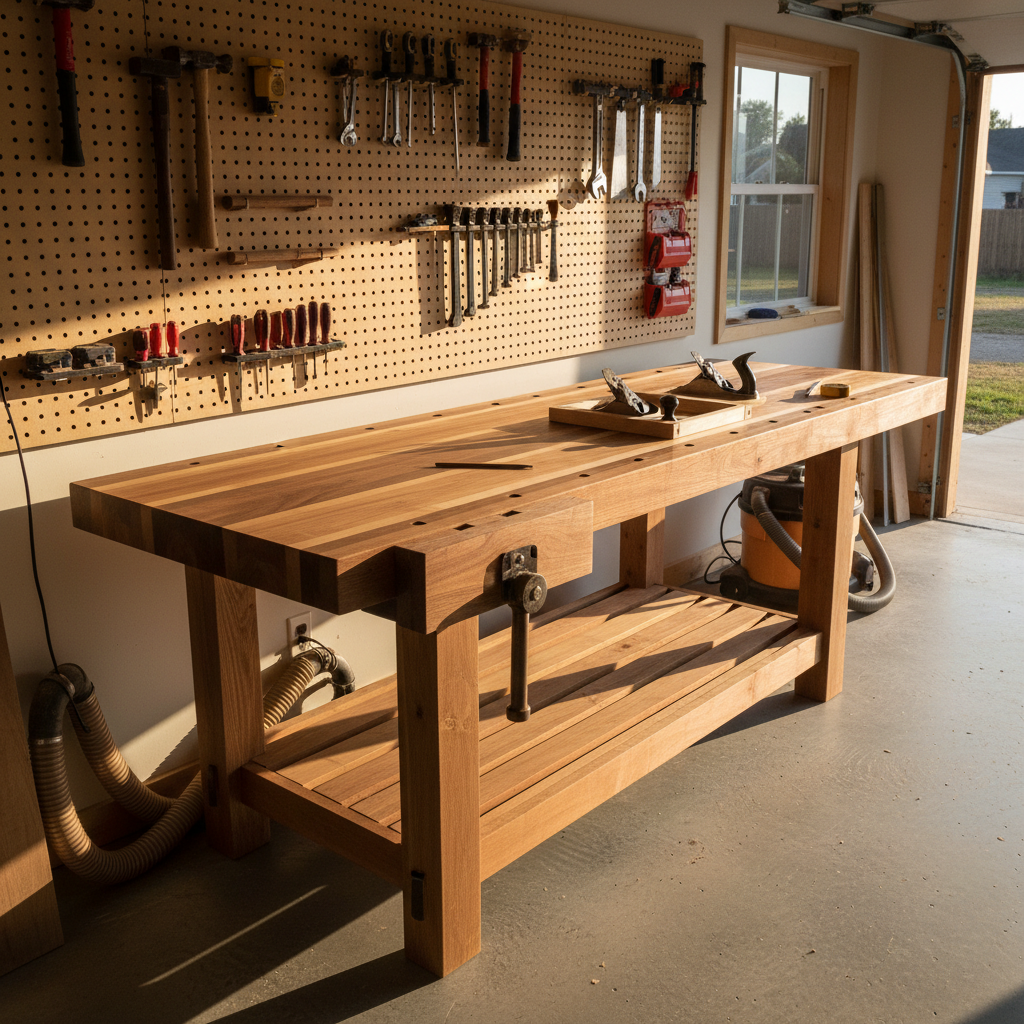
- 4x Legs @ 3.5" x 3.5" x 31.5"
- 4x Short Stretchers (upper & lower) @ 1.5" x 3.5" x 17"
- 2x Long Stretchers (upper & lower) @ 1.5" x 3.5" x 47"
Note on measurements: A "2x4" is actually 1.5" x 3.5". A "4x4" is 3.5" x 3.5". Always measure your actual lumber.
Step-by-Step Guide
Safety First: Before starting, ensure you have and use safety glasses and hearing protection. A dust mask is critical during sanding, and proper dust collection is highly recommended. Use a push stick for all table saw operations.
Step 1: Select Your Lumber (1 Hour) Go to a big-box store or lumberyard. Spend time picking through the stacks of 2x10 or 2x12 Douglas Fir or Southern Yellow Pine. Look for boards that are straight ("crowned" is okay, "twisted" is not), have the fewest knots possible, and have straight grain running down the length of the board. Buy about 30% more than you need to account for waste. Get your 4x4 posts and 2x4s for the base, again prioritizing straightness.
Step 2: Acclimate & Rough Mill (1.5 Hours + Acclimation Time) Let the wood sit in your workshop for at least 48-72 hours to acclimate to your shop's humidity. This is a critical step. Once acclimated, set your table saw fence to rip about 1/4" off each rounded edge of your 2x10s. This will leave you with square-edged boards approximately 1.5" thick and 9" wide. Cut them to a rough length of 62" (2 inches longer than final size). Now, rip these boards into narrower strips, between 3" and 5" wide. This minimizes the effect of any wood movement. Arrange them on a flat surface in the order you'll glue them.
Step 3: The Top Lamination (2 Hours) This is the most crucial glue-up. Alternate the direction of the growth rings (the "smile" or "frown" on the end grain) for each board. This helps keep the top stable over time. You will need a lot of clamps—at least 5-7 parallel or pipe clamps. For best results, use clamping cauls (scraps of wood with packing tape on one face) across the top and bottom of the glue-up to keep it flat. Apply a generous, even layer of Titebond II or Titebond III wood glue to the face of each board. Work quickly. Bring the boards together and apply clamping pressure, starting from the center and working your way out. Tighten until you see a small, consistent bead of glue squeeze-out along each seam. The target PSI is around 200-250 for these softwoods. Don't overtighten. Let it cure for at least 12-24 hours.
Step 4: Flattening the Slab (2-3 Hours) Your slab is now heavy and probably not perfectly flat. The best method for a beginner is a router flattening sled. You can build one in 30 minutes with scrap MDF. The sled is a frame that holds your router and slides along two perfectly parallel rails, which are raised slightly above your workbench top. Using a 1" or larger mortising or flattening router bit, you skim off the high spots in shallow passes (no more than 1/8" at a time). Move the router back and forth across the sled, advancing the sled down the length of the bench top after each pass. Flip the slab and repeat on the other side. This process guarantees a dead-flat top.
Step 5: Cut Base Parts to Size (1.5 Hours) While the top is curing or after it's flattened, you can build the base. Following the cut list, use a miter saw or a circular saw with a speed square to cut your four legs (from 4x4s) and your stretchers (from 2x4s) to their exact final lengths.
Step 6: Cut Half-Lap Joinery (2 Hours) Set your table saw blade height to exactly half the thickness of your 2x4 material (3/4"). Using your miter gauge, make repeated passes to nibble away the material for the lap joint at the end of each stretcher board. The lap should be 3.5" long (the width of a 4x4). For the legs, you can use a dado stack on the table saw or continue with a standard blade to cut the matching notches where the stretchers will sit. Test the fit—it should be snug but not require a hammer to assemble.
Step 7: Assemble the Base (1 Hour) Assemble the two leg sets first. Apply glue to the half-lap joints for the short stretchers and legs. Clamp them together and check that the assembly is perfectly square using a framing square. Drive two 3" deck screws through each joint for mechanical strength. Once the two leg assemblies are dry, connect them with the long stretchers, again using glue, clamps, and screws. Check for square again.
Step 8: Final Sizing and Sanding (2 Hours) Trim the ends of your workbench top to their final 60" length using a circular saw and a straight-edge guide. Now, sand everything. Start with 80-grit sandpaper on an orbital sander to remove all milling marks. Pay special attention to the top. Once smooth, move to 120-grit, then 180-grit, and finish at 220-grit. Do not skip grits. Vacuum all the dust off every surface between grits. This is a vital step in any DIY workbench plans.
Step 9: Attaching the Top (30 Minutes) Never glue the base directly to the top. The top will expand and contract across its width with humidity changes, and restricting this movement will cause it to crack. The best method is using z-clips or figure-8 fasteners. These metal clips sit in a slot cut into the aprons and screw to the underside of the top, holding it down firmly while allowing for movement. Drill oversized holes in the top stretchers, then use a screw and a washer to attach the top. The oversized hole allows the screw shank to move as the wood expands.
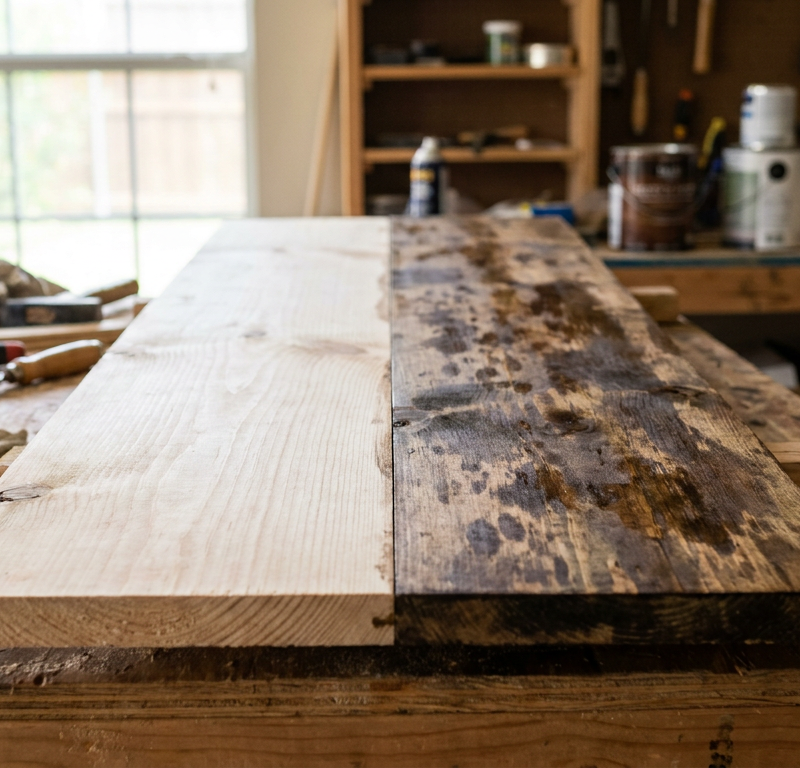
Step 10: Applying the Finish (1 Hour + Dry Time) For a workbench, you want a durable, repairable finish. A 50/50 mix of oil-based polyurethane and mineral spirits is a great choice. It soaks in, hardens the wood fibers, and provides excellent protection. Apply a liberal coat with a rag, let it sit for 15 minutes, then wipe off all the excess. Let it dry for 24 hours, lightly sand with 320-grit paper, and apply a second coat. Ensure your finishing area has excellent ventilation to deal with the fumes.
Common Mistakes
- Not Acclimating Lumber: Bringing wet construction lumber straight into your shop and building with it will result in a warped, twisted disaster as it dries.
- Using Twisted Boards: You can work with a crown or a bow, but a twist in a board is nearly impossible to work around for a laminated top.
- Insufficient Clamping: Not using enough clamps or not using cauls will result in a gappy, uneven, and weak top.
- Gluing the Top to the Base: This is the cardinal sin of tabletop construction. It will ruin your top. Use fasteners that allow for wood movement.
- Not Flattening the Top: A workbench that isn't flat is just a heavy table. The router sled method is non-negotiable for achieving a high-quality reference surface.
Cost & Time Breakdown
| Item | Quantity | Estimated Cost | Notes |
|---|---|---|---|
| 2x10 Lumber (10 ft) | 3 | $60 - $75 | Douglas Fir or Southern Yellow Pine |
| 4x4 Post (8 ft) | 2 | $30 - $40 | For the legs |
| 2x4 Lumber (8 ft) | 4 | $20 - $25 | For the stretchers |
| Wood Glue (Titebond II) | 16 oz | $10 | You'll use a surprising amount |
| Screws (3" construction) | Box | $10 | For base assembly |
| Sandpaper (assorted) | Pack | $15 | 80, 120, 180, 220 grits |
| Finish (Oil/Poly blend) | Quart | $20 | |
| Total | $165 - $195 |
| Phase | Estimated Time | Notes |
|---|---|---|
| Day 1: Top Construction | 5-6 Hours | Lumber selection, milling, and glue-up |
| Day 2: Base & Assembly | 6-8 Hours | Cutting joinery, assembly, flattening, finishing |
| Total | 11-14 Hours | A full, productive weekend |
Tips & Pro Notes
- Read the Grain: When you arrange your boards for the top lamination, pay attention to the end grain. Alternating the cup direction ("smiles and frowns") helps the top remain stable and resist warping as a unit.
- Sharp Blades are Key: A new, sharp blade on your table saw and a fresh router bit will make cleaner cuts, reducing tear-out and making joinery and finishing much easier.
- Bench Height: A common rule of thumb is that the top of the bench should be at the same height as your wrist bone when your arm is hanging at your side. Adjust the leg length accordingly before you cut.
- Add a Vise Later: Get the bench built and in use first. You can always add a face vise or end vise later. A simple 7" or 9" quick-release vise from a brand like Pony Jorgensen is an excellent first addition and costs around $60-$100.
When to Upgrade Tools
- Circular Saw to Table Saw: While this build is possible with a circular saw, a table saw makes ripping the boards and cutting the joinery much faster, more accurate, and safer.
- Basic Clamps to Parallel Clamps: If you find yourself enjoying woodworking, invest in a set of four parallel clamps. They provide more even pressure and are guaranteed to have jaws that are parallel, which is a massive help for glue-ups.
- Hand Plane: While the router sled works wonders, learning to use a hand plane (like a No. 5 Jack Plane) to flatten a top is a foundational woodworking skill. It's quieter, creates shavings instead of dust, and is deeply satisfying. A vintage, restored Stanley Bailey plane can be had for under $100 and will last a lifetime.
What should this project cost?
Enter your project details for a realistic cost range before you call anyone.
Cost depends heavily on which system turns out to be the source.
- Regional adjustment
- National average
- Labor share (typical)
- ~$1,620
- Quotes to collect
- 3 written estimates
Educational estimate based on national averages — not a binding quote. Always confirm with written local estimates.
Recommended for DIYers & woodworkers
Sponsored
The Top 20 Tools for Workshops of Any Budget
No stationary machines or power tools required — plus 3 fundamental tools that can't be bought at any price.
Get the free guide
Ted's Woodworking — The #1 Woodworking Resource
Detailed instructions, dimensioned drawings, materials & cutting lists, and 3D schematics for every skill level.
See the plansSponsored: links above are affiliate links. FixlyGuide may earn a commission on qualifying purchases — at no extra cost to you.
Frequently asked questions
What's the best cheap wood for a workbench top?+
Douglas Fir or Southern Yellow Pine are the top choices. They are sold as construction lumber but are significantly harder and more dense than standard Spruce-Pine-Fir (SPF). Look for 2x10 or 2x12 boards as they tend to be of higher quality with fewer knots.
Can I use pocket holes to build the workbench base?+
You can, but it is not recommended for a heavy-duty workbench. Pocket holes are strong in shear but offer less resistance to the racking forces a workbench endures compared to traditional joinery like half-laps or mortise and tenons. For a long-lasting, rigid base, the extra time to cut half-laps is worth it.
How heavy will this workbench be?+
This workbench will be very heavy, which is its main advantage. The laminated top alone can weigh 100-120 lbs, and the complete bench will weigh between 175-225 lbs depending on the final dimensions and wood density. This mass is what keeps it from moving when you work on it.
Do I absolutely need a planer and jointer?+
No. This plan is designed to be built without a thickness planer or a jointer, which are expensive tools. We achieve square lumber by ripping the edges on a table saw and flatten the final top using an accessible router-based flattening sled, which you can build yourself.
Discussion
Loading comments…