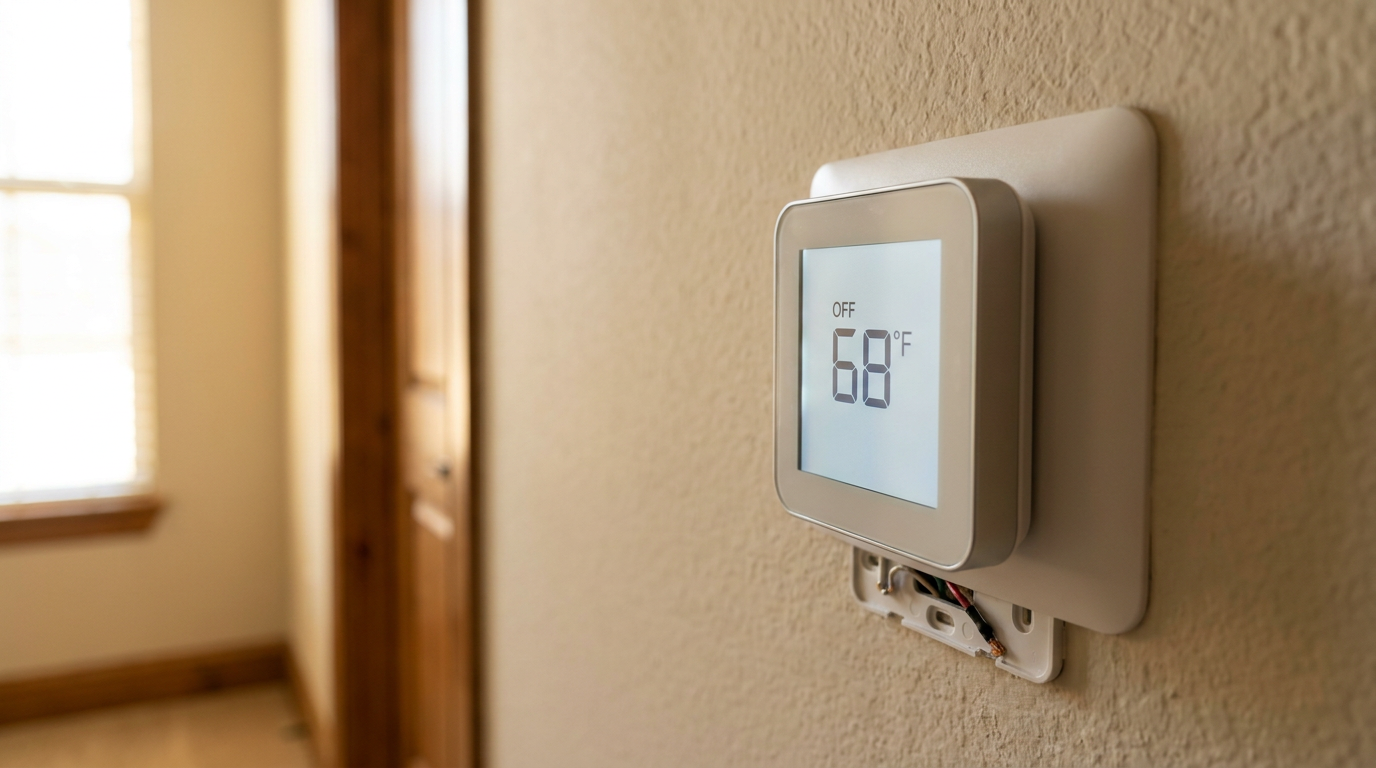
- Inspect the Thermostat Baseplate for Pinched or Bridged Wires — Look over the terminal block on the wall plate. Check for stray copper strands touching between the R terminal and the Y (cooling) or W (heating) terminals.
- Peek behind the wall plate too: mounting screws driven through drywall will sometimes pierce the multi-conductor thermostat sheath and short the 24V hot wire straight to the call wires.
- If the wires are pinched or crushed, strip them back and re-terminate them cleanly with your wire strippers, and don't leave bare copper hanging outside the push-in lugs.
HVAC · High energy usage
| Project category | HVAC |
|---|---|
| Problem type | High energy usage |
| Trade required | HVAC |
| Urgency | Planned project |
| Safety risk | Low safety risk |
| DIY suitability | DIY for experienced homeowners |
| Cost category | High cost |
| Typical timeline | Assessment within weeks; replacement planned off-season |
| Contractor type | Licensed HVAC technician |
Repair option
Duct sealing, insulation, and a tune-up before touching the equipment.
Replacement option
High-efficiency replacement sized by a load calculation, not a rule of thumb.
Common causes
- Aging, low-efficiency equipment
- Leaking ducts losing conditioned air
- Insufficient attic insulation
- Oversized system short-cycling
Relevant tools:project cost estimatorrepair or replace
Published October 23, 2026Last updated October 23, 2026
Tools & materials you'll need
Affiliate linksAs an Amazon Associate FixlyGuide earns from qualifying purchases — at no extra cost to you. Prices and availability are accurate as of publication and subject to change.
Quick Answer
If your thermostat won't turn off your heat or AC, your system's stuck in an active call. Start simple: make sure the fan's on "Auto" and not "On," then flip the mode all the way over to "Off." If the equipment's still running after 3 to 5 minutes, you've probably got a welded contactor outside, a shorted thermostat wire, or a stuck sequencer relay inside the air handler. Kill power at the breaker right away. Don't let it cook itself.
The Problem
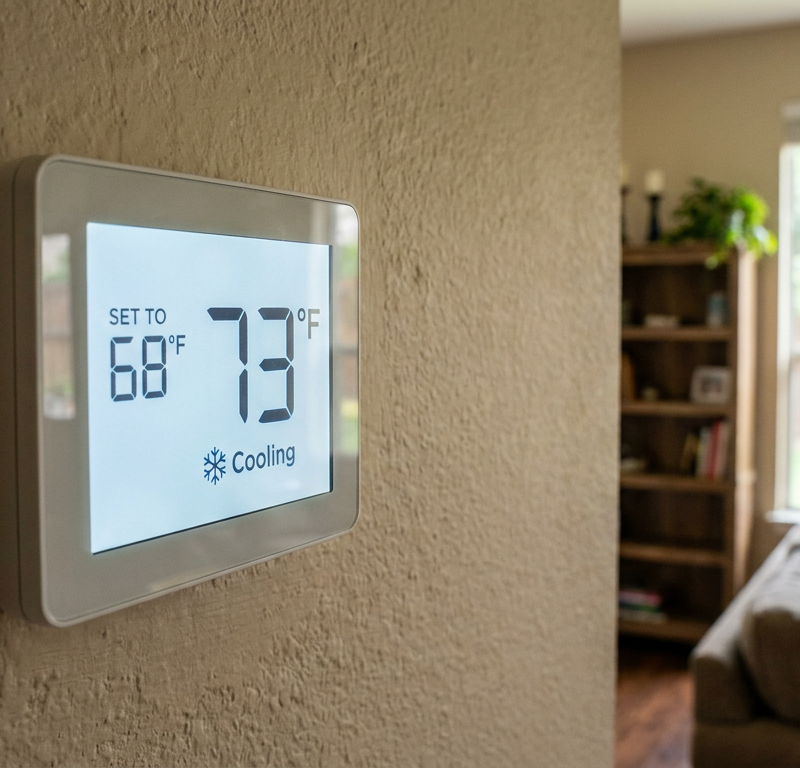
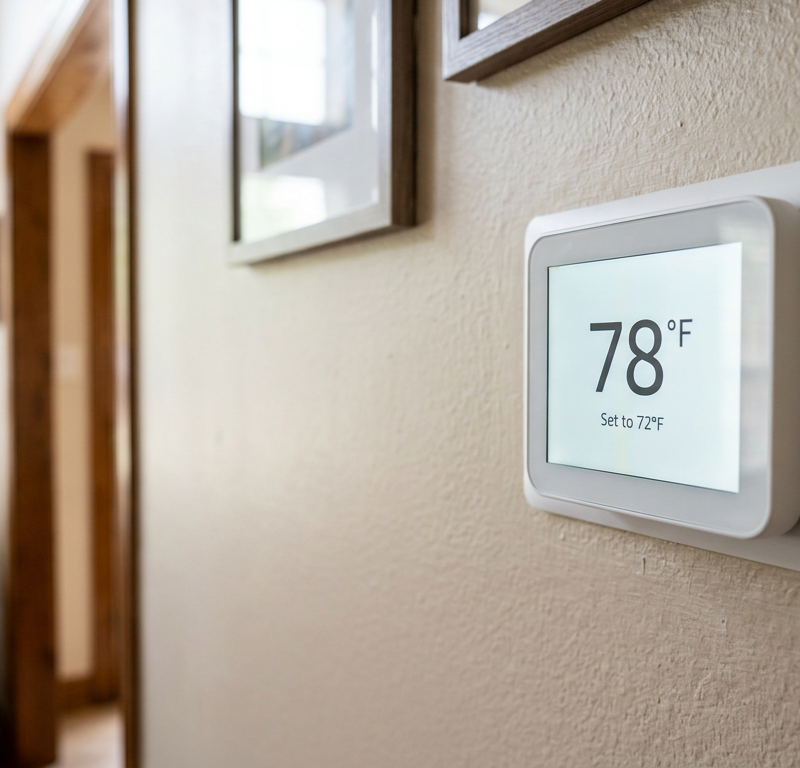
Your house hit 72°F an hour ago. The thermostat says the setpoint's satisfied, or maybe you already shoved the system to "Off" out of pure frustration. Yet cold air keeps coming out of the supply registers, or the furnace just keeps hammering away until the living room feels like a sauna at 84°F.
That isn't just annoying. It can beat up your equipment in a hurry. A furnace that never cycles off can trip high-limit switches, crack a heat exchanger, and burn through hundreds of dollars in natural gas. An air conditioner that runs nonstop can drop coil temps below 32°F, freeze condensate into a solid block of ice, choke airflow, and trash your compressor. When a thermostat loses its grip and can't shut the HVAC system down, you've got to figure out whether the brain (the thermostat), the nerve (the low-voltage wiring), or the muscle (the control board and contactor) is the one hanging on.
How It Works
Your central heating and cooling system runs on a 24-volt alternating current (VAC) control loop powered by a transformer inside your furnace or air handler. The red wire (R or Rc) sends steady 24VAC up to the thermostat on the wall. Inside modern digital thermostats, solid-state relays or micro-switches act like little gatekeepers.
When your home needs cooling, the thermostat bridges the red power wire to the yellow wire (Y) to start the compressor and the green wire (G) to spin up the indoor blower fan. For heat, it closes the connection between R and white (W). Once the room temperature matches your setpoint, the thermostat opens those internal relays and physically breaks the circuit. Without that 24-volt signal moving through the wiring harness, the magnetic coil on your outdoor condenser's contactor drops out, the spring-loaded switch pops open with an audible click, and 240-volt line power gets cut to the compressor. At the same time, the furnace control board de-energizes the gas valve or electric heat sequencer. If any link in that chain stays fused, jammed, or shorted, current keeps flowing and the equipment just runs and runs.
Step-by-Step Fix
Follow this isolation process and you'll narrow down why the system refuses to shut down and whether the trouble is at the wall or inside the equipment.
-
Verify the Fan Setting on the Display — Walk up to the thermostat and check the fan mode. If the fan switch is set to "On" instead of "Auto," your indoor blower fan will run 24 hours a day, 7 days a week, even after heating and cooling cycles are done. Switch it to "Auto" and wait 60 seconds.
- If air stops coming out of the vents, that was just the fan setting.
- If hot or cold air keeps moving through the house, keep going.
-
Set the System Mode to "Off" and Wait Five Minutes — Move the system selector switch directly to the "Off" position. Modern digital thermostats use built-in compressor delay timers ranging from 3 to 5 minutes so the equipment doesn't short-cycle itself to death. Step away and set a timer on your phone for a full 5 minutes so those delays can expire.
- Tools needed: None.
- If the equipment shuts off completely after this delay, the thermostat was probably just finishing a normal cycle or a fan-purge mode.
-
Pull the Thermostat Off the Wall Subbase — If the system keeps running with the unit set to "Off," gently grab the thermostat faceplate and pull it straight off the wall mounting plate. Most modern models (Honeywell, Nest, Ecobee, Emerson) snap onto pins or terminal blocks. I pulled a water heater in Frisco last month that had exactly this kind of stuck call, and the homeowner swore the wall unit was fine until we popped it off and the whole thing died instantly.
- Pulling the faceplate physically breaks the internal relay connections between the R terminal and your equipment terminals (Y, W, G).
- Watch it close: did the outdoor unit or furnace shut off within 10 seconds of pulling the faceplate? If yes, the thermostat's internal relays are bad or welded shut. That thermostat's toast.
-
Cut Power at the Breaker Panel Before Touching Wires — If the furnace or AC condenser keeps running with the thermostat completely off the wall, the thermostat faceplate isn't the problem. Go to your main electrical panel immediately. Flip off the breakers labeled "Furnace / Air Handler" and "AC / Condenser."
- Safety check: Never mess with exposed copper wires while the 24V transformer is energized; shorting R to common (C) will pop the 3-amp or 5-amp blade fuse on your indoor control board in a heartbeat.
-
Inspect the Thermostat Baseplate for Pinched or Bridged Wires — Look over the terminal block on the wall plate. Check for stray copper strands touching between the R terminal and the Y (cooling) or W (heating) terminals.
- Peek behind the wall plate too: mounting screws driven through drywall will sometimes pierce the multi-conductor thermostat sheath and short the 24V hot wire straight to the call wires.
- If the wires are pinched or crushed, strip them back and re-terminate them cleanly with your wire strippers, and don't leave bare copper hanging outside the push-in lugs.
-
Disconnect the Control Call Wire at the Wall Plate — To confirm a wire short, loosen the screw or press the release tab on the call terminal. For cooling, remove the Y wire; for heating, remove the W wire. Bend the bare wire away so it can't touch anything. Restore breaker power.
- If the system starts up again with the call wire floating loose, the low-voltage wire running through your walls has a dead short somewhere between the living room and the attic or basement.
- If the system stays off, the backplate itself may have an internal tracking short.
-
Inspect the Outdoor Contactor (Air Conditioning) — If your outdoor AC unit runs nonstop even with thermostat wires disconnected, the outdoor contactor is the first thing I'd blame. Kill power at the outdoor disconnect box (pull the pull-out plug). Remove the metal service panel on the corner of the condenser with a 5/16-inch nut driver.
- Check the contactor: it's a rectangular relay with high-voltage wires on either side and a central plastic plunger.
- Look for dead ants, carbon pitting, or melted plastic. Insects are drawn to low-voltage magnetic fields in Texas and the South all the time; they crawl between the copper contact pads and get squashed, which can jam the high-voltage contacts closed.
- If the plunger's stuck in the pulled-down position, the contactor's welded or jammed.
-
Test the Contactor Coil with a Multimeter — If the contactor looks mechanically free, check for phantom voltage. Set your digital multimeter to 200 VAC. Reinsert the outdoor disconnect plug carefully (high voltage alert: keep fingers clear of exposed terminals) and touch the meter probes to the two small low-voltage terminals on the sides of the contactor coil.
- If you read 24 VAC with the thermostat unplugged inside, low-voltage control power is leaking from a shorted wire harness or bad defrost control board.
- If you read 0 VAC but the contactor stays pulled in, the contact points are physically welded together from arcing and the part needs replacement.
-
Inspect Heating Sequencers or Relays (Electric Heat / Gas Furnace) — If your electric furnace or heat pump air handler keeps blowing scalding air, check the heating sequencers inside the indoor unit. Sequencers are small cylindrical switches mounted on flat plates that use internal heating elements to stage electric heat strips.
- When sequencers fail, their internal bi-metal contacts can fuse together.
- Shut off indoor power, open the blower/heating compartment, and look for heat discoloration or burnt wire spades.
- Test continuity across the main load terminals with your multimeter set to Ohms (Ω) with power off. Closed continuity on a cold sequencer means the switch is stuck shut.
-
Replace the Faulty Component and Restore Power — Swap out whichever part failed the isolation test:
- Replace a bad thermostat with a new unit that matches your system type (heat pump vs. conventional).
- Replace a stuck outdoor contactor (match the coil voltage, typically 24V, and the full load amp rating, typically 30A or 40A). Torque terminal screws to 20 in-lbs.
- Replace shorted 18/5 or 18/8 thermostat wire by pulling a new bundle through the walls.
- Once everything's back together, restore breaker power and run the system through a full cycle: call for heat/cool, satisfy the setpoint, and confirm the system shuts off within 3 minutes of reaching temperature.
Common Causes
HVAC systems that won't shut down usually trace back to a pretty short list of mechanical and electrical failures:
- Thermostat Solid-State Relay Failure: Older mechanical thermostats used mercury bulbs; modern digital thermostats use solid-state triacs or micro-relays. Power surges from summer thunderstorms can weld these micro-relays into a permanent closed state, so they keep sending 24 volts down the line no matter what the screen says.
- Welded Outdoor Contactor: Your AC compressor pulls between 12 and 30 running amps, with inrush current spiking past 80 amps at startup. After thousands of cycles, the electrical arc pits the silver-plated contacts. Eventually, the metal welds together and line-voltage power keeps feeding the compressor and fan motor 24/7.
- Low-Voltage Wire Short: Thermostat wire (usually 18-gauge solid copper) runs through wall cavities, attics, and crawlspaces. Rodent chewing, pictures hung with drywall nails, or vibrating furnace sheet metal rubbing through insulation can short the R (24V constant) wire directly to Y (cooling) or W (heating), which bypasses the thermostat entirely.
- Stuck Electric Heat Sequencer: Electric furnaces use sequencers with internal resistive heaters to bring high-wattage heating elements on in stages. Over time, the internal mechanical contacts can stick closed, locking your 5kW or 10kW heating strips on all the time.
- Defective Defrost Control Board (Heat Pumps): Heat pump outdoor units use logic boards that control reversing valves and electric auxiliary heat. A failed relay on the defrost board can lock auxiliary heat on or keep the outdoor compressor energized continuously.
Common Mistakes
- Leaving the unit running while troubleshooting: Homeowners often try to diagnose a continuously running AC while letting it run for hours. A frozen evaporator coil can slug the compressor with liquid refrigerant and destroy a $2,500 compressor over a $25 contactor failure. Pull the breaker or disconnect right away.
- Confusing the continuous fan setting with a system failure: We see this constantly: a homeowner assumes their heating or AC won't shut off, but the thermostat fan toggle got bumped from "Auto" to "On." Check the fan switch before you grab screwdrivers.
- Ignoring insect nests in the outdoor contactor: DIYers often replace an outdoor contactor without cleaning the electrical cabinet. In North Texas and southern states, tiny "crazy ants" swarm 24V contactor coils. If you don't seal the cabinet knockout holes and clean the compartment, a new contactor will jam again within a month.
- Yanking thermostat faceplates without turning off equipment power: Thermostats connect directly to a 24V transformer inside the air handler. If you twist or short the wires while popping the backplate off with power energized, you'll pop the low-voltage blade fuse on the furnace control board—or fry the transformer if the board doesn't have fuse protection.
- Prying welded contactor points open and calling it fixed: Taking a pocket screwdriver and prying stuck contactor points apart is only a temporary diagnostic move, not a repair. Once contacts pit and weld once, the plating's done. They'll weld shut again on the very next cycle. Always replace the contactor.
Cost & Time Breakdown
| Task | DIY Cost | Pro Cost | Time |
|---|---|---|---|
| Thermostat Replacement | $40–$180 | $225–$450 | 30–45 mins |
| Outdoor Contactor Replacement | $15–$35 | $175–$325 | 30–60 mins |
| Electric Heat Sequencer Replacement | $20–$45 | $200–$350 | 45–60 mins |
| Thermostat Wire Short Repair (Patch) | $5–$15 | $150–$300 | 1–2 hours |
| Full Thermostat Cable Pull (Attic to Wall) | $30–$60 | $350–$650 | 2–4 hours |
Tips & Prevention
- Set your thermostat fan to "Auto" year-round: Unless you're intentionally moving air for filtration during high-allergen seasons, keep the fan on "Auto." It saves motor wear and keeps you from wondering whether the system's cycling right.
- Inspect outdoor electrical components every spring: Before cooling season starts, shut off the breaker, open the condenser panel, and look over the contactor for bug intrusions, burnt plastic, or black soot.
- Install a contactor with a sealed coil cover: When you replace your outdoor contactor, buy one with a protective plastic enclosure over the contact points. That keeps insects, geckos, and debris from physically bridging the switch contacts.
- Check the furnace control board fuse: Make sure your indoor unit has a standard 3A or 5A automotive blade fuse on the low-voltage terminal strip. That cheap little fuse protects your transformer and board from dead shorts in the thermostat line.
- Watch your electric bill for silent sequencer failures: If your home heating bills suddenly double during mild winter months, an electric heat strip may be stuck on continuously without you realizing it. Keep an eye on the utility spikes.
When to Call a Professional
If you pull the thermostat faceplate off the wall, disconnect the call wires, and your furnace or air handler still runs out of control—and you aren't comfortable opening high-voltage equipment panels—it's time to stop. Air handlers and outdoor condensers carry 240-volt circuits that can hurt you bad, or worse.
Call a licensed HVAC technician immediately if you smell burning electrical wiring or plastic, if your indoor furnace high-limit switch keeps cycling with roaring burners that won't go out, or if your outdoor condenser compressor is humming loudly and overheating without the fan spinning. And if tracking a shorted thermostat wire means fishing lines through multi-story finished drywall or unfloored attic spaces, a pro with tone-generator wire-tracing equipment will find the break a lot faster without tearing up your house.
Frequently Asked Questions
Why does my AC keep running even after reaching the set temperature?
This usually happens because the thermostat fan switch is set to "On" instead of "Auto," or the outdoor contactor switch has welded shut. If the fan is on "Auto" and the thermostat display says the room temperature is below the setpoint, the system's getting an unintended signal or a mechanical relay is physically stuck.
Can a bad thermostat cause the heat to stay on continuously?
Yes. Thermostats use internal relays to send a 24V signal to the furnace or heat pump. If an internal relay burns closed or shorts out from an electrical surge, it keeps sending power down the white (W) wire and forces the furnace burners or heating elements to run non-stop no matter the room temperature.
How do I turn off my HVAC system if the thermostat switch does nothing?
Go straight to your home's main electrical service panel and shut off the circuit breakers labeled "Furnace," "Air Handler," or "AC." If you can't find the right breaker, look for the service switch—which looks like a standard light switch—mounted directly on or next to your indoor furnace or air handler and flip it down.
Why won't my indoor blower fan shut off?
If your indoor fan runs all the time while the outdoor compressor and furnace burners are off, the fan setting on your thermostat is set to "On" instead of "Auto." If switching to "Auto" doesn't help, your furnace control board may have a stuck fan relay or a safety high-limit switch may have tripped, forcing the blower to run continuously as a built-in safety move to cool the heat exchanger.
What is an AC contactor, and why does it stick?
An AC contactor is an electromechanical switch inside the outdoor condenser that uses a 24-volt electromagnet to close high-voltage 240-volt contacts and power the compressor and fan. Over time, high electrical current creates tiny sparks that pit the metal pads. Those contacts can physically melt and weld together, keeping the condenser running even after the 24V signal stops.
How can I tell if the problem is the thermostat or the wiring?
Remove the thermostat faceplate from the wall. If the equipment shuts off right away, the thermostat itself has a bad relay and is the culprit. If the equipment keeps running with the faceplate completely removed, the trouble's in shorted low-voltage wiring inside the walls, a bad control board, or a stuck contactor.
Is it dangerous if my furnace won't shut off?
Yes, a furnace that keeps firing is an urgent safety hazard. Constant burning can overheat the heat exchanger, crack it, and potentially leak deadly carbon monoxide into your living space. Turn the furnace off at the circuit breaker or service switch immediately if the burners won't go out.
Why does my air conditioner freeze up if it won't turn off?
Air conditioners depend on regular off-cycles to balance pressures and keep the indoor evaporator coil from getting too cold. When an AC runs nonstop, especially on cooler night hours, the coil temperature drops below 32°F. Condensation on the coil freezes into ice, blocks airflow, and can send liquid refrigerant back to destroy the compressor.
Related Articles
Keep troubleshooting with these hand-picked guides from FixlyGuide:
- The #1 Reason Your AC Blows Warm Air (And It's Not What You Think) — A dirty air filter is often the overlooked culprit behind an air conditioner blowing warm air, hindering its ability to cool your home effi…
- The #1 Mistake Homeowners Make Installing a Smart Thermostat (and How to Fix It) — Avoid the most common pitfall when installing a smart thermostat yourself and ensure a smooth, energy-efficient setup.
- The Secret Culprit Behind Your Humid House (Even with the AC On) — If your house feels sticky and damp despite the AC running, a common and often overlooked issue is an oversized air conditioner.
- The #1 Mistake Homeowners Make When Heat Pumps Stop Heating in Winter — Discover the crucial mistake most homeowners make when their heat pump struggles in cold weather and how to fix it, potentially saving hund…
- Why Your Heat Pump Auxiliary Heat Won't Turn Off — Discover why your heat pump's auxiliary heat keeps running, driving up your energy bills. Learn to troubleshoot common issues and know when…
- The #1 Mistake Homeowners Make When Protecting Pipes From Freezing — Preventing frozen pipes is crucial in winter; many homeowners make a common mistake that leaves their plumbing vulnerable.
Should you do this yourself?
Answer five quick questions before you start. Safety outranks savings every time.
Your experience with work like this
How high do you have to work?
Does the job involve any of these?
Will it need a permit?
Specialty tools
Free and instant. Educational guidance only — not a quote, inspection, or professional diagnosis.
Estimate your own project cost
National averages are a starting point. Enter your details for a range that fits your house.
HVAC replacement cost
- Equipment$2,200 – $3,800
- Installation labor$1,200 – $2,500
Always insist on a Manual J load calculation — sq-ft sizing is only a rough check. Federal heat-pump rebates may reduce cost significantly.
Educational estimate only — always confirm with written local bids.
What should this project cost?
Enter your project details for a realistic cost range before you call anyone.
Service calls and common repairs run $150–$900; full system replacement typically $6,000–$12,000.
- Regional adjustment
- National average
- Labor share (typical)
- ~$1,935
- Quotes to collect
- 3 written estimates
Educational estimate based on national averages — not a binding quote. Always confirm with written local estimates.
Fixly Project Decision Box
- DIY difficulty
- Advanced
- Estimated time
- Homeowner checks 20–30 minutes
- Cost level
- Moderate
Main tools / materials
- Clean air filter
- Garden hose for condenser coils
- Shop vac for the condensate line
When to stop and call a pro
- Burning smell, smoke, or a tripping breaker
- Refrigerant lines iced over or hissing
- Any work inside the sealed refrigerant circuit (EPA-licensed only)
- Gas smell near a furnace — leave and call the utility
Need professional help?
Find an HVAC Pro Near YouBefore you start
Check the difficulty, permits, and safety risk — then decide whether to call a pro.
Free, no signup required. Estimates are educational guidance, not a quote or an inspection.
Get the print-ready PDF of this guide
A clean, ad-free, printable version you can keep on your phone or pin to the workshop wall. Free with a FixlyGuide account.
- Print-optimized layout
- Tools, materials & every step included
- Saved to your account
Frequently asked questions
Why does my AC keep running even after reaching the set temperature?+
This usually happens because the thermostat fan switch is set to "On" rather than "Auto," or the outdoor contactor switch has welded shut. If the fan is on "Auto" and the thermostat display says the room temperature is below the setpoint, the system is receiving an unintended signal or a mechanical relay is physically stuck.
Can a bad thermostat cause the heat to stay on continuously?+
Yes. Thermostats use internal relays to send a 24V signal to the furnace or heat pump. If an internal relay burns closed or shorts out from an electrical surge, it continuously sends power down the white (W) wire, forcing the furnace burners or heating elements to run non-stop regardless of room temperature.
How do I turn off my HVAC system if the thermostat switch does nothing?+
Go straight to your home's main electrical service panel and switch off the circuit breakers labeled "Furnace," "Air Handler," or "AC." If you cannot find the correct breaker, locate the service switch—which looks like a standard light switch—mounted directly on or next to your indoor furnace or air handler and flip it down.
Why won't my indoor blower fan shut off?+
If your indoor fan runs non-stop while the outdoor compressor and furnace burners are off, the fan setting on your thermostat is set to "On" instead of "Auto." If switching to "Auto" does not help, your furnace control board may have a stuck fan relay or a safety high-limit switch has tripped, forcing the blower to run continuously as a built-in safety measure to cool the heat exchanger.
What is an AC contactor, and why does it stick?+
An AC contactor is an electromechanical switch inside the outdoor condenser that uses a 24-volt electromagnet to close high-voltage 240-volt contacts, powering the compressor and fan. Over time, high electrical current creates tiny sparks that pit the metal pads. These contacts can physically melt and weld together, keeping the condenser running even after the 24V signal stops.
How can I tell if the problem is the thermostat or the wiring?+
Remove the thermostat faceplate from the wall. If the equipment immediately shuts off, the thermostat itself has a faulty relay and is to blame. If the equipment continues running with the faceplate completely removed, the problem lies in shorted low-voltage wiring inside the walls, a bad control board, or a stuck contactor.
Is it dangerous if my furnace won't shut off?+
Yes, a continuously firing furnace is an urgent safety hazard. Constant burning can overheat the heat exchanger, causing it to crack and potentially leak deadly carbon monoxide into your living space. Turn the furnace off at the circuit breaker or service switch immediately if the burners refuse to extinguish.
Why does my air conditioner freeze up if it won't turn off?+
Air conditioners rely on regular off-cycles to balance pressures and prevent the indoor evaporator coil from getting too cold. When an AC runs non-stop, especially during cooler night hours, the coil temperature drops below 32°F. Condensation on the coil freezes into ice, blocking airflow and potentially sending liquid refrigerant back to destroy the compressor.
Discussion
Loading comments…