- Find the breaker for the dishwasher in your main panel. It should be a dedicated 15- or 20-amp breaker.
- Flip it to the “OFF” position.
- Wait a full five minutes. That’s not me stalling—those capacitors need time to discharge so the fault code really clears.
- Flip the breaker back to the “ON” position.
- Try a new cycle. If the blinking light’s gone, call it a day.
HVAC · High energy usage
| Project category | HVAC |
|---|---|
| Problem type | High energy usage |
| Trade required | HVAC |
| Urgency | Planned project |
| Safety risk | Low safety risk |
| DIY suitability | DIY for experienced homeowners |
| Cost category | High cost |
| Typical timeline | Assessment within weeks; replacement planned off-season |
| Contractor type | Licensed HVAC technician |
Repair option
Duct sealing, insulation, and a tune-up before touching the equipment.
Replacement option
High-efficiency replacement sized by a load calculation, not a rule of thumb.
Common causes
- Aging, low-efficiency equipment
- Leaking ducts losing conditioned air
- Insufficient attic insulation
- Oversized system short-cycling
Relevant tools:project cost estimatorrepair or replace
Published October 14, 2026Last updated October 14, 2026
Tools & materials you'll need
Affiliate linksAs an Amazon Associate FixlyGuide earns from qualifying purchases — at no extra cost to you. Prices and availability are accurate as of publication and subject to change.
Quick Answer
That blinking light on your dishwasher is basically a built-in error code. The number of blinks, or which light’s flashing—like “Clean” or “Rinse”—points to a specific problem. Most of the time, it’s something simple: a door that isn’t latched all the way, a dirty filter choking off water flow, or a snag in the water inlet or drain line. I’ve cleared plenty of these in under 30 minutes with a hard reset, a quick look at the door latch, and a filter cleaning.
The Problem
You load the dishwasher, hit start, and instead of that familiar fill sound, you get a blinking light. Maybe it’s the “Start” light. Maybe it’s “Clean.” Sometimes it’s a little string of flashes from one LED. Annoying? You bet. Random? No. That blinking light is the machine telling you something’s off. It’s a fault code, plain and simple, and figuring it out is the first step to getting the thing back in service.
How It Works
Modern dishwashers run off a central computer, usually called the main control board or MCU (Microcontroller Unit). That board keeps an eye on a whole pile of sensors through the wash cycle. It checks water temp, water level through a float switch or pressure sensor, how fast it drains, and whether the door’s shut tight.
If one of those sensors sends back data outside the normal range—say the water never heats up, or it takes forever to drain—the control board flags it as a fault. Instead of powering on through the problem and maybe making a leak worse, the MCU stops the cycle and flashes a light to get your attention. The blink pattern—which light, how many times, steady or intermittent—is the code. Think of it like Morse code for appliance repair. Some fancier models will throw an alphanumeric code like “F2E1” or “i30” on the display, but same idea. The code points you at the water supply, drain pump, heating element, or whatever else has gone sideways.
Step-by-Step Fix
Before you call for service, here’s the order I’d go in. It handles most of the blinking-light jobs I see.
1. Perform a Hard Reset
- Tools: None.
- Safety: You’ll be cutting power to the appliance.
First thing I do is reset the dishwasher’s brain. Same as a laptop acting goofy—sometimes the control board just needs a hard reboot.
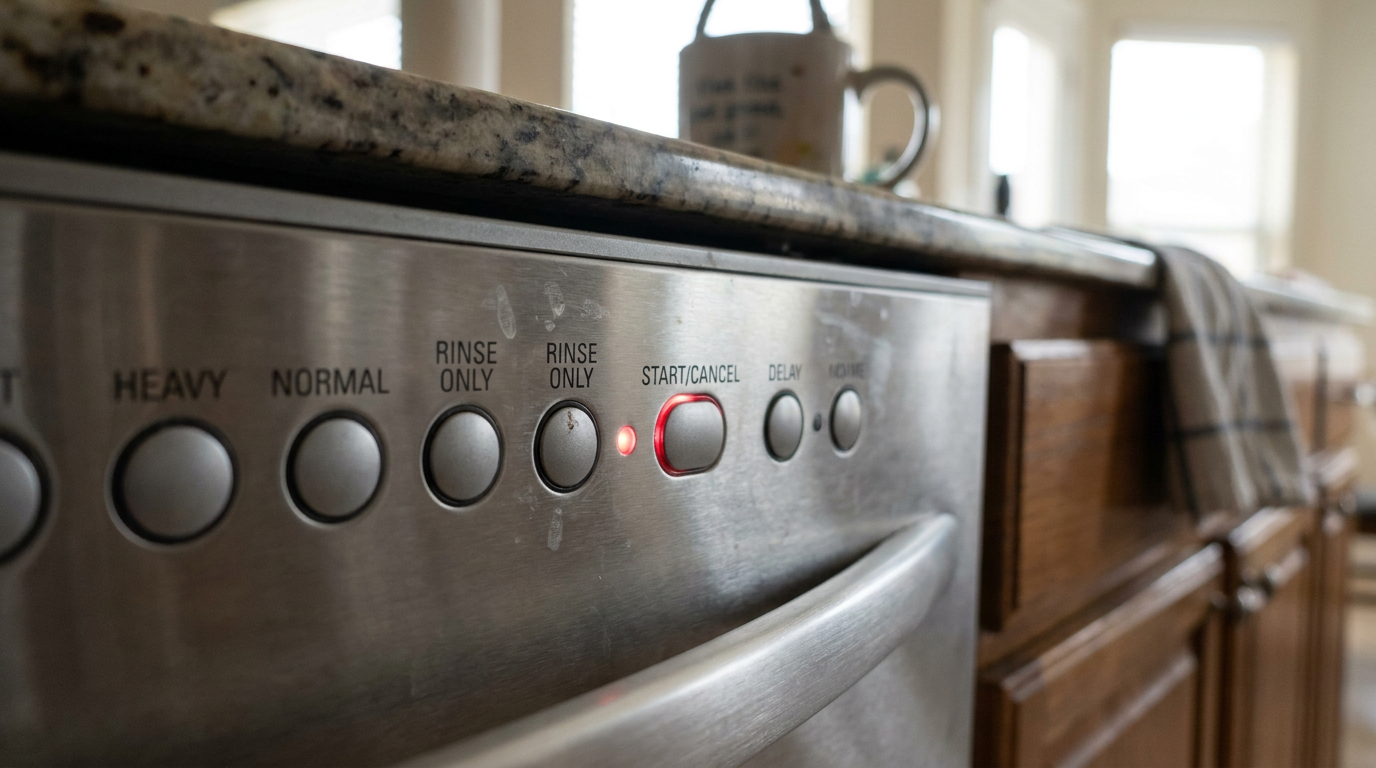
- Find the breaker for the dishwasher in your main panel. It should be a dedicated 15- or 20-amp breaker.
- Flip it to the “OFF” position.
- Wait a full five minutes. That’s not me stalling—those capacitors need time to discharge so the fault code really clears.
- Flip the breaker back to the “ON” position.
- Try a new cycle. If the blinking light’s gone, call it a day.
2. Check the Door Latch
- Tools: None.
If the machine doesn’t think the door’s latched, it won’t run. A blinking “Start” or “Lock” light usually points right here.
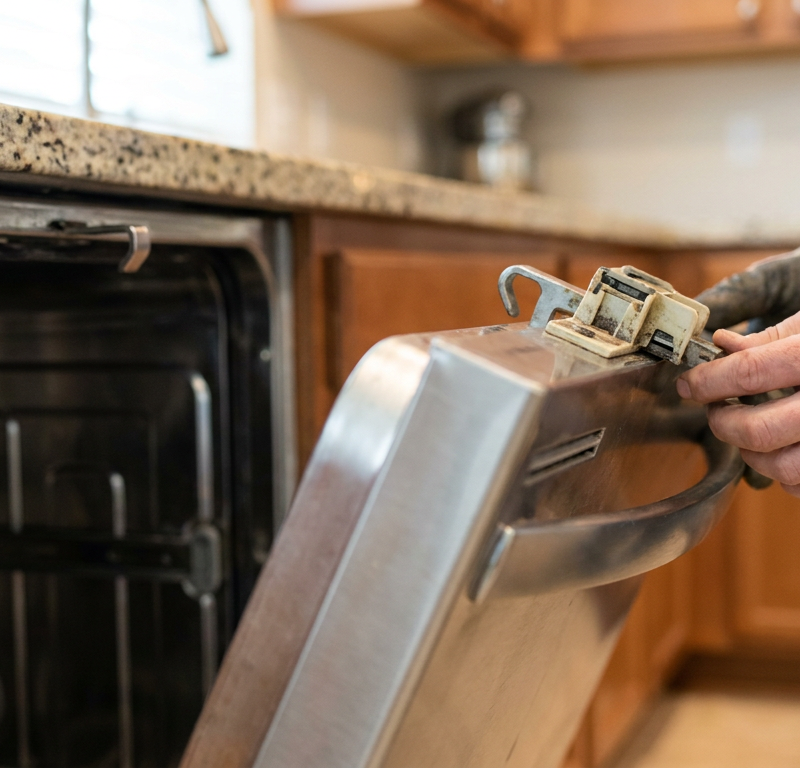
- Open the door and shut it firmly. You should hear a solid “click.”
- If it feels mushy or doesn’t click, check the latch at the top of the tub and the strike plate on the door. I’ve seen forks, spatulas, even a little plastic spoon jam the thing up.
- Wipe both parts with a damp cloth to clear off grease or debris that might be messing with the connection.
3. Clean the Filter and Sump
- Tools: Old towel.
- Safety: The filter area might have sharp debris.
A clogged filter is a regular culprit. If water can’t move the way it should, the sensors get mad and throw a code—usually something tied to draining or water level.
- Open the dishwasher door and pull out the bottom rack.
- Put an old towel in the bottom of the tub to catch any standing water.
- Find the main filter assembly. Usually it’s a cylindrical piece that twists to unlock, often with a flat mesh screen around it. Twist it, usually counter-clockwise, and lift it out.
- Take it to the sink and wash it well with a brush and hot, soapy water. Get the food bits, labels, and slime off it.
- While the filter’s out, reach into the cavity where it sits—the sump. Feel around carefully for glass shards, olive pits, chicken bones, all the usual junk the filter missed. Pull it out.
- Put the filter back in and make sure it locks down tight. Loose filter, loose problems.
4. Inspect the Water Supply
- Tools: None.
A blinking light can also mean the dishwasher isn’t getting enough water.
- Look under the kitchen sink for the water supply valve. It’s usually a small valve separate from the main faucet lines, with a little handle.
- Make sure the handle’s turned fully counter-clockwise, the “on” position. Sometimes somebody bumps it halfway closed and starves the machine.
- Check the hose for sharp kinks or bends that could pinch off the flow.
5. Check the Drain Hose
- Tools: None.
If the dishwasher can’t drain, it’ll stop and flash at you. A lot of times it’s just a clog in the drain line.
- The drain hose, a corrugated plastic tube, runs from the dishwasher to either your garbage disposal or a dedicated air gap on the sink.
- Look for kinks. Make sure the hose has a “high loop”—it should arc up under the countertop before it hooks to the disposal or drain. That keeps sink water from backing up into the dishwasher.
- If it ties into the garbage disposal, make sure the disposal isn’t packed up. Run it for 30 seconds with cold water and see if it clears. If you just put the disposal in, check that the knockout plug at the dishwasher connection was actually knocked out. That one gets missed all the time.
6. Examine the Float Switch
- Tools: None.
This little part keeps the dishwasher from overfilling. If it sticks, it can tell the machine it’s full when it’s empty, or the other way around.
- The float switch is a small plastic cap or dome in the bottom front corner of the tub.
- Lift it gently. It should move up and down freely about an inch, and you might hear a soft click.
- If it’s stuck, there’s probably food debris jammed under it. Wiggle it a few times to free it up. You can also pour a cup of hot water and vinegar around it to break up greasy buildup.
7. Consult the Error Code Chart
- Tools: Your phone or computer.
If none of that fixes it, you’ve got to get specific. That blinking light is a code, so let’s decode it.
- Write down the exact light that’s blinking, like “Clean” or “Sanitized,” or count how many times it flashes before repeating.
- Search online for “[Your Dishwasher Brand] [Your Model Number] blinking light codes”. For example: “Whirlpool WDT730PAHZ clean light blinking 7 times”.
- The results should pull up charts that translate the blink code into a specific failure, like 7 blinks for heating circuit failure or 10 blinks for a bad drain pump.
- That’ll tell you if you’re staring at a bigger repair, like a burned-out heating element or a weak drain pump, and that’s often where a pro earns their keep.
Common Causes
Why did it happen? Most of the time, it’s one of these:
- Clogged Filters: Hands down the most common one. Food bits, paper labels from jars, and other junk build up and choke off water flow, which trips the sensors.
- Improper Loading: Pack the racks too tight or block the spray arms, and water can’t reach the detergent cup or circulate right. That’ll throw the cycle off in a hurry.
- Power Surges: A short outage or surge can scramble the control board and make it lock up with a fault code.
- Kinked Hoses: A water inlet hose or drain hose getting pinched behind the unit is a basic mechanical issue, but the dishwasher sees it as a big problem.
- Stuck Float Switch: A stray popcorn kernel or a chunk of food can hang up under the float switch and make the machine think the water level’s wrong.
- Component Failure: Stuff wears out. Heating element burns open, drain pump motor quits, door latch switch breaks. That error code is there to point you to the bad part.
Common Mistakes
Don’t get caught by these when the light starts blinking:
- Ignoring the Code: Don’t just keep hammering the start button. That blinking light is trying to tell you something. If the drain’s blocked and you keep running it, you could end up with a flooded kitchen.
- Forgetting the Breaker Reset: Turning the dishwasher off and on at the control panel doesn’t clear the main board. You need to shut it off at the breaker for at least five minutes.
- Using the Wrong Detergent: Never pour regular dish soap into a dishwasher. It’ll foam like crazy and can make the machine overflow and trip the flood sensor.
- Not Cleaning the Filter: The filter doesn’t clean itself. You’ve got to pull it and wash it by hand on a regular basis—at least once a month if you want to stay ahead of flow problems.
- Replacing the Disposal without Removing the Plug: If you install a new garbage disposal, you MUST remove the little plastic knockout plug inside the dishwasher connection port. If you don’t, the dishwasher’s got nowhere to drain, and it’ll throw an error on the very first run.
Cost & Time Breakdown
Here’s what you’re usually looking at to fix a blinking light issue.
| Task | DIY Cost | Pro Cost | Time |
|---|---|---|---|
| Hard Reset & Basic Checks | $0 | $90–$150 (trip fee) | 15 minutes |
| Clean Filter & Sump | $0 | $90–$150 | 20 minutes |
| Replace Door Latch Switch | $20–$40 (part) | $150–$250 | 45–60 minutes |
| Replace Water Inlet Valve | $30–$60 (part) | $200–$350 | 1–1.5 hours |
| Replace Drain Pump | $50–$90 (part) | $250–$400 | 1–2 hours |
| Replace Control Board | $150–$250 (part) | $400–$600+ | 1 hour |
Tips & Prevention
- Clean Your Filter Monthly: Put it on your calendar. That five-minute chore prevents more service calls than you’d think.
- Scrape, Don't Rinse: Modern detergent wants a little food soil to grab onto. Scrape the chunks off plates, but don’t pre-rinse them clean. Saves water and lets the soap do its job.
- Run Hot Water First: Before you start the dishwasher, run the kitchen sink hot until the water’s actually hot. That way the first fill is hot water, which helps cleaning and keeps the temperature sensor happy.
- Use a Dishwasher Cleaner: Every 2-3 months, run an empty cycle with a citric acid-based dishwasher cleaner like Affresh or Lemi Shine. It knocks down mineral buildup from hard water and cuts greasy residue.
- Check Spray Arms: Every few weeks, spin the spray arms by hand and make sure they move freely without hitting a utensil handle. Check the spray holes for food bits or mineral crust.
When to Call a Professional
A lot of blinking-light problems are straightforward, but there are times I’d tell you to stop and bring in a licensed appliance technician:
- The error code points to a heating circuit failure. Working on the heating element means high voltage (240V), and it can get dangerous fast. A bad repair can create a fire hazard.
- You see standing water and smell a burning electrical odor. That can mean a seized drain pump or circulation pump that’s overheating. Unplug the unit right away.
- The fix requires pulling the dishwasher out and testing components with a multimeter. If you’re not comfortable checking pumps, valves, and control boards, it’s safer to let a pro handle it.
- Water is leaking from the bottom of the unit. A leak plus an electrical fault is nothing to shrug off.
Related Articles
Keep troubleshooting with these hand-picked guides from FixlyGuide:
- Fridge Door Won't Stay Shut? 9 Reasons It Keeps Popping Open—and What to Check First — Is your refrigerator door refusing to stay closed? We'll walk you through the most common causes, from a simple overloaded shelf to a worn-…
- The Mystery of the Warm Fridge: Why Your Food Is Spoiling (and When to Call a Pro) — If your refrigerator isn't keeping food cold, it could be a simple fix or a serious problem requiring a professional. Learn what to check a…
- Why Your Dishwasher Leaves Dishes Soaking Wet (And It's Not Your Rinse Aid) — Discover the real reasons your dishwasher isn't drying dishes and how to fix them, from blocked vents to faulty heating elements. Don't let…
- The Real Reason Your Dishwasher Stinks (And It's Not Just Old Food) — Don't let a stinky dishwasher ruin your kitchen. Often, the problem isn't just old food; it's a buildup of grime and bacteria in hidden spo…
- Your 'Clean' Dishes Are Still Dirty? The Culprit Is Hiding — Frustrated by gritty, food-flecked dishes after a full wash cycle? The problem isn't your detergent. Your dishwasher is making dishes dirti…
- That Ceaseless Hum? Why Your Sump Pump Runs When It's Dry — A constantly running sump pump often points to issues beyond rain, such as a high water table, a stuck float switch, or a failed check valv…
What should this project cost?
Enter your project details for a realistic cost range before you call anyone.
Cost depends heavily on which system turns out to be the source.
- Regional adjustment
- National average
- Labor share (typical)
- ~$1,620
- Quotes to collect
- 3 written estimates
Educational estimate based on national averages — not a binding quote. Always confirm with written local estimates.
Decide what your roof needs
Two minutes of questions turns "something is wrong up there" into a clear next step.
- Repair or replace your roof?Answer 10 questions about age, leaks, and damage to get a clear next step.Open
- Compare contractor quotesScore up to four bids on price, warranty, licensing, and timeline.Open
- Get local estimatesSend one request and compare written estimates from vetted pros.Open
Free, no signup required. Estimates are educational guidance, not a quote or an inspection.
Frequently asked questions
Why is the 'Clean' light blinking on my dishwasher?+
The 'Clean' light blinking is a common indicator of a heating or water temperature problem. It often means the dishwasher failed to reach the target temperature within a set time. This could be due to a faulty heating element, a bad thermostat, or even just running the cycle with cold water because the sink's hot water wasn't run first.
How do I force my dishwasher to reset?+
To perform a hard reset, you must cut its power at the source. Go to your home's main circuit breaker panel, find the breaker labeled for the dishwasher, and switch it to the 'OFF' position. Leave it off for a full five minutes before switching it back on.
What does it mean when the start light is blinking on a dishwasher?+
A blinking start light almost always means the dishwasher's control board doesn't register the door as being securely closed. Try opening the door and slamming it shut more firmly. If that doesn't work, the door latch assembly itself might be faulty or blocked.
Can a clogged dishwasher cause a blinking light?+
Yes, absolutely. A clogged filter or drain hose is one of the most frequent causes of a blinking light. Sensors detect that water isn't draining properly, and the dishwasher stops the cycle and flashes a fault code to prevent an overflow.
Why is my dishwasher light blinking and it's full of water?+
This combination points directly to a drainage problem. The dishwasher tried to drain, failed, and triggered an error. The cause is likely a clog in the filter, the drain hose, the air gap on your sink, or the garbage disposal connection. It could also be a failed drain pump.
How much does it cost to fix a dishwasher that has a blinking light?+
The cost varies widely. If it's a simple fix you can do yourself like cleaning a filter or resetting the unit, the cost is $0. If you need a pro and it's a simple clog, expect to pay a $90-$150 service fee. If a major part like a control board or drain pump needs replacement, the repair could cost anywhere from $250 to $600.
Is it worth repairing a dishwasher with an error code?+
It depends on the dishwasher's age and the cost of the repair. For a dishwasher that's under 8 years old, a repair under $300 is often worthwhile. If the machine is over 10 years old and the error code points to an expensive part like the main control board, it's often more economical to invest in a new appliance.
Can I just ignore the blinking light and restart the dishwasher?+
You shouldn't. The blinking light is a specific warning about a fault. Attempting to run the dishwasher without addressing the underlying issue could lead to bigger problems, like a water leak that damages your floor and cabinets, or burning out a motor.
Discussion
Loading comments…