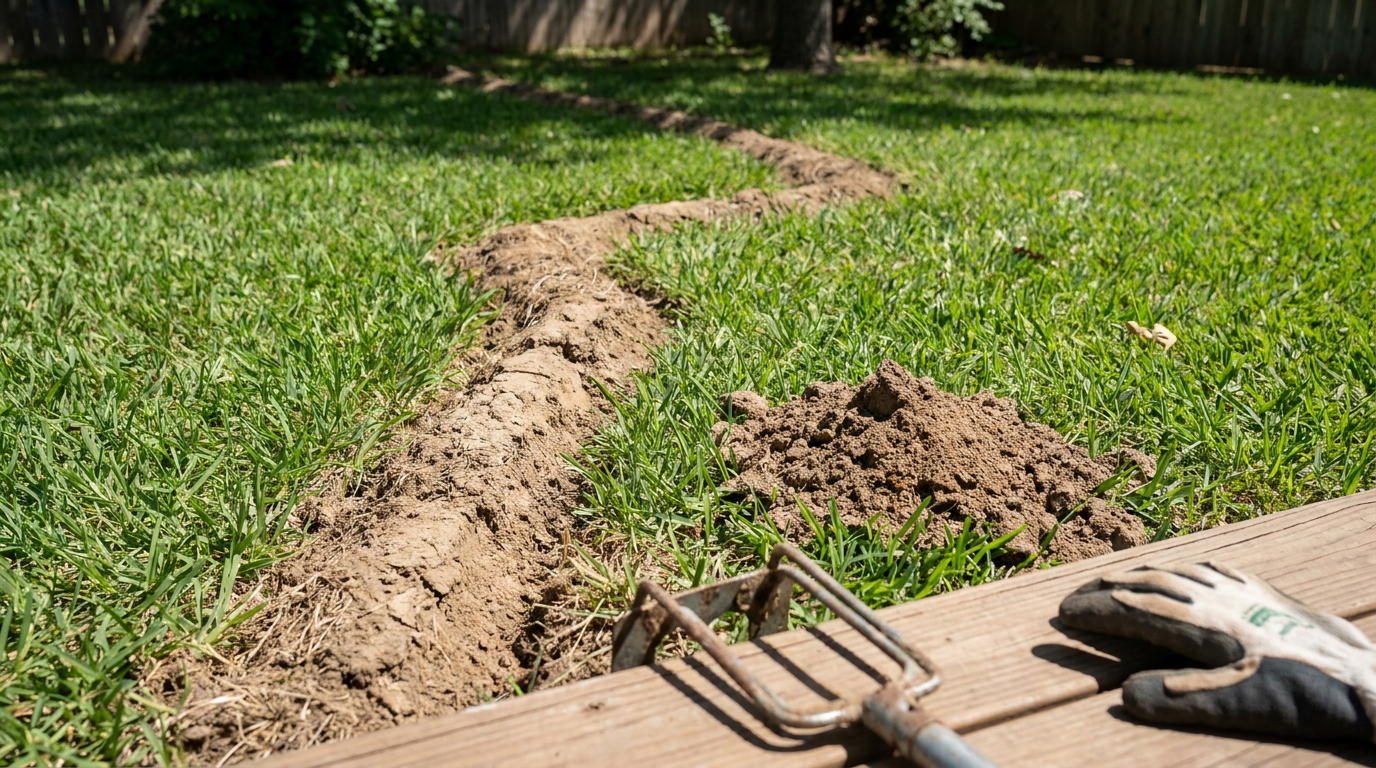
- Tools needed: Garden trowel, scissor-jaw trap, 5-gallon bucket.
- Cover the setup with an overturned 5-gallon bucket weighted with a brick so you block out light and keep pets away.
- If you don’t get a catch within 72 hours, pull the trap; the mole has shifted routes.
Landscaping · Deck or fence project
| Project category | Landscaping |
|---|---|
| Problem type | Deck or fence project |
| Trade required | Landscaping |
| Urgency | Planned project |
| Safety risk | Moderate safety risk |
| DIY suitability | DIY for experienced homeowners |
| Cost category | High cost |
| Typical timeline | Most builds 3–10 days depending on size |
| Contractor type | Landscaping contractor |
Repair option
Replace failed boards, posts, and hardware; reseal the surface.
Replacement option
Rebuild when framing or the ledger connection is unsafe.
Common causes
- Rot at posts and ledger
- Storm damage
- Adding outdoor living space
Relevant tools:home improvement material pricesproject cost estimator
Published October 24, 2026Last updated October 24, 2026
Tools & materials you'll need
Affiliate linksAs an Amazon Associate FixlyGuide earns from qualifying purchases — at no extra cost to you. Prices and availability are accurate as of publication and subject to change.
Quick Answer
To stop moles and voles from chewing up your lawn, you’ve got to know which pest you’re dealing with first. Raised, volcano-shaped dirt piles and deep ridges point to moles — they’re insect eaters, after grubs and earthworms. Ground-level 1- to 2-inch wide surface runways and chewed grass crowns point to voles. For moles, get rid of active tunnels with mechanical scissor-jaw or cinch traps set right inside fresh, probe-located main runs. For voles, clear surface thatch, set shrouded snap traps baited with peanut butter along active runways, and trench 1/4-inch galvanized hardware cloth 10 inches deep around flower beds.
The Problem
You walk out on a Saturday morning, and your boot sinks into a soft, caved-in trench. Or you spot conical dirt mounds that look like little strip mines scattered across the turf. Not a great start to the day.
Subterranean lawn pests can turn a healthy root zone into a minefield fast. A lot of folks reach for caster oil, sulfur smoke bombs, or a garden hose jammed down the hole. Most of that doesn’t get you anywhere, because homeowners mix up moles and voles.
Moles are solitary insectivores with broad, paddle-like claws made for digging. They don’t eat grass, roots, or bulbs. They rip through root systems hunting earthworms, beetle larvae (white grubs), and other bugs underground. Voles are a different animal altogether — stocky, mouse-like rodents with blunt snouts and short tails. They’re strict vegetarians. They chew turf right down to the crown, girdle ornamental shrub bark under snow cover or heavy mulch, and leave perennial beds hollowed out. Try to treat voles like moles with grub killers, and you’ll be disappointed. Same deal if you set mole harpoon traps for voles — that’s like using a bear trap to catch a field mouse. No dice.
How It Works
To figure out what’s tunneling under your yard, you’ve got to look at how the soil is laid out and how each critter feeds.
+-------------------------------------------------------------+
|                      LAWN SURFACE                           |
|   (Voles: Open surface runs, clipped grass, gnawed bark)    |
+-------------------------------------------------------------+
| SHALLOW SUBSURFACE (1 to 4 inches down)                     |
| - Mole surface feeding tunnels (raised spongy turf ridges)   |
| - Active when soil is damp; grubs & earthworms present      |
+-------------------------------------------------------------+
| DEEP SUB-BASE (8 to 18 inches down)                         |
| - Mole structural highway / main travel tunnels             |
| - Connects nesting chambers; excavated dirt pushed up into  |
|   conical mounds (molehills)                                |
+-------------------------------------------------------------+
Moles dig two different kinds of tunnels: deep travel highways and shallow feeding runways. Deep runs sit 8 to 18 inches below the surface, where they’re buffered from temperature swings. When they chew through dense clay or loam and build those permanent highways, they shove the extra soil up through vertical shafts and leave those volcano-looking mounds with the plug off to one side.
Feeding tunnels are shallower, just 1 to 4 inches below the turf. The mole pushes through moist topsoil like a snowplow, lifting grass roots as it goes so it can catch earthworms and grubs moving below. That tears the roots away from moisture, and you end up with dead brown tracks across the yard. Ugly stuff.
Voles usually don’t build deep dirt highways. They hang out right where the thatch meets the soil surface. They make narrow 1- to 2-inch wide little superhighways through thick grass, hiding under thatch, tall fescue, or heavy hardwood mulch to stay out of sight from hawks, owls, and the neighborhood cat. They breed all year long; a single female can produce up to 10 litters each season. Moles work alone — I’ve rarely seen more than three to five moles per acre. Voles, though? They pile up in colonies with dozens of animals and can wreck hundreds of square feet before you even know they’re there. I pulled a water heater in Frisco last month that had exactly this kind of hidden damage around the yard — the homeowners thought it was “just soft soil” until the whole border started collapsing.
Step-by-Step Fix
Here’s the order I use when I’m cleaning up both pests and trying to keep them from coming right back.
-
Perform the Tunnel Flattening Test to Identify Active Mole Runs — Walk the yard and stomp down a 6-inch section of several raised ridges with your heel, or flatten the top of a mound. Mark each flattened spot with a brightly colored wire utility flag. Check back in 24 to 48 hours; if the turf pops back up, you’ve found an active feeding run or main highway.
- If a tunnel stays flat, it was abandoned — don’t waste traps there.
- Straight, long ridges that hug edging, sidewalks, or fences are the ones I’d chase first. Those are the permanent highways.
-
Conduct the Apple Slice Test for Suspected Vole Colonies — Find an open, surface-level run or pencil-sized burrow hole near mulch beds. Put a 1-inch cube of fresh apple directly inside the runway, then cover it loosely with an inverted cardboard box or wooden shingle to keep birds and pets out.
- Check it after 24 hours.
- If the apple has clean, parallel incisor marks or disappears completely, voles are using that corridor.
-
Set Mechanical Scissor-Jaw Traps for Deep Mole Runs — Dig a clean core across an active mole run with a garden spade, taking out a 6-inch by 6-inch turf plug without caving in the nearby openings. Build a firm dirt dam 1 inch high in the middle of the run, set the trigger mechanism of a scissor-jaw trap tight against the dam, and prime the spring.
- Tools needed: Garden trowel, scissor-jaw trap, 5-gallon bucket.
- Cover the setup with an overturned 5-gallon bucket weighted with a brick so you block out light and keep pets away.
- If you don’t get a catch within 72 hours, pull the trap; the mole has shifted routes.
-
Deploy Plunger-Style Traps in Shallow Surface Ridges — Line up the frame of a spring-loaded spear or plunger trap right over a confirmed shallow run. Press the center trigger pad against the roof of the tunnel until it sits flush with the compressed turf, then drive the spike frame into the ground until the trigger pan rests on the depressed soil.
- Test-fire it once to make sure the spikes will bite into deep clay without binding, then re-cock it.
- Safety note: Wear heavy leather gloves; those springs have enough tension to break fingers.
-
Deploy Covered Snap-Traps Along Active Vole Corridors — Set standard wooden or plastic snap traps in pairs directly inside active vole surface paths, with the traps turned perpendicular to the run and trigger pedals facing opposite directions. Bait the triggers with a sticky slurry of peanut butter mixed with rolled oats.
- Shelter every trap under a length of 4-inch corrugated PVC pipe or an inverted gutter section.
- Voles hate open space. Covering the traps boosts strike rates and keeps songbirds and pets out of trouble.
-
Strip Mulch Away from Shrub Bases and Tree Trunks — Pull wood mulch, pine straw, and fallen leaves back at least 6 to 8 inches from the base of woody plants, trees, and ornamental beds. Voles use mulch cover to chew through bark cambium layers in winter and early spring without getting spotted.
- Keep the lawn perimeter mowed tight, around 2 to 2.5 inches in problem areas, so you don’t give them overhead cover.
- Rake out thick thatch with a heavy dethatching rake or a mechanical power rake.
-
Trench Hardware Cloth Barriers Around High-Value Garden Beds — Dig a trench 10 to 12 inches deep and 6 inches wide around vulnerable vegetable patches, hosta beds, or prized borders. Drop in 1/4-inch galvanized steel hardware cloth, then bend the bottom 3 inches outward at a 90-degree angle away from the bed to make an L-shaped underground barrier.
- Bring the wire mesh up at least 4 to 6 inches above the final grade line.
- Don’t use chicken wire; voles slip right through 1-inch hexagonal openings, and moles chew through aluminum mesh.
-
Treat Turf for Secondary Food Attractants — If moles keep coming back, knock down the underground food source with a granular insect control product containing imidacloprid (for preventative grub control in early summer) or trichlorfon (for fast curative control of mature grubs in late summer).
- Water it in with at least 0.5 inches of water right away so the active ingredients move past the thatch layer where grubs feed.
- Even then, don’t expect moles to vanish if your soil’s full of earthworms, but it’ll cut tunneling down a lot.
-
Apply Castor Oil Soil Drench as a Behavioral Deterrent — Mix 8 ounces of 100% pure cold-pressed USP-grade castor oil and 2 tablespoons of liquid dish soap with 1 gallon of water in a hose-end sprayer. Saturate the active areas with the drench, then follow it with 15 to 20 minutes of overhead irrigation to push the oil down into the root zone.
- Castor oil coats earthworms and soil insects without poisoning them; moles hate the taste and scent, and it messes with their digestion enough to make them tunnel elsewhere.
- Reapply every 14 to 21 days, especially after rainfall over 1 inch.
Common Causes
Lawn tunneling doesn’t happen by accident. A few yard conditions practically invite these pests in:
- Over-Irrigated, Soft Soil: Sprinklers set to run every day keep the topsoil loose and damp. Moles don’t dig efficiently through dry, compacted soil; moist clay and loam make it easy, and they pull earthworms right up where they want them.
- Heavy White Grub Infestations: Japanese beetle, June beetle, and masked chafer larvae feed on grass roots during late summer and fall. Their movement in the top 3 inches of soil sends out a feeding signal moles seem to find fast.
- Thick Turf Thatch and Excessive Mulch Layers: A thatch layer over 1/2 inch or wood mulch piled 3 to 4 inches deep gives voles a sheltered runway system. It hides them from raptors, snakes, and cats.
- Unprotected Low-Lying Fruit and Bulb Beds: Planting tulip bulbs, crocuses, hostas, and root vegetables straight into native soil without wire cages is basically laying out a buffet for voles.
- Proximity to Open Fields or Greenbelts: Yards backing up to retention ponds, native fields, drainage easements, or golf courses get hit with constant migration from young pests looking for their own territory.
Common Mistakes
- Relying on Ultrasonic Spikes and Solar Buzzers: Don’t burn money on battery-operated or solar ground buzzers. Subterranean rodents get used to steady sound patterns within 48 to 72 hours and tunnel right around the vibrating stakes.
- Using Bubblegum, Broken Glass, or Mothballs: Tossing fruit gum, broken bottles, cayenne pepper, or mothballs down tunnels doesn’t work and can be dangerous. Moles won’t eat gum, they just route around it. Mothballs (paradichlorobenzene) leak toxic chemicals into your lawn and groundwater without producing enough vapor to push pests out.
- Flooding Tunnels with Garden Hoses: Shoving an open hose down a molehill wastes water and turns the yard into a muddy mess. Mole networks have plenty of air pockets and drainage spurs, so they back up or bypass the flooded section without drowning.
- Setting Traps in Dormant Surface Ridges: Tossing traps into visible tunnels without checking whether they’re active first just gives you empty springs. Moles only use most exploratory feeding tunnels once or twice before moving on.
- Leaving Mulch Piled Against Tree Trunks ("Mulch Volcanoes"): Piling mulch against the trunk invites voles to chew through the bark ring in winter, which can kill mature trees and shrubs right down to the stump.
Cost & Time Breakdown
| Task | DIY Cost | Pro Cost | Time |
|---|---|---|---|
| Active Runway Flagging & Identification | $5–$10 (wire flags, apple) | $75–$125 (inspection) | 30–45 mins |
| Mechanical Trap Setup (Moles or Voles) | $25–$60 (2–4 traps) | $200–$450 (setup & checks) | 1–2 hours |
| Grub / Subsurface Insecticide Application | $30–$55 (granular bag) | $80–$150 (spray treatment) | 45 mins |
| Castor-Oil Soil Repellent Drench | $18–$35 (concentrate) | $100–$175 (application) | 1 hour |
| Hardware Cloth Exclusion Trenching (20 ft) | $45–$70 (wire & screws) | $300–$600 (labor & trench) | 3–5 hours |
Tips & Prevention
- Mow Grass Low Before First Winter Frost: Keep lawn height around 2 to 2.5 inches on your final fall mow. Long, matted winter fescue makes protected foraging spots for voles under leaf packs or snow cover.
- Aerate Hard-Packed Lawns Annually: Core aerating in spring or fall breaks up compacted subsoil, which cuts down the advantage moles get from loose, softened garden zones.
- Cage Bulb Plantings with Hardware Cloth: Drop ornamental bulbs into homemade 1/4-inch hardware cloth boxes before backfilling with dirt. Roots can still spread out, but vole teeth can’t reach the bulb.
- Switch from Wood Mulch to Pea Gravel Around Foundations: Replace bark and shredded cypress mulch within 18 inches of home foundations with washed river rock or pea gravel. Voles don’t like burrowing through unstable, loose aggregate stone.
- Establish Routine Perimeter Inspections: Walk fence lines and mulch borders every two weeks from April through October. Look for spongy soil spots or fresh dirt mounds before one pest turns into a whole network.
When to Call a Professional
If you’re staring at dozens of active mounds across multiple zones, mechanical trapping can turn into hours of daily work. Call a licensed pest control operator or wildlife management professional if tunnels are undermining concrete features like patios, structural slabs, or driveway edges. Once soil settles under hollowed-out runs, concrete can crack and drop, and now you’re talking about thousands in repairs.
You should also bring in a licensed pro if local or state wildlife rules restrict mechanical kill traps or certain rodenticides. Pros have certified restricted-use carbon monoxide injection systems — like the PERC machine — or pressurized smoke equipment that can wipe out deep tunnel networks without tearing up the yard.
Frequently Asked Questions
How can I tell the difference between a mole mound and a gopher mound?
Mole mounds are rounded and volcano-shaped, with excavated dirt pushed up evenly and a central soil plug hidden under the peak. Pocket gopher mounds are crescent- or kidney-shaped, with the entrance hole plugged visibly off to one side at an angle.
Will killing lawn grubs make moles leave my yard permanently?
Not necessarily. White grubs are a favorite seasonal meal, but earthworms actually make up 75% to 85% of a mole's regular diet. A healthy, fertile lawn with rich organic soil will always have plenty of earthworms, so moles may stay even after the grubs are gone.
Can voles get inside my house?
Voles rarely get into living spaces because they rely on grass, roots, and bulbs for food. That said, they’ll sometimes slip into attached garages, outbuildings, or unfinished basements during freezing winter snaps if weatherstripping is damaged or door sweeps are missing.
Are mole and vole repellents safe around dogs and cats?
Castor oil-based repellents are non-toxic and generally safe for pets once they’re watered into the soil profile. Still, keep dogs away from fresh mechanical kill traps or baited snap-trap runs — curious paws can trigger the spring and get hurt.
What time of day are moles most active?
Moles work around the clock in four-hour sleep-and-feed cycles, though they tunnel hardest during the quiet hours of early morning and late evening. Spring and fall — when rains soften the earth and push insects near the surface — bring the most digging.
Do chewing gum sticks work to kill moles?
No, that one’s a stubborn lawn myth. Moles are strict carnivores that hunt live insect prey by soil vibration; they don’t eat fruit-flavored sticks of gum. Traps and properly watered repellents work a whole lot better than old wives’ tales.
Why do voles chew the bark off my young trees?
During late winter and early spring, when green growth and seed heads are scarce, voles go after the tender cambium layer under tree bark for food. If they chew a complete ring around the trunk, known as girdling, the tree’s vascular system gets cut off and the tree dies.
How many moles are usually tearing up an average suburban yard?
Homeowners usually think they’ve got an army out there, but moles are solitary and territorial. A typical 1/4-acre to 1/2-acre residential lot is rarely home to more than one or two active moles at a time.
Related Articles
Keep troubleshooting with these hand-picked guides from FixlyGuide:
- Water Pooling in Landscape Beds? 10 Steps to Stop Foundation Flooding — Fix standing water and poor drainage in landscape beds around your foundation with pro-tested regrading, downspout extensions, and sub-surf…
- The #1 Mistake Killing Your Lawn's Clover—and the Easy fix That Spares Your Grass — Discover the most common mistake homeowners make when trying to eliminate clover, and learn how to remove it effectively without harming yo…
- The 3 Hidden Water Sources Breeding Mosquitoes in Your Yard (And How to Eliminate Them) — Naturally control mosquitoes in your backyard by targeting and eliminating hidden standing water sources where they breed, using simple, ec…
- The Mulching Mistake That Invites Pests (And How to Fix It in 3 Steps) — Discover the common mulching blunder that creates a haven for pests and learn a simple, three-step method to apply mulch correctly for heal…
- The #1 Mowing Mistake That Leaves Your Lawn Brown and Patchy — Discover the most common mowing mistake homeowners make that leads to unhealthy, patchy grass and how to fix it for a vibrant lawn.
- Three-Way Switch Not Working? 11 Steps to Fix Crossed Common and Traveler Wires — Fix a three-way switch that only works half the time or works backward by learning how to identify the line, load, and traveler wires with…
Repair or replace this system?
Plug in four numbers and see which choice holds up financially.
Free and instant. Educational guidance only — not a quote, inspection, or professional diagnosis.
Questions to ask before you sign
Ask every contractor the same questions and the cheapest bid stops looking cheapest. Check them off as you go — your progress is saved on this device.
Free, no signup. Bring this to every walkthrough so you compare bids on the same terms.
What should this project cost?
Enter your project details for a realistic cost range before you call anyone.
Cost depends heavily on which system turns out to be the source.
- Regional adjustment
- National average
- Labor share (typical)
- ~$1,620
- Quotes to collect
- 3 written estimates
Educational estimate based on national averages — not a binding quote. Always confirm with written local estimates.
Handle this before it gets worse
First steps that limit damage, then a way to reach a qualified pro.
- Emergency repair checklistThe first steps that limit damage before a pro arrives.Open
- Get local estimatesSend one request and compare written estimates from vetted pros.Open
- Estimate this projectGet a cost range for your scope and ZIP before you call anyone.Open
Free, no signup required. Estimates are educational guidance, not a quote or an inspection.
Get the print-ready PDF of this guide
A clean, ad-free, printable version you can keep on your phone or pin to the workshop wall. Free with a FixlyGuide account.
- Print-optimized layout
- Tools, materials & every step included
- Saved to your account
Frequently asked questions
How can I tell the difference between a mole mound and a gopher mound?+
Mole mounds are rounded and volcano-shaped, featuring excavated dirt pushed up symmetrically with a central soil plug hidden beneath the apex. Pocket gopher mounds are crescent- or kidney-shaped, with the entrance hole plugged visibly off to one side at an angle.
Will killing lawn grubs make moles leave my yard permanently?+
Not necessarily. While white grubs are a favorite seasonal snack, earthworms make up 75% to 85% of a mole's regular diet. A healthy, fertile lawn with rich organic soil will always hold plenty of earthworms, meaning moles may stick around even after grubs are gone.
Can voles get inside my house?+
Voles rarely enter living spaces because they rely on grass, roots, and bulbs for food. However, they occasionally slip into attached garages, outbuildings, or unfinished basements during freezing winter snaps if weatherstripping is damaged or door sweeps are missing.
Are mole and vole repellents safe around dogs and cats?+
Castor oil-based repellents are non-toxic and generally safe for pets once watered into the soil profile. However, you should keep dogs away from fresh mechanical kill traps or baited snap-trap runs, as curious paws can easily trigger spring mechanisms and suffer fractures.
What time of day are moles most active?+
Moles work around the clock in four-hour sleep-and-feed cycles, though they tunnel most heavily during the quiet hours of early morning and late evening. Spring and fall—when rains soften the earth and push insects near the surface—bring peak excavation activity.
Do chewing gum sticks work to kill moles?+
No, this is a persistent lawn myth. Moles are strict carnivores that hunt live insect prey detected via soil vibrations; they do not eat fruit-flavored sticks of gum. Traps and properly watered repellents are far more reliable than old wives' tales.
Why do voles chew the bark off my young trees?+
During late winter and early spring, when surface greens and seed heads are scarce, voles turn to the tender cambium layer beneath tree bark for food. If a vole chews a complete ring around the trunk (known as girdling), the tree's vascular system is cut off, killing it.
How many moles are usually tearing up an average suburban yard?+
Homeowners usually assume they are dealing with an army of pests, but moles are strictly solitary, territorial creatures. A typical 1/4-acre to 1/2-acre residential lot is rarely home to more than one or two active moles at any given time.


Discussion
Loading comments…