- Drive 6-inch steel staples across the grid — Pin the jute tight against the contours with heavy-gauge, 6-inch steel landscape staples. Set them every 2 feet down the center and every 12 inches on the overlaps, using a rubber mallet.
- Safety check: Call 811 to locate underground lines before pounding metal stakes into the bed.
- Testing grip: Give the mesh a gentle tug; it shouldn’t lift more than a quarter inch.
Landscaping · Drainage or grading problem
| Project category | Landscaping |
|---|---|
| Problem type | Drainage or grading problem |
| Trade required | Landscaping |
| Urgency | Soon — within weeks |
| Safety risk | Low safety risk |
| DIY suitability | Pro recommended |
| Cost category | Moderate cost |
| Typical timeline | Most yards 1–3 days |
| Contractor type | Landscaping contractor |
Repair option
Regrade, extend downspouts, and add a French drain where water collects.
Replacement option
Full drainage system with catch basins for chronic flooding.
Common causes
- Negative grade toward the house
- Compacted clay soil
- Downspouts discharging at the foundation
Relevant tools:project cost estimator
Published November 12, 2026Last updated November 12, 2026
Tools & materials you'll need
Affiliate linksAs an Amazon Associate FixlyGuide earns from qualifying purchases — at no extra cost to you. Prices and availability are accurate as of publication and subject to change.
Quick Answer
If mulch keeps washing out on a slope, I’d ditch the light bark nuggets and go with shredded hardwood bark mulch, cut a 2- to 3-inch deep catch trench at the bottom, and terrace the steeper parts with natural timbers or dry-stacked fieldstone. If you’re dealing with anything over 15 degrees, lay down biodegradable jute or coir netting over bare soil and pin it with 6-inch steel landscape staples every 2 feet before you spread a 2-inch layer of fibrous mulch. That’s the setup that actually stays put.
The Problem
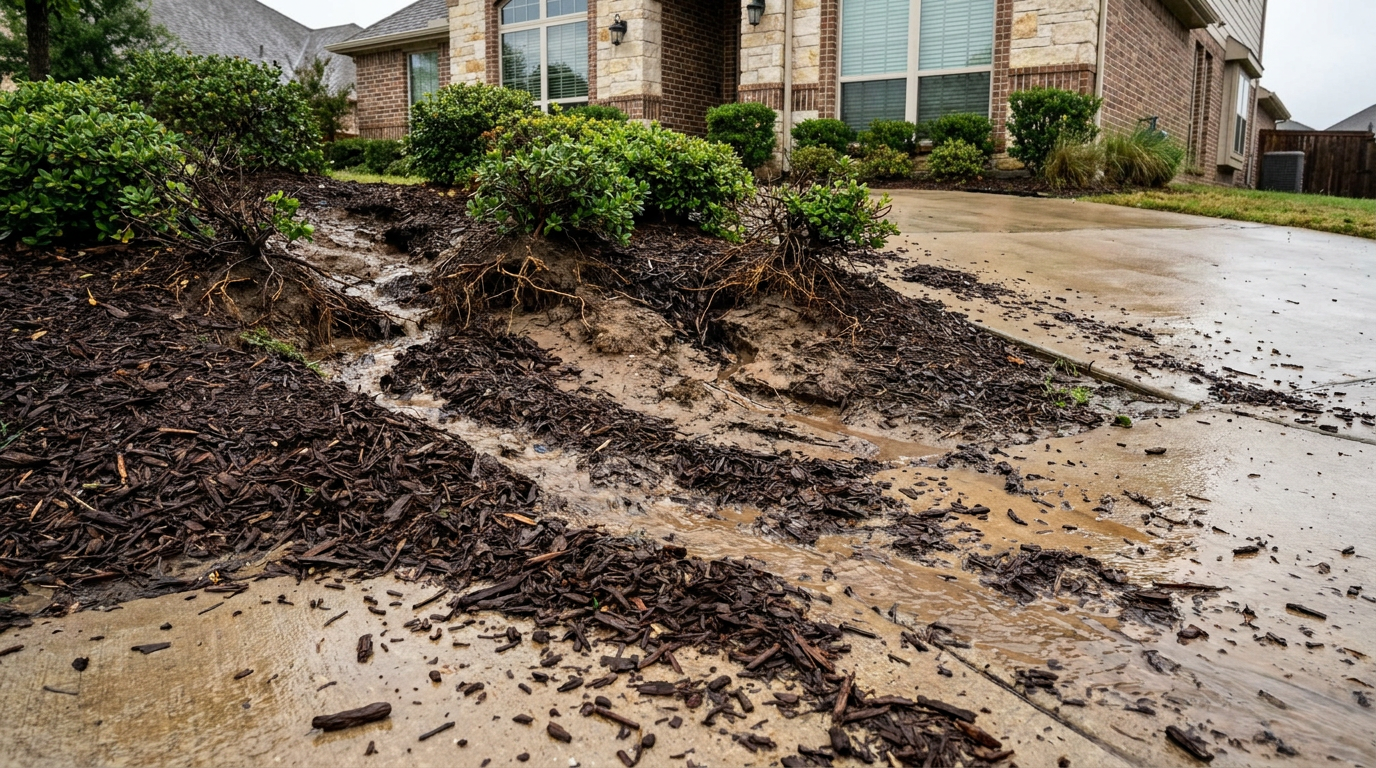
Every big rain turns a sloped bed into an orange-brown mess. Bark chips end up on the sidewalk, stacked against the garage door, and jammed up in curb drains — and your plant roots are left out there baking in the sun.
You rake it back. You smooth it out. You water it in. Then, two weeks later, another thunderstorm rolls through and dumps two inches of rain in forty-five minutes. Same story. No dice.
And the real problem isn’t just the mess you see out front. When mulch washes out, it takes topsoil with it, exposes root flares to heat and cold, dries out feeder roots, and leaves weed seeds wide open to germinate. I’ve also seen loose mulch pile up against brick weep holes and siding, which is a nice little bridge for subterranean termites and carpenter ants — not something you want hanging around the house. Trying to fix that by tossing on more mulch just feeds the next washout.
How It Works
Keeping mulch on a slope comes down to friction, weight, and water control. Smooth stuff — pine bark nuggets, wood shavings, rubber chips — doesn’t lock together worth a damn. A lot of that material’s lighter than water when it’s dry, so once runoff starts moving, it’ll lift and carry it downhill in a hurry.
As water runs down a slope, it breaks into little channels called rills. Once that water hits about 2 feet per second, it’s got enough punch to start pulling loose mulch with it.
So what do you do? Slow the water down and give the mulch something to grab. Shredded hardwood mulch has those rough, fibrous strands that mat together like an old felt pad once it gets wet. That mat acts like a bunch of tiny speed bumps, so water soaks in instead of racing across the top.
Once you get steeper than a 3:1 pitch — that’s a 33% slope — friction alone usually won’t cut it. That’s where anchors matter. Jute erosion netting and stepped mini-swales bind the mulch to the soil and take the sting out of heavy rain before it can start moving everything downhill.
Step-by-Step Fix
Here’s how I’d lock mulch onto a sloped planting bed and keep it there.
-
Clear the loose floaters and expose bare soil — Rake off every loose pine bark nugget, rounded chip, and stray bit of debris from the slope. Scoop the mess into a wheelbarrow and get it out of the way, or reuse it on level ground. You want clean soil so the mulch can actually grab hold.
- Tools needed: Heavy-duty steel bow rake, square-point transfer shovel.
- Watch out: Don’t tear up shallow surface roots while you’re cleaning the bed out.
-
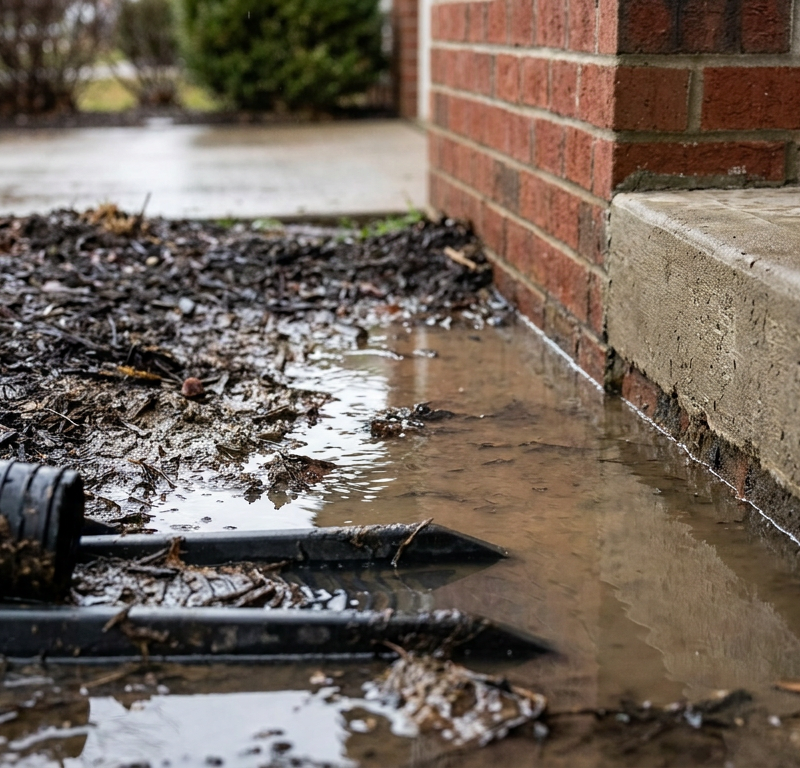
Divert upstream downspouts and surface runoff — Check the top edge of the slope. If gutter overflow or a downspout dumps right above the bed, the mulch’s got no chance. Run 4-inch corrugated or smooth PVC pipe past the bottom of the bed, or set a pop-up emitter in the lawn below.
- Safety note: Make sure downspout extensions discharge at least 10 feet away from your home's foundation.
- If this doesn't work: Put in a catch basin at the high corner of the bed to grab sheet flow coming off the lawn.
-
Carve a bottom retention trench (the catch trench) — Dig a 3- to 4-inch deep, 6-inch wide trench along the low edge of the slope, right behind the lawn or hardscape border. Give the uphill side a soft bevel. That trench acts like a settling zone where sediment drops out before it hits the grass or driveway.
- Tools needed: Flat spade or trenching shovel.
- Pro tip: Throw the dirt you dig out just uphill from the trench and pack it down to form a small berm.
-
Rough up the slope surface for mechanical grip — Hard-packed clay can act like a sheet of concrete. Use a 4-tine garden cultivator or hand mattock to scratch shallow horizontal grooves 1 to 2 inches deep across the face of the slope, running across the water flow.
- Why this matters: Those horizontal furrows catch trickling water and help mulch fibers bite into the soil.
- Don't do this: Never till deeply on a slope; that loosens the whole thing up and can trigger serious slumping.
-
Terrace steep sections with anchor logs or stone ledges — For slopes greater than a 20-degree pitch, build small terraces. Drive 18-inch rebar stakes through cedar landscape timbers or set flat fieldstones horizontally every 3 to 4 feet up the slope.
- Materials needed: 8-foot cedar 4x4s, #4 (1/2-inch) rebar pins, mini-sledgehammer.
- If you're on a budget: Use rough fallen limbs along the contour lines and stake them down with untreated hardwood survey stakes.
-
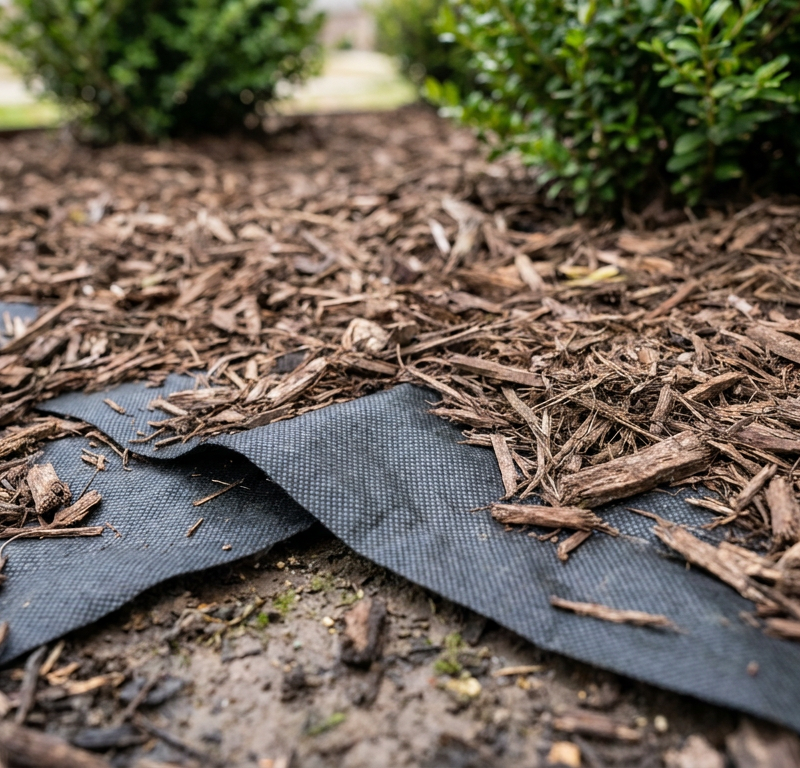
Roll out open-weave jute erosion mesh — If your slope drops more than 1 foot for every 3 feet of run, lay open-weave jute or coir netting right over the bare, furrowed soil. Unroll it across the slope and overlap horizontal edges by 4 to 6 inches and vertical seams by 8 inches.
- Materials needed: 4-foot-wide woven jute netting (1-inch grid spacing).
- Important: Don’t use synthetic plastic landscape fabric here. That stuff turns into a slick slide and sends the top layer right off.
-
Drive 6-inch steel staples across the grid — Pin the jute tight against the contours with heavy-gauge, 6-inch steel landscape staples. Set them every 2 feet down the center and every 12 inches on the overlaps, using a rubber mallet.
- Safety check: Call 811 to locate underground lines before pounding metal stakes into the bed.
- Testing grip: Give the mesh a gentle tug; it shouldn’t lift more than a quarter inch.
-
Spread double-shredded hardwood mulch — Dump wheelbarrows of double- or triple-shredded hardwood mulch along the slope. Spread it by hand or with a pitchfork to an even depth of 2 to 2.5 inches. Don’t go over 3 inches, or it’ll shear under its own weight when it gets wet.
- Mulch type: Shredded cedar, cypress, or native hardwood bark. Skip dyed single-ground mulch chips.
- Crucial technique: Work the shredded mulch into the open mesh with the back of your bow rake or even your boots.
-
Saturate and pack the mulch layer immediately — Put your hose nozzle on a gentle shower and soak the bed until water gets all the way through the 2 inches. Once the mulch starts wetting out, walk it in or tamp it with the flat side of a spade.
- Timing: 10 to 15 minutes of thorough watering per 100 square feet.
- Why this works: Wet fibrous mulch lets out natural lignins and fine plant fibers that tangle up and dry into one semi-rigid blanket.
-
Install deep-rooting groundcovers on high-shear zones — Plant creeping thyme, liriope, dwarf mondograss, or creeping juniper through small slits cut right into the jute netting. Over the next 6 to 12 months, those roots take over the job before the jute breaks down on its own.
- Spacing: 12 to 18 inches on center across the most vulnerable sections of the slope.
I pulled a water heater in Frisco last month and the homeowner showed me a side bed that had washed clean down to clay — same exact problem. Once we reworked the runoff and switched the mulch, that thing stayed put through the next hard rain.
Common Causes
Why does mulch keep washing away in the first place? Usually it’s one of these five headaches:
- Using buoyant mulch materials: Big pine bark nuggets, shredded cypress chips, and rubber mulch all float like crazy in moving water. Once they lift, the runoff just carries them away.
- Over-mulching beyond 3 inches: When you pile it 4 to 6 inches deep, the top layer gets separated from the soil and sits there loose. First hard rain, it’s moving.
- Underlying non-woven landscape fabric: Putting slick weed fabric under mulch on a slope works like a slip-and-slide. The mulch can’t grip it, so it skates off.
- Direct gutter and roof runoff: A bad gutter seam or a downspout dumping hundreds of gallons of water per hour onto the bed creates a little flash flood right where you don’t want it.
- Compacted native subsoils: In places with dense Texas blackland clay or packed-up urban soil, water can’t soak in fast enough. Runoff spikes within three minutes of rainfall starting.
Common Mistakes
- Layering weed fabric underneath: Folks think fabric will stop weeds on a hill. It won’t. It just stops the mulch from grabbing the soil, and your $150 mulch investment ends up in the storm drain after the first big rain. Skip it on slopes; use dense plant cover instead.
- Using dyed hardwood chips instead of shredded bark: Dyed mulch is usually chopped-up pallet scraps in flat chunks. They don’t have the fibrous “hairs” that shredded bark uses to knit itself together. Buy double-shredded bark.
- Building a mulch volcano around tree trunks: Piling mulch high against root crowns on a slope leads to bark rot, rodents, and a cone-shaped pile that slumps downhill. Keep mulch 3 to 4 inches away from trunk bases.
- Neglecting horizontal contours: Raking mulch straight up and down makes natural water lanes. Always rake and grade across the slope face so you don’t hand water a path.
- Applying dry mulch right before a forecasted thunderstorm: Dry shredded mulch needs a little soak to lock its fibers together. If a hard storm hits before you water and tamp it, that dry mulch will just float right out.
Cost & Time Breakdown
| Task | DIY Cost | Pro Cost | Time |
|---|---|---|---|
| Clear Old Mulch & Grade Soil | $0 (existing tools) | $200–$400 | 2–3 hours |
| Downspout Rerouting (10 ft pipe) | $20–$45 | $150–$300 | 1–2 hours |
| Jute Netting & Staples (500 sq ft) | $45–$80 | $250–$450 | 2–3 hours |
| Timber or Stone Mini-Terraces | $60–$180 | $400–$900 | 3–5 hours |
| Double-Shredded Bark Mulch (2 yds) | $80–$140 | $250–$500 | 2–3 hours |
| Erosion-Control Groundcover Plugs | $50–$150 | $300–$600 | 2–4 hours |
Tips & Prevention
- Top-dress annually with 1 inch of fresh shredded bark: Don’t dump down another full 3-inch layer every spring. A light 1-inch top-off freshens the look and ties into the layer underneath without making a sliding mess.
- Inspect the slope after the season's first big freeze: Freeze-thaw cycles heave clay soil and can push landscape staples right out. Walk the bed in late winter and tap any loose staples back down flush.
- Look for channel ruts every spring: If you spot little carved-out rills under the mulch, that’s your warning sign that runoff has found a path. Fill them with a 50/50 mix of coarse sand and native topsoil, tamp it, and re-anchor.
- Establish root systems before rainy seasons: Get groundcovers in during early fall or spring so their roots have time to knit the slope together before storm season shows up.
- Check gutter downspouts during downpours: Put on a raincoat during a hard storm and make sure the downspout extensions aren’t overflowing or shooting water out the side of the bed.
When to Call a Professional
Most sloped beds can be fixed with hand tools, decent mulch, and a solid afternoon of work. But sometimes the problem goes deeper than the top layer.
If your planting bed slope exceeds 30 degrees (a 1:1.7 pitch), or if you see deep horizontal cracks and the soil is starting to slump, you’re looking at structural slope failure. Mulch isn’t the issue then — soil mechanics are. At that point, surface fixes won’t hold, and moving ground can threaten fences, retaining walls, or your home’s foundation.
Call a licensed landscape contractor or civil engineer when the slope borders your home's foundation footer, when retaining walls taller than 4 feet are needed, or when water pooling at the base puts septic drain fields at risk. Building engineered block walls with proper perforated drain tile, crushed gravel backfill, and geotextile reinforcement takes specialized grading equipment, local permits, and structural calculations that go way beyond a weekend DIY job.
Frequently Asked Questions
Can I use liquid mulch glue to stop washouts on a hill?
Yes, water-based landscape mulch glue (liquid binder) works pretty well on low to moderate slopes (under 15 degrees). Spray it on with a standard pump sprayer in two thin coats, and let it dry 24 hours between applications. Still, it’s only temporary. It usually breaks down after 6 to 12 months of strong UV and heavy rain, and it won’t hold lightweight pine nuggets on steep slopes.
What is the best type of mulch for steep slopes?
Double-shredded or triple-shredded native hardwood bark is the gold standard for slopes. Its long, jagged, fibrous strands lock together and form a woven blanket that fights water shear. Shredded western red cedar is another solid pick. Don’t use round pine bark nuggets, wood chips, or pea gravel on an uncontained incline.
Should I put landscape fabric under mulch on a slope?
No, I wouldn’t. Ever. Smooth fabric makes a slip-plane with almost no friction. Once rain soaks it, the mulch rides on top and slides off like a little avalanche. Use biodegradable open-mesh jute netting instead — it anchors into the dirt and lets roots get established.
How steep is too steep for mulch alone?
Anything steeper than a 3:1 ratio — 1 foot of vertical drop for every 3 feet of horizontal run, or roughly 18 degrees — won’t reliably hold mulch by itself. On slopes steeper than 3:1, you need erosion control netting, horizontal terrace timbers, boulder steps, or dense groundcovers to keep washouts from happening.
Why do pine bark nuggets always float away?
Pine bark has trapped air pockets and a high resin content, so its density ends up lower than water. Once rainfall turns into surface runoff, those nuggets pop up and ride downhill like tiny boats, no matter how flat the bed seems.
How deep should mulch be applied on an incline?
On a slope, mulch should stay at 2 to 2.5 inches deep. A lot of homeowners think thicker is better, but too much depth makes a loose, top-heavy layer that’s not tied to the soil. Gravity and water will shear it right off the bed.
Can I mix gravel with mulch to hold it down?
Bad idea. It turns into an ugly mess and makes planting, weeding, and maintenance a pain later on. Gravel doesn’t bond with bark; the heavy stone migrates down to the soil while the organic mulch still wants to float away on top.
How long does jute netting take to decompose?
Untreated biodegradable jute netting usually lasts 12 to 24 months, depending on soil moisture, temperature, and microbial activity. That’s plenty of time for perennials, shrubs, and spreading groundcovers to build strong root systems that anchor the slope for good.
Will heavy groundcovers attract snakes and pests to the slope?
Dense groundcover can give insects and small critters a place to hang out, but it generally won’t raise pest problems inside your home as long as you keep a clear 12- to 18-inch buffer of bare dirt or crushed granite against the foundation wall. Don’t let groundcovers run right up against siding or brick veneer.
Related Articles
Keep troubleshooting with these hand-picked guides from FixlyGuide:
- Water Pooling in Landscape Beds? 10 Steps to Stop Foundation Flooding — Fix standing water and poor drainage in landscape beds around your foundation with pro-tested regrading, downspout extensions, and sub-surf…
- The #1 Secret to Edging Flower Beds That Last Years (and Resist Weeds) — Discover the crucial, often-skipped step that ensures your landscape edging stays put and keeps weeds out for years, transforming your flow…
- Nutsedge Taking Over Your Lawn? 10 Steps to Kill It at the Root — Stop pulling nutsedge by hand. Learn how to identify yellow and purple sedge, select the right selective herbicide, and destroy tubers with…
- Lawn Covered in Bleached Spots After Snow Melts? How to Fix Snow Mold in 10 Steps — Discover why snow mold leaves ugly bleached circles on your spring lawn, how to tell gray from pink mold, and the step-by-step fix to resto…
- The 3 Permanent Weed Killers No One Talks About (And How to Use Them Safely) — Discover three overlooked, highly effective methods for permanently eliminating weeds from your yard, moving beyond temporary fixes to long…
- Bouncy Floating Floors? 5 Causes and How to Fix Hollow Spots — Eliminate hollow sounds and bounce in floating vinyl or laminate floors by relieving pinched wall gaps or injecting subfloor voids with spe…
Should you do this yourself?
Answer five quick questions before you start. Safety outranks savings every time.
Your experience with work like this
How high do you have to work?
Does the job involve any of these?
Will it need a permit?
Specialty tools
Free and instant. Educational guidance only — not a quote, inspection, or professional diagnosis.
Estimate your own project cost
National averages are a starting point. Enter your details for a range that fits your house.
Mulch & topsoil calculator
- Material cost (delivery extra)$45 – $90
Bulk delivery typically adds $50–$150 per trip but is cheaper than bagged for jobs over ~2 cu yd.
Educational estimate only — always confirm with written local bids.
What should this project cost?
Enter your project details for a realistic cost range before you call anyone.
Maintenance projects start a few hundred dollars; full redesigns often $6,000–$15,000.
- Regional adjustment
- National average
- Labor share (typical)
- ~$2,453
- Quotes to collect
- 3 written estimates
Educational estimate based on national averages — not a binding quote. Always confirm with written local estimates.
Before you start
Check the difficulty, permits, and safety risk — then decide whether to call a pro.
Free, no signup required. Estimates are educational guidance, not a quote or an inspection.
Get the print-ready PDF of this guide
A clean, ad-free, printable version you can keep on your phone or pin to the workshop wall. Free with a FixlyGuide account.
- Print-optimized layout
- Tools, materials & every step included
- Saved to your account
Frequently asked questions
Can I use liquid mulch glue to stop washouts on a hill?+
Yes, liquid landscape mulch glue works on low to moderate slopes (under 15 degrees). Apply two thin coats with a pump sprayer, allowing 24 hours between coats. Keep in mind it's a temporary fix that breaks down after 6 to 12 months under direct UV light, and it won't hold buoyant pine nuggets on steep inclines.
What is the best type of mulch for steep slopes?+
Double-shredded or triple-shredded native hardwood bark is the best choice. Its jagged, fibrous strands physically knit together into an interlocking mat that resists water runoff. Avoid pine bark nuggets, dry wood shavings, and rubber mulch on slopes because they float immediately.
Should I put landscape fabric under mulch on a slope?+
No, avoid landscape fabric on slopes. It creates a slick slip-plane between the dirt and mulch. When rainwater saturates the bed, the mulch simply slides off the smooth synthetic fabric. Use biodegradable jute netting instead, which locks mulch fibers directly into the underlying earth.
How steep is too steep for mulch alone?+
Any incline steeper than a 3:1 ratio (1 foot of vertical drop for every 3 feet of horizontal run, or roughly 18 degrees) cannot hold mulch by itself. Slopes steeper than 3:1 need mechanical aids like jute netting, contour logs, stone check dams, or deep-rooted groundcovers.
Why do pine bark nuggets always float away?+
Pine bark has high air content and buoyant natural resins, giving it a specific gravity lower than water. Even minor rainfall runoff lifts the nuggets, allowing flowing water to sweep them downhill like tiny boats.
How deep should mulch be applied on an incline?+
Mulch on a slope should be kept between 2 and 2.5 inches deep. Piling it thicker than 3 inches separates the top layer from the soil line, creating a buoyant, loose mass that shears off and slides downhill during cloudbursts.
Can I mix gravel with mulch to hold it down?+
Never mix gravel with mulch. Gravel is dense and sinks to the dirt below, while the mulch remains loose on top and continues to wash away. The resulting blend is difficult to weed, impossible to rake, and ruins planting beds for future seasons.
How long does jute netting take to decompose?+
Untreated woven jute netting breaks down naturally within 12 to 24 months. That provides plenty of time for new perennials, ornamental grasses, or creeping groundcovers to establish deep root systems that take over the job of holding the slope.
Will heavy groundcovers attract snakes and pests to the slope?+
Groundcovers can provide harborage for small insects, but they won't bring pests into your home if you keep a dry, 12- to 18-inch maintenance gap between the planting bed edge and your home's foundation or siding.
Discussion
Loading comments…