- Lawn Full of Tunnels? How to Tell Moles from Voles and Stop the Damage — Stop lawn tunnels for good. Learn how to tell moles from voles, locate active runs, set effective traps, and protect your yard from destruc…
- Grass Turning Yellow After Mowing? 5 Causes and How to Fix It — Grass turning pale or yellow after mowing? Discover the causes of mower scalping and torn blades, and learn the step-by-step fix to restore…
- The 1 Mowing Mistake That Leaves Your Lawn Brown and Patchy — Discover the most common mowing mistake homeowners make that leads to unhealthy, patchy grass and how to fix it for a vibrant lawn.
- Water Pooling in Landscape Beds? 10 Steps to Stop Foundation Flooding — Fix standing water and poor drainage in landscape beds around your foundation with pro-tested regrading, downspout extensions, and sub-surf…
- The 1 Mistake Killing Your Lawn's Crabgrass Defense (And the Easy Fix) — Discover why common crabgrass removal methods fail and how to naturally eliminate this stubborn weed for a healthier lawn.
Landscaping · Deck or fence project
| Project category | Landscaping |
|---|---|
| Problem type | Deck or fence project |
| Trade required | Landscaping |
| Urgency | Planned project |
| Safety risk | Moderate safety risk |
| DIY suitability | DIY for experienced homeowners |
| Cost category | High cost |
| Typical timeline | Most builds 3–10 days depending on size |
| Contractor type | Landscaping contractor |
Repair option
Replace failed boards, posts, and hardware; reseal the surface.
Replacement option
Rebuild when framing or the ledger connection is unsafe.
Common causes
- Rot at posts and ledger
- Storm damage
- Adding outdoor living space
Relevant tools:home improvement material pricesproject cost estimator
Published October 27, 2026Last updated October 27, 2026
Tools & materials you'll need
Affiliate links- Amazon1-gallon pump sprayer1 · Handheld compression sprayer with adjustable fan nozzle
- AmazonChemical measuring syringe or graduated spoon1 · For measuring precise liquid or powder doses
- AmazonChemical-resistant nitrile gloves1 pair · Personal protective equipment for handling concentrates
- AmazonSafety goggles1 pair · Eye protection during spray application
As an Amazon Associate FixlyGuide earns from qualifying purchases — at no extra cost to you. Prices and availability are accurate as of publication and subject to change.
Quick Answer
Nutsedge moves into lawns because those underground tubers—nutlets—hang around after standard broadleaf herbicides do nothing to them, and they love compacted, waterlogged clay. If you want it gone for good, you’ve got to hit it with a sedge-specific selective herbicide that contains sulfentrazone or halosulfuron-methyl before the plant gets past six leaves, and you’ve also got to fix the drainage and irrigation mess underneath. Don’t yank mature nutsedge by hand. If you snap the stalk, you wake up dormant tubers below the surface, and one stalk turns into a whole mess of them before you know it.
The Problem
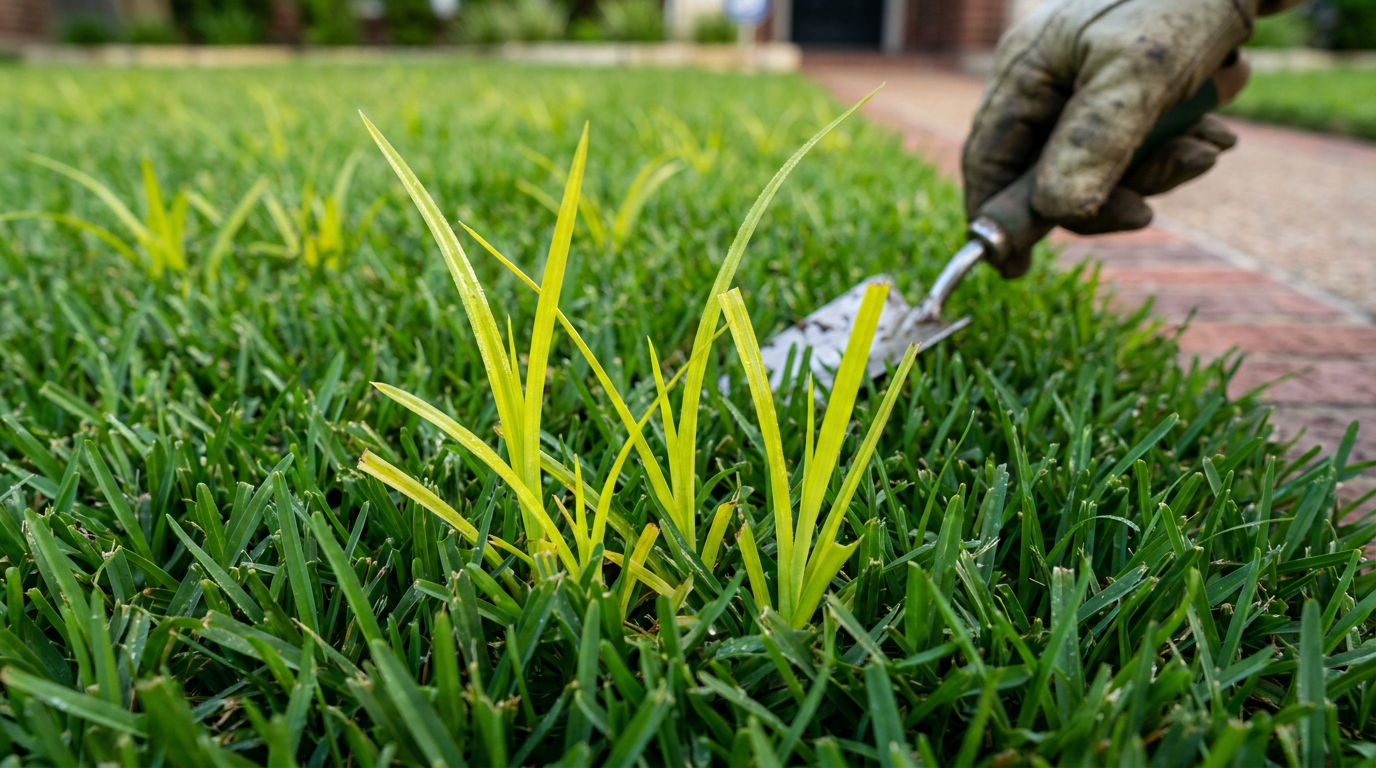
Yellow and purple nutsedge (Cyperus esculentus and Cyperus rotundus) can fool you at first glance. They look like normal turfgrass until they pop up two to three inches above your mower line just forty-eight hours after a cut. They’ve got that lime-green to yellowish sheen, a stiff upright habit, and a hard, triangular stem. Roll the base of the stem between your thumb and index finger—if you feel three distinct sharp edges, you’re dealing with a sedge, not grass.
The real headache’s under the dirt. Nutsedge isn’t a broadleaf weed, and it isn’t a true grass either. It’s an aggressive perennial sedge that builds an underground network of rhizomes and starch-filled tubers called "nutlets." A single healthy nutsedge plant can crank out several hundred tubers in one summer. Those tubers sit between 2 and 14 inches deep in the soil, riding out freezing temperatures down to 20°F, brutal droughts, and standard off-the-shelf broadleaf weed sprays like 2,4-D or dicamba. Those regular weed killers just burn off the foliage, which tells the underground tubers to wake up and send up three to ten new shoots where you had one.
I pulled a water heater in Frisco last month that had exactly this kind of “I’ll be fine if I ignore it” problem in the yard outside—same story, soggy clay, same weed popping back like it owned the place. That’s nutsedge for you. It doesn’t quit.
How It Works
To beat nutsedge, you’ve got to understand how it feeds and how it reproduces. In late spring, once soil temperatures at a 2-inch depth consistently hit 65°F, dormant tubers push shoots toward the surface. The plant runs on starch reserves stored in the tuber until it gets to 4 to 6 leaves. Once it crosses that five-to-six-leaf mark, the plant flips a switch: it stops leaning on the mother tuber and starts making its own food, sending sugars downward through basal bulbs to form new lateral rhizomes and daughter tubers.
Standard contact herbicides (like diquat or glufosinate) only kill the green tissue they touch. Systemic sedge-specific herbicides work a lot differently:
[Sulfentrazone / Halosulfuron Foliar Contact]
                 │
                 ▼
    [Xylem / Phloem Absorption]
                 │
                 ▼
    [Translocation Down Rhizome]
                 │
                 ▼
  [Inhibition of ALS or PPO Enzymes]
                 │
                 ▼
   [Tuber Starvation & Cellular Death]
These selective chemistries mess with enzyme pathways that sedges rely on, like acetolactate synthase, or ALS, and they move down into the vascular bundle and basal bulb. Spray too early? Good. Spray while the plant’s actively photosynthesizing? Even better. The chemical rides the sugar stream right into the mother and daughter tubers and shuts down their ability to come back next spring.
Step-by-Step Fix
Beating nutsedge takes a plan. Don’t grab the nearest generic weed spray and call it a day. Work through these steps if you want to knock it down to the last tuber.
-
Confirm the stem structure — Pluck one stalk near the soil line and roll the bottom two inches between your fingers. A triangular, three-sided stem confirms nutsedge, while a flat or round stem points to crabgrass, dallisgrass, or some other true grass. Check leaf color, too: yellow nutsedge has light green leaves with sharp, pointed tips, while purple nutsedge has blunt, dark green leaves with boat-shaped tips.
- If the stem is round: Stop. Halosulfuron won’t do the job; you need a grassy weed herbicide like quinclorac.
- Tools: Magnifying glass or hand lens (optional).
-
Halt all hand-pulling immediately — Quit yanking nutsedge stalks out of the turf by hand. Hand-pulling shears the root system just below the basal bulb, leaving the nutlet in the ground. That releases apical dominance, and the dormant lateral tubers break dormancy and pop up within 7 to 10 days.
- Safety check: If you’ve already hand-pulled a section, wait 10 to 14 days until new shoots produce at least three fully open leaves before spraying.
-
Map and flag irrigation hot spots — Walk your lawn at 6:00 AM while the sprinkler system runs. Nutsedge loves standing water, low spots, and compacted clay. Flag any area where water pools for longer than 30 minutes after a cycle, or where sprinkler heads overlap too much and leave the ground soggy.
- Quick fix: Cut run times on affected zones by 25% to 35% right away so the top 2 inches of soil can dry out.
-
Time the application window — Check the 5-day weather forecast before you mix anything. You want air temperatures between 65°F and 85°F at application time, zero rain in the forecast for 8 to 24 hours depending on label requirements, and wind under 5 mph so you don’t drift onto shrubs and ornamentals.
- Warning: If you spray halosulfuron or sulfentrazone when it’s above 90°F, you can scorch cool-season grasses like Fescue or Kentucky Bluegrass for a bit, and you may stunt warm-season grasses like Bermuda or St. Augustine.
-
Let the weed grow for 48 to 72 hours — Don’t mow for at least two days before you spray. Nutsedge leaves are waxy and narrow, and you need as much leaf surface as you can get to soak up the systemic ingredient.
- Pro detail: Mowing right before spraying strips away 80% of the target foliage, which makes foliar-absorbed chemicals almost useless.
-
Mix your selective sedge herbicide — In a clean, dedicated 1-gallon pump sprayer, measure out your active ingredient with a proper measuring syringe or spoon. For halosulfuron-methyl (such as Sedgehammer), dissolve one 0.9-gram packet per 1 gallon of water to treat approximately 1,000 square feet. For sulfentrazone, measure 0.18 to 0.25 fluid ounces per gallon according to your specific turfgrass tolerance.
- Safety: Wear nitrile gloves, long pants, closed-toe shoes, and eye protection while measuring and mixing.
-
Add a non-ionic surfactant (NIS) — Add 2 teaspoons (0.33 fl oz) of high-quality non-ionic surfactant per gallon of spray mix unless your herbicide packaging says surfactant is already mixed in. Nutsedge blades have a thick, hydrophobic cuticular wax layer that makes water bead up and roll right off into the dirt. A surfactant breaks that surface tension and lets the droplet flatten so the chemical can get into the leaf tissue.
- Crucial step: Don’t skip this. Without surfactant, up to 70% of foliar herbicide rolls off the blade before it gets absorbed.
-
Calibrate and spray to wet, not runoff — Set your sprayer nozzle to a medium droplet or fan pattern. Skip fine mist, which drifts, and skip jet streams, which bounce off the leaves. Hold the spray wand 12 inches above the weed canopy and coat the nutsedge leaves until they glisten with moisture. Stop before liquid starts pooling and running into the soil.
- Targeting: Spray only the weeds and the turf right around them; don’t broadcast-spray the whole lawn unless the infestation covers more than 40%.
-
Enforce the post-spray hold period — Keep kids and pets off the treated lawn until the spray has fully dried, usually 2 to 4 hours in direct sun. Don’t run sprinklers or irrigate for at least 24 hours. Don’t mow for 48 hours after application so the chemical has time to move down into the root tubers.
-
Monitor and execute a follow-up strike at 21 days — Check the area three weeks later. Sedge herbicides work slow. ALS inhibitors usually take 10 to 14 days to show yellowing and purpling, with full death landing at 3 to 4 weeks. Tubers that were still dormant during the first spray may send up new shoots now. Spot-treat any surviving green shoots that reach the 3-leaf stage to drain the last of the starch reserves.
Common Causes
Why did your lawn get hammered with nutsedge while the neighbor’s yard stayed clean? It doesn’t happen by accident.
| Contributing Factor | How It Triggers Nutsedge | Solution |
|---|---|---|
| Overwatering | Keeps top 2 inches of soil continually saturated, creating the anaerobic conditions nutsedge thrives in. | Shift from daily 10-minute cycles to deep watering 1-2 times per week. |
| Compacted Clay | Prevents rapid drainage; roots of healthy grass suffocate, creating bare dirt gaps. | Core aerate annually in spring (warm-season) or fall (cool-season). |
| Mowing Too Low | Scalping reduces lawn turf density, letting sunlight warm soil and wake up tubers. | Raise mower deck to 3.0–4.0 inches for Fescue, St. Augustine, or Zoysia. |
| Contaminated Topsoil/Mulch | Inexpensive, uncomposted fill dirt or raw mulch often carries dormant viable tubers. | Source certified weed-free compost and purchase topsoil from reputable landscape supply yards. |
| Wrong Herbicide Selection | Standard 2,4-D or triclopyr broadleaf sprays kill grass and weeds, clearing space for nutsedge to explode. | Use halosulfuron-methyl or sulfentrazone products specifically labeled for sedge control. |
Common Mistakes
- Yanking nutsedge with your bare hands — It feels like you’re doing something, but pulling nutsedge almost always snaps the fragile underground rhizome right above the tuber. The tuber stays in the soil, and losing that central leader can trigger up to a half-dozen secondary tubers to sprout. Unless you’re in loose potting mix and you sift out every nutlet, hand-weeding turns one weed into six.
- Using broadleaf killers and expecting results — Spraying standard products containing 2,4-D, dicamba, or MCPP will make nutsedge look tip-burned for a minute, but it usually bounces back in two weeks. Worse, you stress your good turfgrass and hand the field over to the nutsedge.
- Spraying during the heat of the day — Hitting sedge-killing chemistry when temperatures climb above 85°F to 90°F can burn the lawn. The grass turns yellow or brown, and the nutsedge curls its stomata shut to hang onto water, which blocks herbicide absorption. Early morning or evening is the move.
- Skipping the non-ionic surfactant — Water’s got high surface tension, and nutsedge leaves are coated in thick cuticle wax. Spray without surfactant and the chemical beads up, then rolls off onto the soil where it does nothing to the foliage.
- Expecting overnight results — Halosulfuron is an ALS inhibitor; it doesn’t torch weeds overnight like glyphosate or vinegar. If you spray on Monday, the plant probably won’t even look sick by Friday. Homeowners panic, spray again too soon, and beat up their grass. Give systemic chemistry a full 14 to 21 days to finish the kill.
Cost & Time Breakdown
DIY vs. Professional Nutsedge Eradication
┌─────────────────────────┬──────────────┬──────────────┬──────────────┐
│ Task                    │ DIY Cost     │ Pro Cost     │ Time         │
├─────────────────────────┼──────────────┼──────────────┼──────────────┤
│ Initial Spot Spray      │ $25 – $45    │ $75 – $150   │ 30 – 45 min  │
│ Follow-up Application   │ $0 (leftover)│ $60 – $100   │ 20 – 30 min  │
│ Sprayer & Safety Gear   │ $20 – $35    │ Included     │ 15 min setup │
│ Core Aeration (Rental)  │ $60 – $90    │ $120 – $220  │ 2 – 3 hours  │
│ Total First-Year Plan   │ $105 – $170  │ $255 – $470  │ ~4 hours     │
└─────────────────────────┴──────────────┴──────────────┴──────────────┘
Tips & Prevention
- Raise your mowing deck half an inch to a full inch — A thick, tall lawn canopy shades the soil surface. Nutsedge tubers need strong light and warm soil temperatures to wake up, and tall grass starves the new sprouts.
- Audit your irrigation system each April — Put empty tuna cans across your lawn and run the sprinklers for 20 minutes to measure output. If your lawn gets more than 1 to 1.5 inches of water per week including natural rainfall, you’re basically building nutsedge habitat.
- Core aerate compacted ground annually — Heavy clay soils hold water like a bowl. Pulling 2.5-inch to 3-inch soil cores brings in oxygen, breaks up compaction, and speeds drainage so deep turfgrass roots can outcompete shallow-rooting sedges.
- Apply a targeted pre-emergent in early spring — Traditional pre-emergents (like prodiamine or pendimethalin) do not stop yellow or purple nutsedge sprouting from tubers. Look for products containing dimethenamid-P or sulfentrazone applied before soil temperatures reach 60°F to suppress tuber emergence.
- Clean your mower deck after cutting infested zones — If you mow through a nutsedge patch that has gone to seed or is holding wet soil under the deck, you’ll track viable seed heads and loose tubers across clean turf. Hose off the underside of the deck over a paved surface and sweep up the mess.
When to Call a Professional
If nutsedge covers more than 50% of your total lawn area, trying to handle it with a 1-gallon hand sprayer gets impractical fast, and you can end up scorching turf from overlapping passes. Call a licensed commercial pesticide applicator when you’re dealing with widespread infestations that need calibrated multi-nozzle boom sprayers and commercial-grade tank mixes like sulfentrazone combined with quinclorac or prodiamine.
You should also bring in a pro if your nutsedge problem comes from serious yard grading issues or subsurface drainage failure—like a broken French drain, failed underground septic field, or heavy municipal runoff. In those cases, chemical control is just a band-aid. Until an excavation contractor or landscape drainage specialist regrades the property or installs a catch-basin system, the standing water’s going to keep feeding the problem year after year.
Frequently Asked Questions
Can vinegar or boiling water kill nutsedge permanently?
Vinegar (acetic acid) and boiling water will only scorch the top green growth of nutsedge. They don’t get deep enough through the root system to kill the underground basal bulb and tubers. Within 7 to 14 days, the tuber uses its stored carbohydrates to push fresh shoots right back through the soil, and you’re left with dead grass and thriving nutsedge.
Why does nutsedge grow faster than the surrounding grass?
Nutsedge uses C4 carbon fixation, a specialized photosynthetic pathway that runs at peak efficiency in bright sunlight, high temperatures, and humid conditions. While cool-season grasses slow down or go dormant when summer heat hits, nutsedge speeds up, often growing an inch per day in mid-summer heat.
Does round-up (glyphosate) kill nutsedge tubers?
Glyphosate will kill nutsedge foliage, but it doesn’t do a great job wiping out dormant subterranean tubers. On top of that, glyphosate is a non-selective herbicide, meaning it’ll kill all the good lawn turf around the nutsedge and leave an ugly bare dirt ring. That empty patch gives newly awakened nutlets the perfect sunny spot to take over without competition.
What is the difference between yellow and purple nutsedge?
Yellow nutsedge (Cyperus esculentus) has golden-yellow seed heads, leaves that taper into a sharp point, and individual tubers that form at the ends of rhizomes. Purple nutsedge (Cyperus rotundus) has dark purple-brown seed clusters, leaves with blunt, boat-shaped tips, and forms connected chains of multiple tubers underground, which makes purple nutsedge a lot tougher to knock down with one spray.
How long do nutsedge tubers survive in the ground?
Nutsedge tubers can stay dormant in soil for up to three years, and sometimes as long as five years if they’re buried deep under compacted clay. Even if you knock out 100% of the visible top growth this season, you’ve got to stay on it for the next two springs to catch those late-germinating tubers as they wake up.
Will pulling nutsedge work if I dig up the roots with a shovel?
Digging can work in small garden beds if you remove a 10-inch deep by 8-inch wide root ball of soil around the stalk and sift out every little round, marble-like tuber. In an established turf lawn, though, you’ll leave huge craters that wreck the yard, and missing even one pea-sized tuber can restart the whole infestation.
When is the best time of year to spray nutsedge?
The sweet spot is late spring to early summer (typically late May through June), when the weed is actively growing and has between 3 and 5 leaves, but before it reaches maturity or sets seed heads. At that stage, the tuber reserves are already drained from pushing early growth, and the plant hasn’t built enough extra energy to make daughter tubers.
Can I use pre-emergent weed killers to stop nutsedge?
Standard crabgrass pre-emergents like prodiamine or dithiopyr won’t stop nutsedge tubers from sprouting, though they may catch the small percentage that comes from seed. To suppress nutsedge before it emerges from underground tubers, you need specialized pre-emergents labeled for sedges, such as dimethenamid-P (Tower) or sulfentrazone applied in early spring.
Does aeration spread nutsedge across the yard?
Core aeration can spread nutsedge if you do it in the dead of summer through an active, heavily infested patch, since the tines can chop tubers and drag them into cleaner sections of the lawn. Aerate in the spring before nutsedge shows up, or treat it chemically and let it die down completely before you run an aerator across the yard.
Related Articles
Keep troubleshooting with these hand-picked guides from FixlyGuide:
- Lawn Full of Tunnels? How to Tell Moles from Voles and Stop the Damage — Stop lawn tunnels for good. Learn how to tell moles from voles, locate active runs, set effective traps, and protect your yard from destruc…
- Grass Turning Yellow After Mowing? 5 Causes and How to Fix It — Grass turning pale or yellow after mowing? Discover the causes of mower scalping and torn blades, and learn the step-by-step fix to restore…
- The #1 Mowing Mistake That Leaves Your Lawn Brown and Patchy — Discover the most common mowing mistake homeowners make that leads to unhealthy, patchy grass and how to fix it for a vibrant lawn.
- Water Pooling in Landscape Beds? 10 Steps to Stop Foundation Flooding — Fix standing water and poor drainage in landscape beds around your foundation with pro-tested regrading, downspout extensions, and sub-surf…
- The #1 Mistake Killing Your Lawn's Crabgrass Defense (And the Easy Fix) — Discover why common crabgrass removal methods fail and how to naturally eliminate this stubborn weed for a healthier lawn.
- Bathroom Faucet Handle Stuck? 12 Steps to Free It Without Breaking the Stem — Stuck bathroom faucet handle won't budge? Learn how to safely dissolve hard water scale, use a handle puller, and rebuild the valve cartrid…
Should you do this yourself?
Answer five quick questions before you start. Safety outranks savings every time.
Your experience with work like this
How high do you have to work?
Does the job involve any of these?
Will it need a permit?
Specialty tools
Free and instant. Educational guidance only — not a quote, inspection, or professional diagnosis.
What should this project cost?
Enter your project details for a realistic cost range before you call anyone.
Cost depends heavily on which system turns out to be the source.
- Regional adjustment
- National average
- Labor share (typical)
- ~$1,620
- Quotes to collect
- 3 written estimates
Educational estimate based on national averages — not a binding quote. Always confirm with written local estimates.
Get the print-ready PDF of this guide
A clean, ad-free, printable version you can keep on your phone or pin to the workshop wall. Free with a FixlyGuide account.
- Print-optimized layout
- Tools, materials & every step included
- Saved to your account
Frequently asked questions
Can vinegar or boiling water kill nutsedge permanently?+
Vinegar (acetic acid) and boiling water will only scorch the top green growth of nutsedge. They do not penetrate deeply enough through the root system to kill the underground basal bulb and tubers. Within 7 to 14 days, the tuber will use its stored carbohydrates to push fresh shoots right back through the soil, leaving your lawn with dead patches of grass and thriving nutsedge.
Why does nutsedge grow faster than the surrounding grass?+
Nutsedge uses C4 carbon fixation, a specialized photosynthetic pathway that operates at peak efficiency in bright sunlight, high temperatures, and humid conditions. While cool-season grasses slow down or go dormant when summer heat arrives, nutsedge accelerates its growth rate, often growing an inch per day in mid-summer heat.
Does round-up (glyphosate) kill nutsedge tubers?+
Glyphosate will kill nutsedge foliage, but it does a poor job eradicating dormant subterranean tubers. More importantly, glyphosate is a non-selective herbicide, meaning it will kill all the desirable lawn turf around the nutsedge, leaving an ugly, bare dirt ring. This empty patch gives newly awakened nutlets the ideal sunny spot to take over without competition.
What is the difference between yellow and purple nutsedge?+
Yellow nutsedge (Cyperus esculentus) has golden-yellow seed heads, leaves that taper into a sharp point, and individual tubers that form at the ends of rhizomes. Purple nutsedge (Cyperus rotundus) has dark purple-brown seed clusters, leaves with blunt, boat-shaped tips, and forms connected chains of multiple tubers underground, making purple nutsedge significantly tougher to control with a single spray.
How long do nutsedge tubers survive in the ground?+
Nutsedge tubers can stay dormant in soil for up to three years, and occasionally as long as five years if buried deep under compacted clay. Even if you achieve 100% control of visible top growth this season, you must remain vigilant for the next two springs to eliminate late-germinating tubers as they break dormancy.
Will pulling nutsedge work if I dig up the roots with a shovel?+
Digging can work in small garden beds if you remove a 10-inch deep by 8-inch wide root ball of soil surrounding the stalk and carefully sift out all small, round, marble-like tubers. In an established turf lawn, however, this leaves massive craters that ruin your yard, and missing just one solitary pea-sized tuber resets the entire infestation.
When is the best time of year to spray nutsedge?+
The sweet spot is late spring to early summer (typically late May through June), when the weed is actively growing and has between 3 and 5 leaves, but before it reaches maturity or sets seed heads. At this stage, the tuber reserves are depleted from pushing initial growth, and the plant has not yet accumulated enough surplus energy to establish daughter tubers.
Can I use pre-emergent weed killers to stop nutsedge?+
Standard crabgrass pre-emergents like prodiamine or dithiopyr will not prevent nutsedge tubers from sprouting, though they may stop the small percentage that germinate from seed. To suppress nutsedge before it emerges from underground tubers, you need specialized pre-emergents labeled for sedges, such as dimethenamid-P or sulfentrazone applied in early spring.
Does aeration spread nutsedge across the yard?+
Core aeration can potentially spread nutsedge if performed in the dead of summer through an active, heavily infested patch, as the tines can chop tubers and drag them to cleaner sections of the lawn. Aerate in the spring before nutsedge emerges, or treat the nutsedge chemically and let it die down completely before running an aerator across the yard.

Discussion
Loading comments…