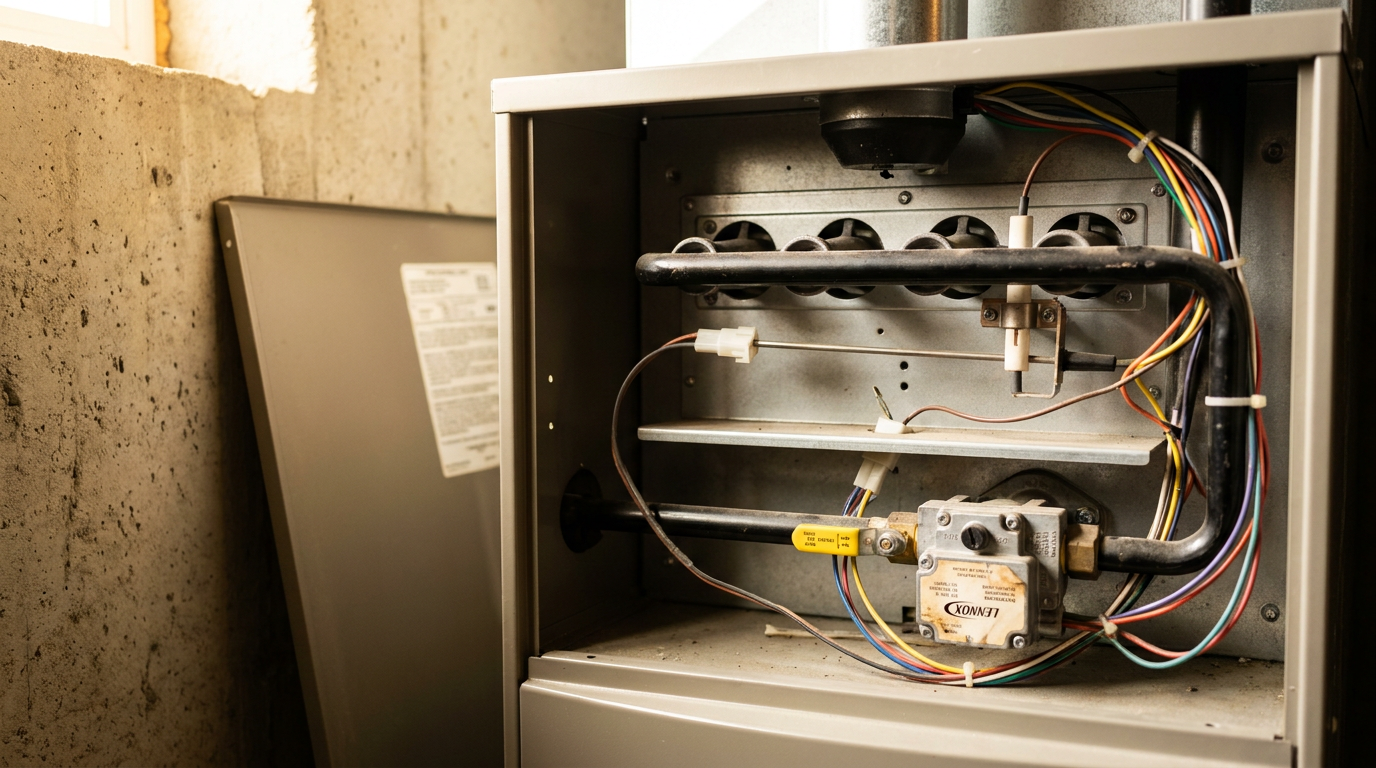
- Kill power to the furnace before you put your hands near the burners.
- Remove the 1/4-inch screw, unplug the single slip-on wire lead, and pull the rod out.
- Wipe the rod with a dry paper towel, slide it back in, and snug the screw down.
HVAC · High energy usage
| Project category | HVAC |
|---|---|
| Problem type | High energy usage |
| Trade required | HVAC |
| Urgency | Planned project |
| Safety risk | Low safety risk |
| DIY suitability | DIY for experienced homeowners |
| Cost category | High cost |
| Typical timeline | Assessment within weeks; replacement planned off-season |
| Contractor type | Licensed HVAC technician |
Repair option
Duct sealing, insulation, and a tune-up before touching the equipment.
Replacement option
High-efficiency replacement sized by a load calculation, not a rule of thumb.
Common causes
- Aging, low-efficiency equipment
- Leaking ducts losing conditioned air
- Insufficient attic insulation
- Oversized system short-cycling
Relevant tools:project cost estimatorrepair or replace
Published November 5, 2026Last updated November 5, 2026
Tools & materials you'll need
Affiliate linksAs an Amazon Associate FixlyGuide earns from qualifying purchases — at no extra cost to you. Prices and availability are accurate as of publication and subject to change.
Quick Answer
If your furnace is blowing cold air, start with the thermostat. Make sure it’s set to HEAT — not COOL — and the fan is on AUTO, not ON. If the fan’s set to ON, it’ll keep moving unheated room air all day long, even after the burners shut down. No magic there. If that doesn’t solve it, swap out a clogged air filter, check that the gas valve lever is turned parallel to the pipe, and clean the flame sensor with an abrasive pad.
The Problem
You wake up cold, walk over to a supply register, and feel a steady stream of room-temp or downright chilly air blowing on your feet. The blower’s humming away, but you’re getting zero heat.
That’s enough to make most homeowners think the whole furnace has given up the ghost. Usually, though, a furnace blowing cold air means the blower is doing its job, but the ignition, fuel supply, or safety circuit bailed out somewhere along the line. Modern furnaces are packed with fail-safes. If a sensor sees bad combustion, weak airflow, or no fuel, the control board shuts off the gas to protect your house from fire or carbon monoxide. The blower can still keep running, though, which is how you end up with a house full of cold air and a pretty irritated owner.
How It Works
If you want to troubleshoot this thing without just guessing, you’ve got to know the heating cycle. It’s not complicated, but there’s a sequence to it.
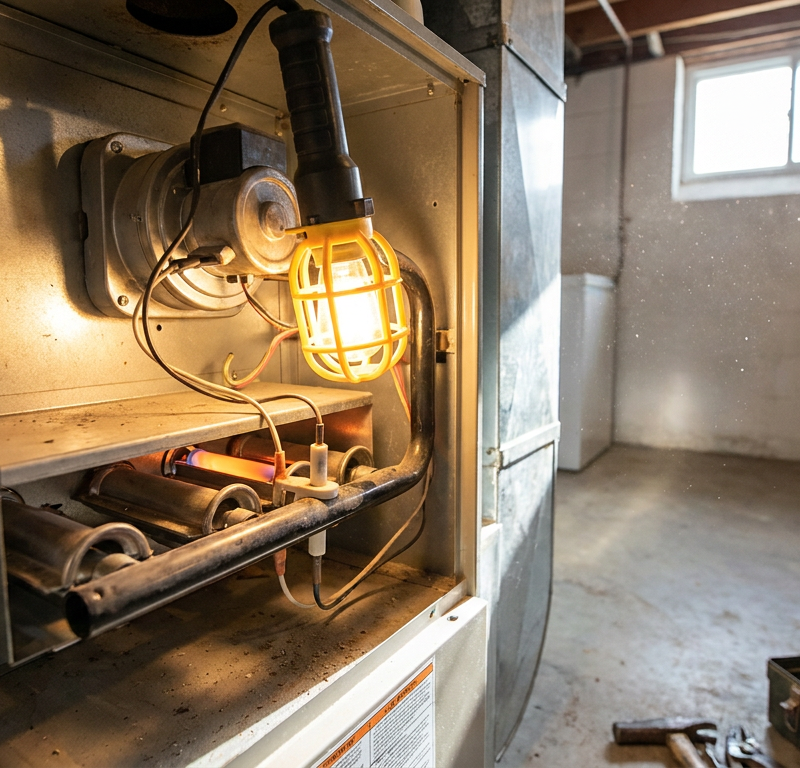
When the indoor temp drops roughly 1°F below the thermostat setting, the thermostat sends a 24-volt AC signal through the white wire (the "W" terminal) to the furnace’s control board. That board wakes up and starts the draft inducer fan. That little exhaust motor runs for 10 to 15 seconds to clear the flue and pull a vacuum on a rubber tube hooked to the pressure switch. Once that switch proves draft, the board powers the ignition system—either a spark igniter or a hot surface igniter (HSI) that glows bright orange at over 1,800°F.
Then the board sends 24V to open the main gas valve. Gas moves across the burners, hits the glowing igniter, and lights off in a clean blue flame. Within 2 to 4 seconds, a slim metal rod called a flame sensor has to detect microamps of electrical current through that flame. That’s flame rectification, in plain English. If the board gets that signal, the gas valve stays open. After a 30- to 45-second delay so the heat exchanger can warm up to roughly 130°F to 140°F, the main blower kicks on and sends that heat through the ductwork. If the flame sensor’s dirty, or a limit switch trips because the unit overheated, the board snaps the gas valve shut right away. The blower keeps running anyway. That’s why you get cold air.
I pulled a furnace in Frisco last month that was doing exactly this. Filter was packed solid, flame sensor looked like it had been buried in soot, and the homeowner swore the whole unit was dead. It wasn’t. It was just mad.
Step-by-Step Fix
Run through these in order. Start simple, then work your way deeper.
-
Verify your thermostat settings — Walk over and make sure the system switch is on HEAT, not COOL or OFF. Then check the fan setting and move it from ON to AUTO. When that fan stays on all the time, the blower runs 24 hours a day, 7 days a week, pushing unheated air through the vents between burner cycles.
- If the display’s blank, change the two AA or AAA alkaline batteries behind the faceplate.
- Turn the heat setpoint at least 5°F above the room temperature so it actually calls for heat.
-
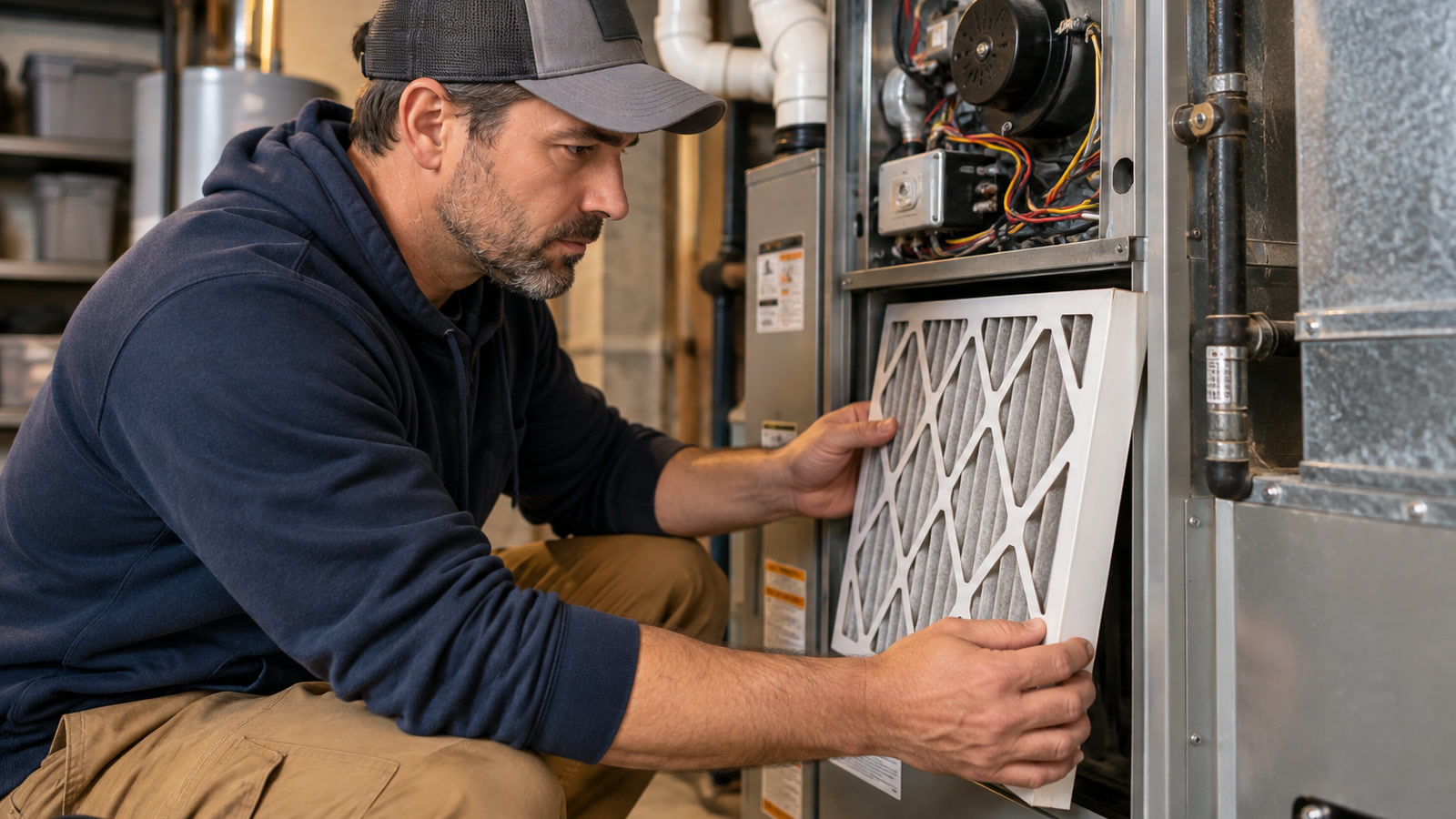
Inspect and replace the air filter — Pull the filter out of the return slot right by the furnace cabinet. A filter full of dust, pet hair, and drywall junk chokes off return airflow and drives cabinet temps past the high-limit switch threshold (often 170°F to 200°F). When that switch trips, the burners shut off, but the blower keeps running on high to keep the heat exchanger from cracking.
- Tools: New 1-inch, 2-inch, or 4-inch pleated filter that matches your cabinet size exactly.
- Put the new one in with the airflow arrow pointing toward the furnace blower compartment, not back toward the return ducts.
-
Check power switches and electrical breakers — Look for the standard toggle switch mounted on the side of the furnace or on an adjacent stud. It’s real common for somebody to bump that thing off while digging around storage bins or holiday stuff. Then head to the main panel and look for the dedicated 15-amp or 20-amp single-pole breaker labeled "Furnace" or "Heat."
- If the breaker’s tripped to the middle, flip it all the way OFF, wait five seconds, then push it firmly back to ON.
- If it trips again right away, stop. That usually means a dead short or a seized motor.
-
Confirm the gas supply valve is open — Follow the black iron or flexible yellow gas line into the furnace cabinet. You’ll find a manual shutoff valve with a lever handle. That handle needs to be parallel with the pipe to be open. If it’s sitting at a 90-degree right angle across the pipe, somebody shut the gas off.
- Check the smaller toggle or knob on the internal gas control valve inside the burner compartment too; make sure it points to "ON," not "OFF."
- If other gas appliances like a water heater or range won’t light either, the utility meter valve may be closed or tagged.
-
Read the diagnostic LED error code — Pull off the upper and lower metal access panels. Look through the clear plastic sight glass on the blower door, or look right at the green control board inside, and find the flashing red, green, or amber LED. Count the flashes. Two quick blinks, a pause, then three blinks might mean code "23" or "3 blinks" depending on the brand.
- Check the diagnostic legend sticker on the inside of the blower access door to decode it. Common ones are "Open High Limit Switch," "Flame Rollout," or "Ignition Lockout."
- Hold the door safety switch down with a piece of tape while testing, or the board cuts all 120V power as soon as the panel comes off.
-
Power-cycle the control board to clear lockouts — If the furnace tried to light three times and failed, the board may go into a safety soft-lockout or hard-lockout for one to three hours. Flip the furnace power switch OFF, or shut the breaker off, leave it off for a full 60 seconds to discharge the board capacitors, then turn it back ON.
- Watch the startup through the sight glass.
- Listen for the inducer motor, then the click of the gas valve, then the igniter glow.
-
Clean the flame sensor rod — A oxidized or soot-coated flame sensor is probably the most common reason for short-cycling and cold air. Find it on the opposite side of the burner rack from the igniter. It’s held in with a single 1/4-inch hex screw and has a white porcelain base with a thin bent rod sticking into the burner flame.
- Kill power to the furnace before you put your hands near the burners.
- Remove the 1/4-inch screw, unplug the single slip-on wire lead, and pull the rod out.
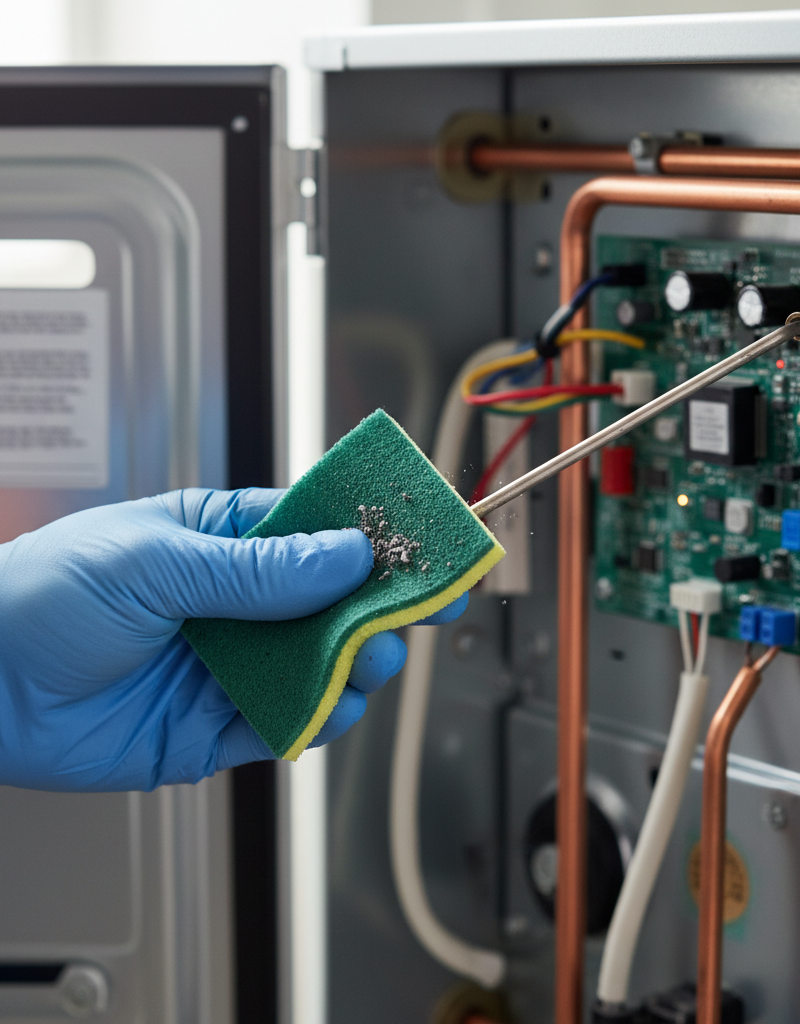
- Scrub the metal rod gently with fine steel wool, an emery cloth, or a green Scotch-Brite scouring pad until the dull gray oxidation’s gone and you’ve got bare shiny metal. Don’t use sandpaper—the silica residue can melt into a glassy insulator under flame.
- Wipe the rod with a dry paper towel, slide it back in, and snug the screw down.
-
Inspect the condensate drain line (for high-efficiency 90%+ condensing units) — If your furnace vents out the side of the house through white PVC pipes instead of a metal chimney, it makes 1 to 2 gallons of acidic water every day. If the clear vinyl drain line, trap, or condensate pump gets clogged with algae or white calcium scale, a float switch or pressure switch trips and shuts the burners off while the blower keeps pushing cold air.
- Take the rubber drain trap loose and flush it in a sink with warm tap water to get rid of slime.
- Check the float switch on the condensate pump; lift it up and make sure the pump kicks on and empties the tank.
-
Clear the exterior PVC intake and exhaust termination pipes — Bundle up and go outside to check the two plastic PVC pipes coming out of the foundation or rim joist. Bird nests, fallen leaves, drifting snow, or ice hanging off the gutters can choke either one.
- A blocked intake starves the burner box for oxygen; a blocked exhaust trips the pressure switch within 5 seconds of the inducer fan starting.
- Clear snow drifts and keep at least 12 inches of open space around the pipe elbows.
-
Test the heating cycle after assembly — Put the metal access panels back on tight, making sure the bottom door pushes the spring-loaded safety interlock switch flat against the chassis. Restore power, set the thermostat to HEAT at 72°F, and wait by the furnace.
- Listen for the inducer fan to start, the gas valve click at 15–20 seconds, the soft whoosh of ignition, and the main blower starting 45 seconds later.
- Hold your hand near a supply vent: warm air ought to show up within 60 to 90 seconds.
Common Causes
- Thermostat fan switch set to "ON" — The blower runs nonstop whether the gas valve is firing or not. Once the burners shut off, the ductwork starts dumping ambient 65°F to 68°F room air, and yeah, that feels cold.
- Oxidized or dirty flame sensor — The burner lights for 3 to 7 seconds, then shuts down with a sharp click. The board gives it three tries, then throws in the towel and locks out the ignition while the blower keeps running on high.
- Severely clogged air filter — Not enough cubic feet per minute (CFM) across the heat exchanger traps too much heat in the cabinet, which trips the bimetal high-limit switch and kills the gas before the thing overheats.
- Cracked or stuck hot surface igniter (HSI) — The inducer fan spins, the control board sends 120V to the igniter, but the silicon nitride element’s cracked or broken. No red-hot ignition source, no gas valve opening, and the blower just blows cold air.
- Tripped rollout switch — Flame rollout switches sit around the burner box perimeter. If draft reverses or the heat exchanger cracks, flames roll back toward the wiring and trip that manual-reset safety button.
- Blocked condensate drain system — On condensing units (90% AFUE or higher), backed-up water in the secondary heat exchanger trips an internal pressure switch and cuts the 24V circuit to the gas valve.
Common Mistakes
- Using sandpaper to scrub a flame sensor — Folks grab whatever sandpaper’s in the junk drawer. Bad move. Sandpaper leaves microscopic silica grit on the rod. When the burner lights, that grit can melt into an invisible glass coating that insulates the sensor for good. Use fine steel wool or a Scotch-Brite pad instead.
- Leaving the blower door unlatched — Modern furnaces have a spring-loaded door safety switch on the blower cabinet. If the metal panel isn’t seated tight in the lower track, the switch stays open. Then you get zero power to the board and think the furnace is toast.
- Overlooking the gas line shutoff valve — After AC work or a plumber’s visit, that inline manual gas valve might’ve been turned off. Always check the yellow handle before swapping parts.
- Setting the thermostat fan to "ON" for air circulation — Keeping the fan on all the time sounds nice for air movement, but in cold weather it chills the house between heating cycles and can bump your electric bill by $15 to $30 a month. Leave it on "AUTO."
- Ignoring a repeated high-limit trip — Resetting the power over and over when the filter’s plugged forces the heat exchanger through repeated thermal shock. That metal expands and contracts until it cracks, and then you’re dealing with carbon monoxide in the supply air. No dice.
Cost & Time Breakdown
| Task | DIY Cost | Pro Cost | Time |
|---|---|---|---|
| Thermostat adjustments & battery replacement | $3–$8 | $85–$150 | 5–10 minutes |
| Air filter replacement (standard 1" vs media 4") | $12–$45 | $75–$120 | 5 minutes |
| Flame sensor cleaning | $0–$5 | $125–$225 | 15–20 minutes |
| Flame sensor replacement (if rod is fractured) | $15–$35 | $150–$250 | 20 minutes |
| Condensate trap flush & line clearing | $5–$15 | $120–$200 | 30–45 minutes |
| Hot surface igniter replacement | $25–$65 | $200–$350 | 30–45 minutes |
Tips & Prevention
- Swap air filters on a strict schedule — Check 1-inch filters every 30 days during peak heating months; replace them at least every 60 to 90 days. For thick 4-inch or 5-inch media filters, change them twice a year.
- Clean the flame sensor every autumn — Make flame sensor maintenance an annual pre-winter habit. It takes 15 minutes with a piece of steel wool and prevents 80% of middle-of-the-night furnace lockouts.
- Keep supply and return vents wide open — Don’t close off more than 10% to 15% of the registers in your home to "save energy." That just creates too much static pressure, starves the furnace of air, and trips the high-limit switch just like a dirty filter.
- Check exterior PVC vent terminations after heavy weather — After ice storms, heavy snowfall, or high-wind windstorms, walk the foundation line and make sure leaves or ice haven’t sealed up the combustion air intake.
- Test your carbon monoxide detectors simultaneously — Anytime you service or inspect the heating system, test the CO alarms on every floor and replace any unit older than 7 to 10 years.
When to Call a Professional
Some furnace repairs are flat-out beyond safe homeowner DIY. If you smell natural gas or rotten eggs (mercaptan) anywhere near the unit, get everybody out of the house right away, leave the front door open, and call your gas utility from your car or a neighbor’s porch—don’t touch light switches or flip appliances on and off.
You also need an HVAC tech if you see black soot on the outside cabinet panels, find the manual-reset flame rollout switches tripped, or notice yellow, lazy, flickering flames instead of a crisp, steady blue torch. A yellow flame means incomplete combustion and carbon monoxide is being made. And if your furnace is over 15 years old and a tech confirms a cracked heat exchanger with a combustion analyzer or camera scope, stop using it immediately. Heat exchangers can’t be patched or welded; the assembly or the whole furnace has to be replaced.
Related Articles
Keep troubleshooting with these hand-picked guides from FixlyGuide:
- Thermostat Reading Wrong Temperature? 9 Reasons and How to Recalibrate — Your thermostat says it's 75°F, but it feels like 80°F. Here are the most common causes for a thermostat reading the wrong temperature and…
- Furnace Short Cycling? 5 Causes and How to Fix It Step by Step — Is your furnace turning on and off every few minutes? Learn the most common causes of furnace short cycling and how to troubleshoot and fix…
- AC Not Turning On? 9 Things to Check Before You Call a Pro — Your air conditioner won't turn on, and it's getting hot inside. Here are the 9 most common reasons—and the simple checks you can do yourse…
- Bathroom Fan Making Loud Noises? 8 Reasons and the Fix for Each — A noisy bathroom exhaust fan is more than an annoyance—it's a sign of a problem. Here are the 8 most common causes for a loud fan and how y…
- Thermostat Won't Go Below 70 Degrees? 9 Causes and the Fix — Struggling to get your home cooler? If your thermostat won't go below 70°F, we'll walk through the nine most common reasons and the steps t…
- Paint Bubbling or Blistering? 8 Reasons It's Happening—and How to Fix It for Good — Seeing bubbles or blisters in your new paint job? Here are the eight most common causes, from heat and humidity to surface contamination, a…
Should you do this yourself?
Answer five quick questions before you start. Safety outranks savings every time.
Your experience with work like this
How high do you have to work?
Does the job involve any of these?
Will it need a permit?
Specialty tools
Free and instant. Educational guidance only — not a quote, inspection, or professional diagnosis.
Estimate your own project cost
National averages are a starting point. Enter your details for a range that fits your house.
HVAC replacement cost
- Equipment$2,200 – $3,800
- Installation labor$1,200 – $2,500
Always insist on a Manual J load calculation — sq-ft sizing is only a rough check. Federal heat-pump rebates may reduce cost significantly.
Educational estimate only — always confirm with written local bids.
What should this project cost?
Enter your project details for a realistic cost range before you call anyone.
Service calls and common repairs run $150–$900; full system replacement typically $6,000–$12,000.
- Regional adjustment
- National average
- Labor share (typical)
- ~$1,935
- Quotes to collect
- 3 written estimates
Educational estimate based on national averages — not a binding quote. Always confirm with written local estimates.
Fixly Project Decision Box
- DIY difficulty
- Advanced
- Estimated time
- Homeowner checks 20–30 minutes
- Cost level
- Moderate
Main tools / materials
- Clean air filter
- Garden hose for condenser coils
- Shop vac for the condensate line
When to stop and call a pro
- Burning smell, smoke, or a tripping breaker
- Refrigerant lines iced over or hissing
- Any work inside the sealed refrigerant circuit (EPA-licensed only)
- Gas smell near a furnace — leave and call the utility
Need professional help?
Find an HVAC Pro Near YouBefore you start
Check the difficulty, permits, and safety risk — then decide whether to call a pro.
Free, no signup required. Estimates are educational guidance, not a quote or an inspection.
Get the print-ready PDF of this guide
A clean, ad-free, printable version you can keep on your phone or pin to the workshop wall. Free with a FixlyGuide account.
- Print-optimized layout
- Tools, materials & every step included
- Saved to your account
Frequently asked questions
Why is my furnace blowing cold air when the heat is turned on?+
Check your thermostat fan switch first. If it is set to 'ON', the fan motor runs continuously 24/7, even when the furnace burners have shut down. Switch the setting to 'AUTO' so the blower only kicks on when the burners are actively heating the heat exchanger.
Why does my furnace blow cold air for a minute before getting hot?+
The integrated control board has a built-in blower delay. When the burners ignite, the blower motor intentionally waits 30 to 60 seconds so the metal heat exchanger can warm up to roughly 130°F. If the blower started instantly, it would blast chilly air through your ductwork for the first minute of every cycle.
How do I reset my furnace when it gets locked out?+
Most control boards enter a safety lockout after 3 consecutive failed ignition attempts. A soft lockout resets on its own after 1 to 3 hours, but you can manually reset it instantly by flipping the furnace electrical power switch OFF, waiting 60 seconds, and flipping it back ON.
Can a dirty air filter cause a furnace to blow cold air?+
An extremely dirty air filter blocks return airflow, causing heat to build up inside the furnace cabinet. Once the internal temperature exceeds the high-limit switch rating (usually between 170°F and 200°F), the safety switch trips, cutting off the gas valve while running the blower constantly to cool the system down.
Can I clean a flame sensor myself, and what should I use?+
Yes, but only use fine steel wool, an emery cloth, or a green nylon scouring pad. Never use sandpaper because the silica grit rubs off onto the metal rod; under high burner heat, that silica melts into a thin glass coating that permanently ruins the sensor's electrical conductivity.
How do I read the error codes on my furnace?+
Look through the small sight glass on the lower blower access panel to spot a flashing LED light on the control board. Count the number of flashes (or notes of alternating red/yellow lights), then match that count to the diagnostic code chart pasted on the inside of the furnace door.
What color should my furnace flames be?+
A normal, clean natural gas or propane flame burns with a sharp, steady, bright blue core and light blue tip. If your flames are predominantly yellow, orange, dancing, or rolling out of the burner compartment, the burners are starving for oxygen or generating high levels of dangerous carbon monoxide.
Why is my high-efficiency furnace blowing cold air and leaking water?+
High-efficiency condensing furnaces produce up to 2 gallons of condensate water daily. If the drain pipe, trap, or pump gets clogged with algae or debris, water backs up into the secondary heat exchanger or trap, tripping a float or pressure switch that cuts the gas valve off while the blower continues to run.
Discussion
Loading comments…