- Using the Wrong Filler: Interior caulk or cheap wood putty on an exterior crack is asking for trouble. It’ll shrink, crack, and fall out. Use something made for the frame material and where it lives.
- Painting Over the Crack: Smearing paint over the top doesn’t fix anything. It’s just a band-aid that hides the issue and can trap moisture underneath, which makes the real damage worse.
- Ignoring the Cause: If the house is moving a lot or the wood is rotten, patching the crack is only a temporary win. You’ve got to deal with the root problem or that crack will be back.
- Getting Impatient: Skipping the cleaning step or not giving the filler/sealant enough time to cure are two big reasons repairs fail within a year. Follow the product directions. Every time.
Plumbing · Leak
| Project category | Plumbing |
|---|---|
| Problem type | Leak |
| Trade required | Plumbing |
| Urgency | Emergency — act now |
| Safety risk | High safety risk |
| DIY suitability | DIY for experienced homeowners |
| Cost category | Low cost |
| Typical timeline | Shut water off now; repair usually same or next day |
| Contractor type | Licensed plumber |
Repair option
Isolate at the shutoff, replace the failed component, and dry the cavity fully.
Replacement option
Repipe the run or the branch when corrosion is widespread.
Common causes
- Failed supply line or shutoff valve
- Worn washers, cartridges, or P-trap connections
- Pinhole corrosion in older copper
Relevant tools:emergency checklistdiy or hire a pro
Published October 9, 2026Last updated October 9, 2026
Tools & materials you'll need
Affiliate linksAs an Amazon Associate FixlyGuide earns from qualifying purchases — at no extra cost to you. Prices and availability are accurate as of publication and subject to change.
Quick Answer
Most window frame cracks come from house settling, moisture damage, or big temperature swings. For small wood cracks, I’d use wood filler or epoxy after I clean the area up good. For vinyl or aluminum, a specialized epoxy or sealant is usually the best bet. If the crack is wide (over 1/4 inch) or it’s tied into the surrounding wall, you’re better off calling a window pro to check for structural issues. That’s the honest answer.
The Problem
You spot a line on your window frame that wasn’t there yesterday. Easy to shrug it off, right? But that hairline crack can be the first clue that something else is going on. A damaged window frame isn’t just ugly; it breaks the seal your house depends on. Now you’ve got drafts, moisture, and bugs looking for a way in. And once that crack starts moving, it can turn into a sticky window, water intrusion, rotted wall framing, or even a sign of foundation movement. Around North Texas, I’ve seen heat hammer a frame all summer and then a freeze open it up like a bad zipper. I pulled a water heater in Frisco last month that had exactly this kind of slow-building damage around the nearby window—small stuff until it wasn’t. Ignoring it is the one thing you don’t want to do.
How It Works
A window’s not just a piece of glass slapped in a hole. It’s a whole system sitting in an opening in your wall. The main parts are the frame (the outer box tucked into the wall opening), the sash (the part that holds the glass and moves up and down or cranks out), and the casing (the trim you see on the inside). The frame is the big one. That’s the piece doing the heavy lifting.
Frames are made from wood, vinyl, aluminum, or composite materials. They get shimmed in place and sealed into the rough opening. That connection has to stay tight, but not so tight it can’t move a little. Houses breathe. Materials expand and contract. The frame’s got to live through all of that without splitting apart. A crack shows up when the stress beats the material’s ability to flex. Could be settling. Could be rot. Could be age. Could be a knock from a ladder or a kid launching a basketball the wrong way. Once you understand the frame is part of a bigger system, it gets easier to figure out why it cracked—and what’ll actually fix it.
Step-by-Step Fix
Before you touch anything, figure out what the frame’s made of—wood, vinyl, or aluminum—and how bad the crack really is. These steps are for cracks that are only in the frame itself and less than 1/4-inch wide. If you’ve got cracks in the drywall or brick around the window, stop right there and call a pro.
1. Clean and Prep the Area Em-dash—You can’t repair a dirty, crumbly surface. Use a stiff-bristle brush to scrub out loose debris, old paint, and grit from the crack. For vinyl or aluminum, wipe it down with denatured alcohol on a clean rag. For wood, make sure it’s clean and bone dry. No dice otherwise. The repair needs a dry surface to grab onto.
- Tools: Stiff-bristle brush, clean rags, denatured alcohol (for vinyl/aluminum).
2. Widen Hairline Cracks Slightly Em-dash—Sounds backward, I know. But on really fine hairline cracks, the filler can’t sink in deep enough to hold. Use the tip of a utility knife or a 5-in-1 tool and gently open the crack into a small "V" shape. Don’t go wild here. You’re just making a little channel for the repair material to lock into.
- Safety: Always cut away from yourself.
3. Apply the Right Filler (Wood Frames) Em-dash—For painted wood frames, a good stainable/paintable wood filler is the move. If the wood’s stained, pick a filler that matches or go with a two-part wood epoxy if you want more strength. Use a flexible putty knife and press the filler into the crack hard, then overfill it a touch because it’ll shrink as it cures. Smooth it out, but leave it just a hair proud of the wood.
- Tools: Putty knife, wood filler or epoxy.
4. Apply the Right Sealant (Vinyl & Aluminum Frames) Em-dash—Don’t reach for wood filler on vinyl or aluminum. It won’t stick worth a darn. You need the right sealant for the job. For vinyl windows, use a quality elastomeric sealant made for vinyl. For aluminum, a polyurethane-based sealant usually does the trick. Tape both sides of the crack with painter’s tape so you get a clean edge. Run a neat bead into the crack, then tool it with a moistened finger or a sealant tool to press it in and smooth it out. Pull the tape before it skins over.
- Tools: Caulk gun, vinyl/polyurethane sealant, painter's tape.
5. Let It Cure Completely Em-dash—This isn’t the part to rush. Read the label and follow the cure time. Some wood fillers can be sanded in an hour; epoxies and sealants might need 24 hours or more before they’re fully ready. If you paint too soon or put stress on it early, you’ll just mess up the repair.
6. Sand the Repair Smooth (Wood Only) Em-dash—Once the wood filler is fully hard, sand it flush with the frame. Start with 120-grit sandpaper, then finish with 220-grit if you want it silky smooth. A sanding block keeps everything level. You want it to disappear to the touch.
- Tools: Sanding block, 120-grit and 220-grit sandpaper.
7. Prime the Repair Em-dash—Don’t skip primer. Ever. Good primer seals the repair, keeps the paint from flashing, and gives the topcoat something solid to bite into. That matters a lot on bare wood filler or epoxy. Let it dry all the way.
8. Paint to Match Em-dash—Now you’re at the finish line. Put on one or two thin coats of high-quality exterior or interior paint, depending on which side of the frame you’re fixing, and blend the edges so it fades into the rest of the frame. Once it dries, that crack should be gone from sight.
Common Causes
Why did the frame crack in the first place? Here are the usual suspects.
- House Settling: Every house moves some. In clay soil areas like North Texas, that movement can be pretty rough on openings. Minor settling can squeeze the window frame until it cracks. These often show up as diagonal cracks starting at a corner.
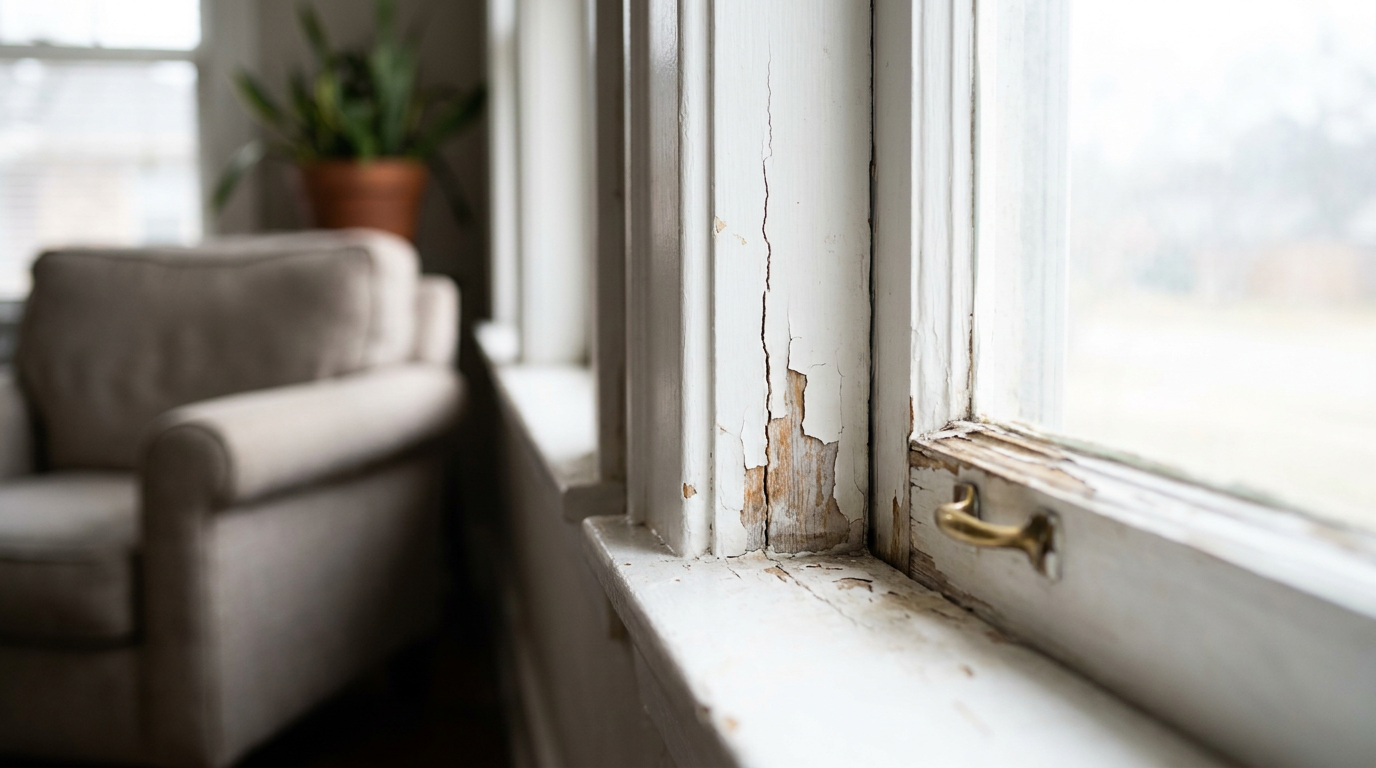
- Moisture Damage (Wood Frames): Once paint fails, water gets into the wood. Then the wood swells when it’s wet and shrinks when it dries. That back-and-forth beats it up over time and leads to cracks and rot. Peeling paint or dark staining near the crack is a bad sign.
- Thermal Expansion/Contraction: Big temperature swings make materials expand and contract. Vinyl and aluminum move more than wood. After years of that, you can get fatigue cracks, especially on darker frames that soak up more heat (up to 150-190°F in direct summer sun).
- Impact Damage: Happens all the time. A baseball, a ladder, a slipped tool, moving furniture—one hit can crack a frame. These are usually easy to spot.
- Installation Error: If the window went in wrong—shimmed too tight, not flashed right, or poorly insulated—it can create pressure points that crack the frame over time.
Common Mistakes
Don’t make a small problem bigger. Stay away from these common DIY mistakes.
- Using the Wrong Filler: Interior caulk or cheap wood putty on an exterior crack is asking for trouble. It’ll shrink, crack, and fall out. Use something made for the frame material and where it lives.
- Painting Over the Crack: Smearing paint over the top doesn’t fix anything. It’s just a band-aid that hides the issue and can trap moisture underneath, which makes the real damage worse.
- Ignoring the Cause: If the house is moving a lot or the wood is rotten, patching the crack is only a temporary win. You’ve got to deal with the root problem or that crack will be back.
- Getting Impatient: Skipping the cleaning step or not giving the filler/sealant enough time to cure are two big reasons repairs fail within a year. Follow the product directions. Every time.
Cost & Time Breakdown
Here’s what I’d expect for a DIY repair on one minor window frame crack.
| Task | DIY Cost | Pro Cost | Time |
|---|---|---|---|
| Assess & Clean | $0 | (part of labor) | 15 minutes |
| Fill Wood Crack | $8–$20 (filler) | $125–$250 | 30-45 minutes |
| Seal Vinyl Crack | $10–$25 (sealant) | $150–$275 | 30-45 minutes |
| Sand, Prime, Paint | $20–$40 (supplies) | (included in labor) | 1-2 hours |
| Full DIY Repair | $30–$65 | N/A | 2-3 hours |
| Pro Repair (minor) | N/A | $150–$350 | 1-2 hours |
Tips & Prevention
- Inspect Annually: Once a year, walk the house and look closely at every window frame, inside and out. Catching little cracks or peeling paint early saves headaches.
- Keep It Clean: Keep sills and tracks clear. Dirt and debris hold moisture against the frame, and that speeds up rot and corrosion.
- Manage Water: Make sure your gutters are clean and your downspouts push water far away from the foundation. Less foundation movement means less stress on the windows.
- Check Your Sealant: The sealant around the outside of your window frame is your first line of defense. If it’s cracked or peeling, scrape out the old stuff and lay down a fresh bead of high-quality exterior caulk.
When to Call a Professional
You can handle a small, simple crack yourself. But call a window contractor or structural engineer if you see any of these red flags. If the crack is wider than 1/4 inch, that usually points to more movement than a patch can handle. If it runs from the frame into the drywall, plaster, or exterior siding/brick, the window may not be the problem—the wall is. If the window’s hard to open or close now, the frame’s probably warped, and a simple patch isn’t going to fix that. And if you’ve got multiple windows cracking the same way, that’s a pretty strong hint you may be dealing with a foundation issue that needs a specialist right away. Don’t mess around with structural problems.
Should you do this yourself?
Answer five quick questions before you start. Safety outranks savings every time.
Your experience with work like this
How high do you have to work?
Does the job involve any of these?
Will it need a permit?
Specialty tools
Free and instant. Educational guidance only — not a quote, inspection, or professional diagnosis.
What should this project cost?
Enter your project details for a realistic cost range before you call anyone.
Cost depends heavily on which system turns out to be the source.
- Regional adjustment
- National average
- Labor share (typical)
- ~$1,620
- Quotes to collect
- 3 written estimates
Educational estimate based on national averages — not a binding quote. Always confirm with written local estimates.
Fixly Project Decision Box
- DIY difficulty
- Professional Recommended
- Estimated time
- Monitoring over 60–90 days · engineer visit 1–2 hours
- Cost level
- Major Project
Main tools / materials
- Crack monitor or pencil marks with dates
- Tape measure
- Marble or level for floor slope
When to stop and call a pro
- A crack wider than 1/4 inch or growing month over month
- Doors and windows that suddenly stick or will not latch
- Stair-step cracks in brick or block
- Separation between walls and ceilings or floors
Need professional help?
Get a Foundation EvaluationBefore you start
Check the difficulty, permits, and safety risk — then decide whether to call a pro.
- Estimate this projectGet a cost range for your scope and ZIP before you call anyone.Open
- Get local estimatesSend one request and compare written estimates from vetted pros.Open
Free, no signup required. Estimates are educational guidance, not a quote or an inspection.
Recommended for DIYers & woodworkers
Sponsored
The Top 20 Tools for Workshops of Any Budget
No stationary machines or power tools required — plus 3 fundamental tools that can't be bought at any price.
Get the free guide
Ted's Woodworking — The #1 Woodworking Resource
Detailed instructions, dimensioned drawings, materials & cutting lists, and 3D schematics for every skill level.
See the plansSponsored: links above are affiliate links. FixlyGuide may earn a commission on qualifying purchases — at no extra cost to you.
Frequently asked questions
Can I just use caulk to fix a crack in my wood window frame?+
It's not the best solution. While caulk can seal a gap, it doesn't provide any structural strength and isn't sandable or easily paintable. A dedicated wood filler or two-part epoxy is much better because it hardens and can be sanded flush to create an invisible repair.
The crack in my window frame is on the outside. What product should I use?+
For exterior repairs, you must use a product rated for outdoor use. For wood, use an exterior-grade wood filler or epoxy. For vinyl or aluminum, use a high-quality polyurethane or elastomeric sealant that is UV-resistant and waterproof.
My window is suddenly hard to open and I see a new crack. What's happening?+
This combination strongly suggests the frame has been warped or twisted. This is often caused by house settling, which puts pressure on the entire window unit. A simple crack repair won't fix the operational issue; it's time to call a professional to assess the situation.
How can I tell if a window frame crack is a structural problem?+
The biggest clue is if the crack extends beyond the window frame itself and into the surrounding drywall, plaster, or exterior brick. Also, if the crack is wider than 1/4 inch or if you have similar cracks on multiple windows, you should suspect a structural or foundation issue and call a pro.
Is it worth repairing a cracked vinyl window frame, or should I replace the window?+
For small, non-structural cracks, a repair with the correct vinyl-specific sealant is a cost-effective solution. However, if the crack is large, affects the window's operation, or is on a welded corner, replacement is often the better long-term choice as repairs on vinyl corners are very difficult.
What's the difference between wood filler and wood putty?+
Wood filler is a solvent-based product that hardens and can be sanded and painted, making it ideal for repairs before finishing. Wood putty is a non-hardening, oil-based product used to fill nail holes or small imperfections in already-finished wood, and it's not meant for structural repairs.
Can I repair a crack in a metal window frame?+
Yes, for aluminum frames, you can. After cleaning the area thoroughly, you can use a two-part metal epoxy or a high-grade polyurethane sealant. Make sure to sand the area slightly to help the product adhere, and choose a color that matches or is paintable.
The paint over my old crack repair is peeling. What did I do wrong?+
This almost always means one of two things: you didn't use a primer over the filler, or the repair material itself has failed. All repairs with porous fillers like wood filler need to be primed to seal them before painting. If the filler itself is cracking, it was likely the wrong type or it got wet before it could be painted.

Discussion
Loading comments…