- Direct Sun Exposure: South- and west-facing windows, especially here in Texas, get hammered. That long, hot exposure cooks the sealant. A window in full afternoon sun will usually give out before a shaded north-facing one.
- Improper Installation: If the frame wasn’t set plumb and square, it can put uneven pressure on the sash and IGU. That kind of stress adds up. Same thing if nobody used setting blocks—the glass can shift and work the seals loose.
- Water Damage: A window with bad flashing that lets water pool at the bottom of the sash will wreck an IGU seal. Sealant isn’t meant to sit in water all day. It breaks down fast.
- Manufacturing Defects: Not common with decent brands, but it happens. Sometimes an IGU leaves the factory with a bad seal. Those usually show up in the first 1-2 years and are often covered by warranty.
HVAC · High energy usage
| Project category | HVAC |
|---|---|
| Problem type | High energy usage |
| Trade required | HVAC |
| Urgency | Planned project |
| Safety risk | Low safety risk |
| DIY suitability | DIY for experienced homeowners |
| Cost category | High cost |
| Typical timeline | Assessment within weeks; replacement planned off-season |
| Contractor type | Licensed HVAC technician |
Repair option
Duct sealing, insulation, and a tune-up before touching the equipment.
Replacement option
High-efficiency replacement sized by a load calculation, not a rule of thumb.
Common causes
- Aging, low-efficiency equipment
- Leaking ducts losing conditioned air
- Insufficient attic insulation
- Oversized system short-cycling
Relevant tools:project cost estimatorrepair or replace
Published October 3, 2026Last updated October 3, 2026
Tools & materials you'll need
Affiliate linksAs an Amazon Associate FixlyGuide earns from qualifying purchases — at no extra cost to you. Prices and availability are accurate as of publication and subject to change.
Quick Answer
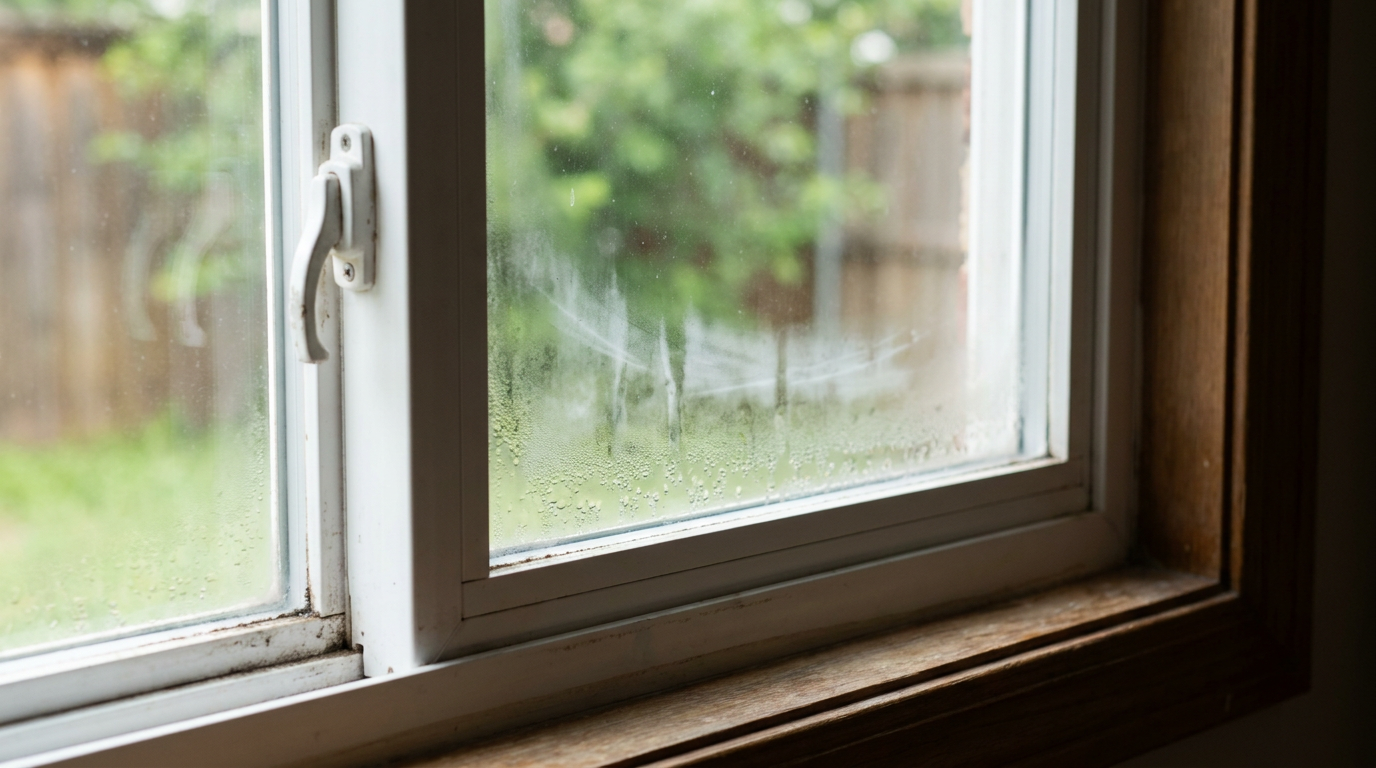
If you’re seeing condensation, fog, or mineral deposits between the two panes of glass in a double-pane window, the airtight seal has failed. That lets the insulating argon or krypton gas leak out and moisture-filled air sneak in. The only permanent fix is to replace the insulated glass unit (IGU) or the entire window sash.
The Problem
You clean your windows, but that hazy fog just won’t quit. You wipe the inside. Then the outside. No dice. That’s because the moisture is trapped between the panes of your double-pane (or triple-pane) window. Classic seal failure.
And yeah, it doesn’t just look rough. It means your window’s lost most of its insulating value, so heat gets in during the summer and out during the winter, and your energy bills start climbing. I’ve seen this a hundred times. I pulled a water heater in Frisco last month that had exactly this leak pattern on the kitchen window right above it—same cloudy band, same dead seal. It happens.
How It Works
Modern double-pane windows are pretty slick pieces of work. They’re called Insulated Glass Units, or IGUs. An IGU isn’t just two pieces of glass; it’s a sealed, self-contained sandwich.
The two panes are held apart by a spacer, usually aluminum, stainless steel, or a non-metallic foam. That spacer carries a moisture-absorbing material called a desiccant—think of the silica gel packet in a new pair of shoes, just scaled up and built to do a real job. Then the whole unit gets hermetically sealed around the perimeter with a high-grade, flexible sealant.
Here’s the big thing: the space between the panes is filled with a dense, inert gas, usually argon or sometimes krypton. Those gases are way denser than regular air, so they conduct heat much worse. That gas fill is what gives the window its efficiency, often measured by its U-factor, which is just a fancy way of saying how much heat sneaks through.
Once that perimeter seal gives up—age, heat, damage, whatever—the whole setup starts falling apart. The argon leaks out. Outside air gets in. The desiccant gets soaked with moisture. That’s when the fog shows up, which is just condensation from moist air trapped inside the unit. At that point, your high-tech IGU is basically two pieces of glass with a useless air gap. Might as well be an old single-pane window from 70 years ago.
Step-by-Step Fix
Let’s get one thing straight: you can’t fix a failed seal the old-fashioned way by patching it. The gas is gone, and the desiccant’s loaded up. The real fix is replacement. What we’re talking about here is swapping the IGU itself, which is a common, cost-effective repair if the frame’s still in good shape.
-
Confirm It's Seal Failure — First thing, make sure the fog is actually between the panes. Wipe the interior glass. Wipe the exterior glass. If the haze won’t move, that’s seal failure. If it wipes off, you’re dealing with regular condensation, and that’s a humidity problem, not a glass failure.
-
Measure for the New IGU — This part matters. You need the exact dimensions of the unit you’re replacing. Measure the visible glass width and height with a tape. Then figure the thickness. Look at the spacer between the panes—it may have markings, but the cleanest way is to carefully pop off a piece of the vinyl or wood stop so you can see the edge. An IGU is usually ½-inch to 1-inch thick overall. Your measurements must be precise, down to 1/16 of an inch. Write it down as Width x Height x Thickness.
-
Order the Replacement IGU — With those numbers in hand, order a new IGU from a local glass shop or a specialty online supplier. You’ll need to say whether you want argon gas fill and any coatings, like Low-E for sun protection, which you should—it’s what keeps the window performing. A new unit can cost between $75 and $300, depending on size and features.
-
Gather Your Tools — You’ll want a pry bar or stiff putty knife (thin is better), a utility knife, a heat gun (optional, but handy), safety glasses, and gloves. For installation, grab new glazing points if you’ve got wood frames, or setting blocks and glazing tape/sealant for vinyl or metal frames.
-
Remove the Window Sash — On most modern vinyl or wood windows, it’s easier to work on the sash after you pull it from the frame. On a double-hung window, you can usually pop the sash out by engaging the tilt latches. For casement or fixed windows, you may have to work with the frame in place.
-
Pry Off the Glazing Stops — The glass unit is held in with strips of vinyl or wood trim called stops. This is the delicate part. On vinyl windows, there’s often a snap-in bead. Find the seam and work it out with a thin putty knife. On wood windows, the stops are often brad-nailed and painted over. Score the paint line where the stop meets the frame so you don’t peel half the trim off. Then gently pry the stops loose. Start in the middle of the longest piece, where it’s got the most flex. Take your time. Rushing here is how you crack stuff.
-
Remove the Old IGU — Once the stops are off, the old foggy IGU can come out. It might still be hanging on by old glazing tape or sealant. Wear gloves—the unit can be heavy, and if it’s cracked, those edges are sharp. Lift it out carefully. Pay attention to how it sat on the little rubber or plastic "setting blocks" at the bottom; the new one goes in the same way.
-
Clean the Frame — Scrape out all the old sealant, glazing tape, and junk from the sash frame. You want a clean, dry surface for the new IGU to sit on. Clean surface, good seal. Dirty surface, trouble later. Pretty simple.
-
Set the New IGU — Put the new setting blocks in the bottom of the frame, usually about 4 inches in from each corner. Carefully lower the new IGU into place and rest it on the blocks. Make sure it’s centered, with an even gap all the way around. Those blocks keep the heavy glass from sitting directly on the frame, which can crack it or make the seal fail early.
-
Reinstall the Stops — Press or tap the glazing stops back in. On wood stops, use a brad nailer or a hammer and finish nails. On vinyl stops, they should snap back into the channel. Be firm, but don’t beat up the trim or chip the new glass.
-
Seal and Finish — If your window design calls for it, run a thin bead of exterior-grade silicone sealant around the edge where the stop meets the glass. That gives you the final weather seal. If you scored paint on a wood window, you’ll need a little sanding, priming, and touch-up paint.
-
Reinstall the Sash — Pop the repaired sash back into the window frame, and you’re done. Clear glass again. Better efficiency. No more cloudy mess.
Common Causes
Why do seals fail in the first place? Usually it’s not one big event. It’s a pile-up.
- Age and Thermal Cycles: This is the #1 culprit. Over years of daily and seasonal temperature swings, the whole window expands and contracts. Sun heats it up, night cools it down. That constant movement beats up the flexible perimeter seal until it dries out, gets brittle, and cracks. Most IGUs last 10 to 20 years.
- Direct Sun Exposure: South- and west-facing windows, especially here in Texas, get hammered. That long, hot exposure cooks the sealant. A window in full afternoon sun will usually give out before a shaded north-facing one.
- Improper Installation: If the frame wasn’t set plumb and square, it can put uneven pressure on the sash and IGU. That kind of stress adds up. Same thing if nobody used setting blocks—the glass can shift and work the seals loose.
- Water Damage: A window with bad flashing that lets water pool at the bottom of the sash will wreck an IGU seal. Sealant isn’t meant to sit in water all day. It breaks down fast.
- Manufacturing Defects: Not common with decent brands, but it happens. Sometimes an IGU leaves the factory with a bad seal. Those usually show up in the first 1-2 years and are often covered by warranty.
Common Mistakes
I’ve watched homeowners try some pretty inventive fixes for foggy windows. Creative? Sure. Useful? Not so much. Avoid these:
- Trying to "Defog" the Unit: You’ll see videos where somebody drills a tiny hole in the spacer, blows air through it, dries it out, then seals it back up with silicone. Don’t do that. You’ll never get all the moisture out, you’ve just let in dirty air, and you haven’t replaced the lost argon gas. The fog comes back, and now you’ve got a bigger mess.
- Ignoring the Problem: A failed seal isn’t just ugly. The insulating value drops hard. That means you’re paying more to heat and cool your house every day. A single 3x5 ft window with a failed seal can cost you an extra $40–$80 per year on your energy bills.
- Replacing the Whole Window Unnecessarily: If the frame—the part attached to the house—and the sash—the part holding the glass—are still solid, not rotted, cracked, or warped, you probably don’t need a full replacement. Swapping just the IGU is cheaper and way less of a production.
- Getting Inaccurate Measurements: Ordering a custom IGU is a one-shot deal. If you’re off by even a quarter of an inch, it won’t fit. Measure twice, three times, then have somebody else check your numbers. Be dead sure before you order, because they’re non-refundable.
- Using the Wrong Sealant: Don’t just grab whatever caulk is rolling around in your garage. You need a 100% silicone sealant rated for exterior and window/glass use. Interior painter’s caulk will fail in a single season.
Cost & Time Breakdown
Replacing an IGU is a pretty common job. Here’s how the costs and time shake out for a typical 30" x 48" double-hung window.
| Task | DIY Cost | Pro Cost (per window) | Time |
|---|---|---|---|
| Order Custom IGU | $75 - $300 | (Included in total) | (1-3 week lead time) |
| Pry Tools & Sealant | $20 - $40 | (Included in total) | N/A |
| Labor: IGU Swap | $0 | $150 - $250 | 1-2 hours |
| Full Window Replacement | $400 - $1,200+ | $700 - $2,000+ | 4-8 hours |
| TOTAL (IGU Swap) | $95 - $340 | $225 - $550 | 1-2 hours |
Tips & Prevention
Every sealed unit’s gonna fail someday, but you can stretch the life out and catch trouble early.
- Wash Your Windows Regularly: This isn’t just about looks. It gets you right up on the glass, which is the best way to spot that first little bit of haze before it turns into full-blown failure.
- Manage Exterior Water: Keep gutters clean and make sure downspouts send water away from the foundation and window wells. Check the caulk line between the window trim and your siding every year; a bad caulk joint is an open door for water.
- Protect from Heat: In hot Texas climates, solar screens or awnings on south- and west-facing windows can cut the heat load on the glass, which takes some pressure off the seals and helps keep the house cooler.
- Check the Warranty: When you buy new windows, read the warranty. A lot of them cover seal failure for 10, 20 years, or even a lifetime. Just know this: the warranty might cover the replacement IGU, but not the labor to install it.
- Be Gentle: Don’t slam windows shut. That repeated jolt and vibration can wear on the seal over time.
When to Call a Professional
Replacing an IGU is a manageable DIY for some folks, but it’s not everybody’s cup of tea. Call a professional window repair company if you run into any of these:
- The window frame or sash is rotted, warped, or cracked. Dropping a new IGU into a bad frame is just throwing money away; the root problem has to be fixed first.
- You’ve got very large, heavy, or high-up windows, like a second-story picture window. Those are dangerous to handle and usually call for special tools and more than one person.
- The window’s an odd shape—arch, trapezoid—or it’s part of a more complicated setup like a bow or bay window. Those are a lot trickier to take apart and seal up right.
- You’re not comfortable with precise measurements and the chance of ordering a non-refundable custom part.
- The glazing is held in by structural sealant or it’s part of a commercial-style system. If you don’t see removable stops, that’s pro territory.
A pro can measure, order, and install the new IGU, and the job’s usually wrapped up in an hour or two. For a few hundred dollars, you get a clear view and your efficiency back without the hassle—or the risk of a pricey mistake.
Related Articles
Keep troubleshooting with these hand-picked guides from FixlyGuide:
- Window Won't Stay Up? 3 Reasons Your Sash Falls (and the Real Fix) — Tired of a window sash that crashes down? We'll show you how to diagnose a broken window balance system—the hidden mechanism that holds the…
- That Corner Crack Is Back? It's Not the Drywall's Fault — Discover the real reasons that annoying drywall crack in the corner keeps returning. It's often a sign of deeper issues than just bad mud o…
- Why Your Baseboard is Gapping (and How to Fix It for Good) — Seeing a gap between your baseboard and wall? Learn why this happens, from seasonal wood movement to installation errors, and get the lasti…
- The Grimy Secret Why Your Window Sticks (And The 15-Minute Fix) — Don't let a stubborn window ruin your day; often, the culprit is simple dirt or dried paint that you can easily fix in under an hour.
- The Unseen Culprit Behind Hardwood Floor Gaps (It’s Not Always Age) — Discover why your hardwood floors are gapping and what to do about it, often due to hidden moisture issues, not just normal wear and tear.
- The Weird White Powder on Your Siding: And How to Stop It Coming Back — That strange white powder on your siding isn't just ugly; it's a sign of moisture issues that could lead to bigger problems. Here's how to…
What should this project cost?
Enter your project details for a realistic cost range before you call anyone.
Per-window replacement commonly $450–$1,400 installed; hardware repairs often under $300.
- Regional adjustment
- National average
- Labor share (typical)
- ~$281
- Quotes to collect
- 3 written estimates
Educational estimate based on national averages — not a binding quote. Always confirm with written local estimates.
Get the print-ready PDF of this guide
A clean, ad-free, printable version you can keep on your phone or pin to the workshop wall. Free with a FixlyGuide account.
- Print-optimized layout
- Tools, materials & every step included
- Saved to your account
Recommended for DIYers & woodworkers
Sponsored
The Top 20 Tools for Workshops of Any Budget
No stationary machines or power tools required — plus 3 fundamental tools that can't be bought at any price.
Get the free guide
Ted's Woodworking — The #1 Woodworking Resource
Detailed instructions, dimensioned drawings, materials & cutting lists, and 3D schematics for every skill level.
See the plansSponsored: links above are affiliate links. FixlyGuide may earn a commission on qualifying purchases — at no extra cost to you.
Frequently asked questions
Can a foggy double-pane window be repaired?+
No, not really. The seal is permanently broken, the insulating gas is gone, and the desiccant is saturated. While some companies offer 'defogging' services, this is a temporary fix at best. The only real, long-term solution is to replace the Insulated Glass Unit (IGU).
How much does it cost to fix a foggy window?+
Fixing it involves replacing the glass unit. A new IGU can cost anywhere from $75 to $300 depending on size and features. If you hire a pro for the replacement, expect to pay an additional $150 to $250 in labor per window.
Is a foggy window an emergency?+
No, it's not an emergency. It doesn't pose an immediate structural or safety risk. However, it does mean your window is no longer energy efficient, which will increase your heating and cooling bills until it's fixed.
How long should a double-pane window seal last?+
Most manufacturers warranty their seals for 10 to 20 years. In reality, the lifespan depends heavily on climate and exposure. A window on the shady side of a house might last 25 years, while one in direct, hot sun might fail in as little as 8-10 years.
Will a window with a broken seal cause mold?+
It's possible, but not guaranteed. The trapped moisture and dirt can create a hospitable environment for mold to grow between the panes. While this mold is sealed away from your indoor air, it looks terrible and is another sign the IGU needs to be replaced.
Should I replace the glass or the whole window?+
If the window frame and sash are still in good condition (no rot, not warped, and it operates smoothly), just replacing the glass (the IGU) is much more cost-effective. If the frame itself is in bad shape, you should opt to replace the entire window unit.
What is the 'Low-E' coating I see mentioned?+
Low-E stands for low-emissivity. It's an ultra-thin, transparent metallic coating applied to one of the glass surfaces inside the IGU. It reflects heat back to its source, keeping heat out in the summer and in during the winter, significantly improving the window's efficiency.
Is argon gas really that important?+
Yes, it makes a big difference. Argon is about 34% denser than air, so it's much more resistant to heat transfer (convection) between the panes. A window with an argon fill is significantly more insulating than one that's just filled with air.

Discussion
Loading comments…