- Sliding Too Hard: This is the big one. Slamming a pocket door open or shut can knock the rollers right off the track, especially if the hardware’s older.
- Worn-Out Rollers: Those little plastic or nylon wheels don’t last forever. After 10-20 years, they can crack, flat-spot, or lose their bearings, and then the ride gets rough fast.
- Loose or Damaged Track: If the track sags or has a dent, the rollers can hang up and pop out. Sometimes it’s house settling—especially in North Texas with our clay soil—and sometimes it’s just a screw backing out.
- Debris in the Track: Dust, pet hair, and other junk can build up in there and act like a ramp, pushing the wheel up and over the edge.
- Door Warped: A solid wood door can twist with humidity changes, rub the jamb, and get shoved off its hangers.
General remodeling · Renovation planning
| Project category | General remodeling |
|---|---|
| Problem type | Renovation planning |
| Trade required | General contracting |
| Urgency | Planned project |
| Safety risk | Low safety risk |
| DIY suitability | Pro recommended |
| Cost category | Major investment |
| Typical timeline | Design and permitting often 2–4 months before work starts |
| Contractor type | General contractor |
Repair option
Phase the work and fix the building envelope first.
Replacement option
Full renovation with permits, design, and a general contractor.
Common causes
- Space no longer fits how the household lives
- Resale preparation
- Deferred maintenance stacking up
Relevant tools:project cost estimatorcompare quoteshome improvement material prices
Published September 30, 2026Last updated September 30, 2026
Tools & materials you'll need
Affiliate linksAs an Amazon Associate FixlyGuide earns from qualifying purchases — at no extra cost to you. Prices and availability are accurate as of publication and subject to change.
The Problem
You go to slide your pocket door shut, and it just stops. Dead. Maybe it wiggles, hangs crooked, or only moves a few inches before binding up. Or you pull it open and—poof—it vanishes into the wall and there’s nothing to grab. A pocket door that’s jumped its track is one of those little household headaches that turns a smart space-saving feature into a real nuisance. You might find it scraping the floor, stuck halfway open, or buried in the pocket where you can’t get a hand on it.
Don’t panic, and don’t force it. That scraping noise is the door telling you something’s wrong, and if you keep yanking on it, you’ll just mess up the door, the track, and probably the drywall too. Nine times out of ten, one of the two rollers has simply popped out of the track. Annoying? Sure. Fixable? Usually, yes—with a few tools and a little patience.
How It Works
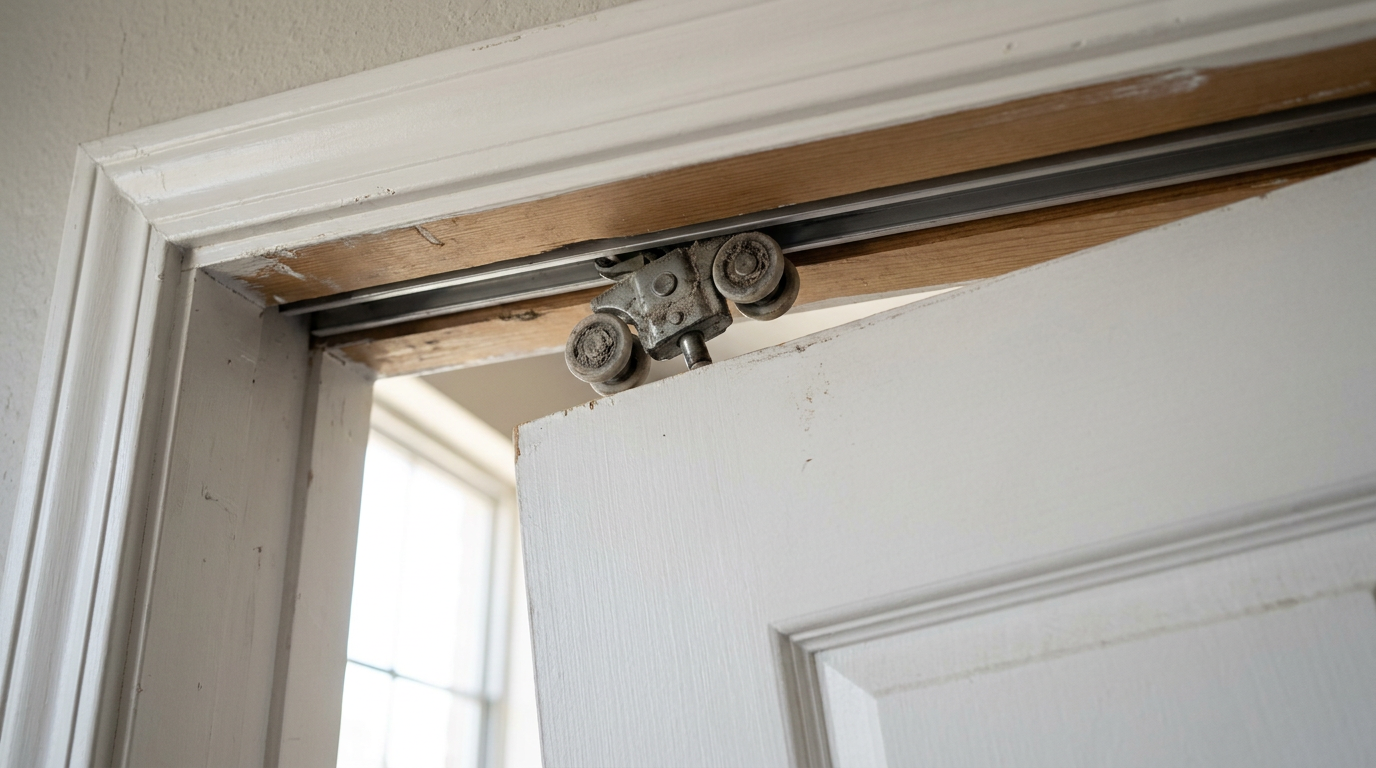
A pocket door doesn’t swing on hinges like a regular door. It hangs from an overhead track tucked inside the wall. I always tell folks to picture a tiny single-car subway system for a door. The “cars” are two little roller assemblies—often a three-wheel tricycle setup—mounted to the top of the door. Those rollers hook or bolt to a plate fastened to the door itself.
The “tunnel” is a metal track, usually aluminum or steel, screwed solidly to the header in the wall framing. That track carries the whole load, and a pocket door can weigh anywhere from 50 to 150 pounds. When you slide the door, those wheels ride along the track. Bottom guides, either on the floor or built into the jamb, keep the door from swinging around side to side. Simple system. Clever, too. But since it’s hidden, one little roller jumping loose can feel like the whole thing’s gone sideways.
Step-by-Step Fix
Follow these steps to figure out what’s going on and get a pocket door back on track. This assumes you can still get to the door. If it’s disappeared deep into the pocket, you may need to jump to Step 3.
-
Inspect the Gap — Grab a flashlight and look up into the space between the top of the door and the track. Can you see the roller? Is one hanger dangling or sitting cockeyed? That quick peek tells you whether this is a simple pop-off or something uglier.
-
Try the "Lift and Shift" — This is the easiest fix, and honestly, it works more often than people think. Get both hands on the door and lift straight up. While you’re lifting, give it a little wiggle and try to guide it back toward the center of the opening. You’re trying to raise the loose roller enough to catch the track again. For a heavy door, you may want a helper. If it catches, ease it back and test the slide. If it rolls smooth, call it a day.
-
Widen the Gap (If Needed) — If the roller won’t re-hook, you need a little more room. Most pocket door hardware has some kind of release built in. Look for a small lever or a J-hook on the roller hanger. Sometimes you can pivot the lever and free the roller from the door plate. Other setups use a thin wrench that came with the hardware to back off the lock nut on the hanger bolt. Lost that wrench? No dice. A very thin adjustable wrench can sometimes do the trick.
-
Remove the Door Stops — If you still can’t get the roller back on, or you need the door out entirely, pull the stops. Those are the skinny vertical strips of wood inside the jamb that stop the door when it closes. Score the paint or caulk line first with a utility knife. Don’t skip that part. Then use a stiff putty knife and a pry bar to gently work them off. Start low and work up. Do the same on the other side of the jamb.
-
Remove the Door — Once the stops are off, you can pivot the door out of the opening. Swing the bottom toward you. That angle usually gives you enough clearance to lift the rollers off the track. Be ready—the door’s heavier than it looks. Set it on sawhorses or lean it against a wall on a drop cloth so you don’t ding it up.
-
Inspect the Rollers and Track — Now you can finally see the whole setup. Check the rollers. Are the wheels cracked, worn flat, or stuck? If they are, replace them. Take the old one to the store so you can match it exactly. Then look at the track for dents, warping, or loose screws. Use a straightedge and see if it sags anywhere. A small dent can often be gently coaxed back into shape with pliers, but a bent or damaged track is usually replacement time.
-
Replace Worn Components — Install the new roller assemblies on the top of the door in the same spots as the old ones. Most hangers have an adjustment nut; start that in the middle of its range. If you found a loose screw in the track, snug it down. If the track itself is bent or shot, now you’ve got a bigger job on your hands, and that usually means pulling the top jamb trim so you can get to the mounting screws.
-
Re-hang the Door — Hook the new rollers back on the track. A helper makes this way easier. Once it’s hanging, swing the bottom of the door back into the opening.
-
Adjust the Height and Plumb — Use the adjustment nut on the roller hangers to get the door level and plumb. You want about a 1/4-inch gap between the door and the floor. Slide it back and forth and make sure it runs clean without scraping.
-
Reinstall the Door Stops — Nail the stops back in place, leaving about a 1/8-inch gap between the stop and the door face so it doesn’t rub. Use a nail set to sink the heads just below the surface. Fill the holes with wood putty, sand it smooth, then caulk and paint.
I pulled a pocket door in Frisco last month that had exactly this leak of a problem—roller jumped, door jammed, owner almost forced it. One look and I knew it was a simple hang-up, not a disaster. Saved the track, saved the drywall, and we were done before lunch.
Common Causes
- Sliding Too Hard: This is the big one. Slamming a pocket door open or shut can knock the rollers right off the track, especially if the hardware’s older.
- Worn-Out Rollers: Those little plastic or nylon wheels don’t last forever. After 10-20 years, they can crack, flat-spot, or lose their bearings, and then the ride gets rough fast.
- Loose or Damaged Track: If the track sags or has a dent, the rollers can hang up and pop out. Sometimes it’s house settling—especially in North Texas with our clay soil—and sometimes it’s just a screw backing out.
- Debris in the Track: Dust, pet hair, and other junk can build up in there and act like a ramp, pushing the wheel up and over the edge.
- Door Warped: A solid wood door can twist with humidity changes, rub the jamb, and get shoved off its hangers.
Common Mistakes
- Forcing the Door: Don’t muscle a stuck pocket door. You can gouge the slab, bend the track, or crack drywall—then a quick fix turns into a weekend you didn’t want.
- Not Scoring the Paint: If you skip cutting the paint line before prying off trim, you’ll peel a big strip of paint right off the wall. That’s extra cleanup nobody asked for.
- Using the Wrong Lubricant: Don’t blast WD-40 or other wet lubes into the track. They grab dust and dirt, and before long you’ve got a sticky mess. Use a dry silicone spray or graphite instead.
- Ignoring a Damaged Track: New rollers on a dented or warped track? That’s just setting yourself up for the same headache in a few weeks. Fix the root issue while it’s apart.
- Guessing at Replacement Parts: Bring the old roller with you. There are a pile of styles out there, and “close enough” usually isn’t close enough at all. It’s got to match.
Cost & Time Breakdown
For a simple derailment or roller swap, this is a pretty approachable DIY job. Costs jump if the track needs replacing, because that means opening up the wall.
| Task | DIY Cost | Pro Cost (Locksmith/Handyman) | Time |
|---|---|---|---|
| Re-hooking a jumped roller | $0 | $125–$175 | 10 minutes |
| Replacing both roller assemblies | $15–$40 | $175–$250 | 1–2 hours |
| Cleaning and lubricating track | $5–$10 | $125–$150 | 30 minutes |
| Replacing a damaged track section | $100–$250+ (includes drywall repair) | $400–$750+ | 4–8 hours |
Tips & Prevention
- Teach Everyone: Make sure the whole house knows not to slam the pocket door. Gentle use goes a long way.
- Clean the Track Annually: Vacuum the overhead track with a crevice tool and get the dust and debris out. A can of compressed air helps with the stubborn stuff.
- Lubricate Sparingly: Once a year, after cleaning, hit the track with a dry lubricant. A light puff of graphite or a quick shot of silicone is plenty.
- Check the Floor Guides: Make sure the little guides at the bottom are intact and tight. If they break, the door can wander around and derail easier.
- Listen for Trouble: If you start hearing grinding, rumbling, or scraping, the rollers are probably on their way out. Catch it early before the door comes off completely.
When to Call a Professional
Call a pro if the problem goes beyond the rollers. If the track is bent, sagging, or pulled loose from the header inside the wall, that’s carpenter or handyman territory. Replacing the track usually means removing the jamb trim and sometimes cutting into drywall, and that’s not everybody’s cup of tea. Also, if you’ve got an extra-tall or heavy custom pocket door—over 8 feet tall or made of solid glass—I’d let a pro handle it. That kind of weight can get away from you in a hurry, and you don’t want a busted door or a busted back.
Related Articles
Keep troubleshooting with these hand-picked guides from FixlyGuide:
- Door Latch Won't Catch? 7 Reasons It Won't Stay Closed—and the Fix — Is your door swinging open because the latch won't catch in the strike plate? Learn the 7 common causes, from simple alignment issues to wo…
- The Grimy Secret Why Your Window Sticks (And The 15-Minute Fix) — Don't let a stubborn window ruin your day; often, the culprit is simple dirt or dried paint that you can easily fix in under an hour.
- Deadbolt Stuck or Hard to Turn? 9 Reasons and How to Fix It — A sticky or hard-to-turn deadbolt isn't just annoying; it's a security risk. Learn the common causes, from simple lubrication needs to seri…
- Door Knob Loose or Wobbling? 9 Causes and the 5-Minute Fix — Have a wobbly door knob that rattles every time you use it? It's not just annoying—it's a sign of a bigger problem waiting to happen. Learn…
- That ONE Reason Your Closet Door Keeps Derailing — Stop just putting your sliding closet door back on the track. We reveal the hidden—and surprisingly simple—hardware issue that causes 90% o…
- The #1 Gutter Mistake That Causes Overflow (And How to Fix It in 20 Minutes) — Overflowing gutters during heavy rain are usually caused by a readily fixable clog, often due to a common cleaning mistake.
Should you do this yourself?
Answer five quick questions before you start. Safety outranks savings every time.
Your experience with work like this
How high do you have to work?
Does the job involve any of these?
Will it need a permit?
Specialty tools
Free and instant. Educational guidance only — not a quote, inspection, or professional diagnosis.
What should this project cost?
Enter your project details for a realistic cost range before you call anyone.
Cost depends heavily on which system turns out to be the source.
- Regional adjustment
- National average
- Labor share (typical)
- ~$1,620
- Quotes to collect
- 3 written estimates
Educational estimate based on national averages — not a binding quote. Always confirm with written local estimates.
Before you start
Check the difficulty, permits, and safety risk — then decide whether to call a pro.
- Estimate this projectGet a cost range for your scope and ZIP before you call anyone.Open
- Get local estimatesSend one request and compare written estimates from vetted pros.Open
Free, no signup required. Estimates are educational guidance, not a quote or an inspection.
Get the print-ready PDF of this guide
A clean, ad-free, printable version you can keep on your phone or pin to the workshop wall. Free with a FixlyGuide account.
- Print-optimized layout
- Tools, materials & every step included
- Saved to your account
Recommended for DIYers & woodworkers
Sponsored
The Top 20 Tools for Workshops of Any Budget
No stationary machines or power tools required — plus 3 fundamental tools that can't be bought at any price.
Get the free guide
Ted's Woodworking — The #1 Woodworking Resource
Detailed instructions, dimensioned drawings, materials & cutting lists, and 3D schematics for every skill level.
See the plansSponsored: links above are affiliate links. FixlyGuide may earn a commission on qualifying purchases — at no extra cost to you.
Frequently asked questions
How do you get a pocket door back on its track without removing the trim?+
Often you can! Try lifting the door straight up while jiggling it side-to-side. The goal is to get the roller's hook to pop back onto the track. A thin pry bar or a pair of long-nosed pliers can sometimes help guide it from the gap at the top.
Why does my pocket door keep coming off the track?+
This usually means there's an underlying issue. The most common culprits are worn-out rollers with flat or cracked wheels, a dent or sag in the track, or simply slamming the door too hard. Inspect the rollers and track for damage.
What's the best lubricant for a pocket door track?+
Always use a dry lubricant like a silicone spray or graphite powder. Avoid wet lubricants like WD-40, as they attract dust and will gum up the rollers over time, making the problem worse.
How much does it cost to fix a pocket door?+
If you just need to replace the rollers, you can DIY it for about $15-$40 in parts. Hiring a handyman for the same job might cost $175-$250. If the entire track inside the wall needs replacing, the cost can jump to $400-$750 or more due to the added labor and drywall repair.
Can you replace pocket door rollers without removing the door?+
Unfortunately, no. The rollers are screwed into the top edge of the door, so the door must be removed from the track to access and replace them. The good news is that removing the door is usually straightforward once you pry off the door stops.
My pocket door is stuck inside the wall. How do I get it out?+
This is tough. You can try fishing for it with a bent coat hanger or a long piece of wood with a screw in the end to 'grab' it. If that fails, you'll likely have to remove the door jamb trim on one side to create a larger opening to reach in and pull it out.
How do you adjust the height of a pocket door?+
Height is adjusted at the roller hangers on top of the door. There's typically a threaded bolt with a lock nut. By turning the nut, you can raise or lower that side of the door. You'll likely need a special thin wrench that came with the hardware, or a very thin adjustable wrench.
What tools do I need to fix a pocket door?+
For most repairs, you'll need a flashlight, a pry bar, a putty knife, a utility knife, and a hammer. If you're replacing rollers, you'll also need a screwdriver and possibly a thin adjustable wrench to adjust the hangers.
Discussion
Loading comments…