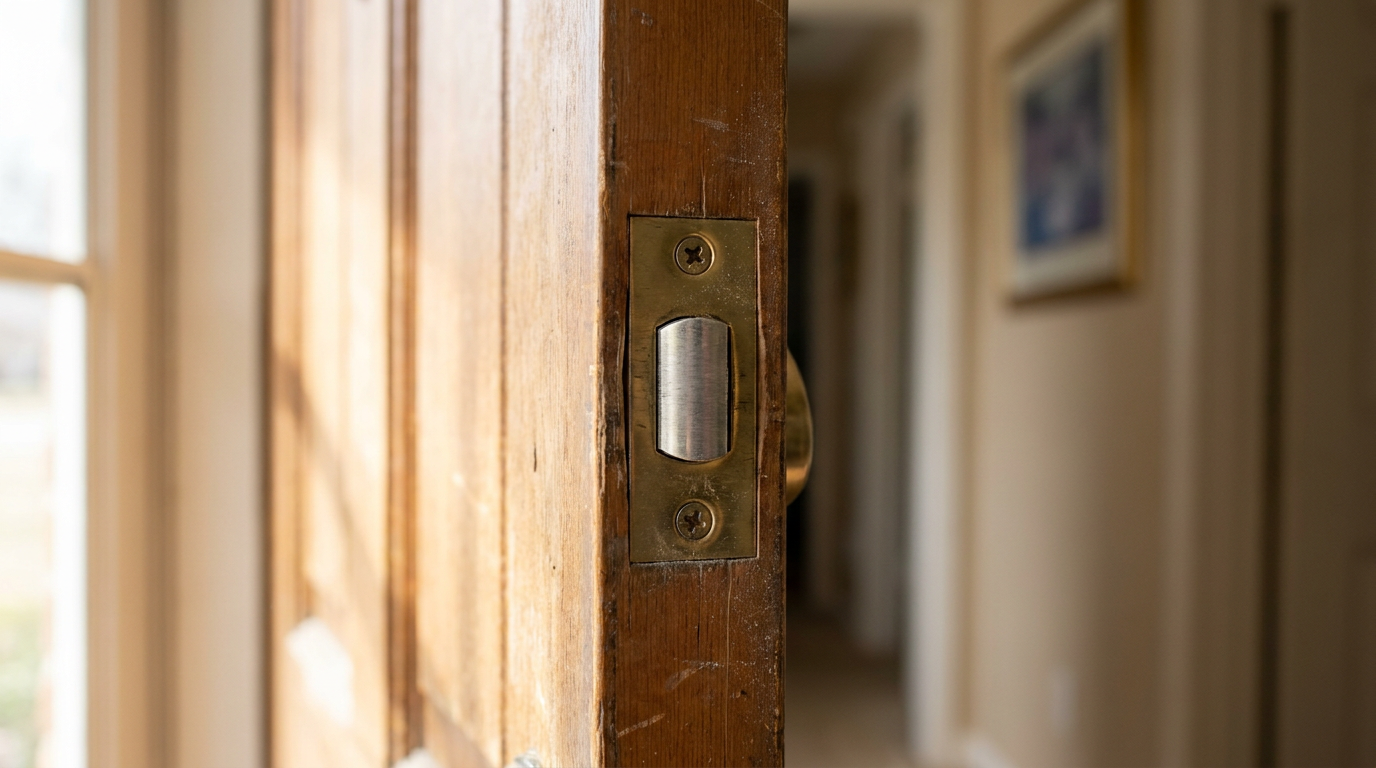
- Manually manipulate the latch hub with a screwdriver — Stick a flathead screwdriver into the square spindle slot of the latch mechanism. Turn it firmly in the retraction direction while you watch the bolt at the door edge.
- If the bolt pops out and stays out, the mechanism was hanging up from handle misalignment.
- If the hub spins loose with no resistance and the bolt stays dead inside the bore, the internal link broke. Wedge your flathead into the internal slider channel and lever the carriage toward the hinges to force the bolt out.
General remodeling · Renovation planning
| Project category | General remodeling |
|---|---|
| Problem type | Renovation planning |
| Trade required | General contracting |
| Urgency | Planned project |
| Safety risk | Low safety risk |
| DIY suitability | Pro recommended |
| Cost category | Major investment |
| Typical timeline | Design and permitting often 2–4 months before work starts |
| Contractor type | General contractor |
Repair option
Phase the work and fix the building envelope first.
Replacement option
Full renovation with permits, design, and a general contractor.
Common causes
- Space no longer fits how the household lives
- Resale preparation
- Deferred maintenance stacking up
Relevant tools:project cost estimatorcompare quoteshome improvement material prices
Published October 30, 2026Last updated October 30, 2026
Tools & materials you'll need
Affiliate linksAs an Amazon Associate FixlyGuide earns from qualifying purchases — at no extra cost to you. Prices and availability are accurate as of publication and subject to change.
Quick Answer
If your door latch is stuck inside the door and won't extend or retract when you turn the knob, the cam inside the latch or the return spring has bound up, cracked, or straight-up let go. Start by checking the door with it held wide open. If the latch frees up then, you’ve got frame sag or hinge misalignment pinching it shut. If it’s still frozen with the door open, pull the knobs or levers off, slide out the drive spindle, and work the internal slide bar by hand to free the spring-loaded bolt.
The Problem
Few things light up a house faster than a door latch stuck inside the door edge. You turn the handle and either get nothing, or you hit a brick wall and the door won’t budge. Or the other way around—you close the door and the spring latch never pops back out, so the slab just hangs there useless. Annoying? You bet.
When a latch mechanism seizes, people want to wrench on the lever or kick the slab. Don’t. That’s how you strip the mounting escutcheon, bend the drive spindle, or splinter the jamb. What you’re usually dealing with is an internal failure inside the 7/8-inch tubular bore bored into the core of the door. Interior privacy lock, exterior entry handle, doesn’t matter much—the fix is still pretty methodical, and most times you can get it sorted in under 30 minutes without dragging in a pro.
How It Works
Most residential doors use a tubular latch assembly set in a 1-inch edge hole that ties into a 2-1/8-inch face bore. Inside that little tube lives a spring-loaded latch bolt, the actuator cam or hub, a retraction slide, and a coil return spring.
When you turn the interior handle or exterior knob, you rotate an 8mm square steel spindle (or a flat half-moon tailpiece). That spindle turns the cam. As the cam swings, its ear grabs a steel slider carriage tied straight to the latch bolt, pulling the beveled bolt about 1/2 inch back into the door against the coil spring. Let go of the handle, and that internal spring—which pushes with about 2 to 4 pounds of force—sends the carriage and bolt right back out into the strike plate on the frame.
[Spindle rotates] ---> [Cam ear engages carriage] ---> [Pulls latch 1/2" into door]
                              |
                     [Return spring compresses]
                              |
[Handle released] ---> [Spring pushes carriage back] ---> [Bolt extends into strike plate]
When this setup fails, it’s usually one of three things. The return spring snapped or jumped loose, so there’s no push sending the bolt forward. The zinc die-cast carriage cracked from wear, and now the handle isn’t connected to the bolt anymore. Or the deadlocking plunger—that little auxiliary pin next to the main bevel on exterior locks—got jammed sideways across the strike plate lip and locked the whole thing solid.
Step-by-Step Fix
Before you grab a tool, figure out whether the door is stuck closed or stuck open. If it’s stuck shut, go straight to Step 1. If it’s swinging open with the latch buried inside the edge bore, jump to Step 4.
-
Card the latch if the door is stuck shut — Slip a flexible plastic credit card or a thin putty knife into the gap between the latch and the strike plate. Angle it toward the beveled face of the bolt, wiggle the slab a little to relieve pressure on the frame, and push inward to shove the latch back into the door edge.
- Tool: Rigid plastic card or 1-1/2-inch flexible putty knife.
- If this doesn't work: Exterior doors have a deadlocking plunger that blocks carding from the outside. If you’re on the hinge side, punch the hinge pins up and out from underneath with a nail set and hammer, then pull the whole door off from that side.
-
Prop the door and examine the exposed latch — Open the door all the way to a 90-degree angle and wedge a rubber doorstop under the bottom rail. Press the latch bolt in with your thumb and let it go.
- If it moves smoothly now that the door’s open, the lock isn’t broken—your house settled, or the strike plate is off by 1/16 to 1/8 of an inch and pinching the latch when the door closes.
-
Remove the interior handle or lever — Look at the neck of the interior knob or lever for a tiny slot, hole, or set screw. If you find a small hole, press a thin wire or 5/64-inch hex key into the detent pin while you pull the knob off the shaft. If you see two exposed Phillips screws on the decorative rose plate, back them out all the way counterclockwise.
- Tool: #2 Phillips screwdriver, 5/64-inch hex key.
- Safety note: Don’t let the loose exterior knob drop onto hardwood or tile when the mounting screws let go. I’ve watched a shiny brass knob leave a nasty little crater on a kitchen floor, and nobody laughed.
-
Pull the exterior knob and drive spindle clear — Slide the exterior half of the lockset straight out of the 2-1/8-inch face bore. You should see the square or half-moon steel spindle pull out from the center of the tubular latch, leaving the face bore wide open.
- Inspect the drive spindle for twisting or metal burrs. A warped spindle binds in the latch hub and freezes the bolt halfway.
-
Examine the latch carriage inside the face bore — Shine a flashlight through the 2-1/8-inch hole in the door face. You’ll see the stamped metal body of the latch with a central square or diamond-shaped opening.
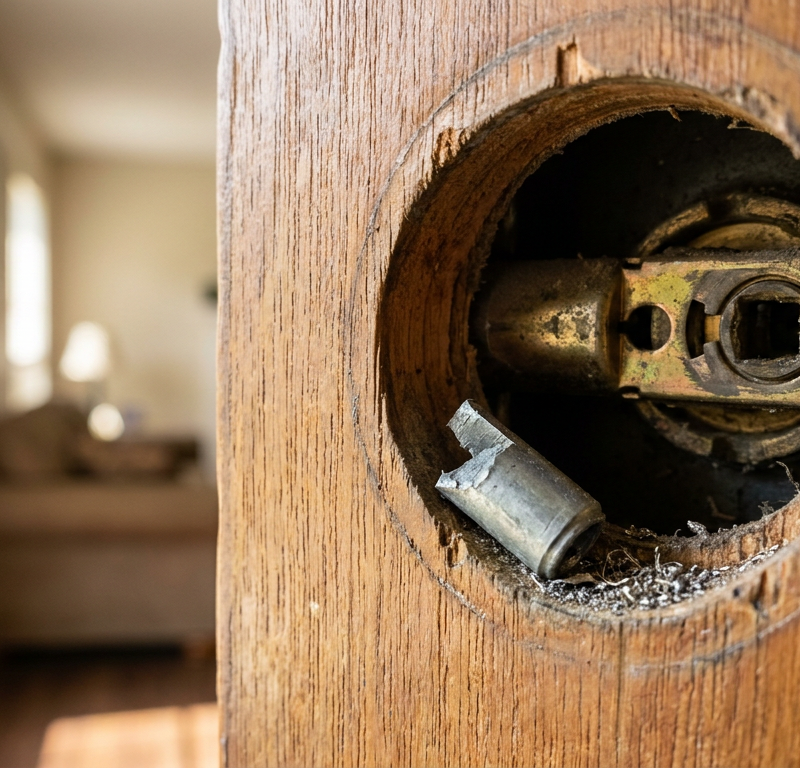
- If you see loose pot metal bits, metal shavings, or a tangled piece of piano wire—the snapped return spring—the internal hub has collapsed.
-
Manually manipulate the latch hub with a screwdriver — Stick a flathead screwdriver into the square spindle slot of the latch mechanism. Turn it firmly in the retraction direction while you watch the bolt at the door edge.
- If the bolt pops out and stays out, the mechanism was hanging up from handle misalignment.
- If the hub spins loose with no resistance and the bolt stays dead inside the bore, the internal link broke. Wedge your flathead into the internal slider channel and lever the carriage toward the hinges to force the bolt out.
-
Remove the latch faceplate screws on the door edge — Back out the two 3/4-inch wood screws holding the rectangular faceplate to the edge of the door. Keep your fingers clear of the latch hole while you’re loosening them.
- Tool: #2 Phillips screwdriver.
- If the screws just spin, slip a stiff putty knife under the screw head and pry outward while turning.
-
Extract the frozen tubular latch from the door edge — Slide a flathead screwdriver straight through the center hub opening in the big face bore. Lever it toward the edge of the door, and tap the handle lightly with your palm to push the whole latch cartridge out through the 1-inch edge hole.
- If this doesn't work: Old wood doors often have paint built up around the latch faceplate. Score the perimeter of the metal plate with a utility knife first so you’re not fighting dried paint.
-
Flush and lubricate the mechanism (if salvageable) — If the latch body is still intact but stuck with grime, grit, or dried construction dust, spray dry PTFE or powdered graphite right into the spring tracks and along the latch bolt shaft.
- Cycle the bolt in and out with your fingers 20 to 30 times.
- Critical rule: Don’t spray standard WD-40, silicone spray, or cooking oils into a door latch. Wet lubes pull in dust and pet hair and turn into a gummy mess that locks the springs up within six months.
-
Install a replacement latch if the internals are broken — If the spring snapped or the carriage cracked, you’re not rebuilding that little thing. You replace it. Measure the "backset" from the door edge to the center of the 2-1/8-inch hole with a tape measure. It’ll be either exactly 2-3/8 inches or 2-3/4 inches (most modern replacement latches have an adjustable barrel that twists to fit both).
- Slide the new latch in, making sure the beveled slope faces the door jamb when the door shuts.
- Secure the faceplate with the two wood screws, snug them down, but don’t over-torque them (roughly 15 to 20 inch-pounds of torque into softwood).
-
Reassemble the handles and test operation — Put the exterior knob and drive spindle back through the new latch hub. Line up the interior mounting plate, start the two long machine screws by hand so you don’t cross-thread them, then tighten them evenly.
- Test the handle 10 times with the door open. It ought to move smooth and spring back with a crisp snap.
- Close the door slowly and make sure the bolt clears the lip of the strike plate without scraping or hanging up.
Common Causes
Why do door latches bind up inside the housing? Here’s the usual hit parade:
- Sheared Zinc Hub or Retractor Link: Low-cost Grade 3 residential locks use cast zinc guts. After thousands of cycles, the little metal ear that pulls the carriage snaps. The handle spins free, but the latch stays pulled inside the door.
- Snapped Return Coil Spring: The internal piano-wire spring works every time somebody touches the door. When it fatigues and breaks, the latch doesn’t have the push to extend back through the faceplate hole.
- Excessive Frame Binding from Foundation Movement: In places with expansive clay soils (like North Texas), seasonal shifting racks door frames out of square. The door drops a hair and pins the latch bolt tight against the lower lip of the strike plate opening. Friction gets high enough that the internal 3-pound spring can’t overcome it.
- Deadlocking Auxiliary Pin Jam: On exterior locks, the small cylindrical or half-round pin sitting beside the main bolt is supposed to stay depressed when the door closes so you can’t card it open. If the strike plate is off, that pin can slide partly into the strike hole with the bolt and jam the retractor wedge sideways.
- Gummed-up Wet Lubricants: Folks spray regular petroleum penetrants into sticky locks and make the problem worse long term. The solvent flashes off, leaves an oily film, then that film grabs dust, dead bugs, and drywall powder and turns into an adhesive sludge that freezes the internal slides.
- Over-Torqued Mounting Screws: Cranking down the two long machine screws that hold the interior knob to the exterior knob bends the tubular latch housing and pinches the slide bar inside its sheet metal sleeve.
Common Mistakes
- Wrenching the handle with extreme force when stuck. Hitting a stuck lever handle like it owes you money won’t free a jammed spring. It snaps the spindle, rounds off the die-cast hub, or breaks the handle off clean, and then your easy $15 latch swap turns into a full lockset replacement.
- Spraying wet lubricants like standard WD-40 or engine oil. Standard WD-40 is a solvent, not a lasting lube. It strips the little factory grease left on the slide carriage, grabs household dust, and turns into gummy varnish in a few weeks. Use dry graphite or dry film PTFE spray.
- Buying a replacement latch without checking the backset. Latches come in two standard backset depths: 2-3/8 inches and 2-3/4 inches. If you grab a fixed-backset latch that doesn’t match your door, the handles won’t pass through the hub. Buy an adjustable universal replacement or measure from the edge of the slab to the center of the handle hole before you head to the hardware store.
- Ignoring the strike plate after installing a new latch. If the old latch failed because the door was sagging into the frame, the new one’ll fail the same way in a few months. Check the strike plate on the jamb every time. If the bolt hits the metal plate instead of dropping cleanly into the center hole, adjust the strike plate or realign the hinges.
- Using an impact driver to tighten knob mounting screws. Driving lockset machine screws with an 18V impact driver strips brass or aluminum threads in a hurry and distorts the tubular housing inside the door. Always run those screws down with a manual #2 hand screwdriver.
Cost & Time Breakdown
| Task | DIY Cost | Pro Cost | Time |
|---|---|---|---|
| Lubricate & Free Sticky Latch | $6–$10 (can of dry PTFE or graphite) | $100–$150 (locksmith service call) | 10–15 mins |
| Replace Interior Tubular Latch Only | $12–$22 (replacement passage/privacy latch) | $120–$175 (parts + minimum labor) | 15–25 mins |
| Replace Complete Interior Knob Set | $18–$45 (new complete lockset) | $140–$200 (parts + install) | 20–30 mins |
| Replace Exterior Entry Lockset/Deadbolt | $40–$130 (ANSI Grade 2 hardware) | $180–$280 (commercial or mobile pro) | 30–45 mins |
| Realign Strike Plate & Plane Door Edge | $0–$15 (longer hinge screws, wood filler) | $125–$190 (handyman or carpenter) | 30–60 mins |
Tips & Prevention
- Do the "Open Door Test" every six months. Turn the knob with the door wide open and let it snap back. The latch bolt should flick out fast with a sharp metallic click. If it feels sluggish or hangs up, flush the assembly with dry PTFE spray before it locks up for good.
- Check the 1/8-inch perimeter gap around your door. A properly hung door should keep a uniform 1/8-inch gap—the thickness of two nickels—along the top and latch sides. If humidity or foundation movement closes that gap, the latch starts taking side-load stress every time the door shuts.
- Replace hinge screws with 3-inch screws to stop door sag. If the latch rubs the bottom of the jamb strike, pull the middle screw from the top hinge on the jamb and drive in a 3-inch #9 hardened wood screw. That pulls the hinge tight into the wall stud framing and can lift the latch side of the door by up to 1/8 inch.
- Keep paint off the latch faceplate and bolt. When you repaint interior doors, don’t paint over the latch or the strike plate. Dried paint on the beveled ramp keeps the bolt from sliding smooth and beats up the return spring until it binds.
- Swap out budget Grade 3 hardware on high-use doors. Interior doors leading to garages, pantries, and laundry rooms get opened and shut a pile of times every day. Upgrading flimsy builder-grade hardware to ANSI/BHMA Grade 2 certified hardware gives you heavier return springs rated for 400,000 cycles instead of 200,000.
When to Call a Professional
Most stuck door latches are plain mechanical replacements that take 20 minutes and one screwdriver. Still, there are times you ought to set the tools down and call a licensed locksmith or finish carpenter:
First, if the door is stuck locked from the inside of a room with no other exit—like a windowless bathroom or storage room—and carding or hinge-pin removal won’t work, an emergency locksmith’s got the air wedges, slim bypass tools, and drill guides to defeat the lock without destroying the slab. Second, if your door is expensive solid mahogany, custom arched, or fire-rated exterior unit, drilling out a mangled latch can do hundreds of dollars in cosmetic and structural damage. Finally, if the latch is binding because the whole frame is badly out of plumb from foundation movement—top corner hitting the jamb while the bottom has a 1/2-inch gap—you need a locksmith or carpenter to rehang the entire jamb instead of just swapping hardware.
Frequently Asked Questions
Can I use WD-40 to unstick a door latch?
You should stay away from standard WD-40 Multi-Use Product. It might free the latch for a little while by washing off surface grime, but it leaves behind an oily petroleum film. That film grabs household dust, pet dander, and airborne junk, and it turns into a thick gummy paste inside the tubular casing over a few months. Use dry film PTFE spray or powdered graphite instead. Dry lubes leave a slick, low-friction coating that doesn’t attract grime or gum up the springs.
Why does my door latch stick when closed, but works fine when open?
If your latch retracts and extends smoothly while the door is wide open, the lockset itself is fine. The trouble is alignment between the bolt and the frame strike plate. House settling, loose hinge screws, or humidity changes can make the slab drop or swell. When the door closes, the bolt gets forced hard against the edge of the metal strike plate, which creates enough friction to overpower the return spring. Tighten the hinge screws or file the strike plate opening a touch and it usually clears up.
How do I know what size replacement latch to buy?
You need your door’s "backset"—the distance from the edge of the slab to the center of the big handle bore hole. In North America, that’s almost always either 2-3/8 inches (standard for interior doors) or 2-3/4 inches (common for exterior commercial and newer residential doors). Measure it with a tape before you head to the store. Most modern aftermarket replacement latches are universal anyway, with a spring-loaded or twist-adjustable barrel that shifts between 2-3/8 and 2-3/4 inches.
Why is my latch stuck retracted inside the door edge?
When a latch bolt gets pulled flush into the door edge and won’t pop back out, the internal coil spring has usually snapped or slipped off its hook. Another possibility is the internal slider carriage made of cast zinc has cracked, so the bolt isn’t connected to the spring anymore. Since these small tubular latches are crimped shut at the factory, you can’t really tear them apart and rebuild them. You pull the handles and slide in a cheap replacement latch cartridge.
How do I open a door if the latch won't retract and there are no exposed screws?
If you’re on the side of the door without visible screws—which is common on privacy bathroom and bedroom locks—check the handle base for a tiny release slot or pinhole detent. Depress that pin with an awl or paperclip to slide the handle off, then pry off the decorative rose plate to expose the structural mounting screws. If the lock is stuck shut and the latch is jammed in the jamb, try slipping a thin, flexible plastic card between the door and frame right at the latch line to push the bolt back. If that doesn’t do it and the hinges are reachable, tap out the hinge pins with a hammer and nail set, then pull the whole door off from the hinge side.
What is the small half-round pin next to my exterior door latch?
That little pin is a deadlocking plunger, sometimes called a deadlatch. Its job is security—it keeps somebody from carding or shimming the latch open with a credit card or knife. When the door closes properly into the strike plate, the big beveled bolt drops into the hole, but the small half-round pin stays depressed flat against the strike plate face. Once that pin is pushed in, an internal bar locks the main bolt so it can’t be shoved back from outside. If the strike plate’s off, that pin can drop into the hole with the bolt and jam the whole assembly.
Can I replace just the latch mechanism without buying a whole new doorknob?
Yes. Hardware stores and online sellers carry standalone replacement tubular latches, often labeled as "deadlatches" for keyed locks or "spring latches" for interior passage sets. You just need the spindle shape to match your handle—usually an 8mm square or a half-moon design—plus the right backset measurement (2-3/8" or 2-3/4") and the faceplate style, whether that’s square corner, round corner, or drive-in collar. A standalone latch usually runs between $10 and $20, which beats buying a whole new handle set.
How tight should the screws on my door handles be?
Door handle mounting screws ought to be hand-tight, about 15 to 20 inch-pounds of torque, using a manual #2 Phillips screwdriver. Don’t use an electric drill or impact driver on door hardware. Overdoing it compresses the face of the slab and bows the tubular latch body sitting in the internal bore. If the housing gets crushed or pinched out of square, the slide carriage binds against the casing walls and the latch starts sticking or stops extending right. If tightening the screws makes the handle hard to turn, back each screw off a half turn.
Related Articles
Keep troubleshooting with these hand-picked guides from FixlyGuide:
- Window Crank Won't Close Flush? 5 Causes and the Step-by-Step Fix — Is your casement window crank spinning or refusing to pull the sash tight? Here is how to diagnose stripped gears, bent tracks, and fix it…
- Door Lock Spinning Freely? 6 Causes and How to Fix It — Is your door lock spinning in full circles without catching? Learn why your deadbolt or knob freewheels and follow our step-by-step guide t…
- The 3 Hidden Reasons Your Door Won't Latch (And the Easy DIY Fixes) — Frustrated by a door that refuses to latch? Discover the common culprits behind this annoying problem and learn simple, effective DIY fixes…
- Vinyl Plank Flooring Gaps? 5 Reasons Seams Separate—and the Quick DIY Fix — Fix separated vinyl plank floor seams in 15 minutes without pulling baseboards using the simple traction block method and rubber mallet.
- Bouncy Floating Floors? 5 Causes and How to Fix Hollow Spots — Eliminate hollow sounds and bounce in floating vinyl or laminate floors by relieving pinched wall gaps or injecting subfloor voids with spe…
- Kitchen Faucet Leaking Under the Sink When Sprayer Runs? 5 Causes and the Step-by-Step Fix — Fix that hidden water leak under your kitchen sink. Step-by-step diagnostic and repair instructions for leaking pull-out hoses, bad O-rings…
Should you do this yourself?
Answer five quick questions before you start. Safety outranks savings every time.
Your experience with work like this
How high do you have to work?
Does the job involve any of these?
Will it need a permit?
Specialty tools
Free and instant. Educational guidance only — not a quote, inspection, or professional diagnosis.
What should this project cost?
Enter your project details for a realistic cost range before you call anyone.
Cost depends heavily on which system turns out to be the source.
- Regional adjustment
- National average
- Labor share (typical)
- ~$1,620
- Quotes to collect
- 3 written estimates
Educational estimate based on national averages — not a binding quote. Always confirm with written local estimates.
Before you start
Check the difficulty, permits, and safety risk — then decide whether to call a pro.
- Estimate this projectGet a cost range for your scope and ZIP before you call anyone.Open
- Get local estimatesSend one request and compare written estimates from vetted pros.Open
Free, no signup required. Estimates are educational guidance, not a quote or an inspection.
Get the print-ready PDF of this guide
A clean, ad-free, printable version you can keep on your phone or pin to the workshop wall. Free with a FixlyGuide account.
- Print-optimized layout
- Tools, materials & every step included
- Saved to your account
Recommended for DIYers & woodworkers
Sponsored
The Top 20 Tools for Workshops of Any Budget
No stationary machines or power tools required — plus 3 fundamental tools that can't be bought at any price.
Get the free guide
Ted's Woodworking — The #1 Woodworking Resource
Detailed instructions, dimensioned drawings, materials & cutting lists, and 3D schematics for every skill level.
See the plansSponsored: links above are affiliate links. FixlyGuide may earn a commission on qualifying purchases — at no extra cost to you.
Frequently asked questions
Can I use WD-40 to unstick a door latch?+
You should avoid standard WD-40 Multi-Use Product. While it might free the latch temporarily, standard WD-40 leaves behind an oily petroleum residue that attracts household dust and pet hair. Over several months, this turns into a thick, gummy paste that locks the springs. Use a dry film PTFE spray or powdered graphite instead.
Why does my door latch stick when closed, but works fine when open?+
If your latch retracts and extends smoothly while the door is wide open, the lockset itself is fine. The problem is alignment between the latch bolt and the frame strike plate. House settling or loose hinge screws cause the door to sag, pinching the latch bolt hard against the strike plate lip and overcoming the internal spring's force.
How do I know what size replacement latch to buy?+
Measure the backset: the distance from the edge of the door slab to the center of the large handle bore hole. In North America, this is almost always either 2-3/8 inches or 2-3/4 inches. Most modern aftermarket replacement latches are universal and adjust between both sizes with a simple twist.
Why is my latch stuck retracted inside the door edge?+
When a latch bolt is pulled flush into the door edge and won't pop back out, the internal coil return spring has snapped or slipped off its hook, or the zinc slider carriage has cracked. Because tubular latches are stamped shut at the factory, you cannot rebuild them—you simply replace the inexpensive latch cartridge.
How do I open a door if the latch won't retract and there are no exposed screws?+
Check the neck of the handle for a tiny slot or pinhole detent. Depress that pin with an awl or paperclip to slide the handle off, then pop off the decorative rose plate to expose the screws. If the door is stuck shut, shim the latch with a plastic card, or remove the door's hinge pins from the frame to pull the door outward.
What is the small half-round pin next to my exterior door latch?+
That is a deadlocking plunger. It prevents intruders from slipping a credit card between the door and frame. When the door is closed, the main bolt extends into the strike opening while this plunger stays depressed against the strike plate face, mechanically deadlocking the main bolt. If it falls into the strike opening, it can bind the latch.
Can I replace just the latch mechanism without buying a whole new doorknob?+
Yes. You can buy standalone replacement tubular latches (passage or deadlatch) for $10 to $20. You just need to match the spindle shape (typically square or half-moon), the backset depth (2-3/8 or 2-3/4 inches), and the faceplate style (rounded corner, square corner, or round drive-in collar).
How tight should the screws on my door handles be?+
Mounting screws should be hand-tightened snugly with a manual screwdriver to about 15 to 20 inch-pounds of torque. Never use an impact driver. Overtightening bends the tubular casing inside the door, pinching the internal slide bar and causing the latch to stick or fail to spring back.
Discussion
Loading comments…