- Solenoid Turn: Slowly turn the entire solenoid counter-clockwise one-quarter to one-half turn. You should hear a click and then the sound of rushing water as the zone activates.
- Bleed Screw: Locate a small knob or screw on the top of the valve body. Slowly turn it counter-clockwise. This will also release pressure and open the valve.
- If water flows: The valve, pipes, and heads for that zone are functional. The problem is electrical (solenoid, wiring, or controller output).
- If no water flows: You have a plumbing issue. Either the main water supply is still off, or there is a blockage or break in the mainline pipe before the valve box.
Landscaping · Deck or fence project
| Project category | Landscaping |
|---|---|
| Problem type | Deck or fence project |
| Trade required | Landscaping |
| Urgency | Planned project |
| Safety risk | Moderate safety risk |
| DIY suitability | DIY for experienced homeowners |
| Cost category | High cost |
| Typical timeline | Most builds 3–10 days depending on size |
| Contractor type | Landscaping contractor |
Repair option
Replace failed boards, posts, and hardware; reseal the surface.
Replacement option
Rebuild when framing or the ledger connection is unsafe.
Common causes
- Rot at posts and ledger
- Storm damage
- Adding outdoor living space
Relevant tools:home improvement material pricesproject cost estimator
Published April 26, 2026Last updated August 17, 2026
Tools & materials you'll need
Affiliate linksAs an Amazon Associate FixlyGuide earns from qualifying purchases — at no extra cost to you. Prices and availability are accurate as of publication and subject to change.
How it works
Your sprinkler system operates on a simple, sequential chain of command involving both electrical and plumbing components. The process begins at the controller, the system's "brain," which is plugged into a standard 120-volt AC wall outlet. An internal or external transformer steps this down to a safer 24-volt AC current, which is used to power the system’s functions.
The controller sends this 24-volt signal down a specific "hot" wire to a designated zone valve. Simultaneously, a "common" wire, which is shared by all valves, completes the electrical circuit. Inside each zone valve is a solenoid—an electromagnet with a plunger. When the solenoid receives the 24-volt signal, it energizes, lifting the plunger. This action releases water pressure from on top of a rubber diaphragm inside the valve body, causing the diaphragm to lift. With the diaphragm raised, pressurized water from the main irrigation line flows through the valve, down the pipes for that zone, and out through the sprinkler heads.
Interrupting this process at any point causes the system to fail. A tripped circuit breaker cuts power at the source. A faulty controller or transformer never sends the initial signal. A disconnected or broken wire prevents the signal from reaching the valve. An active rain sensor acts as a switch, breaking the common wire's circuit to prevent watering. Finally, a closed main water valve or a faulty backflow preventer stops water from ever reaching the zone valves, even if the electrical sequence functions perfectly.
Step-by-Step Fix
Follow these steps in order, moving from the simplest checks to more involved diagnostics. Most non-starting sprinkler systems can be revived without a professional call.
- Tools:
- Multimeter
- Flat-head and Phillips-head screwdrivers
- Wire strippers
- Waterproof wire nuts
- Small shovel or trowel (for accessing valve box)
-
Verify Controller Settings — The problem may be programming, not a malfunction. First, ensure the controller's selection dial or button is set to 'Run' or 'Auto'. Many systems are inadvertently left in the 'Off' or 'System Off' position. Check the display for any messages indicating a 'Rain Delay' or 'Sensor' activation; if a manual rain delay is active, cancel it according to your controller's manual. Confirm the current date and time are correct, as an incorrect setting can prevent a scheduled cycle from starting.
-
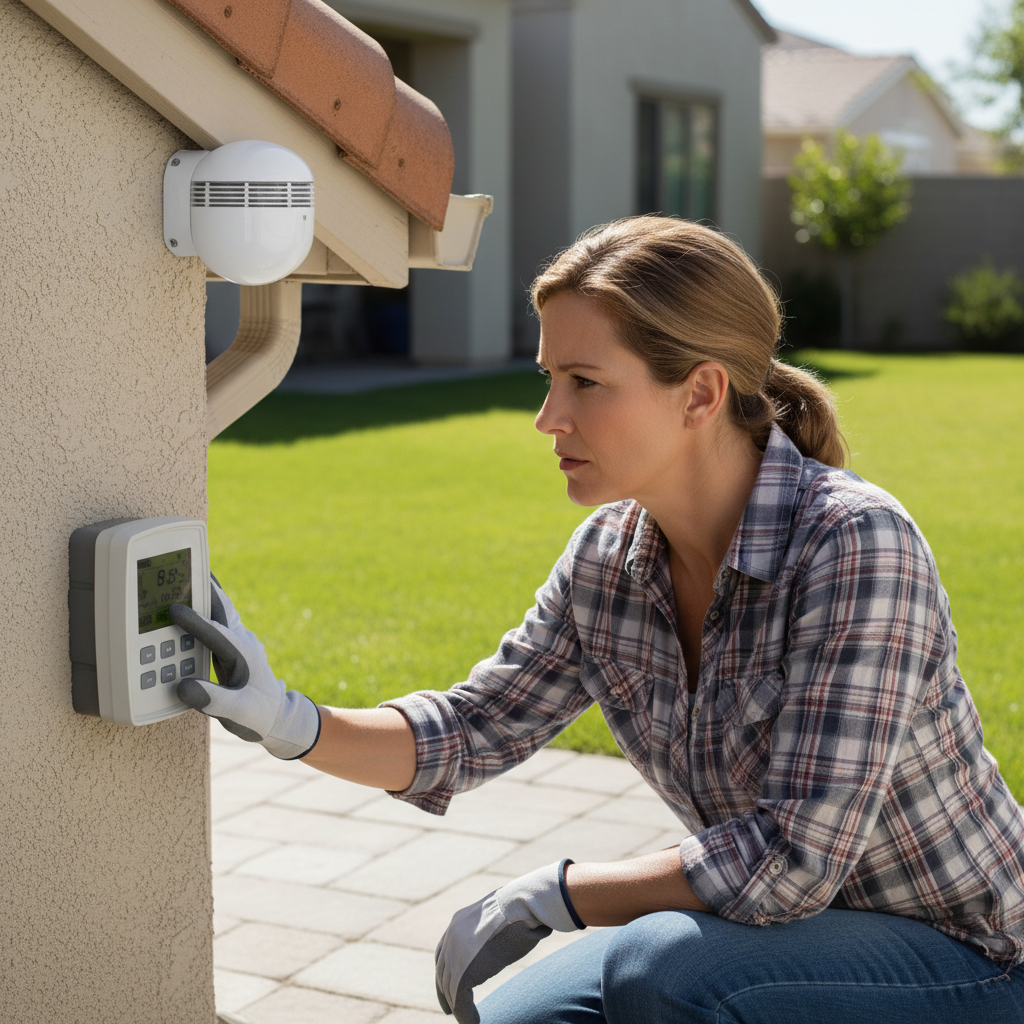
Inspect and Bypass the Rain Sensor — A rain sensor's job is to interrupt the system, and it is a primary culprit for unexpected shutdowns. Locate the sensor, typically mounted on a gutter, eave, or fence line. Check that its collection cup is free of leaves, twigs, or other debris that could hold moisture and trick it into thinking it has rained. If it has rained recently, the sensor's internal cork discs may still be swollen; allow it 24-48 hours of dry weather to reset.
- To test if the sensor is the issue: Bypass it at the controller. Look for two terminals labeled 'SEN' or 'Sensor'. There may be a switch to toggle from 'Active' to 'Bypass'. If there is no switch, disconnect the two sensor wires from the terminals and connect them with a small jumper wire (a short piece of spare irrigation wire is ideal). Run a manual test cycle. If the sprinklers now work, the rain sensor is faulty or needs to dry out.
-
Check Breakers and GFCI Outlets — A loss of power is a common and simple fix. Go to your home's main electrical panel and locate the circuit breaker that powers the sprinkler controller (it may be labeled 'sprinklers,' 'irrigation,' 'garage,' or 'outside'). A tripped breaker will be positioned between 'On' and 'Off'. To reset it correctly, push the switch firmly to the 'Off' position, then back to 'On'. If the controller is plugged into a GFCI (Ground Fault Circuit Interrupter) outlet, check that the 'Reset' button on the outlet is depressed; if the 'Test' button is popped out, press 'Reset' to restore power.
-
Confirm the Water Supply is Fully Open — Your irrigation system has at least one manual shut-off valve that can halt all water flow. This is often located outdoors, near your water meter or where the water supply branches off to the irrigation system. It's frequently part of the backflow preventer assembly.
- Ball Valve: The handle should be parallel to the pipe to be fully open. If it's perpendicular, it's closed.
- Gate Valve: This is a round, wheel-like handle. It should be turned counter-clockwise as far as it will go to ensure it is fully open. Homeowners often forget to reopen these valves completely after winterization.
-
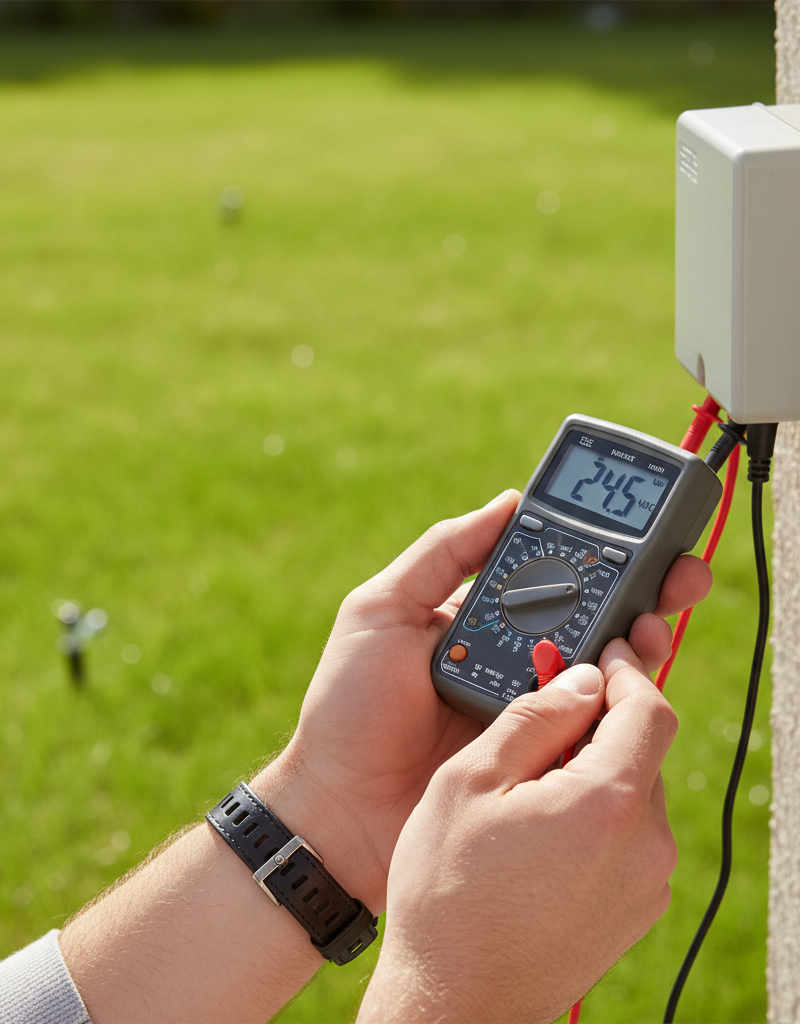
Test for Power to the Controller — This step confirms the controller itself is receiving power. Unplug the controller's transformer from the wall outlet. Set your multimeter to AC voltage (V~). Touch one probe to each of the two metal prongs on the transformer's plug; it should read approximately 120 volts. Next, plug the transformer back in. Locate the transformer's low-voltage wires connected to the controller's AC power input terminals (often labeled '24VAC'). Touch one probe to each terminal. The multimeter should read between 24 and 28 volts AC.
- If you don't get a 24-28V reading: The transformer has failed and needs to be replaced. Ensure the replacement has the same voltage (V) and amperage (mA or A) ratings.
- If you do get a reading but the screen is blank: The controller's internal components have likely failed, and the unit needs replacement.
-
Manually Activate a Zone at the Controller — This test isolates the controller's scheduling function from its ability to send a signal. Use the 'Manual Start' or 'Test All Zones' function on your controller. Select a single zone and set a short run time (e.g., 2 minutes). If the zone activates, the problem lies within your schedule programming (e.g., wrong days, wrong start times). If nothing happens, the problem is downstream in the wiring or at the valve itself.
-
Manually Bleed a Zone Valve — This bypasses the entire electrical system to confirm water is reaching the valves and the valve itself can open. Locate your valve box(es) in the yard—they have green, round, or rectangular lids flush with the ground. Open the lid and identify the individual valves. Find the solenoid (the cylindrical component with wires). You can manually open the valve in one of two ways:
- Solenoid Turn: Slowly turn the entire solenoid counter-clockwise one-quarter to one-half turn. You should hear a click and then the sound of rushing water as the zone activates.
- Bleed Screw: Locate a small knob or screw on the top of the valve body. Slowly turn it counter-clockwise. This will also release pressure and open the valve.
- If water flows: The valve, pipes, and heads for that zone are functional. The problem is electrical (solenoid, wiring, or controller output).
- If no water flows: You have a plumbing issue. Either the main water supply is still off, or there is a blockage or break in the mainline pipe before the valve box.
-
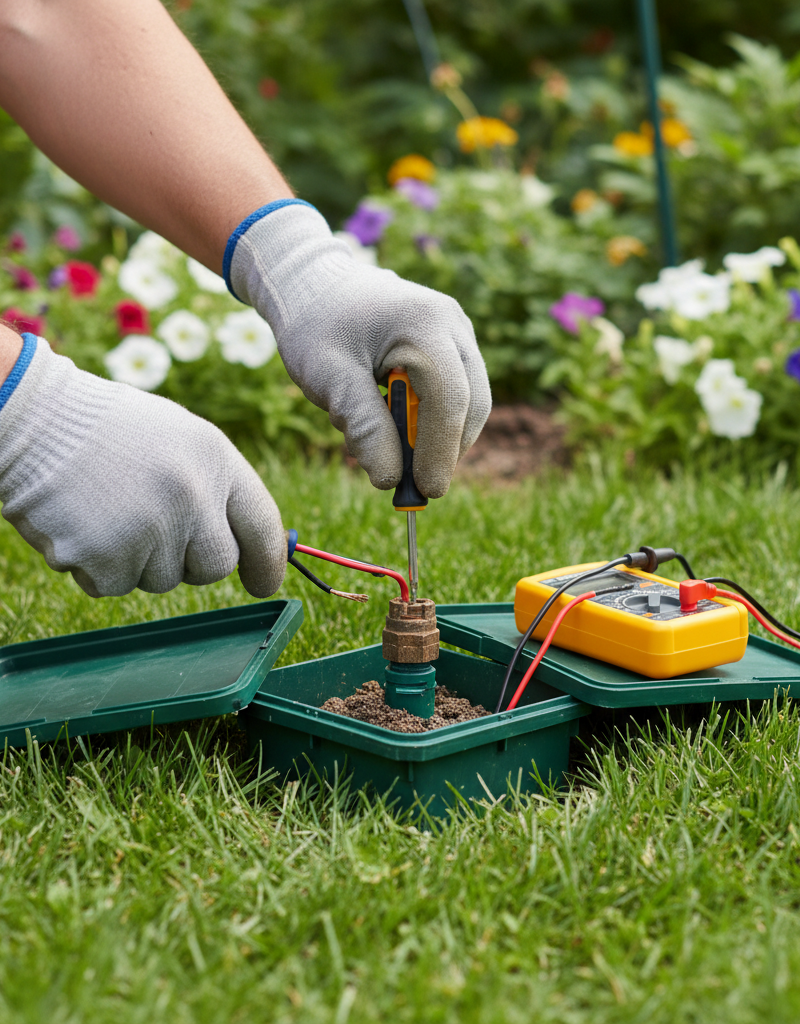
Test the Solenoid Resistance — A failed solenoid cannot open the valve electronically. Disconnect power to the controller. At the valve box, disconnect the two wires leading to the solenoid for the zone you are testing. Set your multimeter to resistance (Ohms/Ω). Touch one probe to each of the solenoid's two wires. A healthy solenoid should give a reading between 20 and 60 ohms.
- High or infinite reading (O.L.): The coil inside the solenoid is broken. The solenoid must be replaced.
- Very low reading (near 0): The solenoid has shorted out. It must be replaced.
-
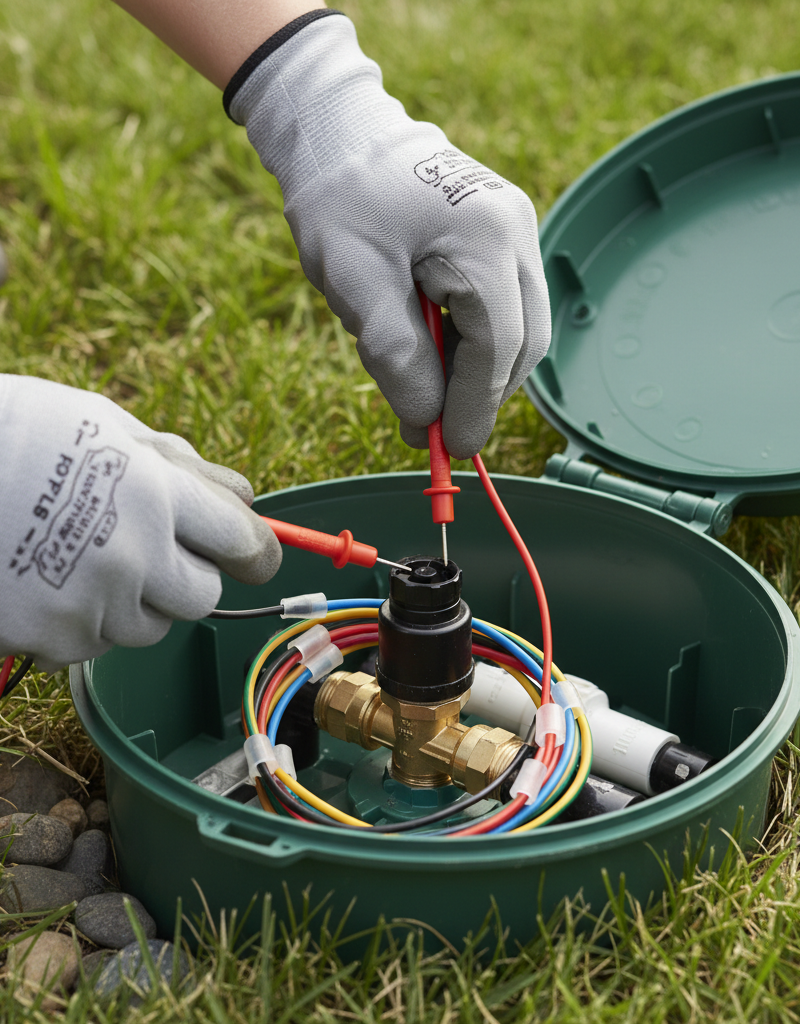
Test for Voltage at the Valve — This a definitive test of the controller and the field wiring. Have another person manually activate the non-working zone at the controller while you are at the valve box. Set your multimeter to AC volts (V~). Touch one probe to the zone's specific hot wire and the other probe to the shared common wire. You should get a reading between 22 and 28 volts AC.
- If you get voltage: The controller and wiring are good. The problem is a faulty solenoid that is receiving power but not activating. Replace the solenoid.
- If you get no voltage: The signal is not reaching the valve. The issue is either a failed output terminal on the controller or, more likely, a break or bad connection in the zone wire or common wire between the controller and the valve box.
-
Inspect the Common Wire Connections — A single break or corroded connection in the common wire will prevent all zones from running, as it is required to complete the circuit for every valve. At the controller, ensure the common wire (often white) is securely fastened in its 'C' or 'COM' terminal. In the valve box, locate the bundle of common wires—one from each solenoid plus the main common from the controller—joined by a single wire nut. Pull gently on the wires to ensure the connection is solid. If the wire nut is old or looks corroded, cut it off, re-strip the wires, and join them with a new, waterproof silicone-filled wire nut.
Common mistakes
- Assuming the Controller is Broken. The controller is often the first thing homeowners blame, but it's one of the more robust components. Before spending $100-$300 on a new one, always perform the simple checks first: power, water supply, and especially the rain sensor bypass.
- Forgetting to Reset a Tripped Breaker Correctly. Simply pushing a tripped breaker switch back towards 'On' will not reset it. You must push it firmly and fully into the 'Off' position first, then snap it back to 'On' to re-engage the internal mechanism.
- Overlooking a Second Water Shut-Off Valve. Some systems have more than one valve. You may have opened the one at the backflow preventer but missed a secondary ball valve closer to the water meter or main supply T-junction. Trace the line and ensure all valves are open.
- Replacing a Valve Instead of a Solenoid. If a valve opens manually but not electronically, the issue is almost always the inexpensive solenoid ($15-25), not the entire valve body ($20-50 plus extensive digging). You can usually unscrew the old solenoid and screw on a new one in minutes with no digging required.
- Using Indoor Wire Nuts for Outdoor Repairs. The valve box is a wet, dirty environment. Standard twist-on wire nuts used indoors will corrode and fail within months. Always use gray or blue silicone-filled waterproof wire nuts for all connections in a valve box to ensure a long-lasting, reliable repair.
Cost & time breakdown
Estimates can vary based on regional pricing and system complexity. Pro costs include service call fees, labor, and parts markup.
| Task | DIY Cost | Pro Cost | Time |
|---|---|---|---|
| System Diagnostics & Reset | $0 | $90 - $175 | 15 - 45 minutes |
| Replace Rain Sensor | $25 - $70 | $150 - $250 | 30 - 60 minutes |
| Replace Valve Solenoid | $15 - $25 | $125 - $200 | 15 minutes |
| Replace Transformer | $20 - $40 | $125 - $180 | 10 minutes |
| Replace Controller | $75 - $350 | $250 - $550 | 30 - 60 minutes |
| Repair Broken Field Wire | $5 (wire nuts) | $200 - $450+ | 1 - 4 hours |
When to call a pro
While many sprinkler issues are simple DIY fixes, certain situations warrant professional help to avoid causing more significant damage or wasting time. Call an irrigation specialist if you encounter any of the following:
- Suspected Underground Wire Breaks: If you test for voltage at the valve box and get no reading, but the controller is sending power, you have a broken wire somewhere between the two. Professionals have specialized wire tracing and fault-finding equipment (tone generators and probes) to locate the exact point of the break without digging up your entire lawn.
- Main Line Leaks or Plumbing Problems: If you manually open a valve and no water comes out, and you have confirmed the main shut-off is open, you likely have a break or major clog in the main irrigation line. This requires extensive digging and plumbing repairs best left to a professional.
- Backflow Preventer Issues: This critical safety device prevents irrigation water from contaminating your home's drinking water. If it is leaking, making strange noises, or you suspect it's faulty, call a licensed plumber or certified backflow tester. Repairing these devices is complex and often legally requires certification.
- Multiple, Random Zone Failures: If different zones fail intermittently or several zones stop working at once without a clear common wire issue, it could signal a complex electrical problem or a failing controller module that is difficult to diagnose without experience.
Prevention & maintenance
A few routine checks can prevent most system failures and extend the life of your irrigation components.
- Perform a Full System Test Each Spring: When you first turn the water on for the season, manually run each zone one by one. Walk the lawn to check for leaks, damaged heads, poor coverage, and any zones that fail to activate.
- Replace the Controller Backup Battery Annually: Most controllers use a 9-volt or coin cell battery to save the programmed schedule during a power outage. Replace this battery every year to avoid having to reprogram the entire system after a brief power loss.
- Clean the Rain Sensor Seasonally: At least twice a year, inspect the rain sensor for spider webs, leaves, and other debris. Clean it out to ensure it can dry properly and doesn't keep your system off unnecessarily.
- Inspect Valve Boxes Annually: Once a year, open your valve boxes and look for signs of trouble. Check for slow leaks (puddles or damp soil), seeping water around valve fittings, and corroded wire connections. Ensure the box is not buried or filled with dirt.
- Winterize the System Properly: In climates with freezing temperatures, failing to properly winterize your system (blowing out the lines with an air compressor) is the leading cause of cracked pipes, broken valve bodies, and damaged backflow preventers.
Related Articles
Keep troubleshooting with these hand-picked guides from FixlyGuide:
- Sprinkler System Not Working? Easy Troubleshooting Steps for Homeowners — If your sprinkler system isn't working, it can lead to a dry lawn and dead plants. This guide will help you identify common issues and prov…
- Fix Your Sprinkler System: Troubleshooting Common Issues — Troubleshoot and fix common sprinkler system problems like no water, low pressure, or zones not activating with these DIY steps.
- The #1 Mistake Killing Your Lawn's Clover—and the Easy fix That Spares Your Grass — Discover the most common mistake homeowners make when trying to eliminate clover, and learn how to remove it effectively without harming yo…
- The 3 Hidden Reasons Your Sprinkler Head Won't Pop Up (And How to Fix Them) — Frustrated by a sprinkler head that won't rise? Discover the top three culprits behind this common irrigation issue and how to resolve them…
- The #1 Mowing Mistake That Invites Weeds (And How to Fix It in 15 Minutes) — Discover t
Should you do this yourself?
Answer five quick questions before you start. Safety outranks savings every time.
Your experience with work like this
How high do you have to work?
Does the job involve any of these?
Will it need a permit?
Specialty tools
Free and instant. Educational guidance only — not a quote, inspection, or professional diagnosis.
What should this project cost?
Enter your project details for a realistic cost range before you call anyone.
Cost depends heavily on which system turns out to be the source.
- Regional adjustment
- National average
- Labor share (typical)
- ~$1,620
- Quotes to collect
- 3 written estimates
Educational estimate based on national averages — not a binding quote. Always confirm with written local estimates.
Get the print-ready PDF of this guide
A clean, ad-free, printable version you can keep on your phone or pin to the workshop wall. Free with a FixlyGuide account.
- Print-optimized layout
- Tools, materials & every step included
- Saved to your account
Frequently asked questions
How do I know if my rain sensor is bad?+
You can test your rain sensor by wetting it thoroughly, then trying to run the system manually. If the system still runs after the sensor is saturated, it might be faulty. Alternatively, temporarily bypass the sensor wires at the controller to see if the system operates normally without it. If it does, the sensor is likely the issue.
Why would only one zone on my sprinkler system not work?+
If only one zone isn't working, the problem is usually isolated to that specific zone valve. This could be due to a faulty solenoid, a broken wire leading to that valve, or debris obstructing the valve diaphragm. Manually activating the solenoid can help diagnose if it's an electrical or mechanical problem.
Can a power surge affect my sprinkler system?+
Yes, a power surge can damage your sprinkler controller, especially if it's not protected by a surge protector. Signs of surge damage include a blank display, unresponsive buttons, or zones not activating. If you suspect surge damage, you may need to replace the controller.
What if my sprinkler heads are just dribbling or have low pressure?+
Low pressure across all zones points to a master water supply issue, such as a partially closed main valve, a clogged backflow preventer, or a problem with your home's water pressure regulator. If only one zone has low pressure, check for clogs in the piping, debris in that zone's valve, or clogged sprinkler nozzles.
Discussion
Loading comments…