- Perform the Crown Squeeze and Tug Test — Pick 3 to 4 different dead-looking spots across the yard. Grab a handful of brown blades right at the soil line and pull up with some force.
- If the whole clump slides out with zero resistance and leaves a hollow, sour-smelling void, the root system rotted out.
- Slice straight down through the base of a turf clump with a pocket knife. If the crown junction is crisp, white to light-yellow inside, the grass is alive; if it’s hollow, mushy, dark brown, or dry as paper, you’ve got winterkill.
Landscaping · Deck or fence project
| Project category | Landscaping |
|---|---|
| Problem type | Deck or fence project |
| Trade required | Landscaping |
| Urgency | Planned project |
| Safety risk | Moderate safety risk |
| DIY suitability | DIY for experienced homeowners |
| Cost category | High cost |
| Typical timeline | Most builds 3–10 days depending on size |
| Contractor type | Landscaping contractor |
Repair option
Replace failed boards, posts, and hardware; reseal the surface.
Replacement option
Rebuild when framing or the ledger connection is unsafe.
Common causes
- Rot at posts and ledger
- Storm damage
- Adding outdoor living space
Relevant tools:home improvement material pricesproject cost estimator
Published October 27, 2026Last updated October 27, 2026
Tools & materials you'll need
Affiliate links- AmazonScreened compost or topdressing blend2–4 bags · Enough for 1/4-inch layer over affected spots
- AmazonTurfgrass seed or matching sod plugs3–5 lbs seed or 1 tray plugs · Matched to existing grass species
- AmazonAgricultural pelletized gypsum1 bag (50 lb) · Only needed for salt damage along concrete borders
- AmazonBalanced starter fertilizer (e.g., 15-0-15 or 10-20-10)1 bag
As an Amazon Associate FixlyGuide earns from qualifying purchases — at no extra cost to you. Prices and availability are accurate as of publication and subject to change.
Quick Answer
To fix lawn winterkill and wake up dormant patches that never kicked back on, I start with the crown tissue down at soil level. If it’s white or cream-colored, the grass is still alive but sleeping, and it needs core aeration, light irrigation (1/2 inch per session), and a balanced 15-0-15 starter feed once soil temps hit 65°F. If the crowns are shriveled, tan, and pull out easy as loose felt, that turf’s toast — it died over winter and you’ll need power dethatching, a 1/4 inch topdressing of compost, and overseeding or plugging right away.
The Problem
Winter wraps up, the neighborhood turf starts waking up in those bright waves of lime and forest green, and yours is sitting there like a patchwork quilt of dead straw. In early spring, or after a rough seasonal swing, big sections just won’t green up. Walk across them and you’ll feel crunch, or spongy give.
A lot of homeowners figure the lawn just needs one more warm week. Two months later, those tan patches are crawling with crabgrass and spurge. I’ve seen that movie plenty. Last month I pulled up a dead strip in Frisco that looked harmless from the driveway, and underneath it was nothing but dried crown tissue and compacted clay — no dice. This whole mess, broadly called winterkill, usually comes from a mix of low-temperature crown hydration, dry winter wind desiccation, fungal suffocation under snow, or hard soil compaction under snowbanks and clay saturation. If you don’t figure out whether those crowns are sleeping or dead by mid-spring, you miss the best planting window and spend the whole summer fighting baked dirt and weeds.
How It Works
Turfgrass survival comes down to a tiny, dense junction called the crown. It sits right at the soil surface — about 1/8 to 1/4 inch deep — and it’s what grows the roots below and every blade, sheath, and tiller above. When cold weather rolls in, healthy warm-season grasses like Bermuda, Zoysia, and St. Augustine, plus cool-season turf like Kentucky Bluegrass and Fescue, harden off. The plant cells push out water and load up on sugars, almost like they’re making their own antifreeze.
That balance falls apart when the weather gets ugly. If you get warm winter rain followed by a hard drop to 15°F overnight, the crowns soak up moisture and crack internally from ice crystal expansion — crown hydration injury. Or maybe winter wind strips moisture out of the leaves while frozen soil keeps the roots from pulling any replacement water, which is winter desiccation. If heavy snow mats wet grass down for 60 straight days, cold-loving fungal molds move in on the crown tissue and choke the plant out. And on heavy clay soils — especially the Blackland clay around North Texas and the central plains — water just hangs there, the roots drown, and the plant suffocates from anoxia. If the crown survives intact with firm, hydrated, pale tissue, dormancy breaks once soil temperatures stay above 55°F for cool-season grass or 65°F for warm-season varieties. If the cell walls collapsed, it’s dead. No watering trick is bringing those blades back.
Step-by-Step Fix
Follow this job-site routine to check viability, clear out dead thatch, and get damaged turf re-established the right way.
-
Perform the Crown Squeeze and Tug Test — Pick 3 to 4 different dead-looking spots across the yard. Grab a handful of brown blades right at the soil line and pull up with some force.
- If the whole clump slides out with zero resistance and leaves a hollow, sour-smelling void, the root system rotted out.
- Slice straight down through the base of a turf clump with a pocket knife. If the crown junction is crisp, white to light-yellow inside, the grass is alive; if it’s hollow, mushy, dark brown, or dry as paper, you’ve got winterkill.
-
Measure Soil Temperature with a Soil Probe — Don’t go by the calendar or the air temp. Stick a metal soil thermometer 3 inches into the ground at 9:00 AM in a shaded part of the yard.
- Cool-season grasses (Tall Fescue, Kentucky Bluegrass) break dormancy when soil hits 50°F to 55°F.
- Warm-season grasses (Bermudagrass, Zoysia, St. Augustine) stay flat-out inactive until soil temperatures hold between 65°F and 70°F. If the soil is only 48°F, hold off on fertilizer; the plant can’t use it yet.
-
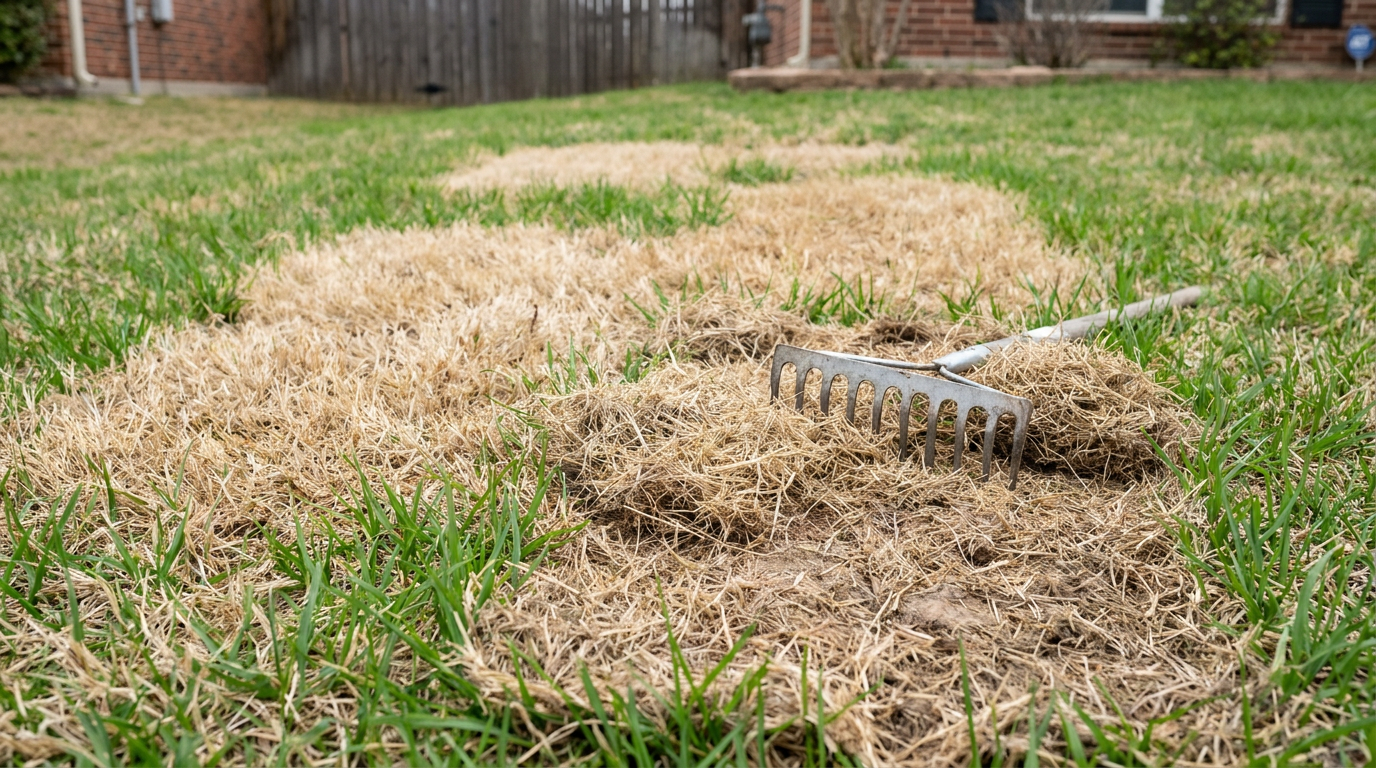
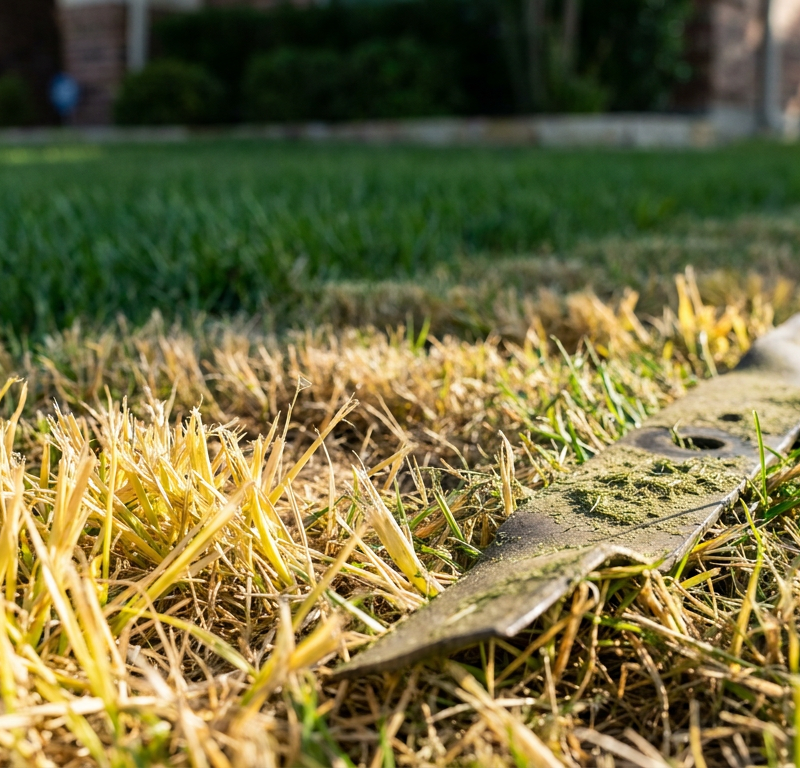
Rake and Scalp the Matted Dead Canopy — Winter leaves behind flattened, decaying leaves that block sunlight from warming the soil underneath. Put a sharp mulching or high-lift bagging blade on the mower and drop the deck one notch below your normal height (for example, take Bermuda down to 1.0 inch; Tall Fescue down to 2.5 inches).
- Tools: Heavy wire leaf rake, lawn mower with grass catcher bag.
- Bag every clipped-off piece. Then run a stiff-tine dethatching rake over stubborn gray patches to lift the dead layer and get sun on the crown area.
-
Address Snow Mold and Fungal Crusts — If the dead spots are covered with a thin, circular, crusty web of silvery-gray or pinkish fuzz, your lawn got hit with snow mold (Typhula or Microdochium spp.).
- Action: Break up the fungal crust with a light push-broom or flexible leaf rake on a dry afternoon.
- Fluffing those crushed blades lets in oxygen and UV light, and that shuts down the fungal mess pretty quick. I wouldn’t bother with chemical fungicides in late spring; by the time you see the damage, the fungus has already run its course, and you’ll just be burning money.
-
Core-Aerate the Compacted Zones — Compacted winter soil suffocates dormant roots and keeps spring rain from getting down where it needs to go. Rent a walk-behind mechanical core aerator or use a manual hollow-tine step aerator for smaller trouble spots.
- Run it when the soil is moist, not muddy (water deeply 24 hours prior if dry).
- Make sure it pulls cylindrical plugs 2.5 to 3 inches deep and spaced 2 to 4 inches apart.
- Leave the plugs right on the lawn; rain and mowing will break them down over the next two weeks, and you’ll be recycling good soil microbes back into the yard.
-
Flush Residual De-Icing Salts — If dead strips run along your driveway, sidewalk, or curb, rock salt (sodium chloride) or chemical de-icers scorched the turf. Sodium pushes potassium and calcium out of the soil mix and yanks moisture right out of the roots.
- Material: Granular agricultural gypsum (calcium sulfate).
- Application: Spread pelletized gypsum over the salt-damaged edges at a rate of 40 to 50 lbs per 1,000 sq ft. Water the area hard with 1 inch of water. The calcium knocks the sodium off the clay particles so the salts can flush below the root zone.
-
Aerate and Rake Bare Seedbeds (Dead Turf Areas) — For areas that failed the crown tug test in step 1, strip away the dead stuff until you’re down to bare soil.
- Scrape off dead organic matter with a steel garden bow rake until about 50% bare native dirt shows through.
- Rough up the top 1/2 inch of soil with the rake tines so seed or sod can bite. Smooth, glazed, hard-packed dirt just won’t hold roots.
-
Apply Topdressing and Amend Heavy Clay — Spread clean, fine-screened compost or a 50/50 sand-compost blend over the bare and struggling patches.
- Keep it thin: exactly 1/8 to 1/4 inch deep.
- Work it into the aeration holes and around the crowns with the back of a push broom. Topdressing adds biological activity, holds crown moisture during spring dry spells, and softens hard crusts.
-
Overseed Cool-Season or Plug Warm-Season Grass — Match the turf species exactly. Don’t throw Northern cool-season seed into a dormant Bermuda or St. Augustine lawn unless you want a patchy mess.
- Cool-Season Turf: Broadcast turf-type tall fescue (TTTF) or Kentucky bluegrass seed at 6 to 8 lbs per 1,000 sq ft for bare spots. Rake lightly so you get 1/8-inch seed-to-soil contact, then tamp it down with your boots.
- Warm-Season Turf: Warm-season turf like St. Augustine can’t be grown from seed, and hybrid Bermuda seed rarely matches the existing texture. Use fresh sod pieces or cut 3-inch plugs from healthy parts of the lawn with a sod plugger tool. Set plugs 8 to 12 inches apart on center, level with the existing soil grade.
-
Apply a Low-Nitrogen, High-Phosphorus Starter Fertilizer — Dumping heavy nitrogen into cold, waking roots forces top growth before the root system can support it, and that usually ends in weak roots.
- Pick a slow-release starter fertilizer with an N-P-K ratio around 10-20-10 or 15-0-15 (if phosphorus is restricted by local ordinance).
- Apply at a rate of no more than 0.5 to 0.75 lbs of actual Nitrogen per 1,000 sq ft. For turf that’s alive but slow to wake up, skip nitrogen altogether until the lawn has reached 60% green-up on its own.
-
Establish a Phased Spring Watering Regimen — Watering makes or breaks winter lawn recovery.
- For living, slow-to-wake grass: Irrigate deeply once a week with roughly 1/2 inch to 3/4 inch of water. Don’t keep the soil soggy; cool, wet spring dirt invites root rot (pythium).
- For freshly seeded/plugged patches: Mist lightly 2 to 3 times daily for 5 to 8 minutes, just enough to keep the top 1/2 inch moist. After 21 days, shift to deeper, less frequent watering once seedlings hit 2 inches tall or plugs show new runner growth.
Common Causes
- Crown Hydration Damage: Rapid late-winter freeze-thaw swings trap water inside plant cells, and when temps plunge into the teens, the crown walls split.
- Winter Desiccation: Long, dry winter winds sweep over snowless turf while the ground is locked up solid. The blades lose moisture, but frozen roots can’t pull any groundwater, so the turf basically freeze-dries.
- De-Icing Salt Poisoning: Runoff from driveways and sidewalks treated with sodium chloride soaks the edges, pulls moisture away from roots, and pushes soil electrical conductivity into toxic territory.
- Snow Mold Infection: Snow sitting on unfrozen turf for weeks creates a dark, damp, 32°F to 36°F microclimate that snow mold fungi love.
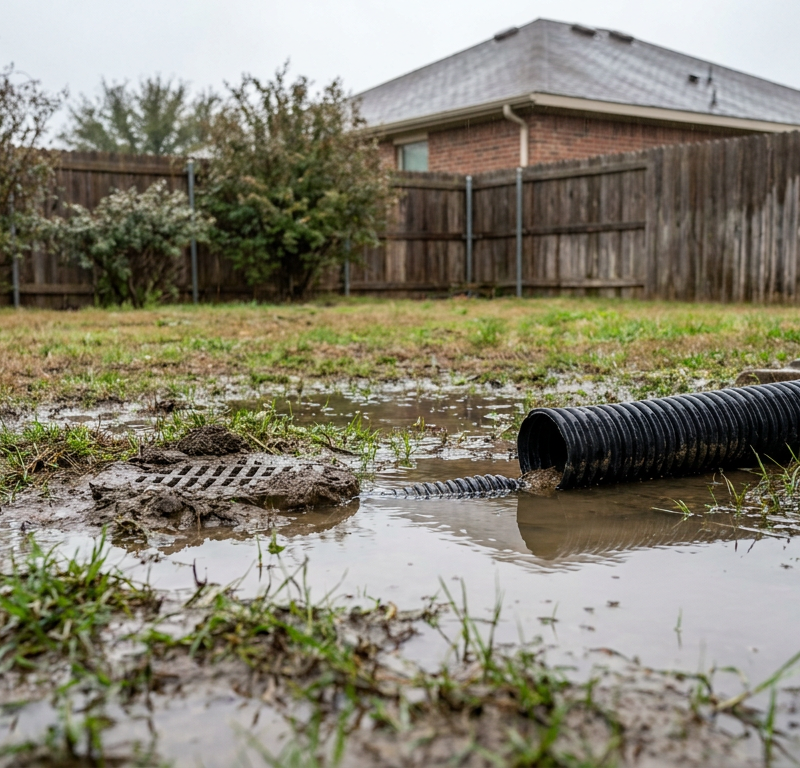
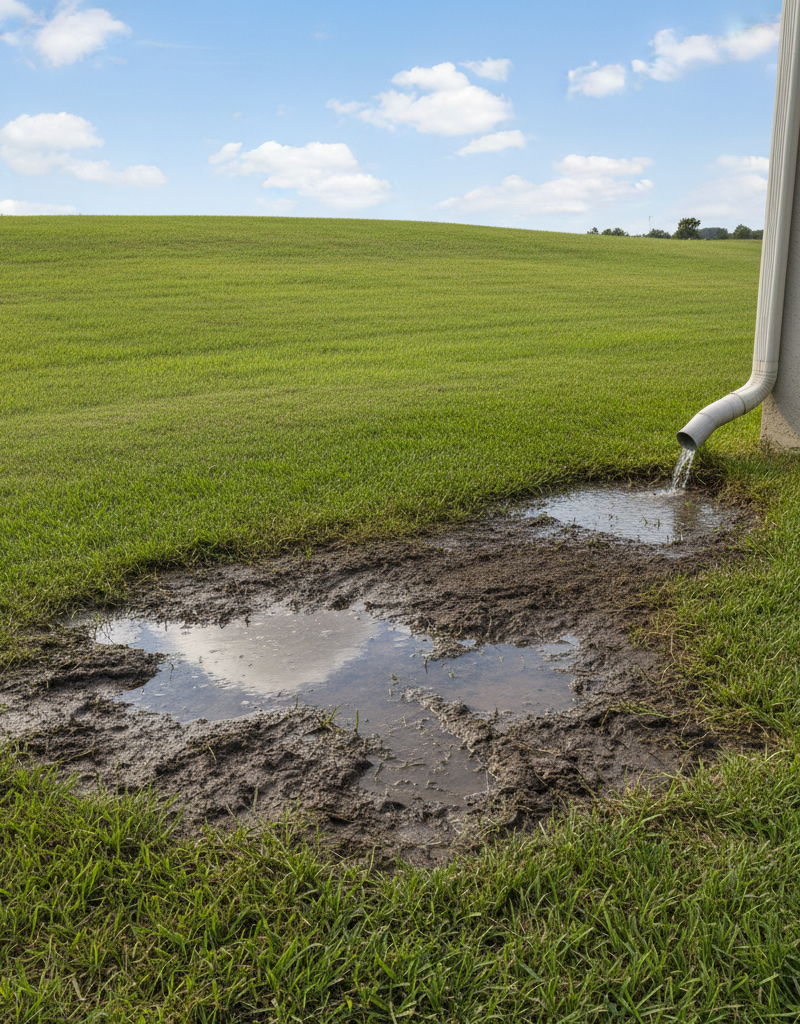
- Soil Compaction and Poor Drainage: Low spots in heavy clay yards hold cold water all winter. That standing water cuts off root respiration and suffocates the turf before spring gets here.
Common Mistakes
- Dumping Fast-Release Nitrogen in Early Spring: Hammering yellow turf with high-nitrogen fertilizer like 30-0-4 before soil temperatures reach 65°F doesn’t force green-up. It salts fragile cold roots, pushes tender leaf growth that’ll get nailed by spring frost, and feeds weed seeds.
- Applying Pre-Emergent Weed Killer Over Patch-Repair Areas: If you spread a standard crabgrass preventer like Prodiamine or Dithiopyr over spots you want to overseed, the barrier blocks grass seed from germinating for 3 to 6 months. Use Mesotrione instead, or wait on pre-emergents where you’re seeding.
- Overwatering Cold Soil: Folks see brown grass, assume it’s thirsty, and run the sprinklers every day in March. Soggy cold soil keeps temps down and invites nasty waterlogged fungal problems like Large Patch (Rhizoctonia solani).
- Raking Frozen or Waterlogged Turf Too Early: If you go after it too soon with a dethatching rake, you can rip still-dormant crowns right out of loose, muddy soil and wreck patches that would’ve come back on their own.
Cost & Time Breakdown
| Task | DIY Cost | Pro Cost | Time |
|---|---|---|---|
| Crown Viability & Soil Temp Diagnostic | $0–$15 (Thermometer) | $75–$125 (Consult) | 20–30 mins |
| Scalping & Dead Thatch Removal | $0–$40 (Rake/Bags) | $100–$250 | 1–2 hours |
| Core Aeration (Machine Rental vs Pro) | $70–$95 (4-hr rental) | $150–$275 | 1.5–3 hours |
| Gypsum Application for Salt Damage | $15–$30 (50-lb bag) | $65–$120 | 30–45 mins |
| Compost Topdressing & Leveling | $30–$80 (Bulk/Bags) | $200–$450 | 2–4 hours |
| Spot Reseeding or Plugging Repair | $25–$65 (Seed/Plugs) | $150–$350 | 1–2 hours |
Tips & Prevention
- Stop Late-Fall Nitrogen Overfeeding: Quit synthetic nitrogen applications 6 to 8 weeks before your average first frost date. Pushing tender leaf growth into early winter all but guarantees crown hydration injury when that first freeze shows up.
- Mow to Recommended Winter Heights: Take the final cut of the year down by about 1/2 inch so long, floppy blades don’t mat under leaves or snow, but don’t scalp the yard before winter hits.
- Switch to Calcium Magnesium Acetate (CMA): Swap harsh rock salt (sodium chloride) for concrete-safe, plant-friendly CMA de-icers along driveway and sidewalk edges so you’re not scorching the grass.
- Winter Watering During Dry Spells: If your area gets warm, snowless winters with drying wind, drag out a hose once every 3 to 4 weeks during a midday warm spell — when air temp is above 45°F — and give the dormant roots a light drink.
- Clear Piles of Leaves Before the Freeze: Thick mats of wet oak or maple leaves left all winter mimic snow mold conditions, trap moisture, block sunlight, and choke the crowns underneath.
When to Call a Professional
Bring in a certified turfgrass pro or landscape contractor if dead areas cover more than 40% to 50% of your total square footage, because that usually means mechanical slit-seeding, laser-grading, or full-lawn replacement with fresh sod rolls. Call in an expert too if the ground stays boggy and saturated for 48 hours without rain, since that points to a bad subsoil drainage issue, a broken irrigation line, or a failed grade pitching toward the house foundation — and that can mean excavation, french drains, or swales. And if you see widespread fungal growth coming back with sour, foul soil odors, you’re likely into commercial-grade regulated fungicides and deep-soil lab testing.
Related Articles
Keep troubleshooting with these hand-picked guides from FixlyGuide:
- The Mystery of the Soggy Spots: Why Your Yard Won't Drain (And How to Fix It) — Persistent soggy spots in your yard after rain can be a real headache, indicating poor drainage that impacts lawn health and even your home…
- The One Soil Secret Killing Your Garden (It Ain't Fertilizer) — Poor drainage and compacted soil can suffocate plant roots, leading to stunted growth, disease, and nutrient deficiencies. I'll show you ho…
- Sod Webworms Chewing Up Your Lawn? 5 Signs—and How to Get Rid of Them for Good — Seeing brown patches and chewed-up grass blades? Sod webworms might be the culprit. Here's how to check for these lawn pests and get rid of…
- The 7 Critical Yard Prep Steps Smart Homeowners Never Miss (And Why) — Prepare your yard for a thriving spring with these essential steps, from soil testing to tool maintenance, ensuring a vibrant outdoor space.
- The #1 Mistake Killing Your Lawn (and the Simple Grub Fix) — Grub worms can covertly destroy a beautiful lawn, but specific biological and chemical treatments applied at the right time can eliminate t…
- Washing Machine Shaking Violently? 6 Causes and How to Stop It — Stop your washing machine from shaking violently, banging during spin cycles, and walking across the floor with these proven mechanical fix…
Your seasonal maintenance checklist
The small jobs that prevent the expensive repairs. Tick them off — progress saves on this device.
Free, no signup. Skip anything that requires roof access or working near live electrical.
What should this project cost?
Enter your project details for a realistic cost range before you call anyone.
Cost depends heavily on which system turns out to be the source.
- Regional adjustment
- National average
- Labor share (typical)
- ~$1,620
- Quotes to collect
- 3 written estimates
Educational estimate based on national averages — not a binding quote. Always confirm with written local estimates.
Stay ahead of the next repair
Turn this guide into a schedule you will actually follow.
- Is this a safe DIY job?Check permits, tools, and risk before you start the steps below.Open
- Estimate this projectGet a cost range for your scope and ZIP before you call anyone.Open
Free, no signup required. Estimates are educational guidance, not a quote or an inspection.
Get the print-ready PDF of this guide
A clean, ad-free, printable version you can keep on your phone or pin to the workshop wall. Free with a FixlyGuide account.
- Print-optimized layout
- Tools, materials & every step included
- Saved to your account
Frequently asked questions
How can I tell if my grass is dormant or completely dead?+
The easiest method is the tug-and-slice test. Grab a fistful of brown grass blades and pull straight up. If it pulls out with the root mass intact or remains firmly anchored, cut a crown in half with a utility knife; if the interior core is white or pale green, it's alive and dormant. If it slides out with zero effort, smells sour, or shows a hollow, brittle, dark-brown center, the plant is dead.
Should I fertilize grass that hasn't greened up yet?+
Soil temperatures must warm up significantly first. Cool-season grasses need soil at 50°F to 55°F to push growth, while warm-season lawns like Bermuda and Zoysia require sustained 65°F to 70°F soil. Applying quick-release fertilizer while roots are cold burns root tips and stimulates spring weeds instead of grass.
Will dethatching help my grass wake up faster?+
Light raking to lift leaves and clear fungal webbing is helpful, but running a heavy mechanical dethatcher over cold, semi-dormant grass will rip loose living crowns from fragile rootbeds. Wait until the lawn is at least 50% green and growing actively before tackling deep mechanical dethatching.
Can I put down pre-emergent weed killer on dead patches?+
Yes, but not at the same time you apply seed. Most standard pre-emergents form a chemical barrier that stops all seeds—including your new lawn seed—from developing roots. If patching bare spots with seed, skip pre-emergent in those zones or use a product formulated with Mesotrione, which is safe for seeding cool-season lawns.
What is the difference between snow mold and winter desiccation?+
Snow mold forms circular, matted, crusty tan or gray patches, often with pinkish webbing visible right after snow melts. Winter desiccation leaves wide, irregular swaths of dry, brittle turf that look sun-scorched, particularly in elevated, wind-exposed areas of the yard that lacked moisture throughout the cold months.
Why is my Bermuda grass taking so much longer to wake up than my neighbor's?+
Bermudagrass is notoriously slow to emerge from winter dormancy. Wait until morning soil temperatures hit a consistent 65°F (usually late April or early May depending on your zone). If soil temperatures have stabilized and the grass remains brown while nearby lawns are fully green, perform the tug test to confirm crown survival.
How do I fix brown lawn edges killed by sidewalk de-icing salt?+
If you used standard sodium chloride rock salt, gypsum is the gold standard fix. Broadcast granular pelletized gypsum at 40 to 50 lbs per 1,000 square feet, followed by deep soaking. The calcium displaces sodium ions so they wash safely down past the root zone, allowing soil recovery.
How long does it take for winterkill repair patches to blend in with the yard?+
If you overseed cool-season grass, seedlings should germinate within 10 to 21 days with steady moisture. For warm-season turf repairing itself via runners or plugs, expect 4 to 6 weeks of active growing weather (daytime temps above 80°F) before bare patches fully fill in and knit together.
Discussion
Loading comments…