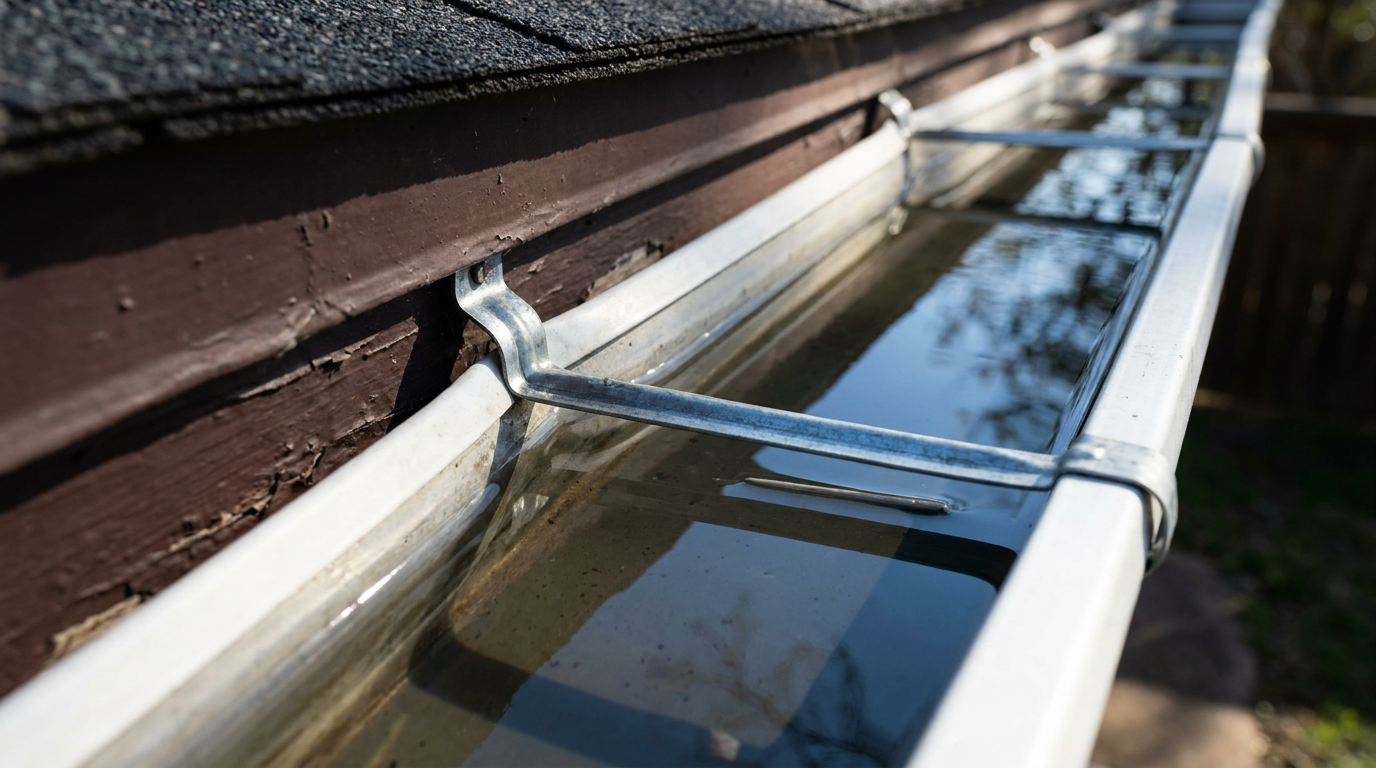
- A gallon of water weighs roughly 8.34 pounds; 20 feet of standing water adds 50 to 100 pounds of deadweight that yanks nails and brackets out of the fascia.
- In freezing weather, that pooled water turns into a hard brick of ice that expands, splits seams, and makes winter ice damming worse.
- In warm weather, stagnant pools become mosquito nurseries and give mold spores a path under the starter shingles.
- Rust and corrosion eat through the factory enamel on aluminum gutters or make steel troughs rust out fast.
Landscaping · Drainage or grading problem
| Project category | Landscaping |
|---|---|
| Problem type | Drainage or grading problem |
| Trade required | Landscaping |
| Urgency | Soon — within weeks |
| Safety risk | Low safety risk |
| DIY suitability | Pro recommended |
| Cost category | Moderate cost |
| Typical timeline | Most yards 1–3 days |
| Contractor type | Landscaping contractor |
Repair option
Regrade, extend downspouts, and add a French drain where water collects.
Replacement option
Full drainage system with catch basins for chronic flooding.
Common causes
- Negative grade toward the house
- Compacted clay soil
- Downspouts discharging at the foundation
Relevant tools:project cost estimator
Published November 7, 2026Last updated November 7, 2026
Tools & materials you'll need
Affiliate linksAs an Amazon Associate FixlyGuide earns from qualifying purchases — at no extra cost to you. Prices and availability are accurate as of publication and subject to change.
Quick Answer
To fix standing water from a bad gutter slope, I’d loosen the hidden hangers along the trouble spot, snap a chalk line with a drop of 1/4 inch per 10 feet toward the downspout, and then fasten everything back into the rafter tails. Don’t let standing water sit deeper than 1/2 inch — that’s mosquito country, it turns into ice in winter, and it’ll chew up your fascia boards if you ignore it. I pulled a water heater in Frisco last month and the homeowner had the same kind of “it’ll drain eventually” thinking with his gutters. No dice.
The Problem
Walk your roofline two days after a heavy rainstorm. If the sky’s clear but your gutters are still holding two inches of nasty, stagnant water, something’s off with the pitch.
A lot of homeowners figure clean gutters mean good drainage. They don’t. A gutter’s just an open trough. If it’s dead level — or worse, pitched backward away from the downspout — the water loses momentum and parks itself in the belly of the metal.
That trapped water brings a few expensive headaches:
- A gallon of water weighs roughly 8.34 pounds; 20 feet of standing water adds 50 to 100 pounds of deadweight that yanks nails and brackets out of the fascia.
- In freezing weather, that pooled water turns into a hard brick of ice that expands, splits seams, and makes winter ice damming worse.
- In warm weather, stagnant pools become mosquito nurseries and give mold spores a path under the starter shingles.
- Rust and corrosion eat through the factory enamel on aluminum gutters or make steel troughs rust out fast.
If your downspouts are clean and moving water during a storm but the run still stays swampy after the rain stops, you’ve got a pitch problem.
How It Works
Roof drainage runs on gravity. That’s it. A standard residential gutter system has the trough (usually a 5-inch or 6-inch K-style profile), fascia mounting brackets (hidden hangers or older ferrules and spikes), an outlet drop, and a downspout assembly.
For water to keep moving toward the outlet without hanging up on debris, the trough has to hold a steady downward pitch. The industry standard is 1/4 inch of fall for every 10 horizontal feet of gutter run. So if you’ve got a 20-foot run, the downspout side should sit 1/2 inch lower than the high end. On longer runs over 40 feet, gutters are usually pitched from the center outward toward downspouts at both corners, which makes a little peak in the middle.
High End (Far from downspout)
  |
  |---\
       \--- 1/4" drop per 10 ft
            \---> Water flow direction
                 \--- Outlet & Downspout
Mount a gutter flat for looks, or let a warped fascia board drag the middle lower than the ends, and gravity stops helping you. Surface tension takes over, silt settles in the bottom, and the water just sits there until it evaporates or starts rotting the wood behind it.
Step-by-Step Fix
Re-pitching a gutter takes patience, a ladder, and a few basic hand tools. You don’t need to rip the whole system down; you’re just adjusting the gutter’s elevation on the fascia board.
-
Clean the entire run thoroughly — Scoop out all the silt, rotten leaves, and pine needles with a plastic gutter scoop or a small garden trowel. Then flush the channel with a garden hose so you can see whether water pools in one dip or all along the run.
- Tools: Gutter scoop, garden hose with spray nozzle, bucket.
- Safety: Wear heavy leather work gloves; gutter edges and sheet metal screws are razor-sharp.
-
Locate and inspect the high and low ends — Measure from the bottom edge of the drip edge flashing down to the bottom of the gutter at the far end (high point) and at the downspout outlet (low point). If the low point isn’t lower than the high point, you’ve got a reverse-slope or no-slope situation.
- Inspection tip: If the low point is already flush with the bottom edge of the fascia board, raise the high end instead of lowering the downspout side.
-
Establish a reference chalk line — Drive a small 1-1/2-inch finish nail into the fascia right at the baseline edge of your gutter’s starting high point. Walk to the downspout end, measure down 1/4 inch for every 10 feet of distance, and tap in a second nail. Stretch a mason’s string or snap a chalk line between the two nails.
- Verification: Hang a line level on the string to make sure it slopes steadily toward the drain end without any sag.
-
Loosen the downspout connection — Pull out the two sheet metal screws tying the top downspout elbow to the gutter drop outlet with a 1/4-inch hex nut driver. Once that elbow’s loose, the gutter run can shift up or down without fighting the downspout piping.
- Caution: Hang onto the elbow as you back the screws out so it doesn’t smack shrubbery or concrete below.
-
Back out the hidden hanger screws along the problem area — Use a cordless drill with a 6-inch magnetic extension and a 1/4-inch hex bit to loosen the screws anchoring the hidden hangers into the fascia. You don’t need to remove the screws all the way — back them out about 1 inch until the gutter trough can slide vertically against the wood.
- If this doesn’t work: If your system uses old-school gutter spikes hammered through metal ferrules, use a flat pry bar and claw hammer with a wood block behind it to ease the spikes outward without crushing the front lip of the aluminum.
-
Check the fascia board for wood rot — With the gutter pulled away from the fascia, press an awl or the tip of a screwdriver into the wood behind the old screw holes. If the wood feels soft, spongy, or crumbles easy, those hidden hangers won’t hold torque, and the re-pitch won’t stay put.
- Branch action: If rot goes deeper than 1/4 inch, stop there. That rotten fascia section needs replacement before you remount the gutter.
-
Align the gutter profile with your chalk line — Starting at the high end, lift or lower the gutter until its bottom crease lines up cleanly with your snapped chalk line. Work in 8-foot stretches, supporting the trough on your shoulder or having a helper hold the run steady from a second ladder.
- Visual check: Look down the front bead of the gutter from one end. It ought to look like a laser-straight ramp, not a roller coaster with dips and humps.
-
Drive new hanger screws into solid rafter tails — Drive self-tapping 1-1/2-inch or 2-inch #10 exterior structural screws through the hanger clips directly into the fascia board and underlying rafter tails (spaced every 24 inches on center). Don’t reuse the stripped, wallowed-out holes from the old mounting.
- Hardware tip: Use heavy-duty aluminum screw hangers with pre-inserted zinc-coated steel screws. Skip the plastic clips; they sag in hot sun.
-
Seal old, abandoned screw holes — Squeeze a nickel-sized dollop of high-grade exterior polyurethane or tripolymer sealant into every exposed hole left behind in the fascia board. That keeps runoff from sneaking into the sub-fascia and roof decking.
- Material note: Don’t use standard indoor/outdoor silicone; it dries out, shrinks, and fails under exterior UV exposure within two seasons.
-
Reattach the downspout drop outlet — Line up the outlet with the top elbow of the downspout. If lowering the gutter shortened the gap, loosen the downspout wall straps and slide the downspout down, or trim 1/2 inch off the corrugated downspout drop with tin snips. Secure the joint with two 1/2-inch #8 self-drilling sheet metal screws.
- Pro detail: Always drive downspout screws into the sides of the elbow, never the back or front face, so the visible profile stays clean and service later is easier.
-
Run a dynamic flow test — Take your garden hose up the ladder, set the nozzle at the far high end of the gutter, and run the water on medium volume for 3 minutes. Shut off the hose, wait 5 minutes, then climb up and inspect the bottom of the trough.
- Success criteria: You should see a moist film or tiny trickles, but zero pooled puddles deeper than 1/16 of an inch. If a puddle hangs around, mark the spot, back out the two neighboring hangers, raise that valley 1/8 inch, and re-tighten.
Common Causes
- Settling and Foundation Movement: As homes settle over time — especially in places with shifting clay soils — the roofline drifts out of square a bit, and a once-good slope turns flat.
- Initial Installer Laziness (Level Installation): A lot of budget installers use a standard spirit level to mount gutters parallel with the fascia for looks, and they ignore the required 1/4-inch-per-10-foot downward grade.
- Hanger Spacing Too Wide: Brackets spaced 36 to 48 inches apart instead of every 24 inches let aluminum gutters sag under wet leaves, which creates low spots in the middle.
- Ice Dam Weight and Snow Loads: Heavy winter snow slides and ice dams bend aluminum hangers downward, and that leaves permanent sags where water pools once the ice melts.
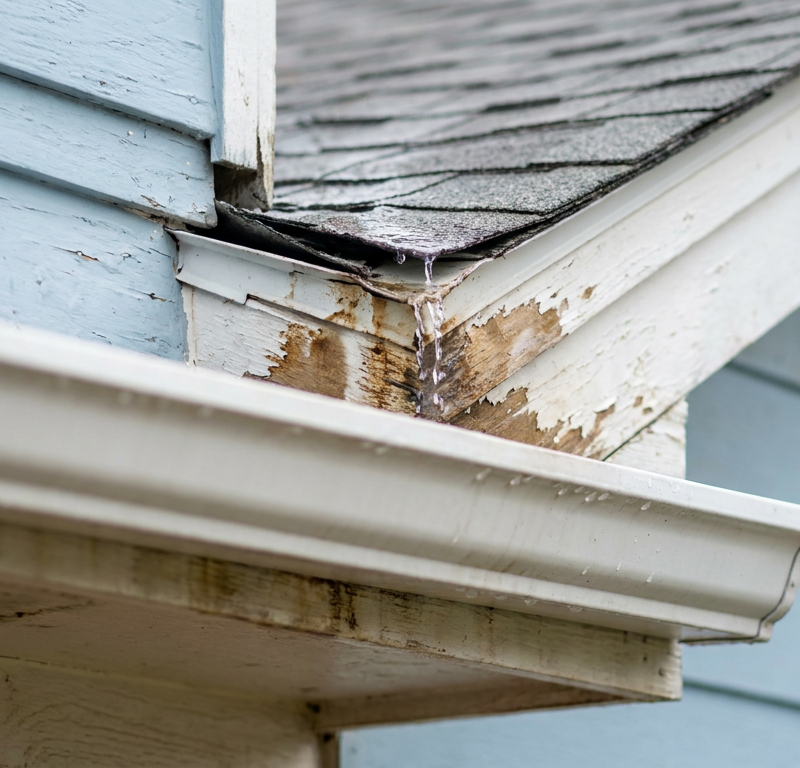
- Warped or Rotting Fascia Boards: Unsealed wood fascia boards soak up humidity, twist, and pull the mounting brackets unevenly along the wall.
Common Mistakes
- Pulling the Whole Gutter Down First: Homeowners often disconnect 40 feet of seamless gutter all at once, and that almost always kinks, twists, or permanently bends the aluminum. Leave the high end lightly anchored and adjust bracket by bracket.
- Reusing the Old Screw Holes: Driving mounting screws back into the same holes that already stripped or pulled loose just sets you up for another sag after the next hard rain. Offset your new screws by at least 1 to 2 inches into solid wood.
- Over-Pitching the Run: Sloping a gutter too hard, say 1 inch per 10 feet, drops the far end too low beneath the roof drip edge. Wind-driven rain will blow right behind the gutter and soak the soffit.
- Relying on Silicone Caulk to Bridge Gaps: Smearing silicone inside the trough to “ramp” water along doesn’t fix pooling. The caulk peels, traps silt, and makes tiny dams that make puddles worse.
- Ignoring the Drip Edge Flashing: Forcing a gutter up too high can shove it behind or bend the metal drip edge. Make sure the drip edge’s lower kick-out still overhangs inside the gutter’s back wall.
Cost & Time Breakdown
| Task | DIY Cost | Pro Cost | Time |
|---|---|---|---|
| Gutter Cleaning & Water Level Inspection | $0–$15 (scoop/gloves) | $125–$225 | 45–60 min |
| Re-pitching 30-Foot Gutter Run | $20–$35 (hangers, screws, sealant) | $175–$350 | 2–3 hours |
| Replacing 10 Hidden Hangers | $15–$25 | $100–$200 | 30–45 min |
| Fascia Board Section Repair (if rotted) | $35–$65 (lumber, primer, screws) | $250–$500 | 2–4 hours |
| Adding an Auxiliary Downspout (for long runs) | $40–$70 | $150–$300 | 1–2 hours |
Tips & Prevention
- Check with a hose every spring: Don’t wait for a big storm. Spend ten minutes flushing your gutters with a garden hose each spring to make sure water clears the trough completely within 3 minutes of shutting off the water.
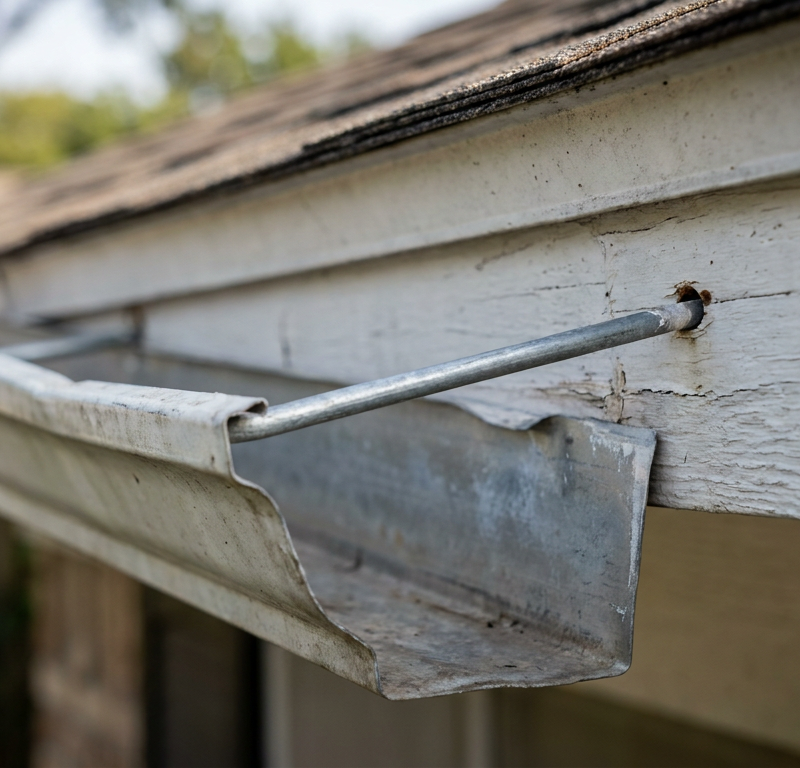
- Upgrade from spikes to screw-in hidden hangers: If your gutters hang on long 7-inch aluminum spikes and ferrules, swap them out one section at a time for heavy-duty screw-in brackets. Spikes back out of wood after a few freeze-thaw cycles.
- Space brackets at 24 inches maximum: In northern states or snow-prone areas, tighten bracket spacing down to 18 inches on center to keep the middle from sagging under snow load.
- Add a second downspout on runs over 40 feet: If your gutter run goes past 40 linear feet, pitching everything one direction makes the low end sit way down the fascia board. Pitch from the center to both corners and install two downspouts.
- Keep trees trimmed back 6 to 8 feet: Overhanging branches dump debris straight into the trough, and that speeds up bracket fatigue and sagging.
When to Call a Professional
If you own a two- or three-story home, working off extension ladders 25 feet in the air while wrestling long runs of flexible aluminum brings serious fall risk. Call an insured gutter specialist.
You should also bring in a pro if your fascia boards show widespread rot across multiple structural rafter tails; fixing structural roof framing means pulling up the bottom course of shingles and drip edge, which is way beyond a basic hanger adjustment. And if your seamless gutters are dented, creased, or structurally warped along the base, re-pitching won’t stop water from pooling. That damaged section needs to be cut out and replaced with a newly extruded seamless run on-site.
Frequently Asked Questions
How much slope should a rain gutter have?
A standard residential gutter should slope at a rate of 1/4 inch of fall for every 10 horizontal feet toward the downspout. On runs shorter than 20 feet, an absolute minimum of 1/8 inch per 10 feet can work if water volume stays low, but 1/4 inch is the gold standard for keeping sediment from building up.
Why does my gutter hold water even when there are no leaves in it?
Water gets trapped because the gutter doesn’t have proper downward pitch toward the downspout, or the center of the span has sagged. Even a tiny 1/8-inch upward bow in the metal can stop gravity from pulling water down the channel.
Can standing water in gutters damage my house foundation?
Yes. When gutters hold standing water, they spill over during sudden heavy downpours instead of sending volume through downspouts and away from the foundation. That concentrated overflow soaks the soil right against the foundation walls, builds hydrostatic pressure, and can lead to basement leaks.
How do I tell if my gutters are pitched correctly without a ladder?
During a light rain or right after a storm, look at your downspout exits. If the rain has stopped but the downspout still dribbles steadily, water’s draining like it should. If the downspout quits right after the rain stops while your neighbor’s keeps dripping, you probably’ve got a low spot somewhere in the trough.
Is standing water in gutters normal after a rainstorm?
No, it isn’t normal. A properly sloped gutter system should empty itself within five to ten minutes after the rain stops. Small droplets or a paper-thin moisture film are normal because of surface tension, but standing water deeper than 1/8 inch means the slope’s wrong.
Can I fix a sagging gutter without taking it down?
Yes. You can loosen the mounting brackets or hidden hangers along the sagging section, push the gutter back up to the correct height using a chalk line or string line as your guide, and drive new screws into fresh spots on the fascia board without removing the run.
Why do my gutters sag in the middle?
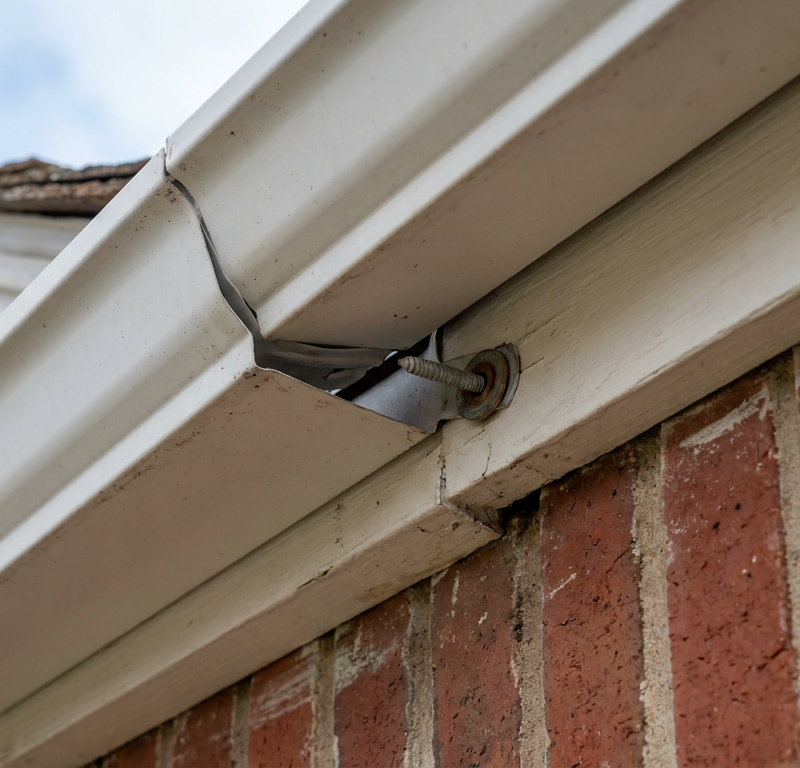
Gutters sag in the middle mostly because hidden hangers are spaced too far apart (more than 24 inches), wet leaves and debris are loading them down, or old mounting spikes have pulled loose from the fascia board over time.
How do I fix water pooling around the downspout outlet?
If water pools right near the downspout drop, the outlet tube was probably installed with its interior flange sitting above the floor of the gutter. Tap the metal lip downward with a ball-peen hammer and a wood block to make a recessed funnel that lets water drop cleanly into the pipe.
Related Articles
Keep troubleshooting with these hand-picked guides from FixlyGuide:
- Is Your Gutter Sagging After Every Storm? The Hidden Flaw Most Homeowners Miss — Discover the overlooked reason your gutters sag after every storm and learn the lasting fix that most homeowners miss.
- The 3 Hidden Reasons Your Gutters Fail in Heavy Rain (It’s Not Just Leaves) — Overflowing gutters during heavy rain often stem from a few common, yet overlooked, issues beyond simple leaf clogs, leading to potential s…
- Deck Screws Pulling Out? 5 Causes and the Step-by-Step Fix — Stop tripping on loose deck screws. Here is why fasteners pop out of deck boards, how to test for joist rot, and the step-by-step fix to an…
- The #1 Mistake Homeowners Make When Sealing a Deck (And How to Fix It) — Discover the crucial, often-missed step in deck sealing that prevents premature wear and water damage, ensuring your wood deck lasts for ye…
- Missing Shingles? The Real Trouble Is Under Your Roof — After a storm, missing shingles seem like a simple fix. But the high winds that tore them off likely broke the seals on surrounding shingle…
- Water Pooling in Landscape Beds? 10 Steps to Stop Foundation Flooding — Fix standing water and poor drainage in landscape beds around your foundation with pro-tested regrading, downspout extensions, and sub-surf…
Should you do this yourself?
Answer five quick questions before you start. Safety outranks savings every time.
Your experience with work like this
How high do you have to work?
Does the job involve any of these?
Will it need a permit?
Specialty tools
Free and instant. Educational guidance only — not a quote, inspection, or professional diagnosis.
What should this project cost?
Enter your project details for a realistic cost range before you call anyone.
Spot repairs commonly run $400–$1,800; full replacement typically $9,000–$18,000 for an average home.
- Regional adjustment
- National average
- Labor share (typical)
- ~$2,948
- Quotes to collect
- 3 written estimates
Educational estimate based on national averages — not a binding quote. Always confirm with written local estimates.
Fixly Project Decision Box
- DIY difficulty
- Professional Recommended
- Estimated time
- Inspection 1–2 hours · repairs 1–3 days
- Cost level
- High
Main tools / materials
- Binoculars for a ground-level look
- Flashlight for attic checks
- Moisture meter
- Roofing cement (temporary patch only)
When to stop and call a pro
- Active leak near lights, fans, or any wiring
- Sagging, bulging, or water-filled ceiling
- Steep, wet, or two-story roof — do not climb it
- Storm or hail damage you plan to claim on insurance
Need professional help?
Free roof assessment first — no phone calls until you ask for them.
Get Local Roofing HelpDecide what your roof needs
Two minutes of questions turns "something is wrong up there" into a clear next step.
- Repair or replace your roof?Answer 10 questions about age, leaks, and damage to get a clear next step.Open
- Compare contractor quotesScore up to four bids on price, warranty, licensing, and timeline.Open
- Get local estimatesSend one request and compare written estimates from vetted pros.Open
Free, no signup required. Estimates are educational guidance, not a quote or an inspection.
Get the print-ready PDF of this guide
A clean, ad-free, printable version you can keep on your phone or pin to the workshop wall. Free with a FixlyGuide account.
- Print-optimized layout
- Tools, materials & every step included
- Saved to your account
Frequently asked questions
How much slope should a rain gutter have?+
A standard residential gutter must slope at a rate of 1/4 inch of fall for every 10 horizontal feet toward the downspout. On runs shorter than 20 feet, an absolute minimum of 1/8 inch per 10 feet can work if water flow volume is low, but 1/4 inch is the gold standard to prevent sediment buildup.
Why does my gutter hold water even when there are no leaves in it?+
Water stays trapped because the gutter lacks proper downward pitch toward the downspout, or the center of the span has sagged. Even a microscopic 1/8-inch upward bow in the metal stops gravity from pulling the water down the channel.
Can standing water in gutters damage my house foundation?+
Yes. When gutters hold standing water, they spill over during sudden heavy downpours instead of directing volume through downspouts and away from the foundation. Concentrated perimeter overflow saturates the soil directly against foundation walls, creating hydrostatic pressure and basement leaks.
How do I tell if my gutters are pitched correctly without a ladder?+
During a light rain or immediately after a storm, look at your downspout exits. If the rain has stopped completely but the downspout dribbles steadily, water is draining properly. If the downspout stops draining immediately after the rain ceases while your neighbor's still drips, water is likely trapped in a low spot along your trough.
Is standing water in gutters normal after a rainstorm?+
No, it is not normal. A properly sloped gutter system should completely empty itself within five to ten minutes after rain stops. Small droplets or a paper-thin moisture film are normal due to surface tension, but standing water deeper than 1/8 inch indicates an incorrect slope.
Can I fix a sagging gutter without taking it down?+
Yes. You can loosen the mounting brackets or hidden hangers along the sagging section, push the gutter up to the correct height using a chalk line or string line as your guide, and drive new screws into fresh spots on the fascia board without removing the run.
Why do my gutters sag in the middle?+
Gutters sag in the middle primarily due to hidden hangers spaced too far apart (more than 24 inches), weight from wet leaves and debris, or loose mounting spikes that have pulled out of the fascia board over time.
How do I fix water pooling around the downspout outlet?+
If water pools right near the downspout drop, the outlet tube was likely installed with its interior flange sitting above the floor of the gutter. Tap the metal lip downward with a ball-peen hammer and a wood block to create a recessed funnel that lets water drop cleanly into the pipe.
Discussion
Loading comments…