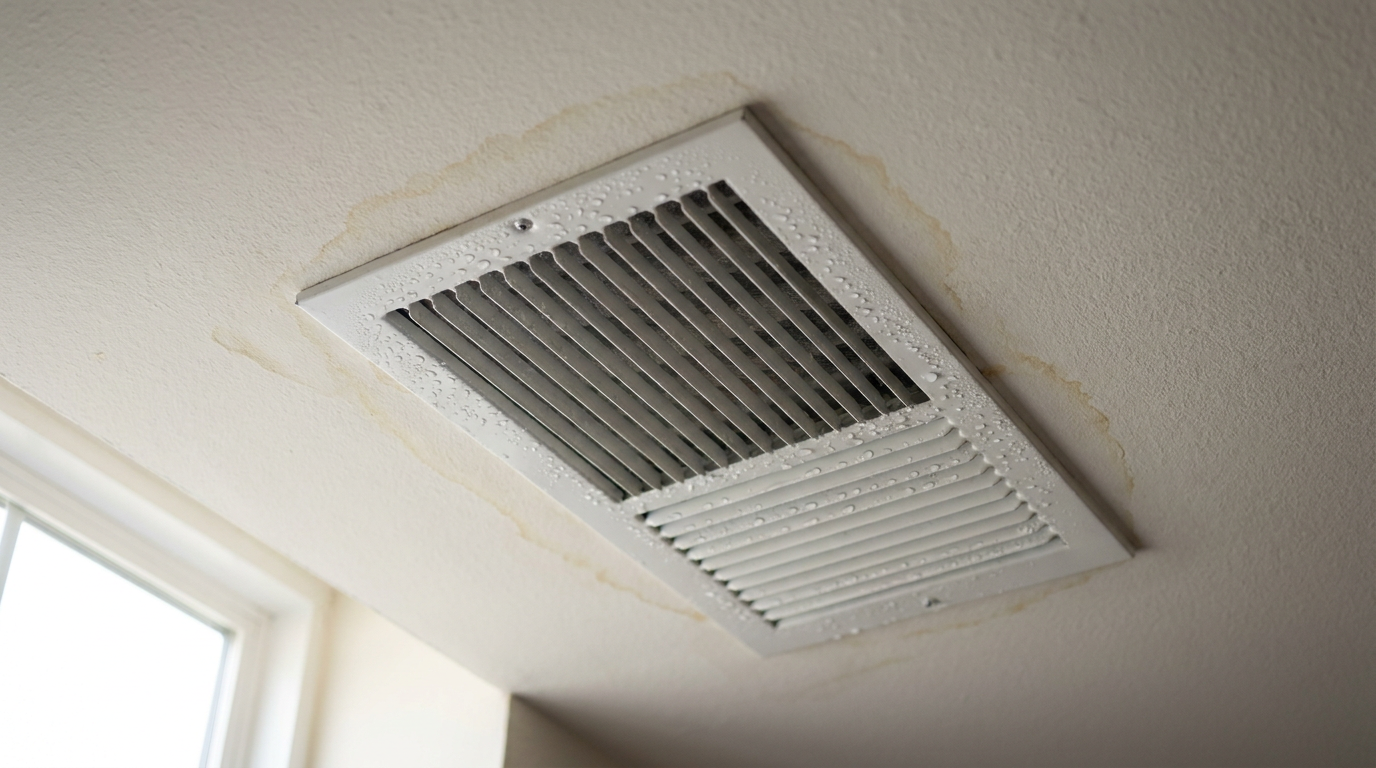
- Unsealed boots leaking attic air: When installers skip sealing the sheet metal boot to the ceiling drywall, hot, moisture-laden attic air gets pulled down through the framing gap by the venturi effect of supply air blowing into the room.
- Thermostat fan set to "ON" instead of "AUTO": Running your blower fan nonstop pulls trapped water droplets off the wet evaporator coil during the off-cycle, pushing indoor humidity above 60% within hours.
- Missing or displaced attic duct insulation: Attic workers, rodents, or failing tape can peel fiberglass wrap off the metal boot, leaving exposed galvanized steel to sweat into the ceiling drywall.
- Oversized AC equipment (short cycling): An oversized system cools the house in 7 to 10 minutes and shuts off before it can pull latent moisture from the air, leaving you with a cold, clammy house and high humidity.
- Damaged or restricted duct boots: Bent dampers or directional louvers pointing air straight back into the ceiling create dead zones of turbulent cold air that condense instantly.
Plumbing · Leak
| Project category | Plumbing |
|---|---|
| Problem type | Leak |
| Trade required | Plumbing |
| Urgency | Emergency — act now |
| Safety risk | High safety risk |
| DIY suitability | DIY for experienced homeowners |
| Cost category | Low cost |
| Typical timeline | Shut water off now; repair usually same or next day |
| Contractor type | Licensed plumber |
Repair option
Isolate at the shutoff, replace the failed component, and dry the cavity fully.
Replacement option
Repipe the run or the branch when corrosion is widespread.
Common causes
- Failed supply line or shutoff valve
- Worn washers, cartridges, or P-trap connections
- Pinhole corrosion in older copper
Relevant tools:emergency checklistdiy or hire a pro
Published October 22, 2026Last updated October 22, 2026
Tools & materials you'll need
Affiliate links- AmazonUL 181 water-based duct mastic paste1 tub (half gallon)
- AmazonFiberglass mesh duct tape1 roll
- AmazonPleated air filter (MERV 8 to 11)1
- AmazonLow-expansion spray foam1 can · for gaps wider than 1/4 inch
- AmazonDistilled white vinegar and microfiber cloth1 bottle
- AmazonR-8 fiberglass duct wrap1 roll · for attic-side boot insulation
As an Amazon Associate FixlyGuide earns from qualifying purchases — at no extra cost to you. Prices and availability are accurate as of publication and subject to change.
Quick Answer
If your HVAC air vents are sweating or dripping water, warm, humid indoor air is hitting cold metal duct boots and grilles that’ve dropped below the local dew point — usually around 55°F to 60°F. Most of the time, I can stop it by sealing air leaks around the vent boot with foil mastic tape, getting indoor humidity below 50% with your thermostat or dehumidifier, and swapping out dirty 1-inch pleated air filters that choke the airflow. If condensation keeps showing up on ceiling registers all over the house, I’d be looking in the attic for torn duct insulation or checking the blower speed.
The Problem
Walk under an AC supply register in July and you might get tagged by a cold drip on the neck. Or worse, you look up and see dark, fuzzy staining spreading around your ceiling vents. Not a fun sight.
Sweating registers look like a plumbing leak at first glance, but they aren’t. What you’re seeing is surface condensation. When ice-cold air chills the painted stamped-steel or aluminum grille below the ambient dew point, moisture gets pulled right out of your home’s air and beads up on the metal. Within days, those beads roll onto the drywall ceiling. Leave it alone long enough and the gypsum core starts to soften, water stains crawl across the paint, and mold can grab hold inside the sub-fascia of your duct terminations.
In humid climates — especially down here in North Texas during muggy summer heatwaves — unconditioned attic air can also sneak down around unsealed drywall gaps. That double-whammy of humid attic air meeting 48°F supply air creates an active indoor cloud chamber right at your vent box. Ugly stuff.
How It Works
Your air conditioning system does two separate jobs: it lowers sensible heat, which is the temperature reading on your wall, and it removes latent heat, which is the moisture hanging in the air. As warm house air gets pulled across your indoor evaporator coil, water vapor condenses on the cold aluminum fins and drips into the primary condensate pan to drain outside.
The air leaving your evaporator coil usually lands somewhere between 45°F and 55°F. That ice-cold air races through insulated supply trunk lines straight to your sheet metal vent boots — those rectangular metal boxes mounted behind your drywall ceilings or floors.
Condensation happens because of plain old psychrometrics. Warm air holds a lot more vapor than cold air does. If your living room sits at 75°F with 60% relative humidity, the dew point of that room is 60°F. If the steel grille of your supply register drops to 52°F because cold air’s blowing across it, the moisture in the room air has to condense the second it touches that steel surface.
Under normal conditions, supply air diffuses cleanly into the room without hanging around at the vent face, and the duct boots are sealed tight against the drywall so muggy wall-cavity or attic air can’t kiss the back of the cold register. But if your blower fan slows down, duct insulation tears, gaps around the drywall let attic air draft through, or your indoor humidity creeps above 55%, you get puddles on your grilles. Simple as that.
       UNCONDITIONED ATTIC AIR (Hot & Humid: 95°F–130°F)
                        │
                        ▼ (Leaking through unsealed drywall gap)
    ┌───────────────────┴───────────────────┐
    │       SHEET METAL DUCT BOOT           │
    │   Cold Supply Air (48°F - 54°F)       │
    └───────────────────┬───────────────────┘
                        ▼
      [ DRYWALL CEILING ] ◄── Unsealed gap creates condensation ring
    ════════════════════╪════════════════════
                 [ STEEL GRILLE ] ◄── Chilled below dew point (55°F)
                        │
                        ▼
      Condensation drops into living room
Step-by-Step Fix
Follow these steps in order. They start with the easy, no-cost checks inside the house and work their way up toward sealing the boots in the attic.
-
Check and drop your indoor relative humidity — Grab a cheap digital hygrometer and set it in the room with the sweating vents. If your indoor relative humidity reads above 55%, your system isn’t dehumidifying well enough, or outdoor air is leaking into the house. Set your thermostat fan setting to "AUTO" instead of "ON" — leaving it on "ON" blows warm air back over a shut-down, wet evaporator coil between cooling cycles, and that re-evaporates gallons of trapped moisture right back into your living space.
- Target reading: Keep indoor relative humidity between 45% and 50% during peak summer cooling months.
- Quick test: If your thermostat has an integrated dehumidification mode (often labeled "Cool to Dehumidify" or "Overcool"), turn it on so the blower slows down by 10% to 15% and pulls a little more moisture out of the air.
-
Replace clogged or restrictive air filters — Pull your return air filter and hold it up to a bright light. If you can’t see much light through it, that filter’s hurting you. Restricted airflow slows the air moving across your indoor evaporator coil, dropping supply air temperatures into the mid-40s and super-chilling the metal registers below the room’s dew point.
- Tool: Fresh pleated air filter (MERV 8 to MERV 11).
- Caution: Don’t grab ultra-dense 1-inch MERV 13+ filters unless your ductwork was built for high static pressure; they choke blower airflow and make sweating registers worse.
-
Kill power to the air handler before working at the vents — Head to your electrical panel or the service disconnect switch near your indoor air handler/furnace. Flip the circuit breaker to the "OFF" position so the blower doesn’t kick on while your hands are inside duct boots or near exposed fasteners.
- Safety: Verify the system is dead by clicking the thermostat down to call for cooling; nothing should hum or spin. No dice if it still runs.
-
Remove the sweating register grilles — Back out the two mounting screws holding the sweating metal grille to the ceiling or wall using a magnetic multi-bit screwdriver. Keep a hand under it so the thing doesn’t drop and chew up your drywall or flooring.
- Inspection: Check the back face of the grille. If you see dark gray or black spotting, that’s surface mold feeding on dust and condensation.
- Clean: Take the metal grilles outside or to a utility sink and scrub them with a 50/50 mix of warm water and distilled white vinegar, then dry them all the way with a microfiber cloth.
-
Inspect the gap between drywall and the metal boot — Look up into the cutout where the duct boot meets your ceiling drywall. I’ve seen builders and drywall crews cut this opening 1/2 inch to 1 inch too large more times than I can count, and it leaves a raw gap straight into your unconditioned attic or floor joist cavity. I pulled a water heater in Frisco last month that had exactly this kind of sloppy gap around a nearby return, and the stain pattern told the whole story.
- The symptom: If you feel a hot draft blowing down through the edges around the cold metal boot while the AC is off, attic air is dumping right onto your register.
- Correction standard: That drywall edge has to be sealed airtight against the perimeter of the galvanized sheet metal boot.
-
Seal the boot-to-drywall gap with fiberglass mesh and mastic — Vacuum away drywall dust and loose attic insulation around the perimeter lip of the sheet metal boot. Lay down self-adhesive fiberglass duct mesh tape spanning the seam between the sheet metal flange and the drywall, then brush on a thick, continuous 1/8-inch layer of water-based duct mastic sealant over the tape using a 2-inch chip brush.
- Material: UL 181A-M or 181B-M rated water-based mastic paste (such as RCD or Ductmate).
- Alternative: If the gap is wider than 1/4 inch, shoot closed-cell polyurethane expanding foam (low-expansion window and door formula) into the gap first, let it cure for 45 minutes, trim it flush with an insulation knife, then coat it with mastic.
- Avoid: Standard gray cloth "duck" tape. The adhesive dries out and falls off in hot attic spaces within two summers, easy.
-
Verify boot insulation from the attic — Climb into the attic and trace the duct run down to the problem ceiling box. The whole sheet metal boot needs to be wrapped in minimum R-6 (or R-8 in southern states) fiberglass or bubble-foil duct wrap.
- Check for bare metal: Any uninsulated metal touching unconditioned 120°F attic air will sweat like crazy on the outside and drip onto your ceiling drywall.
- Fix: Wrap any exposed metal with R-8 fiberglass duct wrap, seal the seams with UL 181-rated aluminum foil tape, and secure it with zip ties cinched down every 12 inches.
-
Adjust louvers to eliminate air stagnation — Reinstall the clean register grilles using your screwdriver, snugging the screws until they’re firm without warping the faceplate. Adjust the register louvers so they send air smoothly across the room ceiling instead of blowing straight down against an adjacent wall or trapping air right at the frame.
- Principle: High-velocity airflow across room surfaces stirs the air enough to prevent those little cold pockets where moisture falls out of suspension.
-
Restore power and test register temperatures — Flip your air handler breaker back on. Let the AC run through a full 20-minute cooling cycle. Use an infrared non-contact thermometer to shoot the temperature of the supply register face and compare it to the ambient room temperature.
- Pass benchmark: Supply air should exit between 15°F and 20°F cooler than the return air temperature (delta-T). The register grille should stay dry to the touch even on 90°F+ afternoons.
Common Causes
- Unsealed boots leaking attic air: When installers skip sealing the sheet metal boot to the ceiling drywall, hot, moisture-laden attic air gets pulled down through the framing gap by the venturi effect of supply air blowing into the room.
- Thermostat fan set to "ON" instead of "AUTO": Running your blower fan nonstop pulls trapped water droplets off the wet evaporator coil during the off-cycle, pushing indoor humidity above 60% within hours.
- Low airflow across the coil: Dirty air filters, collapsed flex ducts in the attic, or closed interior supply dampers drop airflow (CFM). When air moves too slowly, it gets super-chilled to 42°F–46°F, dropping the vent grille below room dew point.
- Missing or displaced attic duct insulation: Attic workers, rodents, or failing tape can peel fiberglass wrap off the metal boot, leaving exposed galvanized steel to sweat into the ceiling drywall.
- Oversized AC equipment (short cycling): An oversized system cools the house in 7 to 10 minutes and shuts off before it can pull latent moisture from the air, leaving you with a cold, clammy house and high humidity.
- Damaged or restricted duct boots: Bent dampers or directional louvers pointing air straight back into the ceiling create dead zones of turbulent cold air that condense instantly.
Common Mistakes
- Reaching for standard gray duct tape: That silver cloth tape you buy at the grocery store has a rubber adhesive that bakes, cracks, and falls off inside hot ceilings in under 18 months. Use UL 181-rated foil tape or water-based mastic paste instead.
- Closing too many supply vents to "save energy": Shutting registers in unused bedrooms spikes the static pressure in your ductwork and slows system airflow. That colder air triggers sweating on the vents that remain open. Never close more than 10% of the registers in your home.
- Insulating over a wet ceiling: If your ceiling drywall is damp from vent sweat, don’t just slather mastic over it or throw fresh attic insulation on top. Let the drywall dry out completely for 24 to 48 hours, clean it with white vinegar, and check structural integrity before sealing.
- Leaving bathroom exhaust fans off: Long, steamy showers without running a 50–110 CFM bath fan dump pints of moisture into the living area. Run your exhaust fan during showers and leave it on for 20 minutes afterward to keep whole-home dew points under 55°F.
- Ignoring the primary condensate drain: If your indoor drain line is partially obstructed with algae slime, water backs up in the pan, raising internal cabinet humidity and dropping coil efficiency.
Cost & Time Breakdown
| Task | DIY Cost | Pro Cost | Time |
|---|---|---|---|
| Thermostat Fan Reset & Filter Swap | $15–$30 | $90–$150 | 10 minutes |
| Sealing 4–6 Vent Boots (Mastic & Mesh) | $25–$45 | $250–$450 | 1.5–2 hours |
| Re-insulating Attic Duct Boots (R-8 Wrap) | $35–$65 | $300–$600 | 1–2 hours |
| Blower Motor Speed Adjustment | $0 | $150–$250 | 30 minutes |
| Whole-House Duct Static Pressure Test & Tune | N/A | $200–$400 | 1 hour |
Tips & Prevention
- Set your thermostat fan strictly to "AUTO": This one switch keeps the system from re-evaporating moisture and can drop whole-home indoor humidity by 5% to 8% within 24 hours.
- Inspect boot seams whenever you paint ceilings: Before cutting in paint around ceiling supply grilles, drop the screws, pull the register, and check for air leaks or dried-out factory sealant.
- Maintain 3-month filter replacement cycles: Check your 1-inch return air filters every 30 to 60 days during peak summer cooling. If you hold a filter up to a flashlight and can’t see the glow through the pleats, swap it out.
- Track your indoor humidity with cheap hygrometers: Place a $10 digital monitor in your main living room and your primary bedroom. If you see numbers climbing past 52% on humid days, bump your cooling setpoint down 1°F to force a longer dehumidification run, or fire up a standalone dehumidifier.
- Keep ceiling fans on only when rooms are occupied: Ceiling fans cool people through evaporative skin cooling, not rooms. Leaving them running in empty rooms adds sensible heat from the fan motor without removing any moisture from the air.
When to Call a Professional
If you’ve sealed every drywall-to-boot joint with mastic, swapped your air filters, verified your attic insulation is intact, and water keeps dripping from your grilles, the problem’s deeper in the HVAC system.
Call a licensed HVAC technician if your air conditioner short-cycles in 8-minute bursts, which points to an oversized condenser or faulty thermostatic expansion valve (TXV). You’ll also need a pro if your evaporator coil shows ice formation along the copper lines, which usually means a refrigerant leak or a bad blower motor. A technician has the manometers to measure total external static pressure (TESP) across your ductwork and the electrical know-how to adjust the blower motor’s ECM speed taps to increase airflow (CFM) without frying your control board.
Related Articles
Keep troubleshooting with these hand-picked guides from FixlyGuide:
- That 'Energy-Saving' HVAC Trick Is Costing You Money — You've heard the advice: close HVAC vents in unused rooms to save on heating and cooling. But this common practice is a myth. It actually h…
- The Mystery of the Vanishing Air: Why Your HVAC Stops Blowing After 10 Minutes — Discover the hidden culprits behind your HVAC system stopping short after just 10 minutes of operation and learn how to fix them yourself.
- Heat Pump Won't Switch to AC? 6 Causes & What to Check First — If your heat pump is stuck in heating mode and won't switch over to air conditioning, it's often a simple fix like a thermostat setting, a…
- That August Chill: Why Your AC Freezes Up & How to Fix It — Is your air conditioner a block of ice in the middle of a heatwave? It seems counterintuitive, but an AC that freezes up is a common August…
- The #1 Mistake Homeowners Make With HVAC Filters (And How Often to Really Change Them) — Discover the crucial mistake most homeowners make with HVAC filters and the specific schedule you should follow to avoid costly HVAC issues…
- Kitchen Faucet Leaking Under the Sink When Sprayer Runs? 5 Causes and the Step-by-Step Fix — Fix that hidden water leak under your kitchen sink. Step-by-step diagnostic and repair instructions for leaking pull-out hoses, bad O-rings…
Should you do this yourself?
Answer five quick questions before you start. Safety outranks savings every time.
Your experience with work like this
How high do you have to work?
Does the job involve any of these?
Will it need a permit?
Specialty tools
Free and instant. Educational guidance only — not a quote, inspection, or professional diagnosis.
Estimate your own project cost
National averages are a starting point. Enter your details for a range that fits your house.
HVAC replacement cost
- Equipment$2,200 – $3,800
- Installation labor$1,200 – $2,500
Always insist on a Manual J load calculation — sq-ft sizing is only a rough check. Federal heat-pump rebates may reduce cost significantly.
Educational estimate only — always confirm with written local bids.
What should this project cost?
Enter your project details for a realistic cost range before you call anyone.
Service calls and common repairs run $150–$900; full system replacement typically $6,000–$12,000.
- Regional adjustment
- National average
- Labor share (typical)
- ~$1,935
- Quotes to collect
- 3 written estimates
Educational estimate based on national averages — not a binding quote. Always confirm with written local estimates.
Fixly Project Decision Box
- DIY difficulty
- Advanced
- Estimated time
- Homeowner checks 20–30 minutes
- Cost level
- Moderate
Main tools / materials
- Clean air filter
- Garden hose for condenser coils
- Shop vac for the condensate line
When to stop and call a pro
- Burning smell, smoke, or a tripping breaker
- Refrigerant lines iced over or hissing
- Any work inside the sealed refrigerant circuit (EPA-licensed only)
- Gas smell near a furnace — leave and call the utility
Need professional help?
Find an HVAC Pro Near YouBefore you start
Check the difficulty, permits, and safety risk — then decide whether to call a pro.
Free, no signup required. Estimates are educational guidance, not a quote or an inspection.
Get the print-ready PDF of this guide
A clean, ad-free, printable version you can keep on your phone or pin to the workshop wall. Free with a FixlyGuide account.
- Print-optimized layout
- Tools, materials & every step included
- Saved to your account
Frequently asked questions
Why does setting my thermostat fan to ON make my vents sweat?+
Setting your fan to ON keeps the blower spinning 24/7, even when the cooling compressor shuts down. This forces warm room air over the sopping-wet evaporator coil and condensate pan, blowing gallons of evaporated water right back into your rooms and spiking indoor humidity above the dew point.
Why are my AC vents dripping water in the summer?+
Condensation occurs when the temperature of your metal register grille drops below the dew point of the room air. If your home has high humidity (above 55%) or hot attic air is leaking down through drywall cutouts around the boot, moisture beads up on the cold steel and drips.
Can I just use regular duct tape to seal around my vent boots?+
Standard gray cloth duct tape uses a rubber-based adhesive that degrades, dries out, and loses its grip within 12 to 24 months in hot attic temperatures. Always use UL 181A-M or 181B-M rated water-based mastic paste or UL-listed aluminum foil tape for lasting seals.
Does a dirty or high-efficiency air filter cause vents to sweat?+
High-MERV filters (like MERV 13 or higher in 1-inch frames) create excessive static pressure that chokes airflow across your cooling coil. Slower air spends more time on the cold coil, dropping supply air temperatures down into the mid-40s, which super-chills the metal vents and accelerates sweating.
Will switching from metal to plastic vent grilles fix sweating?+
If you have sealed the drywall gap and the boot is insulated, plastic or composite grilles can stop condensation because plastic is a poor thermal conductor compared to stamped steel. However, plastic grilles treat the symptom rather than fixing high indoor humidity or unsealed boots.
Is that black stuff around my sweating AC vents mold?+
Black or dark gray spots on or around sweating vents are almost always mold or mildew feeding on drywall paper and dust particles activated by chronic moisture. Clean it with a 50/50 water-and-white-vinegar solution, let it dry completely, and eliminate the condensation to prevent regrowth.
Can an oversized air conditioner cause vent condensation?+
Yes. An oversized air conditioner cools your home down too fast (in 7 to 10 minutes) and shuts off before it can pull moisture from the air. This leaves your home cold and clammy with relative humidity above 60%, creating prime conditions for registers to sweat.
Can I fix sweating air conditioning vents myself?+
In most cases, yes. Sealing the gap between the drywall and the duct boot with mastic paste, replacing dirty filters, and switching your fan setting to AUTO resolves over 80% of sweating vent complaints without needing a technician.

Discussion
Loading comments…