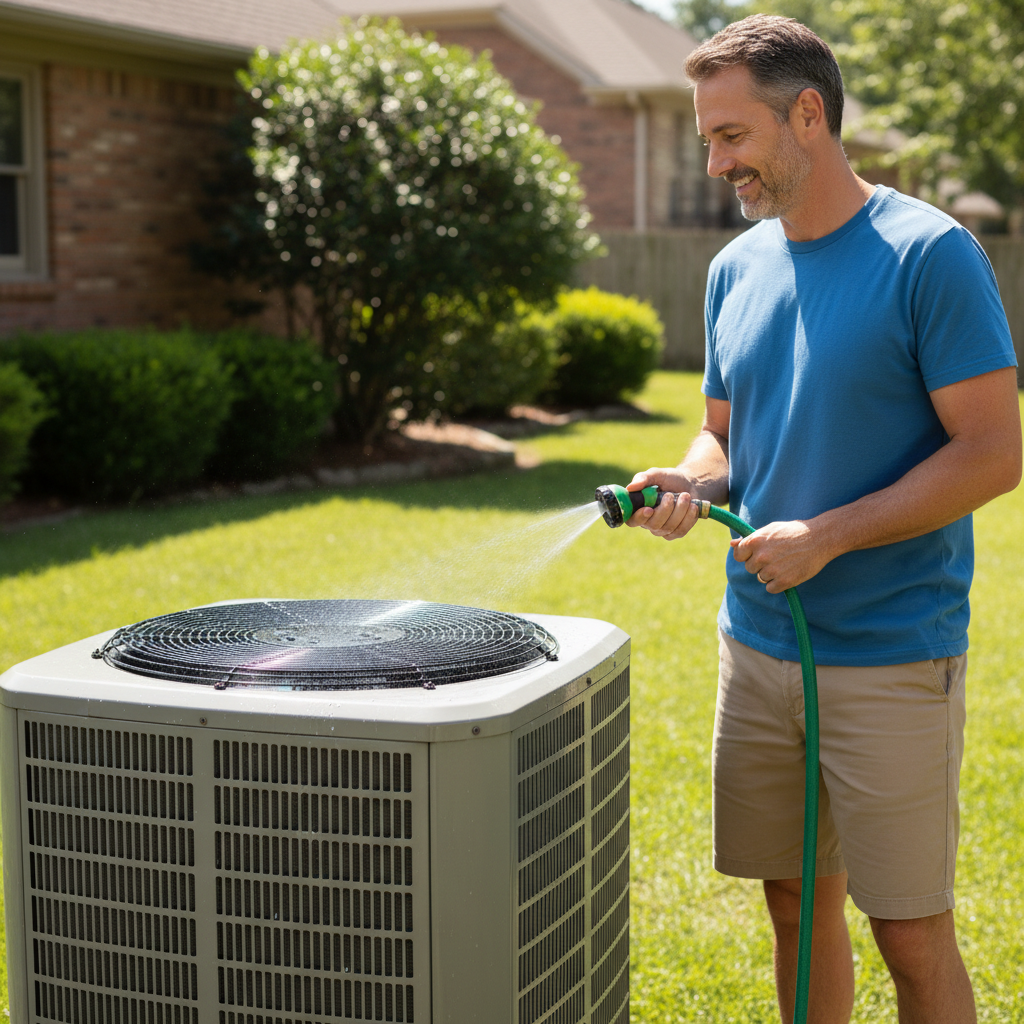
- Inspect the Outdoor Condenser Coils — Free the Heat!
- Safety: Power off the unit at the breaker first!
- Tools: Garden hose with spray nozzle, stiff brush (non-metallic), screwdriver (for panel removal).
HVAC · High energy usage
| Project category | HVAC |
|---|---|
| Problem type | High energy usage |
| Trade required | HVAC |
| Urgency | Planned project |
| Safety risk | Low safety risk |
| DIY suitability | DIY for experienced homeowners |
| Cost category | High cost |
| Typical timeline | Assessment within weeks; replacement planned off-season |
| Contractor type | Licensed HVAC technician |
Repair option
Duct sealing, insulation, and a tune-up before touching the equipment.
Replacement option
High-efficiency replacement sized by a load calculation, not a rule of thumb.
Common causes
- Aging, low-efficiency equipment
- Leaking ducts losing conditioned air
- Insufficient attic insulation
- Oversized system short-cycling
Relevant tools:project cost estimatorrepair or replace
Published August 31, 2026Last updated August 31, 2026
Tools & materials you'll need
Affiliate linksAs an Amazon Associate FixlyGuide earns from qualifying purchases — at no extra cost to you. Prices and availability are accurate as of publication and subject to change.
Quick Answer
When your AC unit’s running and blowing air, but the house isn’t getting cool, I’m usually looking at restricted airflow or a heat-transfer problem. Nine times out of ten, I tell homeowners to check the air filter first — that’s the usual troublemaker. If the filter’s fine, I go straight to the outdoor condenser coil. Both issues keep the system from dumping heat outside the way it’s supposed to, so you end up with lukewarm air and a power bill that’ll make you grumble.
The Problem
You know how it goes: summer shows up, you flip the AC on, and nothing happens. Or worse, it’s running and running and running, and the thermostat just sits there like it’s on strike. Air’s coming out of the vents, sure, but it’s not that cold air you paid for. Pretty maddening, right? You’re burning electricity, the house feels like a sauna, and the unit’s working overtime for no good reason. That kind of setup wears equipment out fast. It’s usually a sign something’s stopping the system from doing its main job: pulling heat out of the house and tossing it outside where it belongs.
How It Works
I like to think of an air conditioner as a big heat-moving machine. It doesn’t make cold. It just moves heat around. You’ve got two main sections: the indoor unit, with the evaporator coil and blower fan, and the outdoor unit, with the condenser coil, compressor, and fan. Here’s the basic rundown:
- Refrigerant's Journey: Inside the indoor unit, a coil holds a special refrigerant. Warm, humid house air gets pulled in by the blower and passes over that cold coil. The refrigerant grabs the heat and changes from a low-pressure liquid into a low-pressure gas.
- Heat Transfer Inside: That warmed-up gas heads outside through the line set. The compressor squeezes it, and that cranks the pressure — and the heat — way up.
- Heat Dump Outside: That hot, high-pressure gas runs through the condenser coil in the outdoor unit. The outdoor fan pulls outside air across those coils. The air pulls the heat out of the refrigerant, and the refrigerant cools down and turns back into a high-pressure liquid.
- Cycle Repeats: The liquid refrigerant heads back indoors through an expansion valve, which drops its pressure and temperature so it can soak up heat again. Then the whole cycle starts over.
If any part of that heat exchange gets fouled up — say a dirty filter cuts off airflow across the evaporator coil, or a packed-up condenser coil can’t dump heat — the system’ll still run, but it’ll be fighting uphill the whole time. I pulled a water heater in Frisco last month that had exactly this kind of “looks like it should work” problem, and HVAC’s the same story: if the heat can’t move, you’re dead in the water.
Step-by-Step Fix
Alright, let’s get this thing pulling its weight again. I’ve seen this a hundred times, and usually it’s one of these basic checks. Before you touch a thing, keep this in mind:
Safety First! Always, always shut off power to the HVAC system at the thermostat and at the circuit breaker before you do any work, especially on the outdoor unit. You don’t want that fan starting up while your hands are in there. I once watched a homeowner in Northridge lose a couple fingertips to a condenser fan blade because he skipped this step. No joke. Not worth it.
-
Check the Air Filter — The First Line of Defense
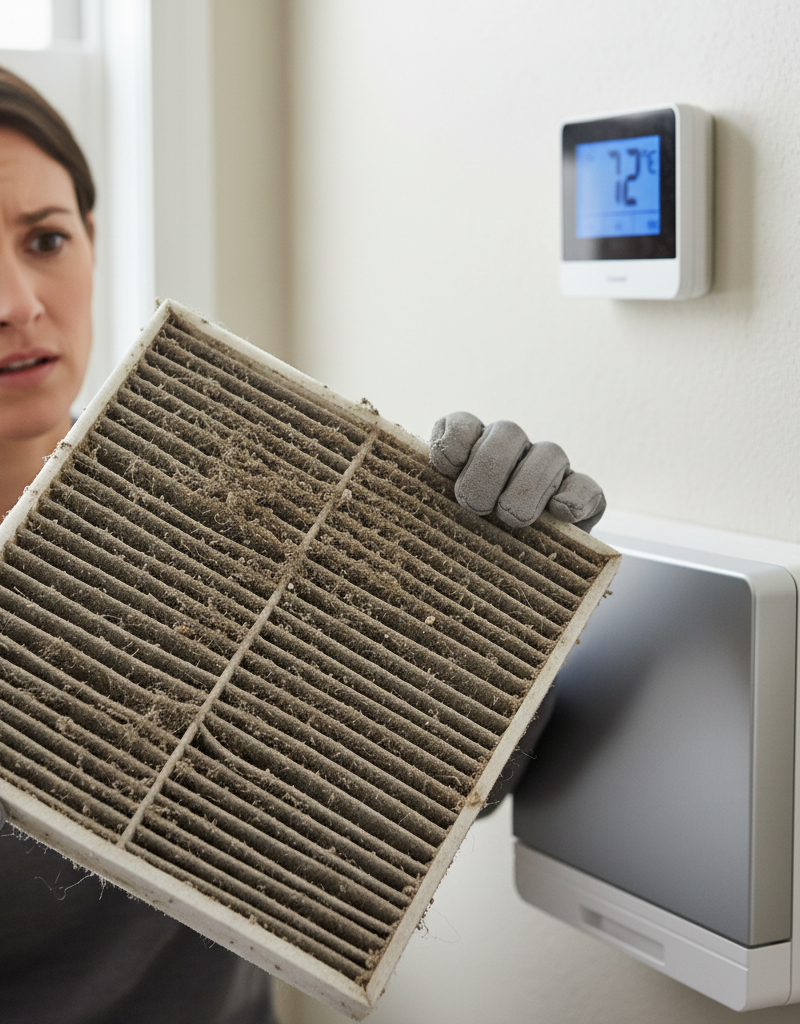
- The air filter catches dust, pet hair, and all the other junk before it clogs up the indoor coil. If it’s plugged, airflow drops hard, and the evaporator coil can’t pull heat out of the air like it should. The unit’ll keep running, but it won’t cool worth a darn. Pull the filter out and hold it up to a light. Can you see through it? If not, that thing’s toast. Swap it for a clean one. I tell folks to check these every month and change them every 1-3 months, depending on pets and allergies. A clean filter can cut energy use by 5-15%.
- Tools: New air filter (check your old one for size, e.g., 20x25x1 inch).
-
Inspect the Outdoor Condenser Coils — Free the Heat!
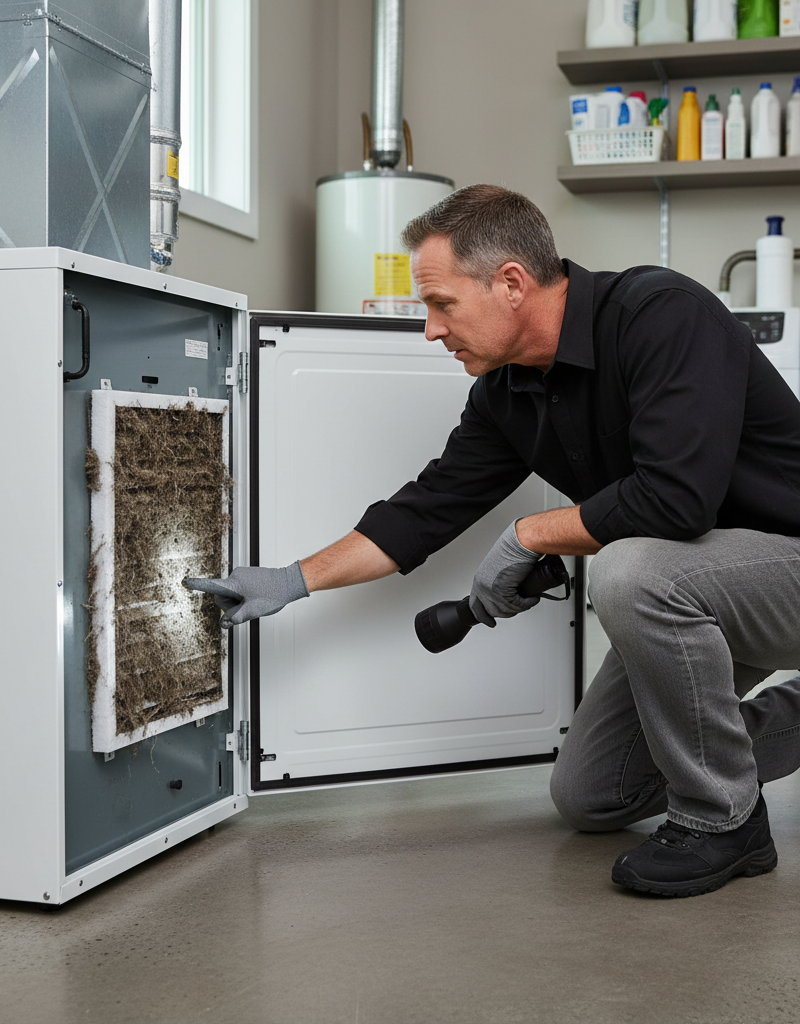
- The condenser coils on the outdoor unit are where the house’s heat gets dumped into the outside air. If those coils are packed with dirt, leaves, grass clippings, or cottonwood fluff, they can’t shed heat the way they should. That leaves the refrigerant running hotter, and the whole system struggles to cool. Take a look at the fins. Are they loaded up? Don’t forget to check inside the cabinet too.
- Safety: Power off the unit at the breaker first!
- Tools: Garden hose with spray nozzle, stiff brush (non-metallic), screwdriver (for panel removal).
-
Clean the Condenser Coils — Give it a Bath
- After the power’s off and you’ve cleared out the bigger junk by hand, gently rinse the coils with your garden hose. Start at the top and work down, trying to flush debris outward from the inside if you can, so you’re pushing it through the fins instead of deeper in. Go easy — those fins bend if you look at them wrong. If the coils are really nasty, use a coil cleaner from the hardware store and follow the label directions. Let it sit for 10-15 minutes, then rinse it out well. Make sure there’s no cleaner left behind before you flip the power back on.
- Pro Tip: For stubborn spots, a soft brush — like a coil cleaning brush, not a wire brush! — can help, but keep it gentle.
-
Check for Blocked Condensate Drain Line — A Sticky Situation
- Your AC pulls humidity out of the air, and that makes condensation. The water drips into a pan and runs out through a drain line, usually a PVC pipe. If that line gets clogged with algae or sludge, water backs up and can trip a float switch that shuts off the cooling cycle, even though the fan might still run. Look for standing water in the drain pan by the indoor unit or a small PVC pipe outside the house that isn’t dripping when the AC’s running.
- Tools: Wet/dry vac, white vinegar (optional).
-
Clear the Condensate Line — Suck it Up
- If you think it’s clogged, try clearing it. Hook a wet/dry vac to the end of the drain line outside and get a tight seal — duct tape helps. Let it run a minute or two to pull out the clog. You might hear a pretty satisfying glug. After that, pour a cup of distilled white vinegar into the access opening of the drain line — usually a T-shaped vent near the indoor unit — to help keep algae from coming back. Give it about 30 minutes before you turn the AC back on.
-
Inspect for Blocked Vents or Return Grilles — Don't Suffocate Your System
- Sometimes it’s as simple as a closed vent in a bedroom or a couch blocking a return air grille. Make sure all the supply vents are open and not covered up. Check the return grilles too — those big openings that pull air back into the system, usually in a hallway or on a wall — and make sure curtains, furniture, or thick rugs aren’t choking them off. If return airflow gets pinched, the system starves.
- Tools: Your eyes and common sense.
-
Check for Ice on Coils/Refrigerant Lines — A Frosty Warning Sign
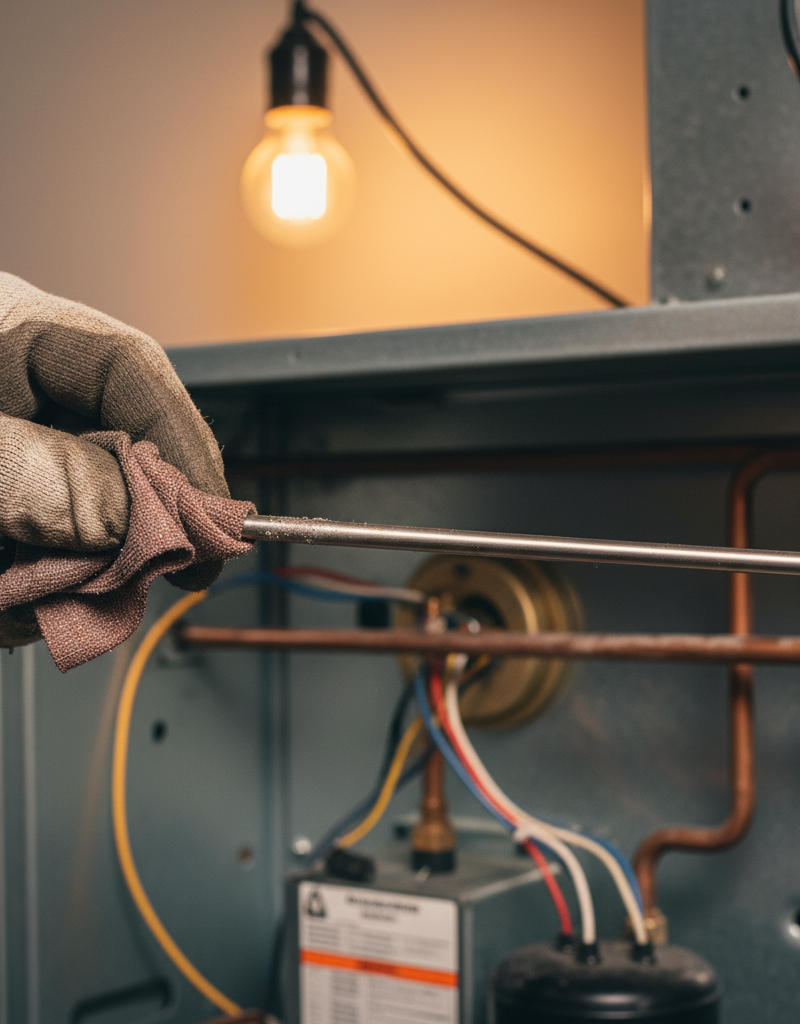
- If you see ice on the big refrigerant line — the insulated one — coming out of the outdoor unit, or if you can peek at the indoor coil and spot ice, that’s trouble. Icing usually points to a serious airflow restriction, like a filthy filter, or low refrigerant. If you see ice, shut the AC off immediately and run fan-only mode for several hours so it can thaw. Running an iced-up system can hurt the compressor. Once it melts, go back to step 1 (filter) and step 2 (coils). If it ices up again after cleaning, you’re probably low on refrigerant, and that’s a pro job.
- Pro Callout: Icing is a big red flag. Don
Related Articles
Keep troubleshooting with these hand-picked guides from FixlyGuide:
- The #1 Reason Your AC Blows Warm Air (And It's Not What You Think) — Discover the most common, often overlooked reason your AC blows warm air and how a simple fix can restore cool comfort to your home.
- The #1 Mistake Homeowners Make When Their AC Won't Turn On (And the Easy Fix) — Before you panic, check these common culprits to get your air conditioner running again without a service call.
- The Secret Reason Your Thermostat Lies (and How to Make It Tell the Truth) — Discover why your thermostat isn't reaching its set temperature and how to diagnose and fix common culprits with simple DIY steps.
- The #1 Mistake Homeowners Make When Their AC Won't Turn On (And the Easy Fix) — Learn the most common oversight homeowners make when their air conditioner fails to start, and how a simple reset can save you a service ca…
- The Hidden Reason Your AC Freezes — And Why Most Homeowners Get It Wrong — An AC freezing up outside is often misunderstood; it's usually not about outdoor temperature but a critical airflow problem that can damage…
- The Hidden Reason Your AC Isn't Cooling (And Why Most Homeowners Get It Wrong) — Is your central AC blowing warm air or struggling to cool your home? The culprit is often a silent but serious issue many homeowners overlo…
What should this project cost?
Enter your project details for a realistic cost range before you call anyone.
Service calls and common repairs run $150–$900; full system replacement typically $6,000–$12,000.
- Regional adjustment
- National average
- Labor share (typical)
- ~$1,935
- Quotes to collect
- 3 written estimates
Educational estimate based on national averages — not a binding quote. Always confirm with written local estimates.
Fixly Project Decision Box
- DIY difficulty
- Advanced
- Estimated time
- Homeowner checks 20–30 minutes
- Cost level
- Moderate
Main tools / materials
- Clean air filter
- Garden hose for condenser coils
- Shop vac for the condensate line
When to stop and call a pro
- Burning smell, smoke, or a tripping breaker
- Refrigerant lines iced over or hissing
- Any work inside the sealed refrigerant circuit (EPA-licensed only)
- Gas smell near a furnace — leave and call the utility
Need professional help?
Find an HVAC Pro Near YouGet the print-ready PDF of this guide
A clean, ad-free, printable version you can keep on your phone or pin to the workshop wall. Free with a FixlyGuide account.
- Print-optimized layout
- Tools, materials & every step included
- Saved to your account
Frequently asked questions
Why does my AC run constantly but not get cold?+
The most common reasons are a dirty air filter blocking airflow, dirty outdoor condenser coils preventing heat release, or a low refrigerant charge. All these issues stop your system from efficiently removing heat from your home.
Can a dirty air filter really stop my AC from cooling?+
Absolutely. A severely clogged air filter drastically reduces airflow over the evaporator coil, preventing it from absorbing heat effectively. This makes your AC work harder, run longer, and often leads to icing on the coil.
How often should I clean my outdoor AC unit?+
I recommend giving your outdoor condenser unit a good cleaning with a garden hose once a year, typically in the spring before you start using your AC heavily. If you live in a dusty area or have pets, you might need to do it twice a year.
What does it mean if my AC unit is icing up?+
Icing on your AC coils or refrigerant lines usually points to either severely restricted airflow (dirty filter, blocked vents) or a low refrigerant level. Turn it off immediately, let it thaw, and then check your filters and coils. If it ices again, call a pro.
Can I add refrigerant to my AC unit myself?+
No, absolutely not. Refrigerant is a controlled substance, and adding it requires specialized equipment and training. If your system is low on refrigerant, it means there's a leak somewhere that needs to be found and repaired by a licensed HVAC technician.
Why is my AC making a gurgling noise?+
A gurgling sound often indicates an issue with the condensate drain line, possibly a clog. As water struggles to flow, it can make gurgling or bubbling noises. Clearing the drain line, as described in the article, usually fixes this.
My vents are blowing air, but it's not very strong. What's wrong?+
Weak airflow, even if the air isn't cold, often points to a severely clogged air filter or obstructions in your ductwork. Check your filter first. If that's clean, ensure all supply and return vents are open and unobstructed.
How long should it take for my house to cool down?+
Generally, a well-sized and properly functioning AC system should lower your indoor temperature by about 1 to 1.5 degrees Fahrenheit per hour. If it's taking much longer, or not reaching the set temperature at all, you've got a problem.
Is it bad if my AC runs all day long?+
Yes, if your AC is running continuously for hours without reaching the set temperature, it's inefficient and indicates an underlying problem. It puts undue stress on the compressor, wears out components faster, and drives up energy costs.
Discussion
Loading comments…