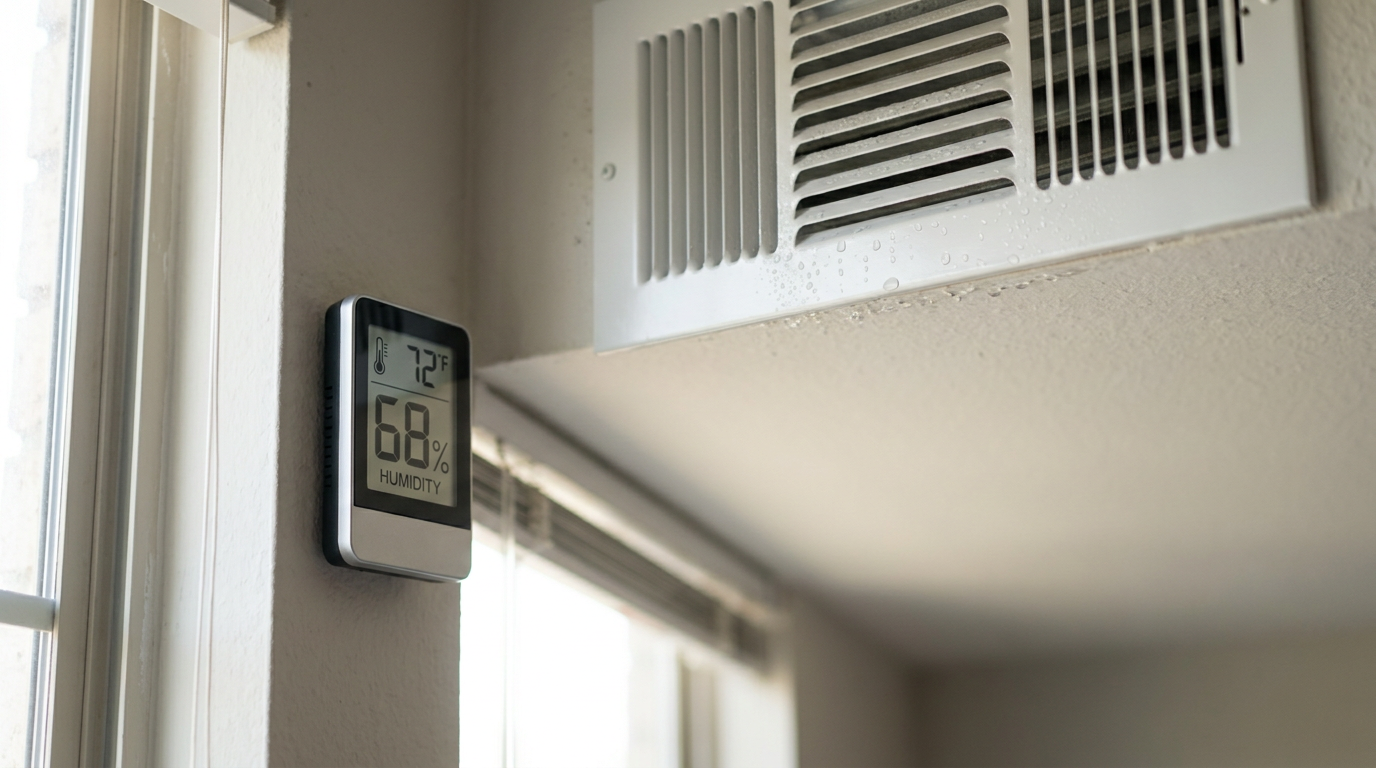
- Return Air Duct Infiltration in Unconditioned Spaces: If a return plenum comes loose in an attic sitting at 130°F and 70% humidity, your air conditioner turns into a giant vacuum, pulling swamp air directly into the house.
- Dirty Evaporator Coil Fins: A 1/16-inch layer of household grime on the coil acts like an insulating blanket, stopping warm room air from transferring heat and condensing onto the cold refrigerant lines.
- Excessive Negative House Pressure: Exhaust fans running nonstop or unbalanced ductwork—more return air pulled from bedrooms than supplied—draws outdoor air through window frames, wall outlets, and floorboards.
Plumbing · Leak
| Project category | Plumbing |
|---|---|
| Problem type | Leak |
| Trade required | Plumbing |
| Urgency | Emergency — act now |
| Safety risk | High safety risk |
| DIY suitability | DIY for experienced homeowners |
| Cost category | Low cost |
| Typical timeline | Shut water off now; repair usually same or next day |
| Contractor type | Licensed plumber |
Repair option
Isolate at the shutoff, replace the failed component, and dry the cavity fully.
Replacement option
Repipe the run or the branch when corrosion is widespread.
Common causes
- Failed supply line or shutoff valve
- Worn washers, cartridges, or P-trap connections
- Pinhole corrosion in older copper
Relevant tools:emergency checklistdiy or hire a pro
Published November 22, 2026Last updated November 22, 2026
Tools & materials you'll need
Affiliate links- AmazonDigital probe thermometer1 · To measure Delta T supply and return split
- AmazonWet/dry shop vacuum1 · To clear blocked 3/4-inch exterior drain line
- AmazonDigital hygrometer1-2 · To monitor indoor relative humidity levels
- Amazon1/4-inch and 5/16-inch nut driver1 set · For removing HVAC air handler access panels
- AmazonReplacement pleated air filter1 · MERV 8 recommended for standard 1-inch slots
- AmazonDistilled white vinegar1 gallon · For clearing algae and slime from condensate trap
- AmazonNo-rinse aerosol evaporator coil cleaner1 can · Self-rinsing formula for indoor evaporator fins
- AmazonMastic duct sealant and brush1/2 gallon · Water-based paste for sealing sheet metal seams
As an Amazon Associate FixlyGuide earns from qualifying purchases — at no extra cost to you. Prices and availability are accurate as of publication and subject to change.
Quick Answer
Your house stays humid with the air conditioner running because the system’s cooling the air without running long enough to wring out moisture, or airflow problems are crippling its dehumidification. The usual suspects are an oversized AC unit short-cycling, a clogged 1-inch pleated air filter, a dirty evaporator coil, or a blower fan set to "ON" instead of "AUTO." Flip the thermostat fan to "AUTO" and swap out a choked filter, and you’ll often see indoor humidity settle back into the target 45% to 50% range within 24 to 48 hours.
The Problem
You check the thermostat. It says 72°F, right where you left it. But your skin feels sticky, the hardwood floors feel slick, and the air’s got that old-basement smell. Air conditioners are refrigeration systems built to handle two jobs at once: sensible heat, which changes the number on the thermostat, and latent heat, which is the hidden moisture hanging in the air.
When an AC strips sensible heat too fast, or when a mechanical issue keeps the refrigerant coil from doing its condensation job, that moisture stays put in the house. High indoor relative humidity—anything consistently above 55% to 60%—turns your place into a breeding ground for dust mites, makes wood trim swell and buckle, and has you cranking the stat down to 68°F just to feel decent. And then, yeah, your power bill climbs like a ladder with a broken rung.
How It Works
If you want to know why your home feels like a terrarium, you’ve got to picture how air conditioning actually dries the air. Your indoor air handler pulls warm, humid room air across an evaporator coil that’s packed with cold, low-pressure liquid refrigerant at roughly 40°F to 45°F.
As that muggy 75°F air hits the cold aluminum fins, its temperature drops below the dew point. Water vapor condenses out and turns into liquid droplets on the coil fins, just like a sweating glass of ice water sitting on a patio table in July. Gravity carries those droplets into a primary condensate drain pan, then down through a 3/4-inch PVC line to the outside or into a floor drain.
For the system to pull gallons of moisture out of your house, air’s got to move across those fins at a controlled speed—roughly 350 to 400 cubic feet per minute (CFM) per ton of cooling—and the compressor needs to run continuously for at least 10 to 15 minutes per cycle. The first 5 to 7 minutes are mostly spent cooling the coil itself. Real moisture removal doesn’t start until the coil’s saturated and water starts running into the drain. If the cycle quits early, or if that moisture gets blown right back into the ducts before it can drain, the house stays swampy.
I pulled a water heater in Frisco last month that had exactly this kind of complaint in the same house—cool air, sticky rooms, and a drain pan that was holding water like a birdbath. Same story, different equipment.
Step-by-Step Fix
Before you go dropping thousands on a whole new system, work through this diagnostic sequence. You can knock out the main culprits with basic hand tools in under an hour.
-
Check the Thermostat Fan Switch — Walk over to the thermostat and check the fan setting right now. If it says "ON," switch it to "AUTO." With the fan on "ON," the indoor blower runs 24 hours a day, even after the outdoor compressor shuts off. That means all the moisture sitting on the cold evaporator coil and in the drain pan gets blown right back into the supply ducts and living spaces before it can drain out through the condensate pipe.
- If this doesn't work: Move to step 2; "AUTO" still has to be your baseline for decent humidity control.
-
Inspect and Swap the Return Air Filter — Slide out the air filter at the return grille or inside the furnace cabinet. A dirty filter chokes airflow, throws off the CFM balance across the evaporator coil, and makes the system cycle weird. If you’ve got a high-restriction MERV 13+ 1-inch filter and your blower motor doesn’t have the static pressure headroom to handle it, swap to a standard MERV 8 pleated filter.
- Tools needed: Replacement filter sized to your cabinet (common sizes: 16x25x1, 20x20x1, or 20x25x4 inches).
- Safety note: Shut off the HVAC breaker or furnace service switch before you open the blower cabinet door.
-
Measure Your Temperature Drop (Delta T) — Grab a simple digital probe thermometer and see if the refrigeration circuit’s actually doing its job. Turn the system on, let it run for 15 minutes, then stick the probe into the return duct (before the coil) and the supply duct (after the coil, past the plenum bend). Subtract the supply temp from the return temp; your "Delta T" should land between 15°F and 20°F.
- If below 15°F: The system may be low on refrigerant, the coil may be filthy, or airflow may be screaming past the coil too fast to condense moisture.
- If above 22°F: Airflow’s badly restricted, and you’re flirting with a frozen evaporator coil.
-
Time the Compressor Run Cycles — Pull up the stopwatch on your phone on a normal warm afternoon. Time exactly how long the outdoor compressor runs before it shuts down. A properly sized system matched to your home’s heat load should run for 15 to 25 consecutive minutes in hot weather. If the unit roars to life, drops the temperature two degrees in 6 minutes, and quits, you’ve got short-cycling or an oversized unit.
- Diagnostic check: If it short-cycles every 3 to 8 minutes, look at the thermostat placement and make sure a supply register isn’t blasting cold air directly onto the sensor.
-
Examine the Condensate Drain Line — Head outside to where your 3/4-inch white PVC condensate pipe dumps, or get into the attic or basement and inspect the drain line. A sluggish or partly clogged drain leaves standing water in the drain pan under the evaporator coil, and that moisture can re-evaporate right back into the airstream. Pour 1 cup of distilled white vinegar down the primary T-pipe cleanout to break up algae and slime.
- Tools needed: Wet/dry shop vac, 1 gallon of distilled white vinegar, funnel.
- Action step: Hook your shop vac to the outside PVC drain terminus and suck out the built-up sludge for 2 minutes.
-
Inspect the Evaporator Coil for Dirt or Frost — Shut off power to the indoor unit and pull the access panel to the evaporator coil inside the plenum. Check the inlet side of the aluminum fins—the side the air hits first—with a bright flashlight. If the fins are covered in gray felt-like dust or packed with pet hair, air can’t make proper contact with the cold metal, and condensation drops way off.
- Tools needed: 1/4-inch or 5/16-inch nut driver, no-rinse aerosol evaporator coil cleaner, soft nylon bristle brush.
- Caution: Don’t use a wire brush or a high-pressure spray; bent fins wreck airflow for good.
-
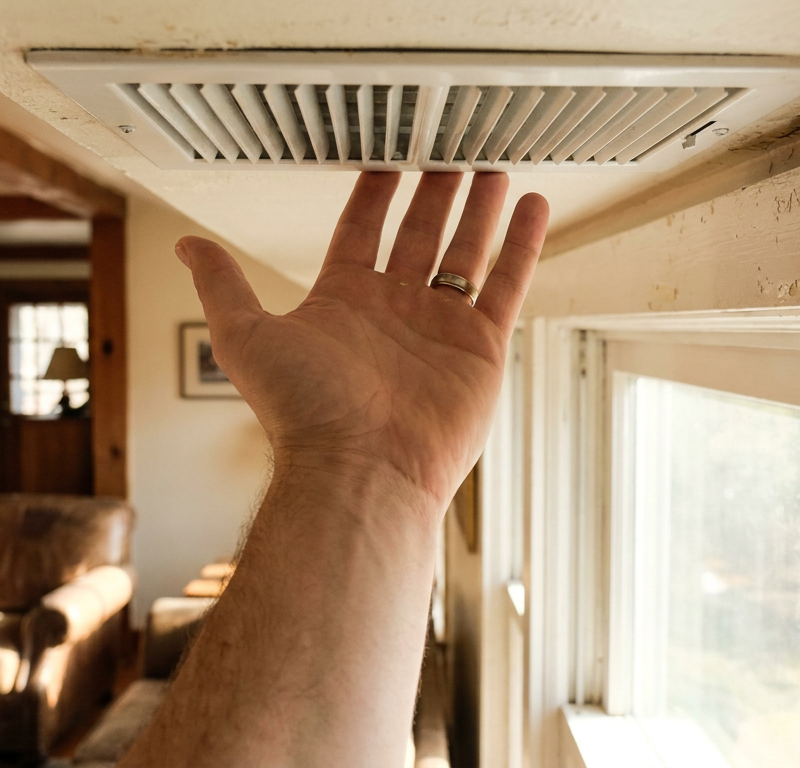
Audit the Ductwork for Return-Side Leaks — Get up into the attic, basement, or crawlspace while the system’s running. Run your hand along the seams and joints of the return ducts—the ones pulling air back to the unit. If you feel suction around unsealed slip joints, the system’s sucking hot, humid 120°F attic air or nasty unconditioned crawlspace air straight into the air handler and sending it back through the house.
- Tools needed: Mastic duct sealant, fiberglass mesh tape, or UL 181A-P foil tape.
- Fix: Spread water-based duct mastic 1/16-inch thick over all seams, then wrap joints with mesh tape for strength.
-
Adjust the Air Handler Blower Speed — A lot of modern ECM and multi-speed PSC blower motors let techs or handy homeowners tweak airflow taps on the control board. In humid climates like the Gulf Coast or Southeast, slowing blower speed from 400 CFM per ton down to 350 CFM per ton gives the air more time across the coil. That colder, slower-moving air pulls a lot more moisture without giving up cooling performance.
- Tools needed: Multimeter, system wiring schematic, insulated screwdriver.
- Safety warning: Working inside a live high-voltage control box carries shock risk. Leave tap changes to a pro if you’re not comfortable reading schematics and checking line voltage.
-
Seal Building Envelope Moisture Infiltration — Don’t just stare at the HVAC gear. Check crawlspace vapor barriers, exterior door weatherstripping, and attic access hatches. If your kitchen exhaust or bathroom fans dump straight into the attic, or the exterior dampers are stuck open, outside humidity will sneak in around the system through stack effect infiltration.
- Fix: Install spring-loaded backdraft dampers on all exhaust duct terminations and seal leaky can lights in top-floor ceilings with fire-rated expanding foam.
Common Causes
Figuring out humid air means isolating why latent heat isn’t getting squeezed out of the living space.
- Oversized AC Equipment ("Short-Cycling"): Bigger isn’t better in HVAC. An oversized unit—say, a 4-ton condenser shoved into a home that only needs 2.5 tons of cooling—cools the air so fast the thermostat is satisfied in 7 minutes. You get sensible cooling, sure, but the latent moisture is still hanging around.
- Thermostat Fan Set to "Continuous ON": When the compressor shuts off, your evaporator coil stays dripping wet with roughly 16 to 32 ounces of condensed water. Let the fan keep blowing and that moisture gets evaporated straight back into the ducts within 10 minutes.
- Return Air Duct Infiltration in Unconditioned Spaces: If a return plenum comes loose in an attic sitting at 130°F and 70% humidity, your air conditioner turns into a giant vacuum, pulling swamp air directly into the house.
- Low Refrigerant Charge from a Leak: When pinhole leaks bleed out R-410A or R-22, system pressures fall. The evaporator coil may freeze solid or run too warm to hit the air’s dew point. An iced coil blocks airflow and drips water outside the pan, which sends indoor humidity through the roof.
- Dirty Evaporator Coil Fins: A 1/16-inch layer of household grime on the coil acts like an insulating blanket, stopping warm room air from transferring heat and condensing onto the cold refrigerant lines.
- Excessive Negative House Pressure: Exhaust fans running nonstop or unbalanced ductwork—more return air pulled from bedrooms than supplied—draws outdoor air through window frames, wall outlets, and floorboards.
Common Mistakes
Skip these common traps. They waste money and don’t fix the clammy feeling in the house:
- Dropping the thermostat to 66°F to fight humidity. It sounds right. Colder air does feel a little less swampy. But if you chill an already humid house too far, building materials drop below their dew point, supply registers start sweating, and mold gets a foothold on the drywall. Leave it at 73°F–75°F and focus on runtime and moisture removal.
- Buying dense MERV 13 filters for a standard 1-inch slot. Everybody wants cleaner air, but high-resistance 1-inch filters can choke airflow so badly that static pressure spikes. That starves the coil, creates temperature imbalance, and can freeze the evaporator solid. Stick with MERV 8 unless you’ve got a dedicated 4-to-5-inch media cabinet made for higher airflow.
- Replacing an AC with an even larger unit. When folks say the house feels muggy, bad contractors love to pitch a bigger unit “to handle the load.” That usually makes the humidity problem worse by speeding up short-cycling. Always ask for a Manual J load calculation before replacing equipment.
- Ignoring the condensate drain line until it backs up. A partly clogged trap holds gallons of stagnant water in the coil cabinet. Under negative pressure, the blower can whip that standing water into aerosol spray and feed it right back into the supply plenum. Flush the drain with vinegar every spring and fall.
- Running bathroom exhaust fans for hours with AC on. Sure, you need to get steam out of the shower. But leaving three exhaust fans running all afternoon pulls dozens of cubic feet per minute of unconditioned, humid outdoor air into the house through unsealed wall cavities. Run them for 20 minutes after the shower, then shut them off.
Cost & Time Breakdown
| Task | DIY Cost | Pro Cost | Time |
|---|---|---|---|
| Thermostat Fan & Filter Reset | $15–$30 (Filter) | $80–$150 (Service Call) | 10 minutes |
| Flush & Vacuum Condensate Line | $5–$15 (Vinegar & fitting) | $120–$225 | 30 minutes |
| Clean Evaporator Coil In-Place | $20–$35 (Cleaner & brush) | $200–$450 | 1–2 hours |
| Seal Return Ductwork Mastic | $25–$50 (Mastic & tape) | $350–$900 | 2–3 hours |
| Adjust Blower CFM Speeds | $0 (Tools on hand) | $125–$250 | 30–45 minutes |
| Whole-Home Dehumidifier Install | $1,200–$1,800 (Unit only) | $2,400–$4,200 | 4–6 hours |
Tips & Prevention
- Target the 45% to 50% relative humidity sweet spot. Pick up a couple of cheap digital hygrometers for the living room and master bedroom. If indoor humidity keeps climbing past 55%, the system’s not pulling moisture well enough; if it drops below 35%, the air’s too dry.
- Keep your thermostat fan permanently on AUTO. Don’t flip it to ON unless you’re running an air scrubber during renovation work. "AUTO" lets moisture drain out of the cabinet between cycles.
- Inspect outdoor condenser clearances every spring. Clear away shrubs, leaves, and dirt within 24 inches of the outdoor unit. A choked condenser can’t dump heat efficiently, and that throws off head pressure and coil temperature.
- Perform a seasonal drain pan inspection. Get up into the attic or crawlspace twice a year. Make sure the primary drain pan dries out within 2 minutes of shutdown, and confirm the secondary emergency pan stays bone-dry.
- Consider a dedicated whole-house dehumidifier in shoulder seasons. In spring and fall, outdoor temps hover around 70°F, but humidity sits at 80%. Since the thermostat isn’t calling for cooling, the AC never turns on to pull out moisture. A ducted dehumidifier, like an AprilAire or Santa Fe unit, can pull up to 70–100 pints of water per day without waiting on a cooling call.
When to Call a Professional
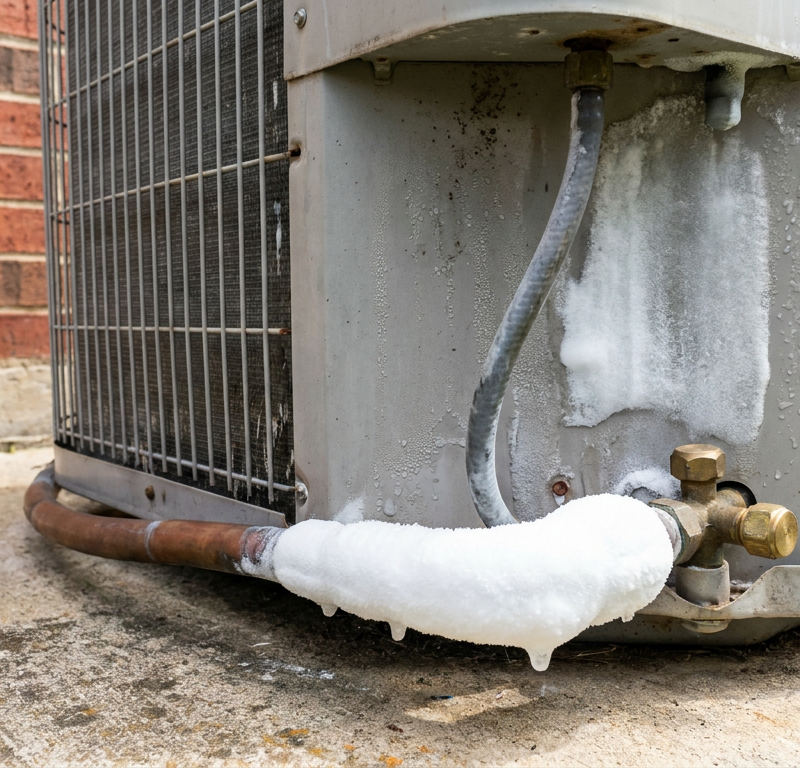
If you’ve switched the fan to "AUTO," put in a fresh filter, cleared the drain line, and indoor relative humidity still climbs above 60%, call a licensed HVAC technician. Stop right away and pick up the phone if you see thick ice wrapped around your copper refrigerant lines or evaporator coil; running a frozen compressor can wreck the pump valves and turn into a $2,500 replacement bill.
Same goes if your Delta T temperature split is less than 12°F. That usually points to an EPA-regulated refrigerant leak or a failing thermal expansion valve (TXV), and neither one is a DIY fix. A certified tech can hook up digital manifold gauges to check subcooling and superheat, run an accurate Manual J load calculation to confirm the equipment sizing, or tap into the air handler board to adjust static pressure and CFM airflow across the coil.
Frequently Asked Questions
Why does my AC cool the house down but leave it feeling clammy?
Your system is knocking down sensible heat faster than it can pull out latent heat. That usually means an oversized air conditioner short-cycling, a blower fan running too fast across the coil, or the thermostat fan switch set to "ON" instead of "AUTO," which re-evaporates water off the wet coil between cycles.
What should indoor humidity be in the summer with the AC running?
Indoor relative humidity should sit between 45% and 50% during the summer. Anything below 30% dries out your skin and respiratory tract, while sustained humidity over 55% encourages mold, feeds dust mites, and makes 74°F feel muggy.
Can an oversized AC cause high humidity?
Yes. Oversizing is one of the biggest causes of chronic indoor humidity. An oversized air conditioner cools the house too quickly—often satisfying the thermostat in under 10 minutes—before the evaporator coil has enough continuous run time to pull moisture out of the air. Moisture removal needs steady 15 to 25 minute cycles.
Does setting the thermostat fan to "ON" cause humidity problems?
Yes, absolutely. Leaving the fan on "ON" keeps the indoor blower running 24/7, even after the compressor shuts off. When the cooling cycle ends, the evaporator coil inside the air handler is covered with condensed water droplets; continuous fan operation evaporates that moisture right back into the living room before it can drain out.
How does a dirty air filter affect humidity levels?
A badly restricted air filter throws off the airflow balance across the evaporator coil. While a little lower airflow can sometimes help dehumidification, an overly choked filter drops static pressure so low it causes erratic cycling or freezes the coil into a solid block of ice, and that stops moisture removal completely.
Will a low refrigerant charge make my house humid?
Yes. If your system develops a pinhole refrigerant leak, suction pressure drops and the evaporator coil can’t stay at its ideal boiling temperature. The coil may run too warm to condense moisture out of the air, or it may dip below 32°F, freezing humidity into frost and choking off airflow through the system.
How much water should an air conditioner drain on a humid day?
A properly working, correctly sized central AC can pull between 5 and 20 gallons of water from your home’s air every single day in hot, humid weather. If your condensate line is barely dripping on an 85°F, muggy afternoon, the system isn’t dehumidifying like it should.
Can leaky return ducts in the attic make my home humid?
Yes. Your return ductwork runs under negative pressure, basically acting like a giant vacuum. If you’ve got cracked seams, disconnected flex duct, or unsealed joints in an unconditioned attic or crawlspace, the air conditioner will pull hot, humid air straight into the system and spread it through the house, overwhelming its dehumidification capacity.
Related Articles
Keep troubleshooting with these hand-picked guides from FixlyGuide:
- AC Blowing Warm Air? 6 Common Causes and the Fix for Each — Is your AC blowing warm air? Learn the top causes—from simple thermostat switches and dirty filters to bad capacitors—and follow our step-b…
- The #1 Reason Your AC Blows Warm Air (And It's Not What You Think) — A dirty air filter is often the overlooked culprit behind an air conditioner blowing warm air, hindering its ability to cool your home effi…
- The Secret Culprit Behind Your Humid House (Even with the AC On) — If your house feels sticky and damp despite the AC running, a common and often overlooked issue is an oversized air conditioner.
- Thermostat Won't Turn Off? 5 Causes and How to Shut It Down — Thermostat won't turn off your heat or AC? Follow this trade-tested isolation guide to diagnose stuck contactors, shorted low-voltage wires…
- AC Smells Like Dirty Socks? 5 Causes and the Step-by-Step Fix — Stop the sour, musty locker-room stench coming from your AC vents. Here is how to clean your evaporator coil, flush the pan, and end season…
- Dishwasher Won't Fill With Water? 5 Causes and the Step-by-Step Fix — Dishwasher running dry? Learn how to diagnose a stuck float switch, unclog a water inlet valve, and test solenoid continuity with step-by-s…
Should you do this yourself?
Answer five quick questions before you start. Safety outranks savings every time.
Your experience with work like this
How high do you have to work?
Does the job involve any of these?
Will it need a permit?
Specialty tools
Free and instant. Educational guidance only — not a quote, inspection, or professional diagnosis.
Estimate your own project cost
National averages are a starting point. Enter your details for a range that fits your house.
HVAC replacement cost
- Equipment$2,200 – $3,800
- Installation labor$1,200 – $2,500
Always insist on a Manual J load calculation — sq-ft sizing is only a rough check. Federal heat-pump rebates may reduce cost significantly.
Educational estimate only — always confirm with written local bids.
What should this project cost?
Enter your project details for a realistic cost range before you call anyone.
Service calls and common repairs run $150–$900; full system replacement typically $6,000–$12,000.
- Regional adjustment
- National average
- Labor share (typical)
- ~$1,935
- Quotes to collect
- 3 written estimates
Educational estimate based on national averages — not a binding quote. Always confirm with written local estimates.
Fixly Project Decision Box
- DIY difficulty
- Advanced
- Estimated time
- Homeowner checks 20–30 minutes
- Cost level
- Moderate
Main tools / materials
- Clean air filter
- Garden hose for condenser coils
- Shop vac for the condensate line
When to stop and call a pro
- Burning smell, smoke, or a tripping breaker
- Refrigerant lines iced over or hissing
- Any work inside the sealed refrigerant circuit (EPA-licensed only)
- Gas smell near a furnace — leave and call the utility
Need professional help?
Find an HVAC Pro Near YouBefore you start
Check the difficulty, permits, and safety risk — then decide whether to call a pro.
Free, no signup required. Estimates are educational guidance, not a quote or an inspection.
Get the print-ready PDF of this guide
A clean, ad-free, printable version you can keep on your phone or pin to the workshop wall. Free with a FixlyGuide account.
- Print-optimized layout
- Tools, materials & every step included
- Saved to your account
Frequently asked questions
Why does my AC cool the house down but leave it feeling clammy?+
Your system is removing sensible heat (temperature) much faster than it can extract latent heat (humidity). This almost always points to an oversized air conditioner short-cycling, an indoor blower fan speed running too fast across the coil, or your thermostat fan switch set to "ON" instead of "AUTO," which re-evaporates water off the wet coil between cycles.
What should indoor humidity be in the summer with the AC running?+
Your indoor relative humidity should sit between 45% and 50% during the summer months. Anything below 30% dries out your skin and respiratory tract, while sustained indoor humidity over 55% encourages mold growth, supports dust mite populations, and makes 74°F feel uncomfortably warm and muggy.
Can an oversized AC cause high humidity?+
Yes, oversizing is one of the leading causes of chronic indoor humidity. An oversized air conditioner cools your home down quickly—often satisfying the thermostat in under 10 minutes—before the evaporator coil has enough continuous run time to draw moisture out of the air. Moisture removal requires long, steady run cycles of 15 to 25 minutes.
Does setting the thermostat fan to "ON" cause humidity problems?+
Yes, absolutely. Leaving the fan set to "ON" keeps the indoor blower running 24/7, even when the outdoor compressor shuts down. When the cooling cycle ends, the evaporator coil inside your air handler is covered with condensed water droplets; continuous fan operation evaporates that moisture right back into your living room before it can drain outside.
How does a dirty air filter affect humidity levels?+
A severely restricted air filter disrupts the precise balance of airflow needed across your evaporator coil. While slightly lower airflow can sometimes increase dehumidification, an excessively choked filter drops static pressure too low, causing erratic cycling or freezing the coil into a solid block of ice, which stops moisture removal entirely.
Will a low refrigerant charge make my house humid?+
Yes. If your system develops a pinhole refrigerant leak, suction pressure drops and the evaporator coil cannot maintain its optimal boiling temperature. The coil may run too warm to condense moisture out of passing air, or it may drop below 32°F, freezing ambient humidity into frost and choking off all airflow through the system.
How much water should an air conditioner drain on a humid day?+
A properly functioning, correctly sized central air conditioning system can extract between 5 and 20 gallons of water from your home's air every single day in hot, humid climates. If your condensate line is barely dripping on an 85°F, muggy afternoon, your system is failing to dehumidify effectively.
Can leaky return ducts in the attic make my home humid?+
Yes. Your return ductwork operates under negative pressure, acting like a giant vacuum. If you have cracked seams, disconnected flex duct, or unsealed joints in an unconditioned attic or crawlspace, your air conditioner will pull hot, humid air directly into the system and distribute it throughout your house, overwhelming its dehumidification capacity.
Discussion
Loading comments…