- Cheap Fiberglass Filters — Blue or green 1-inch fiberglass filters catch pet hair and boulder-sized lint, but they let 90% of the tiny stuff sail right through. That dust lands on wet aluminum fins and turns into a nutrient-rich paste.
- Algae-Choked Condensate Pans — If the main drain line doesn’t slope at least 1/4-inch per foot, water pools in the bottom of the pan. After a while, that standing water turns into a breeding pond for sulfur-producing bacteria.
- Ductwork Drawing Unfiltered Attic Air — A loose return duct or unsealed filter slot can pull hot, musty air straight out of an attic or crawlspace and dump insulation dust and rodent junk onto the coil faces.
HVAC · High energy usage
| Project category | HVAC |
|---|---|
| Problem type | High energy usage |
| Trade required | HVAC |
| Urgency | Planned project |
| Safety risk | Low safety risk |
| DIY suitability | DIY for experienced homeowners |
| Cost category | High cost |
| Typical timeline | Assessment within weeks; replacement planned off-season |
| Contractor type | Licensed HVAC technician |
Repair option
Duct sealing, insulation, and a tune-up before touching the equipment.
Replacement option
High-efficiency replacement sized by a load calculation, not a rule of thumb.
Common causes
- Aging, low-efficiency equipment
- Leaking ducts losing conditioned air
- Insufficient attic insulation
- Oversized system short-cycling
Relevant tools:project cost estimatorrepair or replace
Published October 29, 2026Last updated October 29, 2026
Tools & materials you'll need
Affiliate links- AmazonNon-acidic foaming indoor evaporator coil cleaner1 can · self-rinsing alkaline formula
- AmazonEPA-registered HVAC antimicrobial spray1 bottle · prevents spore regrowth
- AmazonDistilled white vinegar16 oz · for flushing condensate trap
- AmazonPleated air filter (MERV 11)1 · sized to your cabinet
- AmazonUL 181 aluminum foil HVAC tape1 roll · for resealing cabinet seam
As an Amazon Associate FixlyGuide earns from qualifying purchases — at no extra cost to you. Prices and availability are accurate as of publication and subject to change.
Quick Answer
If your AC smells like dirty gym socks or stale vinegar the second it kicks on in spring or early fall, you’re dealing with Dirty Sock Syndrome. Yep, that’s the nickname. What’s happening is simple enough: harmless little colonies of mold, mildew, and bacteria are growing on your indoor evaporator coil when the system keeps bouncing between heat and cool. I’ve fixed this more times than I can count, and the cure is pretty straightforward—kill the buildup, clean the coil faces and drain pan, and use an EPA-registered non-acidic coil cleaner with an antimicrobial spray.
The Problem
It usually hits on the first muggy spring afternoon when you finally fire up the cooling system, or on one of those goofy fall days when you run the furnace at night and flip back to AC by 2:00 PM. The blower starts, air comes blasting through the registers, and the whole room smells like a locker room laundry bag.
That sour, stale, vinegar-and-rotting-cotton stink is so common in HVAC work that it even has a name: Dirty Sock Syndrome (DSS).
And no, it’s not just a nuisance. Folks with dust mite or mold sensitivity can get sneezing fits, headaches, watery eyes—the whole deal. Spraying air freshener into the return grille only makes it worse. You end up mixing perfumed chemical mist with organic dust on damp metal fins, and that’s a nasty combo. I pulled a unit in Frisco last month that had exactly this leak-and-stink mess going on, and the owner had been masking it with plug-ins. No dice.
To get rid of the smell, you’ve got to deal with what’s living inside that dark air handler cabinet.
How It Works
Your split system uses an indoor evaporator coil tucked inside the plenum—usually an A-frame or N-shape stack of aluminum fins wrapped tight over copper or aluminum refrigerant tubing. During normal cooling, refrigerant enters the coil at around 40°F to 44°F. Warm, humid indoor air moves across those fins, moisture condenses on the cold metal, and it drips into a plastic or galvanized drain pan.
       [Warm, Humid Return Air In]
                   │
                   ▼
       ┌───────────────────────┐
       │     Air Filter        │  (Dust bypass coats coil)
       └───────────────────────┘
                   │
                   ▼
         ▲ Evaporator Coil ▲      (Condensation + 40°F cold)
        / \               / \
       /   \  [A-FRAME]  /   \    (Organic debris feeds bacteria)
      /_____\___________/_____\
      │                       │
      │  Drain Pan & P-Trap   │  (Standing water = mold bloom)
      └───────────────────────┘
                   │
                   ▼
       [Cold, Odorous Air Out]
When everything’s working right, that condensate keeps washing down the fins and out through the 3/4-inch PVC drain line. But in mild shoulder seasons, the system short-cycles. The coil gets wet, then sits there doing nothing for 18 hours in a 75°F dark closet or attic.
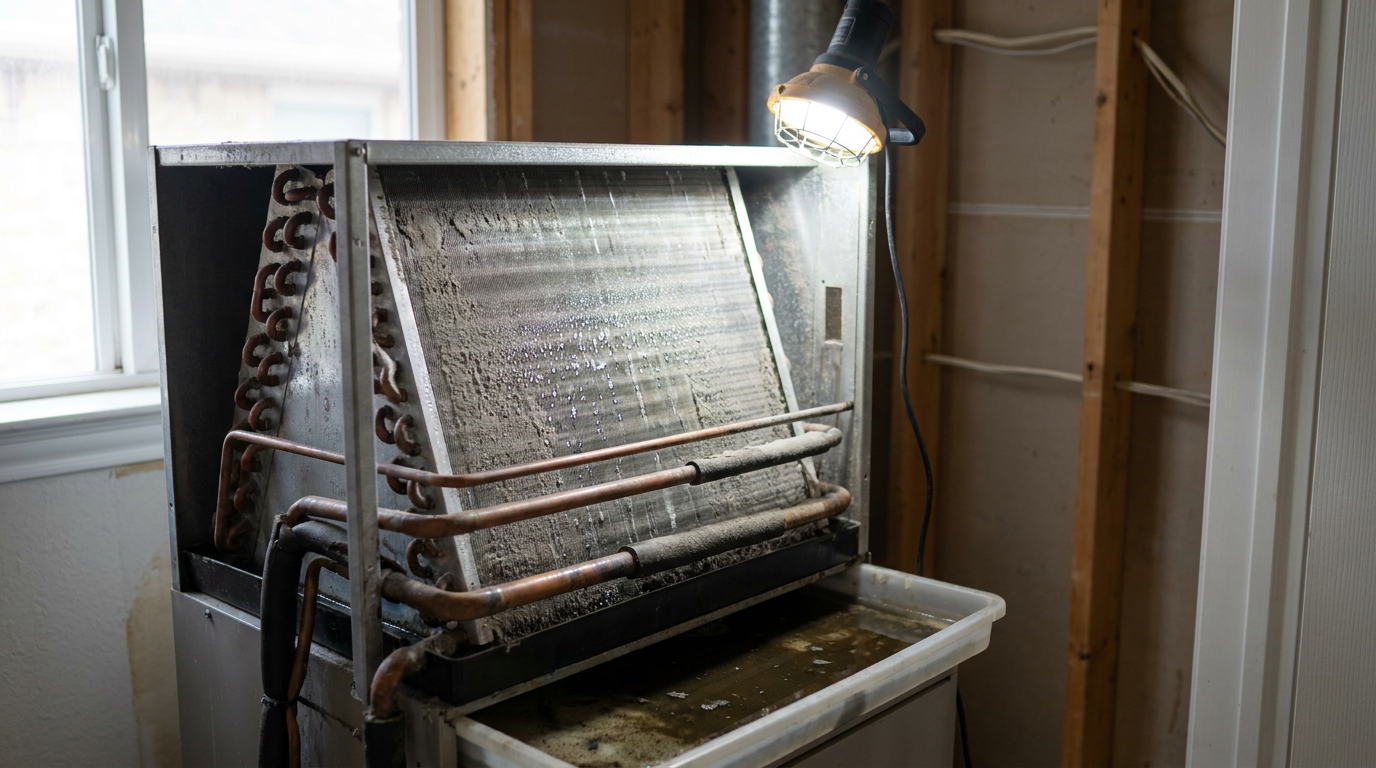
That’s where the trouble starts. Tiny dust bits, skin flakes, cooking oils, and pet dander slip past cheap 1-inch fiberglass filters and stick to the wet fin surfaces. Then bacteria and fungal spores move in. They don’t need a welcome mat.
When the system flips to heat on a cool morning, the air handler warms that coil to over 100°F. That heat bakes the grime onto the aluminum. Then, when the AC kicks back on and fresh cold moisture hits the coil, those baked-up colonies wake up and outgas volatile organic compounds right into your ductwork. Smells awful. Sounds worse. Still pretty basic once you’ve seen it a few times.
Step-by-Step Fix
Follow this whole cleanup process to scrub the coil face, clear the drain channels, and knock out the bacterial source without bending fins or cooking a control board.
-
Cut the High-Voltage Circuit — Go straight to the main electrical panel and shut off the dedicated dual-pole breaker labeled "Furnace" or "Air Handler" (typically 15 to 30 amps). If the indoor unit’s in an attic, closet, or garage, flip the red emergency toggle switch on the stud or cabinet wall too.
- Tools: Non-contact voltage tester.
- Safety: Don’t open a blower cabinet while line voltage is live. Touch the tester probe to the access panel seam before you put a hand on metal.
-
Remove the Evaporator Coil Access Door — Use a 5/16-inch or 1/4-inch hex nut driver to back out the sheet metal screws holding the upper access panel over the indoor coil. If the seam is sealed with metallic mastic foil, slice the foil with a fresh utility knife blade so you don’t twist the cabinet flange.
- Tools: Magnetic 1/4-inch and 5/16-inch hex head drivers, utility knife, heavy leather work gloves.
- If this doesn't work: Some air handlers use one two-piece wraparound door; hold the bottom half so it doesn’t drop and yank your low-voltage thermostat wiring loose.
-
Inspect the Coil Face and Pan Depth — Shine a bright LED work light into the A-frame cavity. Look at the underside of the “A” where the air hits first. You’re checking for a gray, furry mat of dust, lint, and biological slime, plus dark standing water in the plastic condensate pan.
- Tools: 500+ lumen inspection light or headlamp.
- Watch out: Don’t yank on the 3/8-inch copper liquid line or the larger 3/4-inch insulated suction line going into the cabinet. Bend those and you’ll be paying for refrigerant work, plain and simple.
-
Dry-Brush the Upstream Metal Fins — Gently brush the aluminum fins with a nylon-bristle coil brush, and keep your strokes in line with the fin direction, up and down. Never scrub sideways. Those paper-thin fins fold over if you look at them wrong, and then airflow goes to heck.
- Tools: Dedicated nylon evaporator fin brush or soft 2-inch paint brush, HEPA shop vac.
- Tip: Hold the shop vac hose about three inches below the brush so the loose junk gets caught before it drops into the drain pan.
-
Straighten Crushed Fins — If you find flattened spots or bent fins from past service work, slip the matching gauge head of a fin comb into the clean slots above the damage. Pull gently downward and comb the crushed teeth back into a parallel pattern so cleaner can get into the core.
- Tools: Multi-head plastic fin comb tool (matches 8 to 14 fins-per-inch spacings).
-
Soak the Coils with Alkaline Cleaner — Mix an EPA-registered, non-acidic, foaming coil cleaner exactly like the label says in a hand-pump garden sprayer. Pump it up and spray the whole front, back, and apex of the coil, working from the bottom upward so the foam lifts dirt off the inner copper tubes.
- Tools: 1-gallon hand-pump garden sprayer, non-acidic self-rinsing foaming coil cleaner.
- Safety: Wear wrap-around safety glasses and nitrile gloves. Don’t use outdoor condenser cleaners with hydrofluoric acid indoors—they’re nasty, they off-gas, and they’ll chew up indoor aluminum.
-
Let the Chemistry Dwell — Let the foam sit untouched for 15 to 20 minutes. You’ll hear a little sizzling as the surfactant breaks down cooking grease, dead skin, and microbial biofilm, turning the crust into sludge that can drain out.
- Timing: Exactly 15 minutes. Don’t let self-rinsing cleaners dry on the coil before water hits them.
-
Rinse with Warm Water — Even if the label says “no-rinse,” I still flush indoor coils during a seasonal tune-up. Fill the clean sprayer with warm tap water, around 105°F to 115°F, and wash every square inch of the coil face so the muck drops into the collection pan.
- Tools: Pump sprayer with warm water.
- Safety: Aim the spray only at the aluminum fins and copper return bends. Keep water away from the control board, transformer, and blower motor harness below.
-
Clear the Condensate Pan and P-Trap — Take your wet/dry vac outside to the exterior PVC drain termination point, usually near the outdoor unit or foundation, and seal the hose against the PVC pipe with a rag. Run the vacuum for 90 seconds to pull out debris, dead biofilm, and standing water from the indoor pan and trap.
- Tools: Wet/dry shop vac, shop towel.
- If this doesn't work: If the drain line is glued shut or you can’t get to it, uncap the indoor T-vent line and pour 16 ounces of distilled white vinegar into the pipe to loosen the clog, then flush with warm water.
-
Fog the Coil with EPA-Registered Bio-Inhibitor — Once the coil stops dripping muddy runoff, lightly mist the fins and the plastic drain pan with an EPA-registered HVAC antimicrobial spray, like BBJ Mold Inhibitor or Bio-Fresh. That leaves a thin fungistatic barrier that helps stop spores from sticking when cooling starts back up.
- Tools: EPA-registered HVAC disinfectant/antimicrobial spray.
- Note: Don’t use household chlorine bleach. Bleach fumes corrode aluminum fins, pit copper tubing, and can start pinhole refrigerant leaks in a few months.
-
Reseal the Cabinet Air-Tight — Reinstall the sheet metal access panel and hand-tighten the hex screws until they’re snug. Don’t strip the thin sheet-metal holes. Seal the outer seam with UL 181-rated aluminum foil tape and burnish it down hard with a squeegee or plastic putty knife so conditioned air and fiberglass bits don’t escape into the attic or mechanical room.
- Tools: UL 181 foil tape, plastic squeegee, hex driver.
-
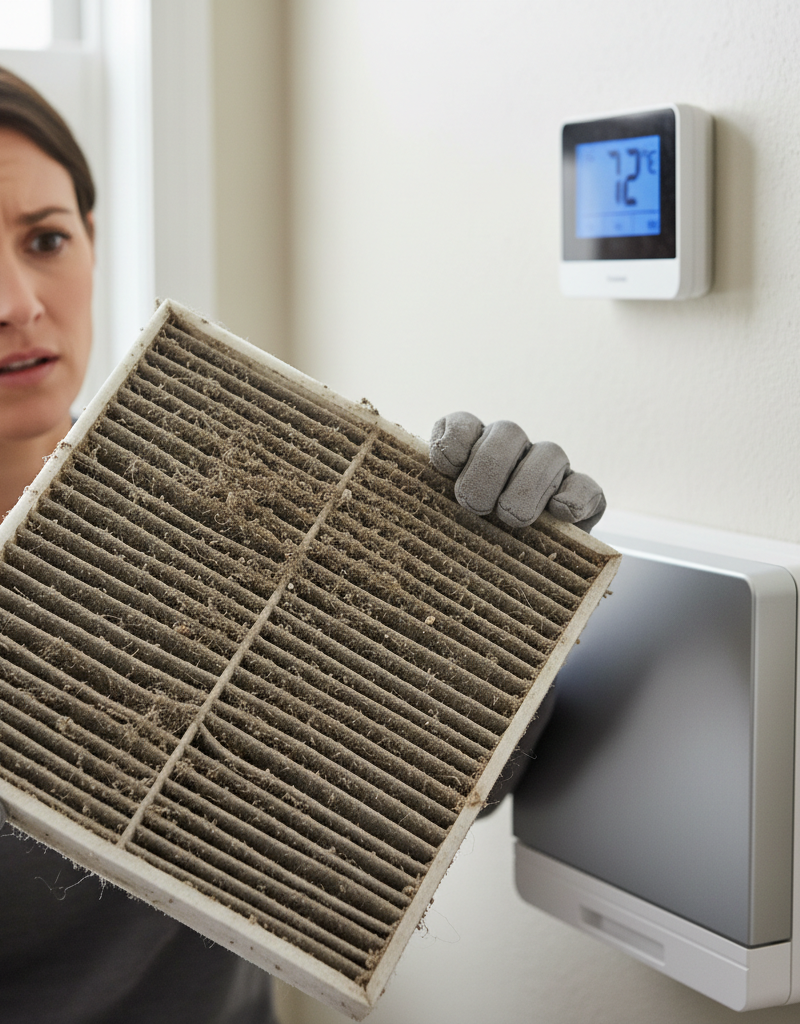
Install a High-Surface MERV 11 Filter and Test Run — Pull out the old dusty return filter and slide in a fresh pleated MERV 11 filter that matches the cabinet frame exactly. Restore breaker power, set the thermostat to "Cool" with a setpoint 3°F below room temperature, and let it run for 30 minutes to make sure the odor’s gone and water drains outside like it should.
- Tools: New pleated MERV 11 filter.
Common Causes
- The Shoulder-Season Moisture Trap — In spring and fall, temperatures bounce around from 45°F at dawn to 82°F by mid-afternoon. The coil keeps swinging between wet-cold and warm, which makes a perfect little incubator for dust-borne bacteria.
- Cheap Fiberglass Filters — Blue or green 1-inch fiberglass filters catch pet hair and boulder-sized lint, but they let 90% of the tiny stuff sail right through. That dust lands on wet aluminum fins and turns into a nutrient-rich paste.
- Algae-Choked Condensate Pans — If the main drain line doesn’t slope at least 1/4-inch per foot, water pools in the bottom of the pan. After a while, that standing water turns into a breeding pond for sulfur-producing bacteria.
- Ductwork Drawing Unfiltered Attic Air — A loose return duct or unsealed filter slot can pull hot, musty air straight out of an attic or crawlspace and dump insulation dust and rodent junk onto the coil faces.
- Chemical Off-Gassing from Cleaners or Paint — Volatile compounds from fresh paint, scented plug-ins, or floor polyurethane cling to damp aluminum fins and react with condensation, which gives you that sharp vinegar smell every time the system starts.
Common Mistakes
- Spraying Household Bleach Directly on the Coil — Chlorine is rough on copper and aluminum. Bleach breaks down the thin tube walls and can lead to expensive micro-leaks of Freon or R-410A, which means a $2,000+ coil replacement. Stick with alkaline, non-acidic HVAC cleaners.
- Power-Washing the Fins — A pressure washer or an aggressive hose nozzle will flatten aluminum fins in a hurry. Once they’re mashed over, airflow drops to almost nothing, the coil freezes into a block of ice, and the compressor runs hot. Use low-pressure hand-pump sprayers only.
- Masking the Smell with Duct Perfumes — Hanging scent wafers in the return or dumping fabric softener sheets over the filter does nothing to kill bacteria. It just stacks sweet fake scent on top of rotting sludge, and now the house smells like a perfumed dumpster.
- Bending Fins with Wire Brushes — A brass wire grill brush or steel scratch brush will tear aluminum fins right off the copper tubing. Use soft nylon bristles and keep the brush running parallel to the grooves.
- Skipping the P-Trap Flush — You can clean the coil until it shines, but if the 3/4-inch drain line still holds two cups of rotting bio-slime in the water seal, the return blower will pull that stink right out of the pipe and blow it through the house.
Cost & Time Breakdown
| Task | DIY Cost | Pro Cost | Time |
|---|---|---|---|
| Coil Access & Manual Fin Brushing | $15 (fin comb/brush) | $150–$250 | 30–45 mins |
| Chemical Soak, Rinse & Decontamination | $20–$35 (cleaner & biocide) | $200–$400 | 45–60 mins |
| Condensate Trap Vacuum & Chemical Clear | $5 (distilled vinegar) | $100–$175 | 20–30 mins |
| High-Efficiency Air Filter Upgrade | $15–$25 (MERV 11) | $40–$65 | 5 mins |
| Full Deep-Clean & Airflow Rebalancing | $40–$75 (total supplies) | $400–$800 | 2–3 hours |
Tips & Prevention
- Upgrade to a 4-Inch Media Filter — If your air handler cabinet can take it, ditch the standard 1-inch slot and go with a 4-inch deep pleated media filter cabinet. Deeper filters give you way more surface area and catch spores down to 1.0 micron without choking static pressure.
- Drop Time-Release Pan Tablets Twice Yearly — Toss two slow-dissolving quaternary ammonium condensate pan tablets into the back corner of the drain pan every April and October. They help stop algae blooms and keep the PVC drain line moving.
- Set Thermostat Fan to "AUTO" Instead of "ON" — If you run the blower fan all the time ("ON"), it keeps blowing air over a wet coil after the outdoor compressor shuts off. That dries stale sludge onto the fins and pushes moisture back into the ductwork. Leave it on "AUTO."
- Install an In-Duct Germicidal UV-C Lamp — A 254-nanometer UV-C bulb aimed right at the coil surface helps sterilize the aluminum 24/7. It breaks down DNA in mold spores and bacteria before they can get established and start the whole mess again.
- Check Your Condensate Fall Line — Use a small torpedo level and make sure the indoor drain line keeps a steady downward pitch of at least 1/4 inch per linear foot until it leaves the house.
When to Call a Professional
If your evaporator coil is boxed in behind a sealed, glued sheet-metal casing with no removable inspection door, cutting in a service opening takes specialized sheet-metal shears and patch work that’s best left to a tech.
I’d also call an HVAC contractor if you see heavy rust scaling on the lower tube sheets, oily black residue on the copper tubing, which usually means an active refrigerant leak, or the sour smell hangs around even after a full chemical rinse.
And in bad recurring cases of Dirty Sock Syndrome, the microscopic pores of the aluminum can hang onto the volatile compounds for good. Fixing that for real may mean the tech has to recover the refrigerant, pull the whole coil out, and replace it with a factory-coated epoxy or silvershield antimicrobial coil.
Frequently Asked Questions
Can Dirty Sock Syndrome make my family sick?
The bacteria and fungal colonies behind Dirty Sock Syndrome are usually non-pathogenic, but they do throw off airborne particles that irritate your respiratory tract. Folks with asthma, seasonal allergies, or chronic sinus trouble often get morning congestion, itchy eyes, coughing, and headaches whenever the system starts.
Why does my AC only smell bad when it first turns on?
The odor is strongest in the first 3 to 5 minutes of a cooling cycle. While the system sits idle, moisture on the coil lets bacteria outgas inside that closed, warm cabinet. Then the blower kicks on and shoves that pocket of concentrated VOCs through the ducts before fresh condensation can wash some of it away.
Will running the furnace burn off the Dirty Sock smell?
Nope. More often, it makes it worse. The heat bakes the biological matter and dead dust onto the aluminum fins, hardening it into a brittle crust. Then you switch back to cooling, moisture hits that crust, and the sour smell comes right back.
Can I spray Lysol or Fabuloso directly into my AC vents?
Don’t do it. Never spray household disinfectants or air fresheners into supply vents or return grilles. A lot of those products use flammable propellants, alcohol, or harsh solvents that can damage duct insulation and may ignite if they hit electric heat strips or furnace burners.
Why shouldn't I use bleach in the AC drain pan?
Bleach is an aggressive oxidizer. It eats into copper tubing, attacks soldered joints, and corrodes steel drain pans. The fumes also get pulled into the duct system, so you can end up circulating hazardous chlorine gas through the living areas.
What is the best cleaner to use on an indoor evaporator coil?
Use an EPA-registered, non-acidic, alkaline foaming coil cleaner made specifically for indoor evaporator coils. Unlike outdoor condenser cleaners, indoor formulas don’t throw harsh acid fumes and they’re built to rinse off with light water or normal condensation.
How often should I clean my evaporator coils?
I’d inspect and clean the indoor coil at least once every 12 months. If you’ve got a couple shedding pets, live somewhere humid like the Gulf Coast or North Texas, or run basic low-MERV filters, you’ll usually do better cleaning it twice a year—once in spring and once in autumn.
Does a UV light actually stop Dirty Sock Syndrome?
Yes, high-output germicidal UV-C lights operating at a 254 nm wavelength work really well. If you mount one inside the plenum aimed at the wet face of the evaporator coil, the ultraviolet energy disrupts the DNA of mold and bacteria in seconds, which keeps micro-colonies from getting established.
Related Articles
Keep troubleshooting with these hand-picked guides from FixlyGuide:
- The #1 Reason Your AC Blows Warm Air (And It's Not What You Think) — A dirty air filter is often the overlooked culprit behind an air conditioner blowing warm air, hindering its ability to cool your home effi…
- Thermostat Won't Turn Off? 5 Causes and How to Shut It Down — Thermostat won't turn off your heat or AC? Follow this trade-tested isolation guide to diagnose stuck contactors, shorted low-voltage wires…
- Sweating AC Vents? 6 Causes and the Step-by-Step Fix for Dripping Grilles — Stop sweating HVAC vents and dripping ceiling registers by sealing boot air leaks with mastic, controlling indoor humidity, and restoring p…
- The Hidden Reason Your Furnace Short Cycles (and the $15 Fix) — Furnace short cycling can drive up energy bills and wear out your system prematurely; often, a simple fix like a dirty filter or miscalibra…
- The HVAC Maintenance Myth: Why "Annual Service" Can Cost You More (and 3 Things to Check Instead) — Discover why strict annual HVAC servicing isn't always necessary and learn the essential checks that can save you money and extend your sys…
- The Secret Hairball Fix Plumbers Don't Want You to Know — Tired of standing in ankle-deep water? Most shower clogs are a gnarly mix of hair and soap scum, and you can clear them yourself without ha…
Should you do this yourself?
Answer five quick questions before you start. Safety outranks savings every time.
Your experience with work like this
How high do you have to work?
Does the job involve any of these?
Will it need a permit?
Specialty tools
Free and instant. Educational guidance only — not a quote, inspection, or professional diagnosis.
Estimate your own project cost
National averages are a starting point. Enter your details for a range that fits your house.
HVAC replacement cost
- Equipment$2,200 – $3,800
- Installation labor$1,200 – $2,500
Always insist on a Manual J load calculation — sq-ft sizing is only a rough check. Federal heat-pump rebates may reduce cost significantly.
Educational estimate only — always confirm with written local bids.
What should this project cost?
Enter your project details for a realistic cost range before you call anyone.
Service calls and common repairs run $150–$900; full system replacement typically $6,000–$12,000.
- Regional adjustment
- National average
- Labor share (typical)
- ~$1,935
- Quotes to collect
- 3 written estimates
Educational estimate based on national averages — not a binding quote. Always confirm with written local estimates.
Fixly Project Decision Box
- DIY difficulty
- Advanced
- Estimated time
- Homeowner checks 20–30 minutes
- Cost level
- Moderate
Main tools / materials
- Clean air filter
- Garden hose for condenser coils
- Shop vac for the condensate line
When to stop and call a pro
- Burning smell, smoke, or a tripping breaker
- Refrigerant lines iced over or hissing
- Any work inside the sealed refrigerant circuit (EPA-licensed only)
- Gas smell near a furnace — leave and call the utility
Need professional help?
Find an HVAC Pro Near YouBefore you start
Check the difficulty, permits, and safety risk — then decide whether to call a pro.
Free, no signup required. Estimates are educational guidance, not a quote or an inspection.
Get the print-ready PDF of this guide
A clean, ad-free, printable version you can keep on your phone or pin to the workshop wall. Free with a FixlyGuide account.
- Print-optimized layout
- Tools, materials & every step included
- Saved to your account
Frequently asked questions
Can Dirty Sock Syndrome make my family sick?+
While the bacteria and fungal colonies causing Dirty Sock Syndrome are generally non-pathogenic, they release organic airborne particles that irritate your respiratory tract. People with asthma, seasonal allergies, or chronic sinus issues often experience morning congestion, itchy eyes, coughing, and headaches whenever the system kicks on.
Why does my AC only smell bad when it first turns on?+
The odor is strongest during the first 3 to 5 minutes of a cooling cycle. While the system sits idle, moisture on the coil allows bacteria to off-gas inside the closed, warm cabinet. When the high-velocity blower starts up, it pushes that built-up pocket of concentrated VOCs directly through your ducts before fresh condensation washes part of it away.
Will running the furnace burn off the Dirty Sock smell?+
No. In fact, running your furnace often makes it worse. The high heat bakes the biological matter and dead dust onto the aluminum fins, hardening it into a brittle crust. The moment you switch back to cooling, the damp humidity reactivates that baked crust, releasing a pungent, sour aroma.
Can I spray Lysol or Fabuloso directly into my AC vents?+
Never spray household disinfectants or air fresheners into your supply vents or return grilles. Many common household cleaners contain flammable propellants, alcohol, or harsh solvents that degrade your duct insulation and can ignite if pulled across electric heat strips or furnace burners.
Why shouldn't I use bleach in the AC drain pan?+
Bleach is an aggressive oxidizer. It eats through the thin copper tubing of your evaporator coil, attacks soldered joints, and corrodes steel drain pans. The fumes are also pulled directly into your duct system, circulating hazardous chlorine gas throughout your living areas.
What is the best cleaner to use on an indoor evaporator coil?+
Use an EPA-registered, non-acidic, alkaline foaming coil cleaner marked specifically for indoor evaporator coils. Unlike outdoor condenser coil cleaners, indoor formulas produce no harsh acid fumes and are engineered to rinse off cleanly with light water application or natural condensation.
How often should I clean my evaporator coils?+
Clean and inspect your indoor coil at least once every 12 months. If you have multiple shedding pets, live in a high-humidity region like the Gulf Coast or North Texas, or run basic low-MERV filters, you will get better performance and odor prevention by cleaning the coil twice a year—once in spring and once in autumn.
Does a UV light actually stop Dirty Sock Syndrome?+
Yes, high-output germicidal UV-C lights (operating at a 254 nm wavelength) work remarkably well. When mounted inside the plenum pointing directly at the wet face of the evaporator coil, the ultraviolet energy disrupts the cellular DNA of mold and bacteria within seconds, preventing micro-colonies from growing.
Discussion
Loading comments…