- The 1 Gutter Mistake That Causes Overflow (It's Not Clogs!) — Discover the often-overlooked culprit behind overflowing gutters during heavy rain and learn the surprising, easy fix most homeowners miss.
- The 1 Gutter Mistake That Causes Overflow (And How to Fix It in 20 Minutes) — Overflowing gutters during heavy rain are usually caused by a readily fixable clog, often due to a common cleaning mistake.
- Deck Screws Pulling Out? 5 Causes and the Step-by-Step Fix — Stop tripping on loose deck screws. Here is why fasteners pop out of deck boards, how to test for joist rot, and the step-by-step fix to an…
- Deck Wobbles When Walking? 10 Causes of Sway and the Step-by-Step Fix — Stop dangerous deck sway before structural failure occurs. Diagnose loose ledger connections, rotten posts, and install code-approved brace…
- Melted Vinyl Siding? 5 Heat Sources and the Complete Step-by-Step Fix — Learn why vinyl siding melts from window reflections or heat, how to replace distorted planks using a zip tool, and ways to stop the glare…
Plumbing · Clog
| Project category | Plumbing |
|---|---|
| Problem type | Clog |
| Trade required | Plumbing |
| Urgency | Soon — within weeks |
| Safety risk | Low safety risk |
| DIY suitability | DIY friendly |
| Cost category | Low cost |
| Typical timeline | Same-day DIY attempt; pro visit within a day or two |
| Contractor type | Licensed plumber |
Repair option
Plunger, hand auger, or trap cleanout before chemicals.
Replacement option
Line replacement when clogs return in the same spot repeatedly.
Common causes
- Hair and soap buildup in the trap
- Grease cooling in the branch line
- Flushed wipes or foreign objects
Relevant tools:diy difficultydiy or hire a pro
Published November 23, 2026Last updated November 23, 2026
Tools & materials you'll need
Affiliate links- AmazonHeavy-duty screw-in hidden gutter hangers1 pack (20-30 ct) · 5-inch or 6-inch size to match your troughs
- AmazonTripolymer elastomeric gutter sealant2 tubes · e.g., Geocel 2300 or OSI Quad (not standard silicone)
- AmazonAluminum roof valley splash guards2 to 4 · Straight or corner diverters
- AmazonSelf-piercing sheet metal zip screws1 box (50 ct) · #8 x 1/2-inch zinc coated
As an Amazon Associate FixlyGuide earns from qualifying purchases — at no extra cost to you. Prices and availability are accurate as of publication and subject to change.
Quick Answer
Gutters overflow in heavy rain for a few usual reasons: a clog right at the downspout drop, troughs or downspouts that are plain too small for a hard cloudburst, bad gutter pitch that lets water sit in the middle, or no splash guards where a steep roof valley dumps a firehose of water. If the gutters are clean as a whistle and you’re still seeing water sheet over the front lip in a real gully-washer, odds are good you’ve got undersized 2x3-inch downspouts or no valley diverters to slow that water down.
The Problem
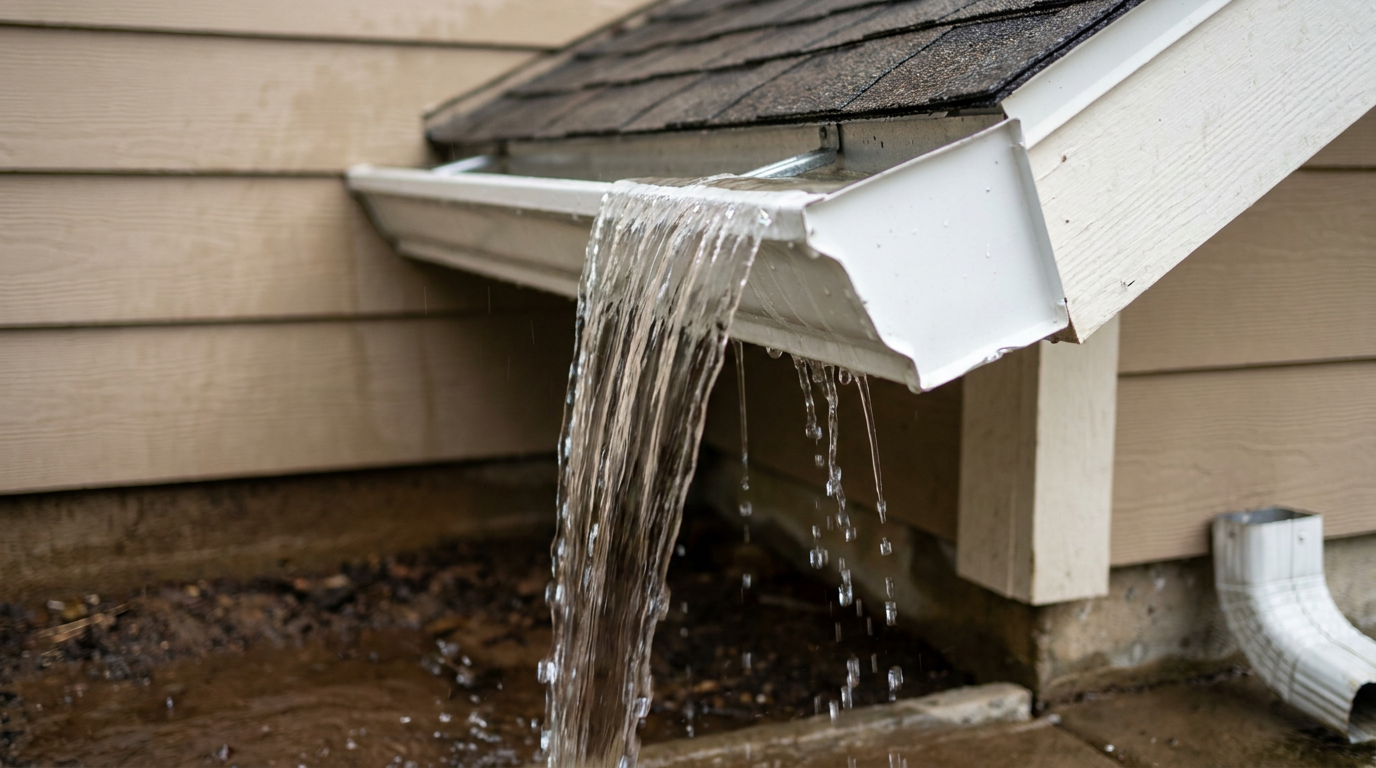
A continuous roar of water spilling off the eaves during a thunderstorm’ll get anybody’s attention. It’s ugly, and it’s rough on the house. When gutters overflow, all that stormwater dumps straight down beside the foundation instead of heading out through the downspouts where it belongs.
In places with expansive clay soils—North Texas, big chunks of the Midwest—that kind of soaking is a mess. The dirt swells up, pushes hard against basement walls, and can crack foundation grade beams before you know it. I’ve seen the rest of the damage too: fascia boards rotting out, soffits getting soft, brickwork stained with mildew streaks, and flower beds washed down to mud.
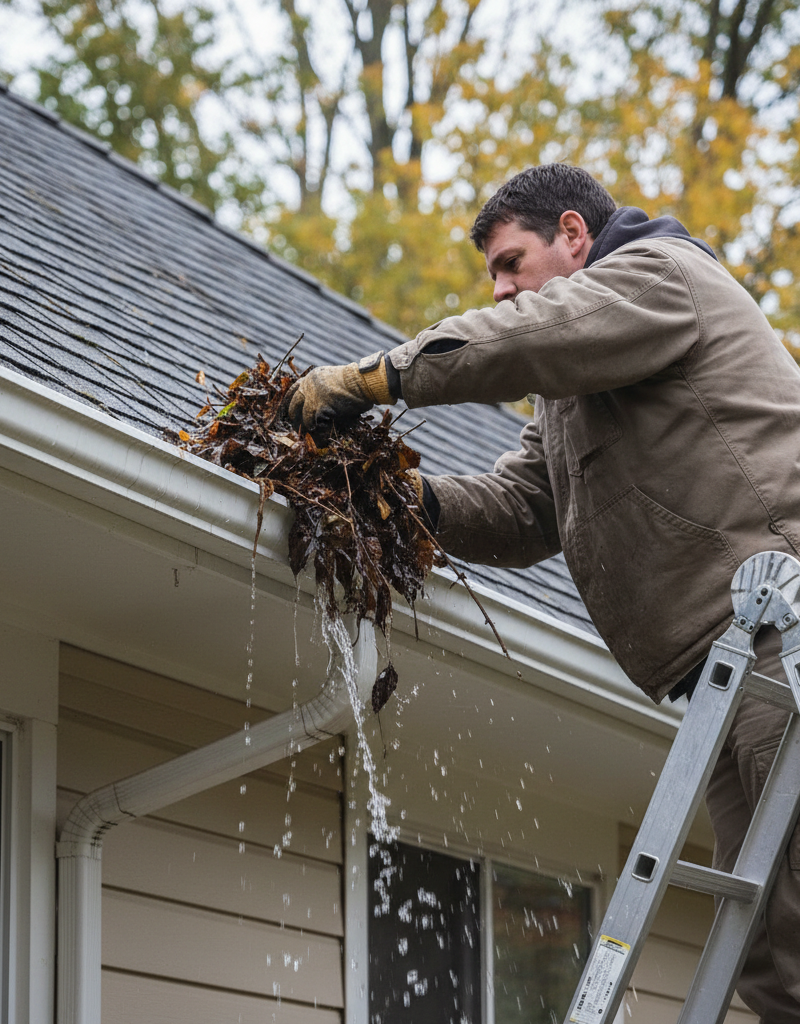
And here’s the trap. A lot of homeowners look up in the middle of the rain and figure, “Yep, the gutters need cleaning.” Sometimes that’s true. But then you get on a ladder after the storm, crack it open, and the aluminum’s spotless. No leaves. No pine needles. No muck. When clean gutters still spill over, you’re not looking at a simple cleaning job—you’re looking at a flow problem, a sizing problem, or an install issue that needs some real troubleshooting.
How It Works
A residential rainwater system runs on gravity and surface tension. That’s it. The roof acts like one big funnel, and every 1,000 square feet sheds about 620 gallons of water for every single inch of rainfall. In a hard summer thunderstorm dropping 2 to 3 inches in an hour, a standard 2,500-square-foot home can shed over 3,000 gallons of fast-moving water. No joke.
That runoff comes ripping down the shingles and into the gutter trough, which has to hold enough volume and have enough slope to catch it without throwing water over the front edge. Most homes use 5-inch K-style gutters with 2x3-inch downspouts. The water in the trough depends on a proper pitch—ideally 1/4 inch of downward slope for every 10 feet of horizontal run toward the downspout drop.
Once the water gets to the outlet, gravity pulls it down the vertical pipe. But if that opening’s too small, you get a bottleneck. The downspout backs up, water builds in the trough, surface tension breaks at the lip, and the whole channel surcharges. That’s when you get hundreds of gallons pouring over the front edge. And at inside corners where two roof planes meet? That runoff gets mean. It acts like a ski jump unless you’ve got a baffle or diverter in place.
Step-by-Step Fix
Follow this diagnostic and repair sequence to stop your gutter system from failing under peak rainfall loads.
-
Conduct a wet-weather inspection — Get out there in the next heavy storm with a raincoat and walk the house perimeter so you can see exactly where it’s failing. Watch for water shooting over inside roof valleys, pooling and spilling over the middle of long runs, or backing up at the downspout entries while the downspouts themselves barely dribble.
- Safety: Stay clear of electrical service drops and keep off metal ladders while lightning is active.
- If this doesn't work: On a dry day, run an open garden hose straight into the roof valleys and troughs at full blast to mimic peak rainfall.
-
Clear and flush hidden downspout bottlenecks — Set an extension ladder with standoff stabilizers so you can reach the downspout drop outlets safely. Pull out any packed debris, roofing gravel, or rotten seed pods sitting just below the drop collar, then run a high-pressure brass jet nozzle down the pipe to blast out clogs in the lower elbows.
- Tools: Ladder with standoff arms, work gloves, high-pressure hose nozzle, or a 25-foot drum drain auger.
- If water still backs up: Pull the bottom elbow apart with a 1/4-inch hex driver and look for compacted leaves jammed on interior sheet metal screws.
-
Check and recalibrate gutter pitch — Set a 4-foot magnetic level inside the gutter bed or along the front bottom lip and check the slope toward the downspout. You want a steady downward pitch of 1/4 inch to 1/2 inch for every 10 linear feet; if the bubble reads level or tilts backward, water’ll stall and spill during a hard downpour.
- Tools: 4-foot level, tape measure, string line, line level.
- If you spot an uneven sag: Snap a chalk line from the high end of the fascia board down to the downspout drop so you’ve got a clean target.
-
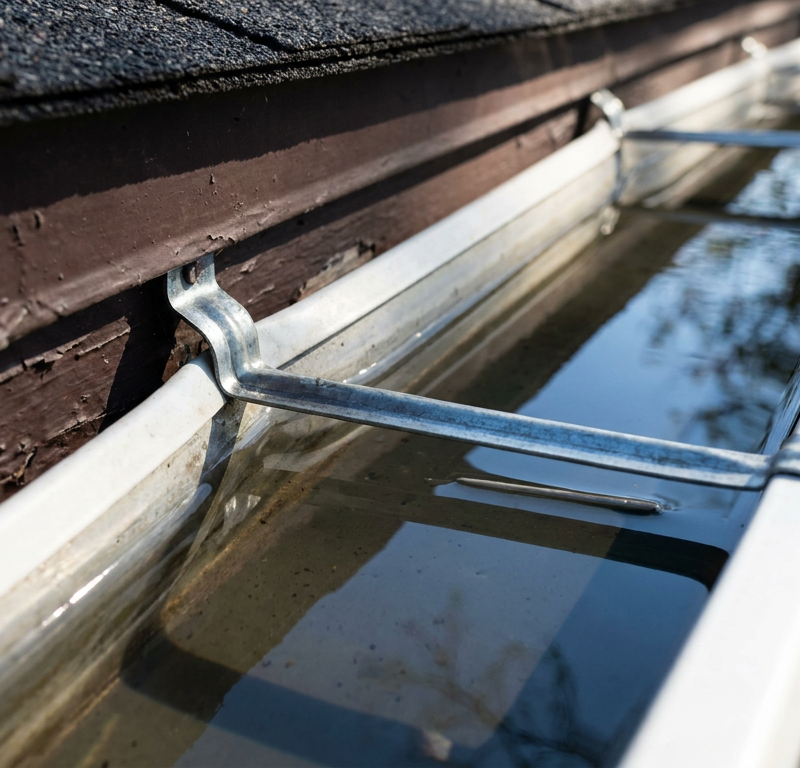
Rehang sagging runs with heavy-duty hidden hangers — Back out the old pulled spikes or weak clips with a cordless drill and a 1/4-inch hex driver. Push the gutter back up to your chalk line to restore the slope, then drive heavy-duty 5-inch or 6-inch aluminum hidden hangers with zinc-coated screws through the fascia board and into the rafter tails on 24-inch centers.
- Materials: Heavy-duty screw-in hidden hangers (pack of 20 to 50), 1/4-inch hex magnetic drive bit.
- Note: In heavy-snow or high-wind zones, go 18 inches apart instead of 24 inches so the run doesn’t flex in the middle under a load of water.
-
Install aluminum splash guards at high-velocity roof valleys — Set a straight or L-shaped embossed aluminum diverter along the outer lip of the gutter right across from any converging roof valley. Fasten it through the pre-drilled hemmed lip with three 1/2-inch self-drilling #8 sheet metal screws, and make sure the 3- to 4-inch vertical barrier forces the water into the trough instead of letting it leap over the edge.
- Tools: Cordless drill, 1/4-inch driver bit, tin snips, rust-resistant self-tapping zip screws.
- Safety: Wear cut-resistant gloves; sheet-metal edges are razor sharp.
-
Enlarge downspout drop outlets — Cut out the undersized 2x3-inch drop outlet collars from the bottom of the trough with tin snips or an oscillating multi-tool and a metal-cutting blade. Trace the perimeter of a new 3x4-inch rectangular drop outlet, snip the opening to fit, drop the collar in from the inside, and fasten it with rivets or short sheet-metal screws before sealing it with gutter-grade tripolymer sealant.
- Tools: Tin snips, oscillating multi-tool, drill, pop-rivet gun, 100% tripolymer gutter sealant (e.g., Geocel 2300 or similar).
- Note: Moving from 2x3 to 3x4 inches more than doubles drainage capacity from roughly 185 to 400 gallons per minute.
-
Upsize or swap standard downspouts for 3x4-inch lines — Measure down the wall, unclamp the existing 2x3 downspout brackets, and pull the undersized pipes off. Fit new 3x4-inch corrugated aluminum elbows onto the expanded drop outlet, connect 10-foot lengths of 3x4-inch pipe with female-downward overlaps, and fasten them to brick or siding with wide pipe bands and exterior-grade structural masonry screws.
- Materials: 3x4-inch corrugated downspout runs, A-style or B-style elbows, downspout bands, 1-1/2-inch Tapcon screws (for brick).
- If replacing downspouts isn't an option: Add an auxiliary drop outlet and a second complete 2x3 downspout at the other end of the run to split the load.
-
Tear out flow-restricting gutter screens or micro-mesh filters — Check whether surface tension is making heavy rain skate right across the top of fine-mesh covers instead of dropping through the openings. If the screens are loaded up with roof silt, algae, or tree sap, scrub them clean with a stiff nylon brush and biodegradable cleaner, or pull the clips entirely if your roof pitch is over 8/12, since steep roofs dump water too fast for fine micro-mesh to keep up.
- Tools: Stiff nylon brush, degreaser/bucket, nut driver to detach gutter guard clips.
-
Seal end caps and joint seams with tripolymer sealant — Clean the interior corners, slip joints, and end caps with isopropyl alcohol and a wire brush to get rid of old silicone or tar. Lay down a continuous 3/8-inch bead of high-grade elastomeric tripolymer gutter sealant over the interior seams and smooth it with a gloved finger dipped in mineral spirits; give it a full 24 to 48 hours to cure before you test it with a lot of water.
- Materials: Exterior tripolymer sealant, lint-free rags, isopropyl alcohol.
- Warning: Skip cheap 100% silicone or asphalt roof patch; neither holds up well on wet aluminum or across thermal shifts long term.
-
Test the completed run with simulated storm flow — Head back up with an open 3/4-inch garden hose turned all the way up, and feed water directly onto the roof shingles 5 feet above the valleys and along the high end of the gutter runs. Watch the whole thing: make sure water drops cleanly into the channel, moves steadily along the pitch without standing water, and exits the 3x4-inch downspout elbow onto splash blocks or underground drains without blowing back onto the siding.
Common Causes
Figuring out why gutters fail in bad weather means looking past simple leaf clogs. These are the five real mechanical and structural reasons water overflows:
- Severely undersized drainage components: Standard 5-inch K-style troughs paired with small 2x3-inch downspouts were built for modest, steady rain. In heavy tropical moisture plumes or hard convective storms, 2x3-inch pipes just can’t move water fast enough, so the whole run backs up.
- Insufficient downward pitch or mid-run sagging: When thermal expansion, heavy snow, or rotten fascia boards pull hangers loose, long runs sag in the middle. Water ponds in those low spots instead of racing to the downspouts, and once the next hard burst hits, it spills right over the front edge.
- High-velocity valley runoff (the ski-jump effect): Where two roof planes meet, they funnel double the rainfall at double the speed into a small 12-inch stretch of gutter. Without a sheet-metal splash diverter, that rushing water skips across the top like a stone across a pond.
- Subterranean drainage blockages: Downspouts that tie into buried corrugated 4-inch black plastic pipe often back up. Roots from oak or crape myrtle trees crush those thin-walled lines underground, or heavy clay mud silts up the pop-up emitter, turning the downspout into a standing water column that overflows back at roof level.
- Gutter guard surface-tension failure: Micro-mesh covers and solid-hood surface-tension guards rely on fluid physics to pull rain around curved metal edges while keeping leaves out. In torrential rain, or on roofs with a steep 8/12 or 10/12 pitch, the volume and speed break that surface tension and turn the guard into a metal slide that dumps water into your flowerbeds.
Common Mistakes
Avoid these common DIY slip-ups that hurt gutter performance or chew up the framing:
- Using 100% standard silicone caulk on interior seams. Silicone hardens, shrinks, and loses adhesion when it’s dealing with aluminum expansion cycles and standing water. Use a dedicated tripolymer or polyurethane gutter sealant (like Geocel 2300 or OSI Quad) that cures into a flexible, rubberized gasket and sticks to unprimed metal.
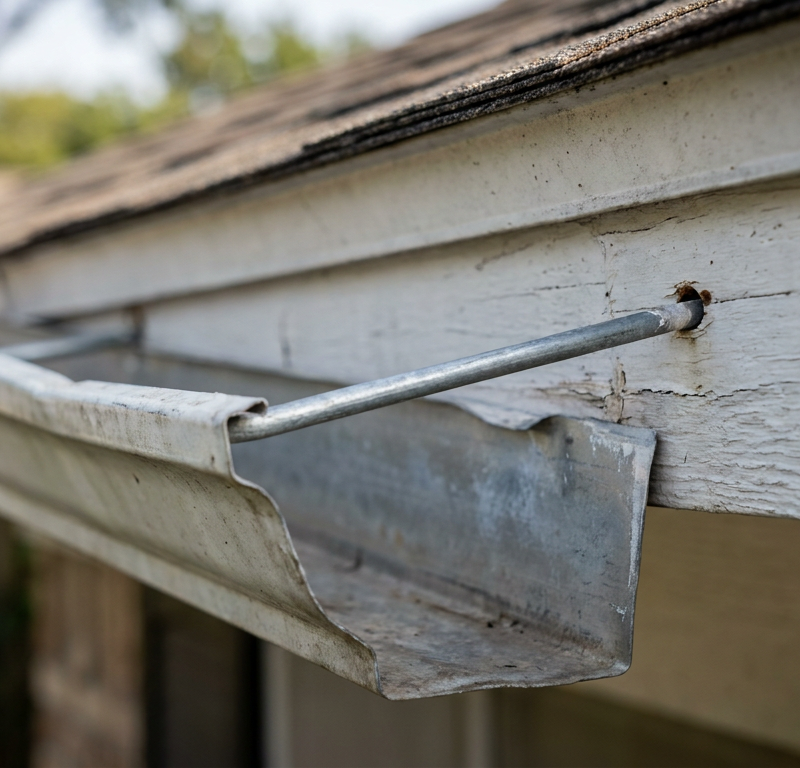
- Re-driving old spikes back into the same rotting holes. When an old 7-inch gutter spike pulls loose from the fascia, hammering it back in does nothing because the wood inside that hole is stripped or softened by dry rot. Pull the spike, drill a pilot hole 2 inches to the side, and install modern heavy-duty internal screw hangers with 2-1/2-inch galvanized wood screws biting into solid rafter tails.
- Pitching gutters too steeply on long runs. Yes, water needs slope. But dropping the gutter more than 1/2 inch per 10 feet on a 40-foot run will leave the low end 2 solid inches below your shingles. That exposes the fascia to wind-driven rain and can make water miss the trough altogether down low. Keep the pitch tight: 1/4 inch per 10 feet is ideal.
- Fastening downspout sections with long interior screws. Running 1-inch or 1-1/2-inch drywall screws through downspout joints creates internal metal hooks that catch twigs, leaves, and asphalt shingle grit. Use 1/8-inch short aluminum pop rivets or 3/8-inch blunt-tip zinc sheet metal zip screws that barely poke through the inner wall.
- Resting heavy extension ladders directly against the thin gutter lip. An aluminum ladder sitting on a 5-inch K-style gutter will crush the outer rim, wreck the pitch, and break seams at nearby slip joints. Always use an adjustable ladder standoff stabilizer bracket that spans across window frames or bears against roof decking.
Cost & Time Breakdown
| Task | DIY Cost | Pro Cost | Time |
|---|---|---|---|
| Clear downspouts & flush underground lines | $15–$45 (auger/nozzle) | $150–$300 | 1–2 hours |
| Re-pitch & reinforce with heavy-duty screw hangers | $25–$60 (hangers/screws) | $200–$450 | 2–3 hours |
| Install valley splash shields (2–4 valleys) | $15–$35 (diverters/hardware) | $120–$250 | 45–60 mins |
| Upgrade to 3x4-inch downspouts & outlets | $80–$180 (pipes/elbows/drop outlets) | $350–$750 | 3–4 hours |
| Complete replacement: upgrade 5" to 6" seamless gutters | $600–$1,200 (sectional kits) | $1,800–$3,800 (seamless pro install) | 1–2 days |
Tips & Prevention
- Inspect downspout discharge points twice a year. Make sure the ground-level discharge elbows extend at least 4 to 6 feet away from the foundation (or 10 feet away if you’ve got a basement or expansive clay soil) so the water doesn’t loop right back toward the footings.
- Clear shingle grit from drop outlets every fall. Asphalt granules shed off the shingles and pile up at the low end of the gutter, and that stuff acts like a little concrete dam during a sudden cloudburst even if there isn’t a single leaf in sight.
- Trim overhanging tree branches back a minimum of 10 feet. Limbs don’t just dump leaves and seed pods; they also shade the shingles, which encourages moss and lichen to grow on the lower courses and then flake off into the drop strainers.
- Test underground pop-up emitters with a garden hose in spring. Freezing soil or mower damage cracks the green plastic caps on yard pop-ups, letting dirt and grass clippings settle in and create hydraulic locks that send water all the way back up to the roof line.
- Check hanger tightness whenever you hang holiday lights. Give each hanger a firm downward tug. If there’s more than 1/4 inch of vertical play, the fascia fasteners are loosening and will fail when they’re loaded with heavy rainwater or winter slush.
When to Call a Professional
Not every gutter overflow problem’s a Saturday-afternoon fix with a little step ladder. If your home has a second or third story and the rooflines sit more than 20 feet off the ground, the fall risk gets serious real fast, and you’ll want safety harnesses, roof jacks, or proper staging.
You should also call a licensed roofing and gutter contractor if you open things up and find widespread dry rot, mold, or structural failure in the fascia boards and rafter tails behind the aluminum. Hanging gutters off rotten wood just doesn’t work. At that point, a pro has to pull the gutters, remove the soffit, splice in fresh exterior-grade framing, and install new flashing before the replacement channels go back on.
And if you’re dealing with big architectural spans, steep 10/12 gables, or standing-seam metal roofing that throws a ton of water, standard 5-inch gutters are just outmatched. I pulled a water heater in Frisco last month that had exactly this sort of runoff problem at the back elevation—same kind of “looks fine until it storms” headache. In cases like that, call somebody with a mobile roll-forming truck who can fabricate and install continuous, heavy-gauge 6-inch or 7-inch seamless commercial-grade gutters with oversized 4x5-inch industrial downspouts. That extra capacity’s the real fix on roofs that dump a serious amount of water.
Related Articles
Keep troubleshooting with these hand-picked guides from FixlyGuide:
- The #1 Gutter Mistake That Causes Overflow (It's Not Clogs!) — Discover the often-overlooked culprit behind overflowing gutters during heavy rain and learn the surprising, easy fix most homeowners miss.
- The #1 Gutter Mistake That Causes Overflow (And How to Fix It in 20 Minutes) — Overflowing gutters during heavy rain are usually caused by a readily fixable clog, often due to a common cleaning mistake.
- Deck Screws Pulling Out? 5 Causes and the Step-by-Step Fix — Stop tripping on loose deck screws. Here is why fasteners pop out of deck boards, how to test for joist rot, and the step-by-step fix to an…
- Deck Wobbles When Walking? 10 Causes of Sway and the Step-by-Step Fix — Stop dangerous deck sway before structural failure occurs. Diagnose loose ledger connections, rotten posts, and install code-approved brace…
- Melted Vinyl Siding? 5 Heat Sources and the Complete Step-by-Step Fix — Learn why vinyl siding melts from window reflections or heat, how to replace distorted planks using a zip tool, and ways to stop the glare…
- Yard Flooding After Heavy Rain? 9 Causes and How to Fix Your Drainage Fast — Tired of a swampy backyard every time it rains? Uncover the common causes of poor yard drainage, from compacted soil to clogged gutters, an…
Should you do this yourself?
Answer five quick questions before you start. Safety outranks savings every time.
Your experience with work like this
How high do you have to work?
Does the job involve any of these?
Will it need a permit?
Specialty tools
Free and instant. Educational guidance only — not a quote, inspection, or professional diagnosis.
Estimate your own project cost
National averages are a starting point. Enter your details for a range that fits your house.
Roof replacement cost
- Per square (installed)$604 – $866
Add $500–$2,500 if decking is rotten and needs replacement. Storm damage may be covered by insurance.
Educational estimate only — always confirm with written local bids.
What should this project cost?
Enter your project details for a realistic cost range before you call anyone.
Spot repairs commonly run $400–$1,800; full replacement typically $9,000–$18,000 for an average home.
- Regional adjustment
- National average
- Labor share (typical)
- ~$2,948
- Quotes to collect
- 3 written estimates
Educational estimate based on national averages — not a binding quote. Always confirm with written local estimates.
Fixly Project Decision Box
- DIY difficulty
- Professional Recommended
- Estimated time
- Inspection 1–2 hours · repairs 1–3 days
- Cost level
- High
Main tools / materials
- Binoculars for a ground-level look
- Flashlight for attic checks
- Moisture meter
- Roofing cement (temporary patch only)
When to stop and call a pro
- Active leak near lights, fans, or any wiring
- Sagging, bulging, or water-filled ceiling
- Steep, wet, or two-story roof — do not climb it
- Storm or hail damage you plan to claim on insurance
Need professional help?
Free roof assessment first — no phone calls until you ask for them.
Get Local Roofing HelpDecide what your roof needs
Two minutes of questions turns "something is wrong up there" into a clear next step.
- Repair or replace your roof?Answer 10 questions about age, leaks, and damage to get a clear next step.Open
- Compare contractor quotesScore up to four bids on price, warranty, licensing, and timeline.Open
- Get local estimatesSend one request and compare written estimates from vetted pros.Open
Free, no signup required. Estimates are educational guidance, not a quote or an inspection.
Get the print-ready PDF of this guide
A clean, ad-free, printable version you can keep on your phone or pin to the workshop wall. Free with a FixlyGuide account.
- Print-optimized layout
- Tools, materials & every step included
- Saved to your account
Frequently asked questions
Can clean gutters overflow during a rainstorm?+
Yes, absolutely. A 5-inch gutter can be immaculately clean, but if it lacks sufficient downward slope (at least 1/4 inch per 10 feet), water pools and spills over the center. Clean gutters also overflow when small 2x3-inch downspouts cannot handle high rainfall rates or when high-speed roof valleys lack splash guards.
How do I know if my gutters are undersized?+
Standard residential gutters are 5-inch K-style troughs paired with 2x3-inch downspouts. If your roof has steep pitches (8/12 or greater), complex multi-plane valleys, or metal panels, step up to 6-inch seamless gutters paired with 3x4-inch downspouts, which carry nearly 50% more water volume.
What is the difference between 2x3 and 3x4 downspouts?+
Standard 2x3-inch downspouts drain roughly 185 gallons per minute, whereas 3x4-inch downspouts carry roughly 400 gallons per minute. That single change more than doubles your discharge capacity and prevents water from backing up in your gutter troughs during severe cloudbursts.
Why does water shoot over the gutter only at roof valleys?+
A roof valley funnels runoff from two distinct roof planes into a single convergence point, creating a high-velocity stream that shoots straight over the outer gutter lip like a ski jump. Installing an aluminum splash guard (a 3- to 4-inch vertical baffle) along the outer rim forces that surging water back down into the trough.
Can gutter guards cause gutters to overflow?+
Gutter guards prevent leaves from entering, but many fine micro-mesh filters or solid surface-tension covers cannot absorb water fast enough during cloudbursts dropping 2+ inches of rain per hour. Water sheets over the top of the guards instead of dropping into the channel. In addition, pine sap and roof sediment can film over the mesh, turning it into a solid, water-repelling barrier.
What is the correct pitch for residential gutters?+
Gutters must slope downward toward downspout drops at a rate of 1/4 inch to 1/2 inch for every 10 linear feet of trough. If a run is 30 feet long, the downspout end should sit 3/4 inch to 1-1/2 inches lower than the high end to maintain steady gravitational velocity.
How many downspouts does my house actually need?+
You should have at least one 3x4-inch downspout for every 30 to 40 linear feet of gutter run, or one standard 2x3-inch downspout for every 20 to 25 linear feet. Homes in regions with extreme convective thunderstorm patterns (like the Gulf Coast or Texas) require downspouts spaced closer together or larger pipes to shed water quickly.
What kind of damage does overflowing gutter water cause?+
Persistent gutter overflow dumps concentrated sheets of water against your home's foundation perimeter, causing soil expansion, basement leaks, and foundation cracks. It also rots out wooden fascia boards, destroys attic soffits, and breeds wood-destroying insect colonies behind siding.
Discussion
Loading comments…