- Tools: A sturdy pair of leather gardening gloves.
- Safety: Watch for fire ants or ground-nesting wasps when you lift loose sod flaps.
- If this doesn't work: If it pulls up with slight resistance but shows dark, slimy, or rotted stems right at soil level, you’re probably looking at a fungal issue like take-all root rot or large patch instead of simple dormancy.
Landscaping · Deck or fence project
| Project category | Landscaping |
|---|---|
| Problem type | Deck or fence project |
| Trade required | Landscaping |
| Urgency | Planned project |
| Safety risk | Moderate safety risk |
| DIY suitability | DIY for experienced homeowners |
| Cost category | High cost |
| Typical timeline | Most builds 3–10 days depending on size |
| Contractor type | Landscaping contractor |
Repair option
Replace failed boards, posts, and hardware; reseal the surface.
Replacement option
Rebuild when framing or the ledger connection is unsafe.
Common causes
- Rot at posts and ledger
- Storm damage
- Adding outdoor living space
Relevant tools:home improvement material pricesproject cost estimator
Published November 17, 2026Last updated November 17, 2026
Tools & materials you'll need
Affiliate linksAs an Amazon Associate FixlyGuide earns from qualifying purchases — at no extra cost to you. Prices and availability are accurate as of publication and subject to change.
Quick Answer
If your grass turns straw-colored, pulls up like a loose carpet, or snaps off at the soil line in late summer, your lawn’s probably dealing with heat dormancy, drought stress, or root-chewing pests like white grubs. Grab a handful and give it a tug. If it holds tight, it’s dormant and needs 1 to 1.5 inches of water weekly to bounce back. If it lifts cleanly with no root resistance at all, grubs have chewed through the root system, and you’ll need an immediate curative insecticide treatment followed by autumn overseeding.
The Problem
Mid-to-late summer hits North Texas and southern lawns like a blast furnace. Triple-digit afternoons baked into solid clay turn good St. Augustine, Bermuda, or tall fescue into dry, brittle patches of pale tan and dirty gold.
Homeowners usually panic and dump thousands of gallons of water onto the turf. Nothing happens. The patch spreads, the edges creep out every day, and the grass feels crunchy underfoot.
Here’s the kicker: brown, dead-looking summer grass isn’t always dead. But if you mistake dormant grass for dead grass—or confuse an insect problem with plain drought—you’ll burn a hole in your wallet. Treat heat dormancy with heavy chemical fertilizer and you’ll scorch the crown. Assume grubs killed your turf when it was just shutting down to survive 102°F heat, and you’ll spray toxic chemicals into your soil for zero benefit while wasting water. You need a fast, mechanical way to tell whether your lawn’s sleeping, starving for water, or getting eaten alive from underneath.
How It Works
Warm-season and cool-season grasses use completely different biological survival playbooks when temperatures peak.
Warm-season varieties like Bermuda, Zoysia, and St. Augustine thrive between 80°F and 95°F. Once air temperatures stay above 100°F and upper soil temps cross 85°F without moisture, their cellular respiration outpaces photosynthesis. The grass burns through stored carbohydrate reserves faster than its blades can produce sugar. So the plant shifts into induced dormancy: it stops top growth, pulls moisture down into the rhizomes, stolons, and crown, and lets the visible leaf tissue dry out and turn brown. The crown—the vital growing point sitting right at the soil surface—stays alive.
Cool-season grasses like Kentucky Bluegrass or Tall Fescue trigger that shutdown much earlier, around 85°F to 90°F.
At the same time late summer heat peaks, masked chafers and June beetles finish their mating flights and lay eggs 1 to 2 inches deep in the soil. By August, those eggs hatch into c-shaped white grubs. These larvae are hungry little devils. They chew on tender fibrous turf roots right below the thatch layer, and when they do, the blades above lose their hydraulic connection to soil moisture. The grass wilts, turns brown, and dies—not from heat directly, but because it’s got no roots left to drink water.
A healthy lawn crown can ride out dormancy for 3 to 4 weeks without water before permanent tissue death kicks in. If grubs severed the crown from its roots, no amount of rain or irrigation’s bringing that turf back.
I pulled a water heater in Frisco last month and the homeowner had the same look on his face over his backyard—sure it was dead, turned out it was just dormant and cooked by a clogged zone. Same song, different house.
Step-by-Step Fix
Follow this diagnostic and remediation sequence to rescue dormant turf and rebuild dead patches before cold weather shows up.
-
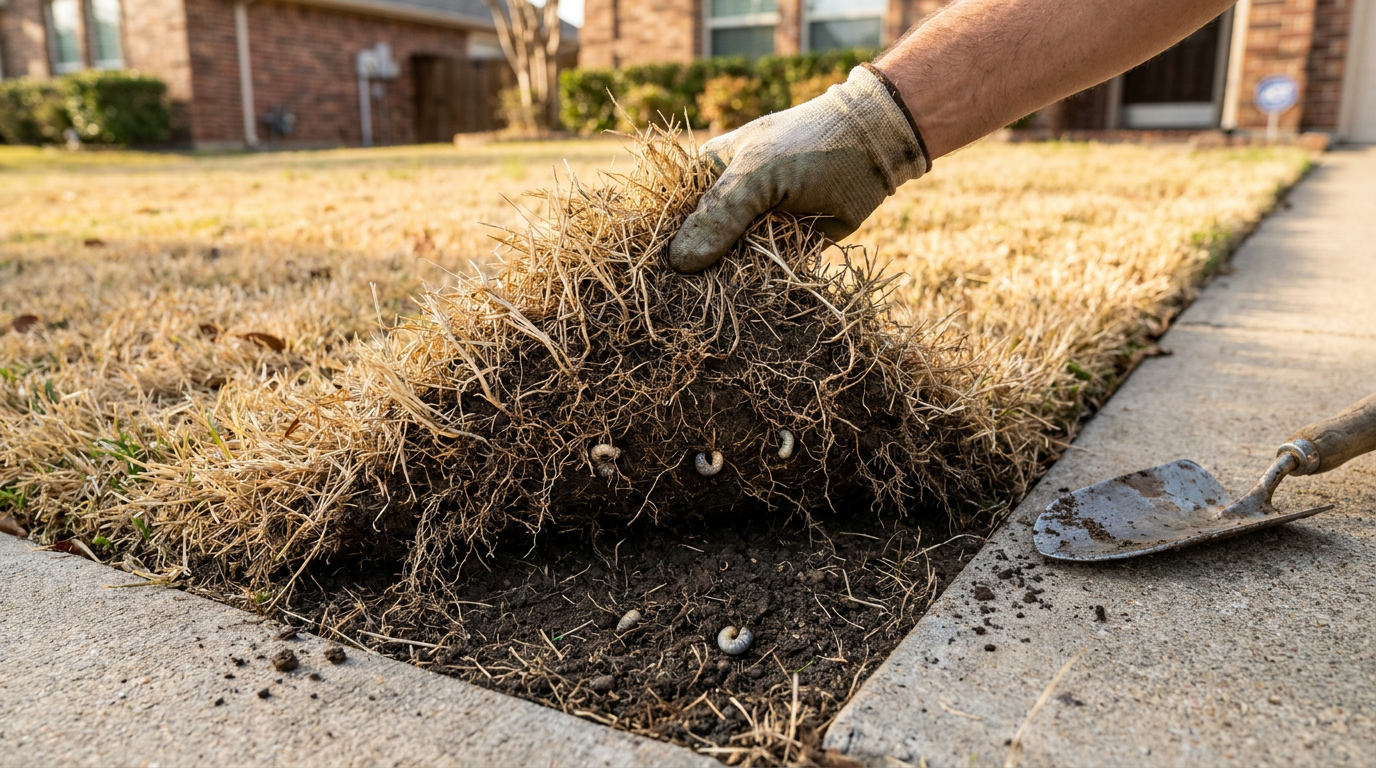
Conduct the 10-Second Tug Test — Walk out to the worst-looking patch, grab a fistful of brown grass blades firmly at the base, and pull straight up toward your chest. If the sod holds firm with stubborn resistance, the roots are intact; your grass is simply dormant or drought-stressed. If the sod rolls back effortlessly like an unglued piece of shag carpet, showing severed roots and bare dirt beneath, insect pests have cut your root system.
- Tools: A sturdy pair of leather gardening gloves.
- Safety: Watch for fire ants or ground-nesting wasps when you lift loose sod flaps.
- If this doesn't work: If it pulls up with slight resistance but shows dark, slimy, or rotted stems right at soil level, you’re probably looking at a fungal issue like take-all root rot or large patch instead of simple dormancy.
-
Inspect for White Grubs Beneath the Turf — Take a flat-edge spade, slice a 1-foot by 1-foot square roughly 3 inches deep along the boundary where green grass meets the brown patch, and peel back the sod flap. Sift through the top 2 inches of exposed soil and root thatch with your fingers, counting any plump, white, c-shaped larvae with tan heads.
- Threshold: If you count more than 5 to 10 grubs per square foot, you’ve got an active grub infestation that needs immediate eradication.
- Inspection detail: Look closely for small black pellets or powdery droppings around the roots. That’s a dead giveaway of heavy feeding.
-
Check the Soil Penetration with a Long Screwdriver — Push a standard 6-inch mechanic's screwdriver straight down into the center of the brown patch, then repeat the test in a green section of your yard. If the tool stops dead after an inch or two in the brown area, your soil has gone hydrophobic and compacted; water’s just sheeting off the surface instead of reaching the root zone.
- Target: The shaft should glide smoothly into moist soil down to the 4-to-6-inch mark with moderate hand pressure.
- If this doesn't work: If the screwdriver sinks into mud but the grass is straw-colored and flat, your irrigation zone is overwatering, and that can lead to root rot through soil oxygen starvation.
-
Run a Catch-Cup Irrigation Audit — Place 5 to 6 shallow, flat-bottomed containers (empty tuna cans or cat food tins work best) evenly across the struggling lawn zone. Fire up that sprinkler zone for exactly 15 minutes, then measure the water depth in each can with a wooden ruler.
- Calculation: Multiply the average depth by 4 to determine your system's hourly output rate in inches.
- Target output: Most spray heads deliver 1.5 inches per hour, while rotating nozzles deliver roughly 0.4 to 0.5 inches per hour.
- Adjustment: If one side of the zone catches 0.5 inches while another catches a quarter-inch, realign or swap your clogged nozzle heads right away.
-
Deploy a Curative Insecticide (If Grubs Were Found) — Apply an active curative insecticide containing Trichlorfon (Dylox) or Carbaryl across the infested zone and extend 6 feet into surrounding green turf. Granular formulations must be spread using a calibrated broadcast spreader at the label rate (typically 2 to 3 lbs per 1,000 sq ft).
- Critical timing: Do not use preventative imidacloprid products in late summer; they work too slowly to kill mature, feeding August grubs.
- Safety: Keep pets and children off the treated lawn until the product is thoroughly watered in and completely dry.
-
Water In Curative Treatments Immediately — Run your sprinklers for 30 to 45 minutes immediately after applying granular grub control, putting down at least 0.5 inches of water. The chemical has to be washed off the grass blades, down through the thatch layer, and into the top 2 inches of soil where the larvae are chewing.
- Caution: If you leave it on dry turf under intense sun, Trichlorfon breaks down fast and burns grass blades.
-
Implement Cycle-and-Soak Watering for Dormant Grass — Switch your irrigation controller away from daily 10-minute sprinkles and move to a deep cycle-and-soak schedule delivering 1 to 1.5 inches of water per week split across two non-consecutive days. In heavy clay soil, break each watering day into three 10-minute cycles spaced 45 minutes apart.
- Why this works: Clay can’t absorb water quickly; cycling lets moisture seep down 6 inches without pooling or running into the street gutter.
- Timing: Set run times to start between 4:00 AM and 7:00 AM to minimize evaporation and keep overnight fungal problems from getting a foothold.
-
Apply a Liquid Soil Surfactant to Hydrophobic Spots — If hard-baked patches keep repelling water, attach a hose-end sprayer loaded with a concentrated soil penetrant (surfactant) or quality horticultural wetting agent. Spray the brown areas thoroughly before your scheduled irrigation run.
- Mechanism: Surfactants break the surface tension of dry organic coatings on soil particles, forcing moisture to soak deep instead of beading up and evaporating.
-
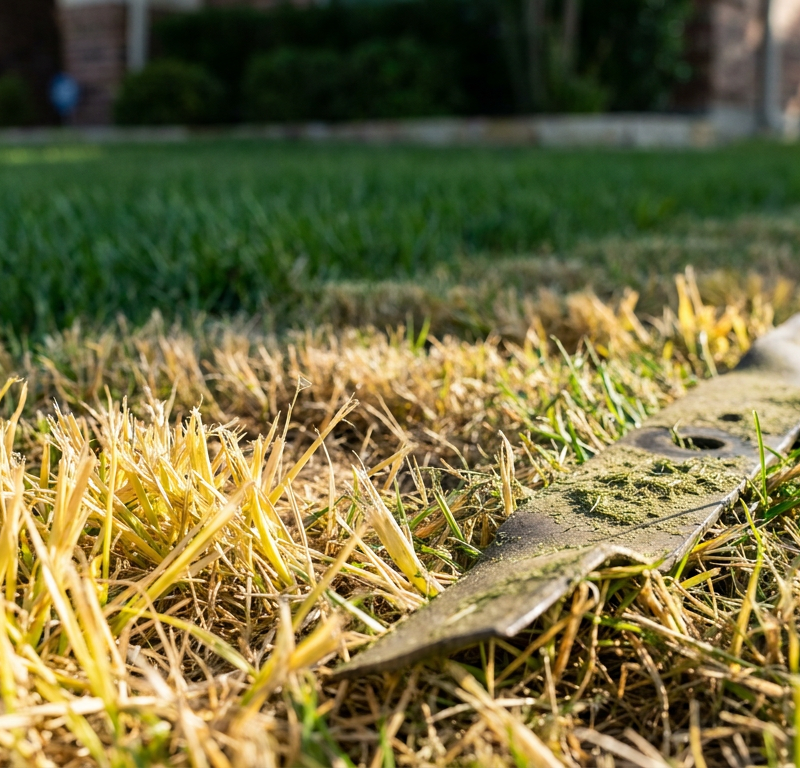
Raise Your Mower Blade to Maximum Height — Slide your mower deck up to 3.5 or 4 inches for St. Augustine and Fescue, or 2 to 2.5 inches for Bermuda. Taller grass blades shade the soil surface, cool root zone temperatures by up to 10°F, and slow moisture loss.
- Sharpness check: Grind or replace dull mower blades; ragged, torn grass tips lose 30% more water through transpiration than clean, razor-sharp cuts.
-
Aerate and Overseed Damaged Zones in Early Autumn — Once daytime temperatures reliably drop below 85°F in September or October, rake away dead, severed thatch and run a core aerator over the compacted areas. Broadcast matching turf seed (for cool-season) or install fresh sod squares (for warm-season), then roll the surface flat to ensure solid seed-to-soil contact.
- Depth: Core aerators should pull plugs 2 to 3 inches deep and drop them across the surface to break down naturally.
| Diagnostic Feature | Heat/Drought Dormancy | White Grub Damage | Chinch Bug Infestation | Fungal Disease (Large Patch) |
|---|---|---|---|---|
| Root Resistance | Firm; cannot pull up by hand | None; rolls back like loose carpet | Firm; blades break at crown | Weak; roots mushy, dark, and rotted |
| Patch Pattern | Large, uniform swathes in full sun | Irregular, expanding circular shapes | Expanding yellow-to-brown halos | Distinct rings with orange/yellow margins |
| Soil Moisture | Dry, rock-hard, compacted | Variable; happens even in wet soil | Typically dry, hot sunny borders | Often excessively soggy or overwatered |
| Recovery Window | 10–14 days after deep watering | Requires insecticide + reseeding | Requires insecticide + new growth | Requires fungicide + water cutback |
Common Causes
- Summer Dormancy (Protective Shutdown): Grass leaves lose chlorophyll and shrivel to protect the crown and subterranean rhizomes when moisture drops below survival thresholds.
- Heavy White Grub Infestations: Larvae chew through structural and feeder roots 0.5 to 1.5 inches below ground, breaking the plant's hydraulic lift mechanism completely.
- Soil Hydrophobicity and Clay Compaction: Repeated baking cycles dry out organic matter and coat clay particles with a waxy, water-repellent layer, starving roots even while the sprinklers are running.
- Shallow, Frequent Sprinkler Habits: Running sprinklers for 5 to 10 minutes every day trains lazy, surface-level roots that bake and crisp within 3 hours of direct sun.
- Southern Chinch Bug Damage: Tiny sap-sucking insects pierce grass nodes in open, blazing-hot areas (especially near driveways and concrete curbs) and inject a toxin that kills blades outright.
- Mower Scalping Under Heat Stress: Dropping your cutting deck too low during a hot spell removes the photosynthetic canopy, exposing delicate crown tissue to direct solar radiation.
Common Mistakes
- Dumping Nitrogen Fertilizer on Brown, Stressed Grass: Homeowners see brown turf, figure it needs food, and spread high-nitrogen fertilizer. That forces dormant grass to burn precious root sugars on new leaf growth right when it can’t support it, burning the crown and killing the lawn for good.
- Applying Preventative Grub Control in Late Summer: Spreading imidacloprid or chlorantraniliprole in August or September won’t stop active damage. Preventatives take 2 to 4 weeks to move through plant tissue and work best against tiny June hatchlings; mature third-instar late-summer grubs need fast-acting contact curatives like Dylox.
- Watering Daily for Short Durations: Sprinkling for 8 minutes every afternoon keeps the surface humid—inviting fungal spores like brown patch—while leaving the lower root profile bone dry. Water deeply and less often instead.
- Throwing Grass Seed on Unprepared, Dead Thatch: Scattering seed over dead grub patches without peeling back the dead mat, raking away debris, and aerating the bare soil guarantees zero seed-to-soil contact. The seed dries out and blows away.
- Assuming Sprinkler Heads Are Working Fine Without Checking: Homeowners look at the control box, see it cycled, and assume the lawn got water. In reality, a jammed gear, cracked riser, or blocked nozzle can leave an entire quadrant bone dry for weeks without you noticing.
Cost & Time Breakdown
| Task | DIY Cost | Pro Cost | Time |
|---|---|---|---|
| Tug Test & Grub Soil Sampling | $0 | $75–$125 (service call) | 15–20 minutes |
| Catch-Cup Irrigation Output Audit | $0–$10 (tuna cans/ruler) | $100–$175 | 45–60 minutes |
| Curative Grub Treatment (5,000 sq ft) | $35–$60 (Dylox granules) | $120–$220 | 30 minutes |
| Soil Surfactant Application | $25–$45 | $90–$150 | 30 minutes |
| Core Aeration & Spot Overseeding | $70–$110 (rental + seed) | $200–$375 | 2–4 hours |
Tips & Prevention
- Switch to Preventative Grub Control Every May or June: Put down preventative products containing Chlorantraniliprole (Scotts GrubEx) or Imidacloprid early in the summer before beetle eggs hatch. It’s cheaper, safer for the environment, and stops root loss before it starts.
- Measure Your Lawn's Hydration with the Footstep Test: Walk across your lawn in the late afternoon. If your footprints stay flattened in the grass rather than springing back up within 5 seconds, your turf is starting to dry out and needs a deep watering run the following morning.
- Sharpen Your Mower Blades Every 25 Hours of Run Time: A clean cut heals within 24 hours; a torn, frayed blade leaf tip can take up to 5 days to close, leaking moisture and welcoming fungal spores.
- Audit Your Sprinkler Heads in April and July: Turn each zone on manually while standing right next to it twice a season. Look for sunken pop-ups, cracked seals bubbling water at the base, and shrubs blocking spray arcs.
- Leave Grass Clippings on the Lawn: Use a mulching blade to deposit clippings back into the turf. Grass clippings are 80% water and break down fast, adding organic nitrogen and creating a little micro-mulch that cuts soil surface evaporation.
When to Call a Professional
If you perform the tug test and find zero grubs, your soil passes the screwdriver test with plenty of moisture, yet your grass keeps dying in rapidly expanding circular zones with yellow or orange borders, you’re likely dealing with a nasty soil-borne fungus like Take-All Root Rot (Gaeumannomyces graminis) or Large Patch. These diseases need commercial-grade, rotational fungicides that the big box garden centers usually don’t stock.
You should also bring in a licensed irrigation contractor if your audit shows erratic water pressure, broken subterranean lateral lines, or failing electric solenoid valves that keep entire zones from firing. And if more than 50% of your total yard area has completely detached roots and bare clay, hiring a landscape contractor to scrape the dead turf, mechanically grade the soil, and lay fresh pallets of drought-tolerant sod will save you months of hard, frustrating DIY work.
Frequently Asked Questions
How long can dormant grass survive without water before it dies permanently?
Most established warm-season lawns can stay dormant for roughly 3 to 4 weeks in hot summer weather without suffering permanent crown death. Cool-season grasses like Tall Fescue start showing partial crown thinning after about 3 weeks of zero moisture. To keep dormant crowns alive during extended municipal watering bans, apply a minimum of 0.5 inches of water every two to three weeks.
Can I spray weed killer on my lawn while it's brown and heat-stressed?
No, don’t apply selective post-emergent herbicides when temperatures exceed 85°F to 90°F or when grass is visibly drought-stressed. In a weakened state, turf grasses can’t metabolize herbicide chemistry properly, and that can lead to severe chemical burns or complete death of the lawn. Wait until autumn temperatures cool and grass actively greens up before targeting broadleaf weeds.
Does dormant grass still need to be mowed?
Dormant grass stops growing upward, so it rarely needs cutting. If stray weeds poke above the canopy, though, you can mow over them with your deck set high. Don’t mow dormant grass during the heat of the day, since heavy mower wheels crush fragile, brittle crowns and leave ugly brown tire ruts that take months to recover.
What is the quickest way to tell grub damage apart from chinch bug damage?
The tug test is your best separator. Grub damage severs the root zone cleanly from the dirt, letting you roll back sod like carpet. Chinch bugs feed on the blades and stems above ground by injecting toxic saliva; the roots stay firmly anchored in the dirt, so you can’t lift the sod cleanly.
If my grass turns brown from heat, will daily watering make it green up faster?
No, daily watering actually makes the problem worse by creating hot, waterlogged soil that suffocates roots and breeds fungal pathogens. Turf crowns recover best from deep, infrequent watering—roughly 0.75 inches delivered twice a week in the early morning. It usually takes 10 to 14 days of proper deep watering for dormant grass to push out fresh green growth.
Why does the grass along my driveway and sidewalk turn brown first?
Concrete and asphalt soak up intense solar radiation all day, driving adjacent soil temperatures up to 20°F hotter than the rest of your yard. That localized thermal mass bakes the moisture right out of the border soil and speeds up plant transpiration. Give those border strips an extra weekly hand-watering or install dedicated drip/micro-spray zones to make up the difference.
Should I rake out the brown, dead-looking grass in August?
Hold off on aggressive dethatching or power-raking until early autumn. Hard raking in late summer pulls up fragile living crowns and exposes baked soil to direct sunlight, which speeds up weed germination and dries the ground out even more. Leave the brown blades in place to shade the soil until temperatures consistently drop in September.
What does a curative grub killer do that a preventative grub killer can't?
Curative insecticides (containing active ingredients like Trichlorfon or Carbaryl) work on contact within 24 to 48 hours to kill large, mature grubs that are actively feeding on roots in late summer. Preventative treatments (such as Imidacloprid) must be absorbed by the plant over weeks and are only effective against tiny, newly hatched larvae in late spring. Applying preventative products in August or September won’t stop active lawn destruction.
Related Articles
Keep troubleshooting with these hand-picked guides from FixlyGuide:
- Grass Turning Yellow After Mowing? 5 Causes and How to Fix It — Grass turning pale or yellow after mowing? Discover the causes of mower scalping and torn blades, and learn the step-by-step fix to restore…
- Nutsedge Taking Over Your Lawn? 10 Steps to Kill It at the Root — Stop pulling nutsedge by hand. Learn how to identify yellow and purple sedge, select the right selective herbicide, and destroy tubers with…
- Lawn Covered in Bleached Spots After Snow Melts? How to Fix Snow Mold in 10 Steps — Discover why snow mold leaves ugly bleached circles on your spring lawn, how to tell gray from pink mold, and the step-by-step fix to resto…
- Sprinkler Zone Won't Turn Off? The Hidden Valve Culprit and 11 Steps to Fix It — Sprinkler zone won't turn off? Discover why your controller isn't to blame and follow these step-by-step instructions to flush or rebuild t…
- Lawn Full of Tunnels? How to Tell Moles from Voles and Stop the Damage — Stop lawn tunnels for good. Learn how to tell moles from voles, locate active runs, set effective traps, and protect your yard from destruc…
- Dishwasher Won't Fill With Water? 5 Causes and the Step-by-Step Fix — Dishwasher running dry? Learn how to diagnose a stuck float switch, unclog a water inlet valve, and test solenoid continuity with step-by-s…
Should you do this yourself?
Answer five quick questions before you start. Safety outranks savings every time.
Your experience with work like this
How high do you have to work?
Does the job involve any of these?
Will it need a permit?
Specialty tools
Free and instant. Educational guidance only — not a quote, inspection, or professional diagnosis.
What should this project cost?
Enter your project details for a realistic cost range before you call anyone.
Cost depends heavily on which system turns out to be the source.
- Regional adjustment
- National average
- Labor share (typical)
- ~$1,620
- Quotes to collect
- 3 written estimates
Educational estimate based on national averages — not a binding quote. Always confirm with written local estimates.
Get the print-ready PDF of this guide
A clean, ad-free, printable version you can keep on your phone or pin to the workshop wall. Free with a FixlyGuide account.
- Print-optimized layout
- Tools, materials & every step included
- Saved to your account
Frequently asked questions
How long can dormant grass survive without water before it dies permanently?+
Most established warm-season lawns can remain dormant for roughly 3 to 4 weeks in hot summer weather without suffering permanent crown death. Cool-season grasses like Tall Fescue begin experiencing partial crown thinning after about 3 weeks of zero moisture. To keep dormant crowns alive during extended municipal watering bans, apply a minimum of 0.5 inches of water every two to three weeks.
Can I spray weed killer on my lawn while it's brown and heat-stressed?+
No, never apply selective post-emergent herbicides when temperatures exceed 85°F to 90°F or when grass is visibly drought-stressed. In a weakened state, turf grasses cannot metabolize herbicide chemistry properly, leading to severe chemical burns or complete death of the lawn. Wait until autumn temperatures cool and grass actively greens up before targeting broadleaf weeds.
Does dormant grass still need to be mowed?+
Dormant grass halts upward growth, so it rarely needs cutting. However, if stray weeds poke above the canopy, you can mow over them with your deck set high. Avoid mowing dormant grass during the heat of the day, as heavy mower wheels crush fragile, brittle crowns and leave unsightly brown tire ruts that take months to recover.
What is the quickest way to tell grub damage apart from chinch bug damage?+
The tug test is your best diagnostic separator. Grub damage severs the root zone cleanly from the dirt, letting you roll back sod like carpet. Chinch bugs feed on the blades and stems above ground by injecting toxic saliva; the roots remain firmly anchored in the dirt, making it impossible to lift the sod cleanly.
If my grass turns brown from heat, will daily watering make it green up faster?+
No, watering daily will actually make the problem worse by creating hot, waterlogged soil that suffocates roots and breeds deadly fungal pathogens. Turf crowns recover best from deep, infrequent waterings—roughly 0.75 inches delivered twice a week in the early morning. It typically takes 10 to 14 days of proper deep watering for dormant grass to push out fresh green growth.
Why does the grass along my driveway and sidewalk turn brown first?+
Concrete and asphalt soak up intense solar radiation throughout the day, driving adjacent soil temperatures up to 20°F hotter than the rest of your yard. This localized thermal mass bakes the moisture right out of the border soil and accelerates plant transpiration. Give these border strips an extra weekly hand-watering or install dedicated drip/micro-spray zones to compensate.
Should I rake out the brown, dead-looking grass in August?+
Hold off on aggressive dethatching or power-raking until early autumn. Vigorous raking in late summer pulls up fragile living crowns and exposes baked soil to direct sunlight, accelerating weed germination and drying the ground out further. Leave the brown blades in place to shade the soil until temperatures consistently drop in September.
What does a curative grub killer do that a preventative grub killer can't?+
Curative insecticides (containing active ingredients like Trichlorfon or Carbaryl) work on contact within 24 to 48 hours to kill large, mature grubs that are actively feeding on roots in late summer. Preventative treatments (such as Imidacloprid) must be absorbed by the plant over weeks and are only effective against tiny, newly hatched larvae in late spring. Applying preventative products in August or September will not stop active lawn destruction.
Discussion
Loading comments…