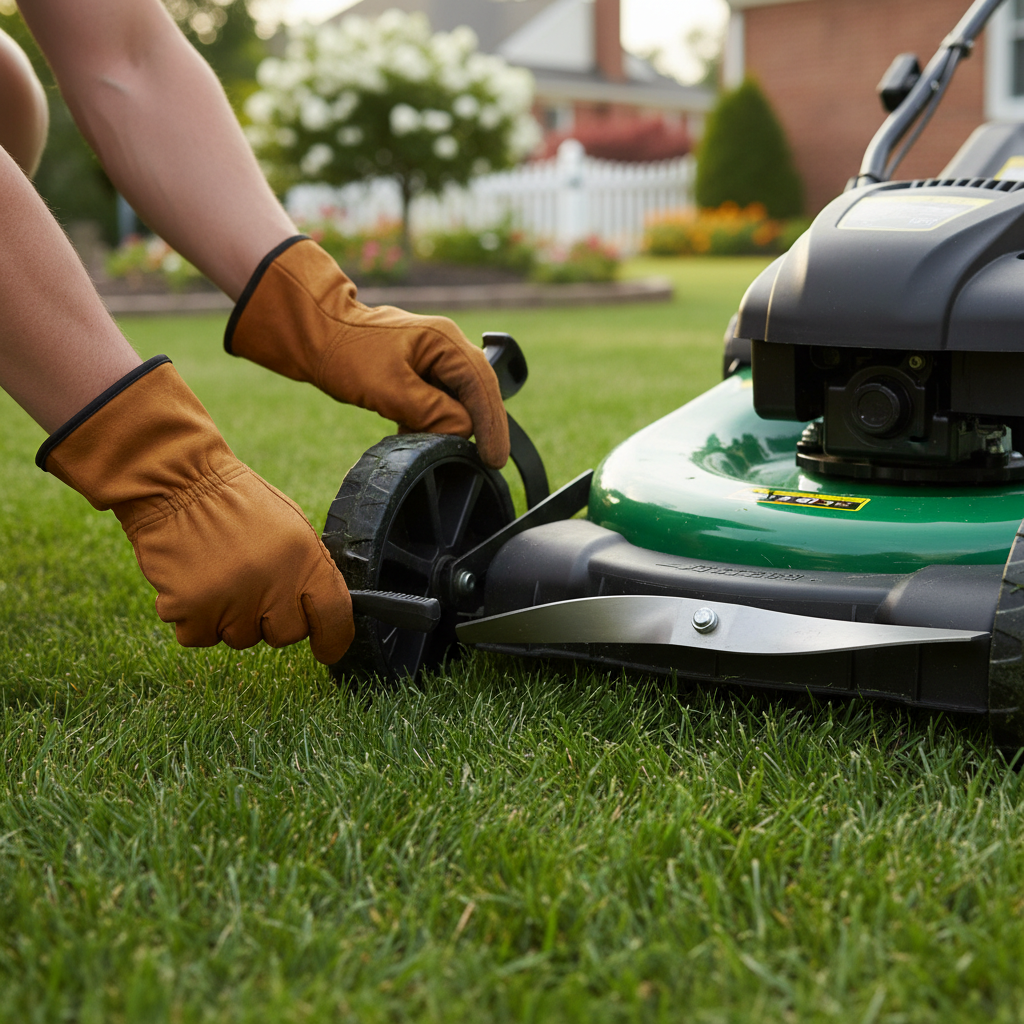
- Tools: You'll need a wrench to remove the blade, a file, grinder, or blade sharpening kit, and a blade balancer to ensure even weight distribution after sharpening.
- Remove Blade: Use a wrench to unbolt the blade from the mower deck. Note the direction of the blade's rotation and which side faces down.
- Sharpen: Use a metal file, bench grinder, or rotary tool with a grinding stone to sharpen the cutting edge at the original angle. Work slowly and evenly. The goal is a clean, sharp edge, not a razor edge.
- Reinstall: Reattach the sharpened and balanced blade, ensuring it's oriented correctly, and tighten the bolt securely. Reconnect the spark plug wire.
- Pro Tip: Consider having a spare sharpened blade on hand so you can easily swap it out when one gets dull, then sharpen the dull one at your convenience.
Landscaping · Deck or fence project
| Project category | Landscaping |
|---|---|
| Problem type | Deck or fence project |
| Trade required | Landscaping |
| Urgency | Planned project |
| Safety risk | Moderate safety risk |
| DIY suitability | DIY for experienced homeowners |
| Cost category | High cost |
| Typical timeline | Most builds 3–10 days depending on size |
| Contractor type | Landscaping contractor |
Repair option
Replace failed boards, posts, and hardware; reseal the surface.
Replacement option
Rebuild when framing or the ledger connection is unsafe.
Common causes
- Rot at posts and ledger
- Storm damage
- Adding outdoor living space
Relevant tools:home improvement material pricesproject cost estimator
Published May 28, 2026Last updated August 17, 2026
Tools & materials you'll need
Affiliate links- AmazonBlock of wood (for stability)
As an Amazon Associate FixlyGuide earns from qualifying purchases — at no extra cost to you. Prices and availability are accurate as of publication and subject to change.
Quick Answer
Achieving a healthier lawn through proper mowing involves three key adjustments: cutting at the correct height (typically 2.5-3 inches for most cool-season grasses), sharpening your mower blade regularly to prevent tearing, and varying your mowing pattern each time. These practices reduce stress on the grass, encourage deeper root growth, and prevent soil compaction. Neglecting these seemingly minor details can lead to a host of problems, from increased weed growth to fungal diseases, ultimately undermining your efforts for a lush, green yard.
The Problem
Every homeowner dreams of a vibrant, healthy lawn, but many unknowingly contribute to its decline through improper mowing techniques. The problem isn't just about making the grass shorter; it's about how it's shortened. Cutting too much at once, using a dull blade, or even repeating the same mowing pattern can severely stress your grass, making it susceptible to disease, pests, and drought. This leads to a thin, patchy lawn that struggles to compete with weeds and doesn't hold its color. You might find yourself fertilizing more, watering more, and still battling an unhealthy-looking yard, all because the foundational practice of mowing is working against you.
How It Works
Grass plants, like all plants, operate on a principle of photosynthesis, converting sunlight into energy through their leaves. When you mow, you are essentially trimming these energy producers. The way you do this significantly impacts the plant's ability to recover and thrive. Each blade of grass has a growth point, or meristem, near its base. When you cut too short, you remove too much of the photosynthetic surface, forcing the plant to use its stored energy to regrow leaves rather than expand its root system or tiller (produce new shoots). This weakens the plant, making it less resilient to environmental stresses.
Furthermore, a sharp mower blade makes a clean cut, allowing the grass to heal quickly. A dull blade, however, tears the grass blades, leaving ragged edges that are open wounds. These tears not only make the grass look brown and frayed at the tips but also provide entry points for diseases and pests. It's akin to having a clean surgical incision versus a jagged tear – one heals cleanly, the other invites infection. The tearing also requires more energy from the plant to repair, diverting resources from growth.
Finally, repeatedly mowing in the same direction compacts the soil in those consistent wheel ruts. Soil compaction reduces the air pockets in the soil, hindering water infiltration and nutrient absorption. Grass roots need oxygen to respire and absorb water and nutrients efficiently. When air is squeezed out of the soil, roots suffer, leading to shallow root systems and a weaker, less drought-tolerant lawn. Varying patterns distribute the compaction pressure, allowing the soil to remain healthier and more porous, which in turn supports a more robust root system.
Step-by-Step Fix
Here's how to correct common mowing mistakes and cultivate a healthier, more resilient lawn:
1. Set the Right Mowing Height – Follow the One-Third Rule
Never remove more than one-third of the grass blade's total height in a single mowing session. For most cool-season grasses (like fescue, rye, bluegrass), an ideal cutting height is between 2.5 and 3 inches. For warm-season grasses (like Bermuda, zoysia, St. Augustine), it can range from 1 to 2.5 inches, depending on the specific varietal. Taller grass shades the soil, reducing weed germination and retaining moisture, which means less watering for you. To determine your ideal cut height, measure your grass before mowing. If it's 4.5 inches tall, you'd set your mower to cut no lower than 3 inches.
- To Adjust Mower Height: Consult your mower's manual. Most walk-behind mowers have a lever or separate levers near each wheel to raise or lower the deck. Generally, push the lever forward or down to lower, and pull up or back to raise. Some have a single lever that adjusts all four wheels simultaneously. Always adjust on a flat, level surface with the engine off.
- If Grass is Too Long: If your grass has grown excessively tall (e.g., you've been on vacation), make multiple passes over a few days, gradually reducing the height until you reach the desired length. Trying to cut too much at once will stress the mower and the grass.
- Safety First: Always turn off the mower and disconnect the spark plug wire before making any adjustments to prevent accidental starts.
2. Sharpen Your Mower Blade Regularly – Ensure a Clean Cut
Inspect your mower blade every 10-12 hours of use, or at least once per season. A sharp blade makes a clean incision, helping the grass recover quickly. A dull blade tears the grass, leaving ragged ends that turn brown and are vulnerable to disease. You can visually inspect the grass tips after mowing; if they look frayed or discolored, your blade is likely dull.
- Tools: You'll need a wrench to remove the blade, a file, grinder, or blade sharpening kit, and a blade balancer to ensure even weight distribution after sharpening.
- Steps:
- Safety: Disconnect the spark plug wire and wear heavy-duty gloves. If your mower has a fuel tank, tilt the mower so the carburetor is facing up to prevent fuel leaks. For most walk-behind mowers, this means tilting the mower onto its side with the air filter facing up.
- Remove Blade: Use a wrench to unbolt the blade from the mower deck. Note the direction of the blade's rotation and which side faces down.
- Sharpen: Use a metal file, bench grinder, or rotary tool with a grinding stone to sharpen the cutting edge at the original angle. Work slowly and evenly. The goal is a clean, sharp edge, not a razor edge.
- Balance: After sharpening, use a blade balancer. If one side is heavier, it will dip. Grind a small amount of metal from the heavier side until the blade hangs level. An unbalanced blade causes excessive vibration, which can damage your mower and lead to uneven cutting.
- Reinstall: Reattach the sharpened and balanced blade, ensuring it's oriented correctly, and tighten the bolt securely. Reconnect the spark plug wire.
- Pro Tip: Consider having a spare sharpened blade on hand so you can easily swap it out when one gets dull, then sharpen the dull one at your convenience.
3. Vary Your Mowing Pattern – Prevent Soil Compaction
Instead of mowing in the same direction every time, rotate your pattern. For example, if you mowed north-south last week, mow east-west this week. The next week, try diagonal passes, and then perhaps an alternating pattern of striping. This simple change distributes the weight of your mower evenly across the lawn, preventing repetitive soil compaction in the same tracks. It also encourages grass blades to grow more upright, leading to a fuller appearance, and helps prevent rutting in the lawn.
- Benefits: Reduces soil compaction, promotes upright growth, prevents rutting, creates a more aesthetically pleasing lawn with varied striping patterns.
- Simple Rotation: The easiest way to vary is to alternate between mowing parallel to the longest edge one week, and perpendicular to it the next. Then, for the third week, try diagonal passes. There's no single
Related Articles
Keep troubleshooting with these hand-picked guides from FixlyGuide:
- The #1 Mowing Mistake That Invites Weeds (And How to Fix It in 10 Minutes) — Discover the most common mowing mistake homeowners make that inadvertently encourages weeds, and learn easy steps to achieve a healthier, m…
- The #1 Mowing Mistake That Invites Weeds (And How to Fix It in 5 Minutes) — Discover the most common mowing error homeowners make that inadvertently encourages weed growth, and learn a simple fix for a healthier law…
- The 3 Lawn Mowing Mistakes Killing Your Grass (and How to Fix Them) — Discover the three most common lawn mowing mistakes homeowners make that damage their grass, and learn simple, actionable steps to correct…
- The #1 Mowing Mistake That Leaves Your Lawn Brown and Patchy — Discover the most common mowing mistake homeowners make that leads to unhealthy, patchy grass and how to fix it for a vibrant lawn.
- The #1 Mowing Mistake That Starves Your Lawn (And How to Fix It in Minutes) — Learn the surprising reason your lawn might be struggling despite regular mowing and how a simple adjustment can lead to healthier, more vi…
- The 7 Mistakes First-Time DIYers Make When Installing a Kitchen Backsplash — Learn the common pitfalls and smart solutions for installing a kitchen backsplash, transforming your space with confidence and avoiding cos…
Should you do this yourself?
Answer five quick questions before you start. Safety outranks savings every time.
Your experience with work like this
How high do you have to work?
Does the job involve any of these?
Will it need a permit?
Specialty tools
Free and instant. Educational guidance only — not a quote, inspection, or professional diagnosis.
What should this project cost?
Enter your project details for a realistic cost range before you call anyone.
Cost depends heavily on which system turns out to be the source.
- Regional adjustment
- National average
- Labor share (typical)
- ~$1,620
- Quotes to collect
- 3 written estimates
Educational estimate based on national averages — not a binding quote. Always confirm with written local estimates.
Before you start
Check the difficulty, permits, and safety risk — then decide whether to call a pro.
- Estimate this projectGet a cost range for your scope and ZIP before you call anyone.Open
- Get local estimatesSend one request and compare written estimates from vetted pros.Open
Free, no signup required. Estimates are educational guidance, not a quote or an inspection.
Get the print-ready PDF of this guide
A clean, ad-free, printable version you can keep on your phone or pin to the workshop wall. Free with a FixlyGuide account.
- Print-optimized layout
- Tools, materials & every step included
- Saved to your account
Frequently asked questions
How often should I sharpen my mower blade?+
You should sharpen your mower blade after every 10-12 hours of use, or at least once per mowing season. If you notice your grass tips are frayed or brown after mowing, it's a clear sign your blade needs sharpening.
What is the 'one-third rule' for mowing?+
The one-third rule states you should never remove more than one-third of the grass blade's total height in a single mowing session. For example, if your grass is 4.5 inches tall, you should set your mower to cut no lower than 3 inches.
Why should I vary my mowing pattern?+
Varying your mowing pattern prevents repetitive soil compaction in the same tracks, which can lead to rutting and inhibit root growth. It also encourages grass blades to grow more upright and contributes to a more uniform, healthier lawn aesthetic.
What is the best height to cut my grass?+
The ideal cutting height varies by grass type. For most cool-season grasses (fescue, rye, bluegrass), aim for 2.5 to 3 inches. For warm-season grasses (Bermuda, zoysia, St. Augustine), consult local recommendations, but it's typically between 1 to 2.5 inches. Taller grass promotes deeper roots and better weed suppression.
Should I leave grass clippings on the lawn?+
Yes, leaving short grass clippings on the lawn (often called 'mulching') is beneficial. They break down quickly, returning valuable nutrients and organic matter to the soil. As long as the clippings are not clumpy and do not smother the grass beneath, they act as a natural fertilizer and improve soil health. Avoid leaving large clumps, which can smother grass.
Discussion
Loading comments…