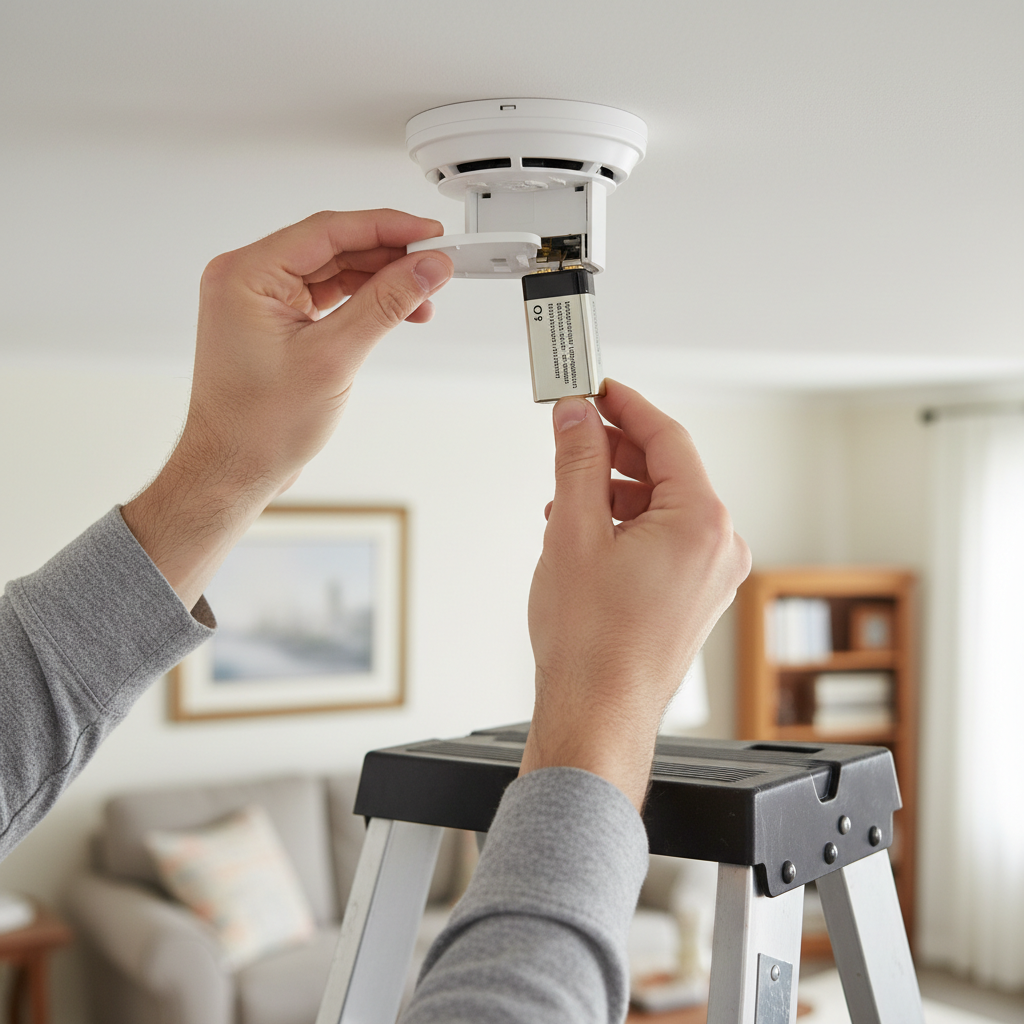
- Tools: Step ladder, fresh 9-volt, AA, or AAA batteries (check your specific model).
- Safety: Use a solid ladder. No wobbly chairs, no leaning way out there.
- If it still chirps: If you’ve got a fresh battery in there and it’s still chirping, keep going.
Electrical · Panel or service upgrade
| Project category | Electrical |
|---|---|
| Problem type | Panel or service upgrade |
| Trade required | Electrical |
| Urgency | Planned project |
| Safety risk | High safety risk |
| DIY suitability | Licensed pro only |
| Cost category | High cost |
| Typical timeline | Permit plus utility scheduling, commonly 2–6 weeks |
| Contractor type | Licensed electrician |
Repair option
Add a subpanel when the main service is adequate.
Replacement option
Full service upgrade with utility coordination and permits.
Common causes
- Obsolete or recalled panel brands
- Service capacity too small for added loads
- No room for required AFCI/GFCI breakers
Relevant tools:project cost estimatorcompare quotes
Published July 29, 2026Last updated August 17, 2026
Tools & materials you'll need
Affiliate linksAs an Amazon Associate FixlyGuide earns from qualifying purchases — at no extra cost to you. Prices and availability are accurate as of publication and subject to change.
Quick Answer
That steady chirping from your smoke detector — the one that goes off about every 30 to 60 seconds — is almost always the battery telling you it’s on its last legs. I’ve heard that sound more times than I can count, and nine times out of ten, that’s all it is. But if you’ve already put in a fresh battery and the little gremlin keeps chirping, don’t toss the detector yet. Could be dust in the sensor, could be the unit’s just plain old, or on a hardwired one it might be a power hiccup. We’ll figure out which one it is and get it to shut up.
The Problem
You’re trying to watch TV, read, or get some sleep, and chirp. Thirty seconds later, chirp again. Makes you want to take the thing down and send it flying, doesn’t it? But that sound isn’t there just to annoy you. It’s your smoke detector trying to tell you something matters.
Most of the time, it’s begging for a new battery. That battery does more than keep the chirp away — it keeps the detector alive when the power’s out, and more important than that, it helps protect your house.
Ignore the chirp long enough and you might end up with a detector that won’t go off when you actually need it. That’s no joke. I’ve been on job sites where folks ignored the warning for weeks, then found out they had a dead unit after a small kitchen fire. They got lucky. Real lucky. Most people wait too long, sometimes months, before they deal with it. Don’t be that guy.
How It Works
Smoke detectors are simple little gadgets, but they’re lifesavers. You’ll usually run into two types in a house: ionization and photoelectric.
Ionization smoke detectors use two charged plates with a tiny radioactive source between them. That creates an ionization current. When smoke gets in there, it messes with the current and trips the alarm. These are usually better on fast-flaming fires.
Photoelectric detectors work a different way. They’ve got a light source and a sensor. Under normal conditions, the light shoots straight past the sensor. Smoke enters, scatters the light, and some of it hits the sensor — then the alarm goes off. These tend to catch slow, smoldering fires better.
Some newer units combine both systems. Smart move, honestly.
All battery-powered smoke detectors, and hardwired ones with battery backup, rely on a small 9-volt or AA/AAA battery to keep working, especially if the power goes out. Once that battery drops below a certain voltage — usually around 7.5 volts for a 9V battery — the detector notices and starts that miserable chirping every 30 to 60 seconds.
Hardwired units pull their main power from your home’s electrical system, usually on a dedicated circuit. But they still have a backup battery, and that’s the part that usually chirps when it gets weak.
And there’s one more thing: smoke detectors have a built-in end-of-life warning. By law, they usually start doing that after 7 to 10 years from the manufacturing date. Fresh battery or not, they’ll chirp to let you know they’re done. Time to swap them out. That’s not a nuisance feature — that’s a safety feature.
Step-by-Step Fix
1. Identify the Chirper — _Finding the offending unit is step one, and sometimes it's tougher than you'd think.
_ If you’ve got more than one detector, that chirp can bounce around and fool you. Stand right under one unit and listen. If it’s not that one, move to the next. Sometimes you’ll need a second set of ears from down the hall or at the bottom of the stairs. Don’t forget the odd spots either — basement, garage, that spare bedroom nobody uses.
2. Check the Breaker — _For hardwired units, a tripped breaker can sometimes cause odd behavior, including chirping.
_ Before you start pulling the detector down, go to your electrical panel. Look for a breaker sitting halfway between ON and OFF. That’s the one that’s tripped. Flip it all the way OFF, then back ON. Gives the circuit a clean reset. If the panel looks fine, keep moving.
3. Replace the Battery — _This is the most common fix, so always start here, even if you think you just changed it.
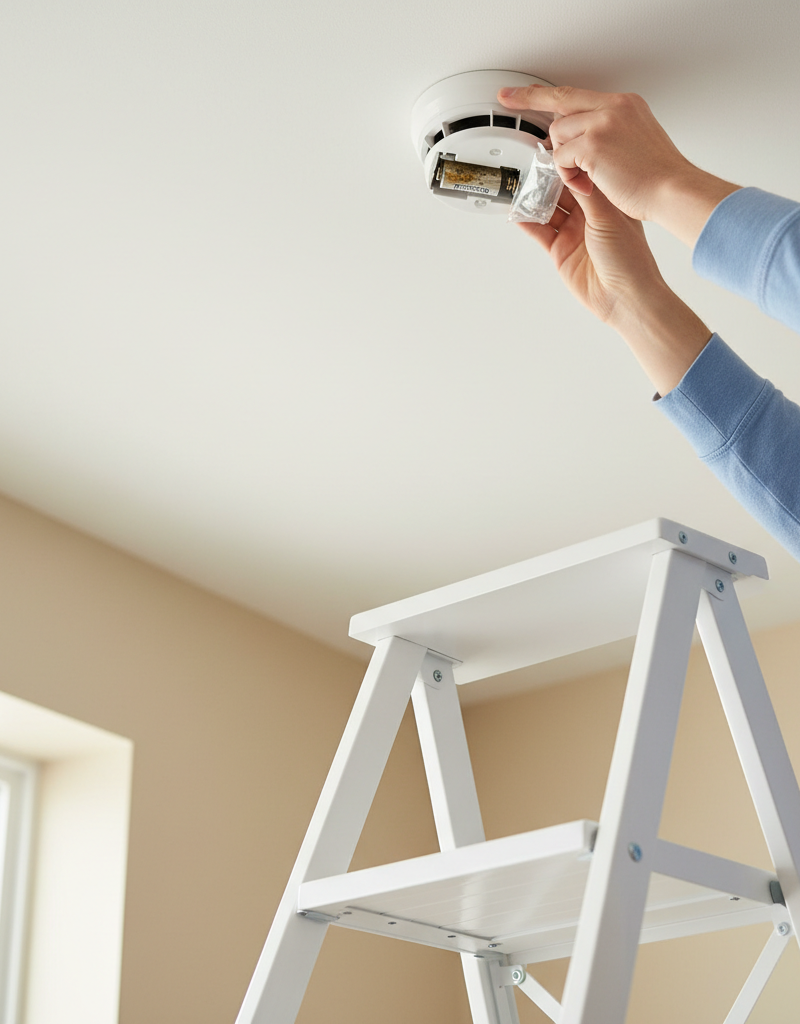
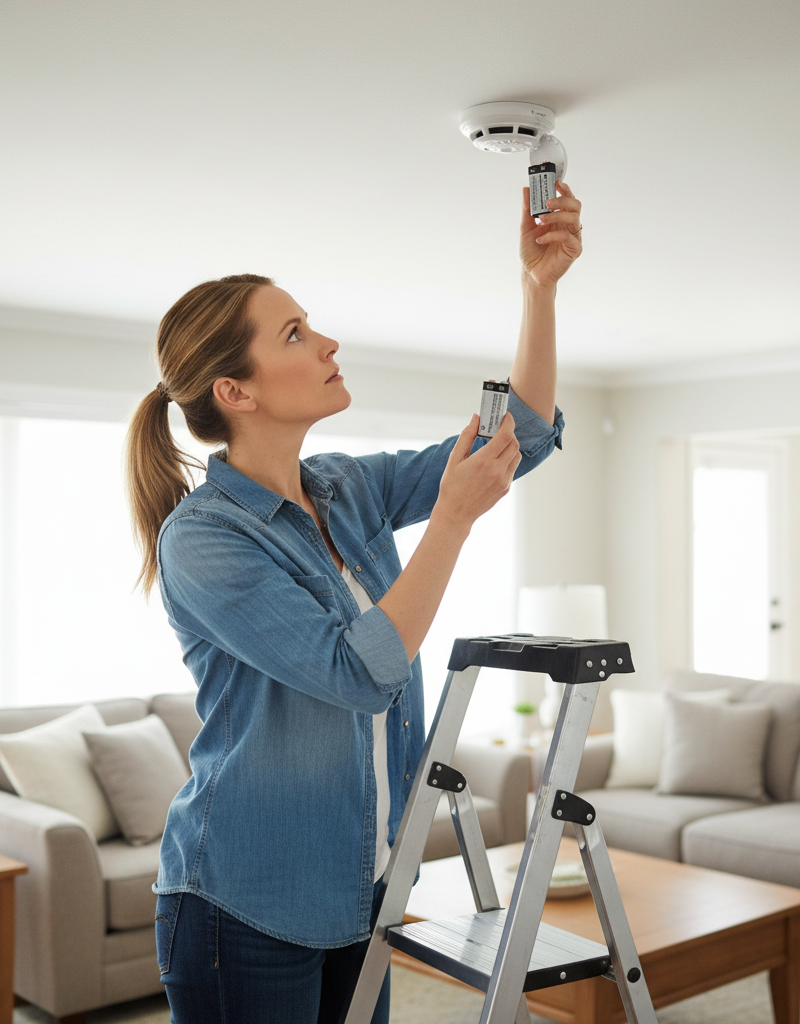
_ Most detectors use a standard 9-volt battery, though newer ones might take AA or AAA. Open the battery compartment — usually a little sliding door or a tab you press. Pull the old battery out. Then wait about 10-15 seconds before you drop the new one in. That pause lets the internal capacitors discharge, and sometimes that’s enough to clear a stubborn chirp.
Make sure the + and - ends line up right. Shut the cover all the way. Some models make you twist the detector off the base just to get to the battery, which is a little annoying, but that’s how they built it.
- Tools: Step ladder, fresh 9-volt, AA, or AAA batteries (check your specific model).
- Safety: Use a solid ladder. No wobbly chairs, no leaning way out there.
- If it still chirps: If you’ve got a fresh battery in there and it’s still chirping, keep going.
4. Press the Test Button — _After a new battery, test the unit to ensure it's functioning correctly and to reset its internal circuitry.
_ Hold the test button down for a few seconds. You should get a loud alarm. That also helps clear any leftover charge or reset the low-battery warning. Good habit to test all your smoke detectors once a month anyway — takes a minute, saves a headache.
5. Clean the Detector — _Dust and debris can accumulate inside the sensing chamber, causing false chirps or alarms.
_ Twist the detector off its mounting base carefully. Take it outside or somewhere with good air flow. Use a can of compressed air and blow out the vents and sensor chamber. Don’t grab a vacuum — static can mess with the electronics. Don’t spray any liquids in there either. Just hit it with air for 15-20 seconds.
I pulled a detector down in Frisco last month that had exactly this problem. Homeowner swore the thing was bad. Turns out the return vent was blowing dust right into it, and that was the whole story. Cleaned it out, reinstalled it, done.
- Tools: Can of compressed air, step ladder.
- Safety: Don’t open the sealed internal parts. Stick to the outside vents only.
6. Check the Manufacture Date — _Smoke detectors aren't forever; they have an expiration date, usually 7-10 years.
_ Look on the back or side of the unit for a
Related Articles
Keep troubleshooting with these hand-picked guides from FixlyGuide:
- Is Your Smoke Detector Lying? The #1 Mistake Homeowners Make — Discover the crucial mistake most homeowners make with their smoke detectors and how to ensure your alarms are always ready to protect your…
- The Hidden Reason Your Ceiling Fan Wobbles (And 3 Cheap Fixes) — A wobbling ceiling fan isn’t just annoying; it can be a sign of imbalance or loose connections that are simple to fix with the right approa…
- The Hidden Reason Your Circuit Breaker Keeps Tripping (It's Not Always an Overload) — Discover the often-overlooked culprits behind a frequently tripping circuit breaker and learn how to diagnose and fix the most common issue…
- Why Does My Extension Cord Keep Tripping the Breaker? (It's Not Always Overload) — An extension cord repeatedly tripping a circuit breaker indicates a serious electrical issue that homeowners need to diagnose and resolve s…
- The #1 Mistake Homeowners Make When Their Range Hood Fan Stops Humming — Before you call an electrician, check the simplest — and most overlooked — cause for a dead range hood fan: a tripped circuit breaker or a…
- The Hidden Reason Your GFCI Trips (It's Not Always a Faulty Outlet) — A continuously tripping GFCI outlet is a critical safety warning, often indicating moisture, a faulty appliance, or a wiring problem that r…
Should you do this yourself?
Answer five quick questions before you start. Safety outranks savings every time.
Your experience with work like this
How high do you have to work?
Does the job involve any of these?
Will it need a permit?
Specialty tools
Free and instant. Educational guidance only — not a quote, inspection, or professional diagnosis.
What should this project cost?
Enter your project details for a realistic cost range before you call anyone.
Outlet and switch work usually $150–$400; panel upgrades commonly $1,800–$4,200.
- Regional adjustment
- National average
- Labor share (typical)
- ~$709
- Quotes to collect
- 3 written estimates
Educational estimate based on national averages — not a binding quote. Always confirm with written local estimates.
Before you start
Check the difficulty, permits, and safety risk — then decide whether to call a pro.
- Estimate this projectGet a cost range for your scope and ZIP before you call anyone.Open
- Get local estimatesSend one request and compare written estimates from vetted pros.Open
Free, no signup required. Estimates are educational guidance, not a quote or an inspection.
Frequently asked questions
How often should I change my smoke detector batteries?+
You should replace your smoke detector batteries at least once a year, even if they haven't started chirping yet. A good practice is to do it when you change your clocks for daylight saving time. Hardwired units also have backup batteries that need annual checks.
What if my smoke detector keeps chirping after I change the battery?+
If the chirp persists after a fresh battery, first ensure the battery is installed correctly and is indeed new. Then, try cleaning the detector with compressed air to remove dust. If it still chirps, check the manufacture date – the unit might be at its end of life (7-10 years).
How long do smoke detectors last?+
Most smoke detectors have a lifespan of 7 to 10 years from their manufacture date. After this period, their sensing capabilities can degrade, and they are required by law to be replaced. Check the date on the back of your unit.
Can dust cause a smoke detector to chirp?+
Yes, absolutely. Dust, cobwebs, or even small insects can accumulate inside the sensing chamber of a smoke detector, which can interfere with its operation and cause nuisance chirps or false alarms. Cleaning with compressed air often resolves this.
Is it dangerous if my smoke detector is chirping?+
A chirping smoke detector is not immediately dangerous, but it's a critical warning that something is wrong. Most often, it's a low battery, meaning the unit might not function during a power outage or a fire, leaving your home unprotected. Address the chirp promptly.
Why would a hardwired smoke detector chirp?+
Hardwired smoke detectors have a battery backup, which is usually a 9-volt battery. When this backup battery is low, the hardwired unit will chirp, even though it's still receiving main power. Replace the battery just as you would for a battery-only unit.
How do I know if my smoke detector is a carbon monoxide detector too?+
Many modern detectors are combination units. Look for explicit labeling on the front or back of the unit that says "Smoke and Carbon Monoxide Alarm" or has both symbols. If it only mentions "Smoke Alarm," it doesn't detect CO.
What's the difference between a chirp and an alarm?+
A chirp is a short, distinct sound, usually occurring every 30-60 seconds, indicating a low battery, end-of-life, or a malfunction. An alarm is a continuous, loud siren, designed to alert occupants to the presence of smoke or carbon monoxide, requiring immediate action.

Discussion
Loading comments…