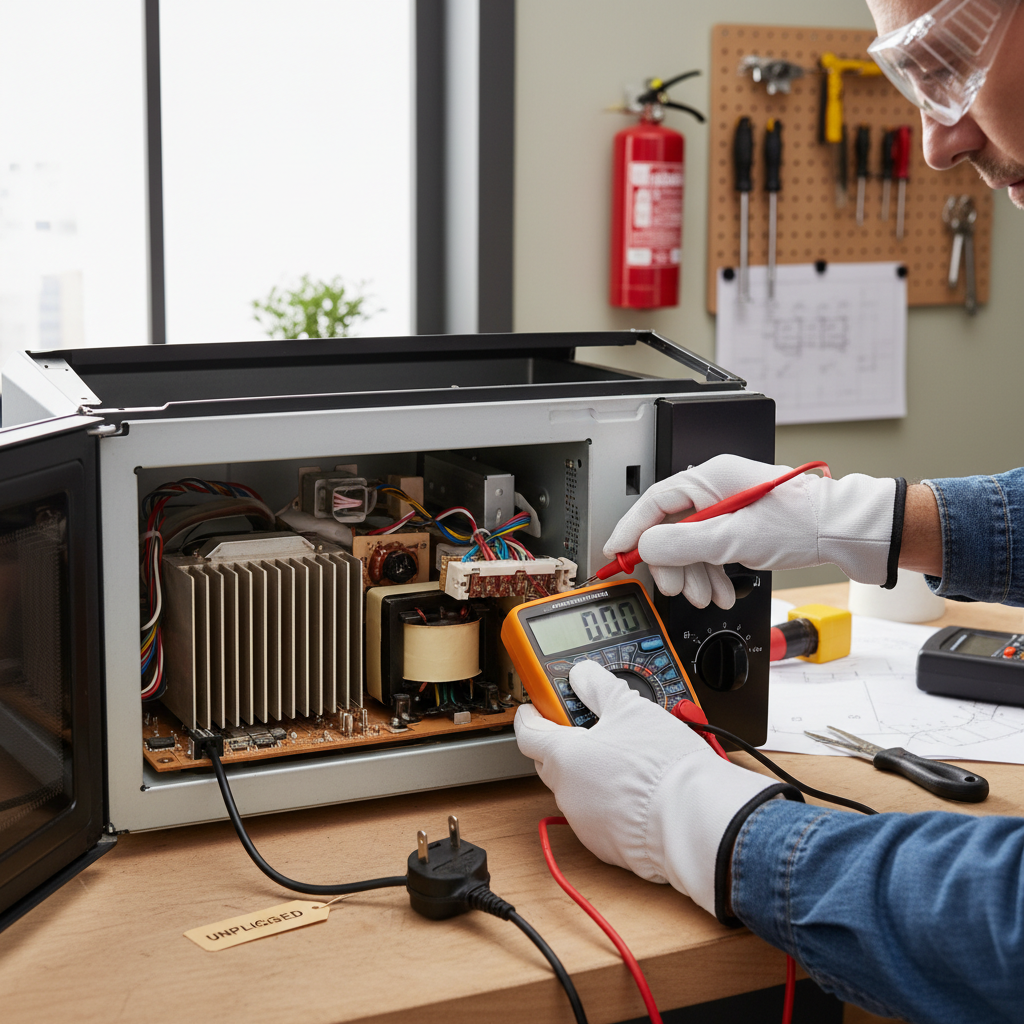
- Locate and Test the Internal Fuse — The sacrificial lamb.
- Remove the outer casing. Usually that means a handful of Phillips head screws on the back and sides. Snap pictures as you go — trust me, that makes reassembly a whole lot less miserable.
- Warning: A blown fuse is often a symptom, not the root problem. If you swap it and it blows again, you've got a deeper issue — maybe a failing magnetron or high-voltage capacitor — and that territory belongs to a pro.
Electrical · Breaker keeps tripping
| Project category | Electrical |
|---|---|
| Problem type | Breaker keeps tripping |
| Trade required | Electrical |
| Urgency | Urgent — within days |
| Safety risk | High safety risk |
| DIY suitability | Pro recommended |
| Cost category | Low cost |
| Typical timeline | Diagnosis in a single visit |
| Contractor type | Licensed electrician |
Repair option
Isolate the load, then repair the fault or replace the breaker.
Replacement option
New dedicated circuit when the load simply exceeds what the circuit was built for.
Common causes
- Genuine overload on a shared circuit
- Ground fault from moisture in an exterior box
- Failing breaker or a damaged appliance cord
Relevant tools:diy or hire a prodiy difficulty
Published September 22, 2026Last updated September 22, 2026
Tools & materials you'll need
Affiliate linksAs an Amazon Associate FixlyGuide earns from qualifying purchases — at no extra cost to you. Prices and availability are accurate as of publication and subject to change.
Quick Answer
Alright, so your microwave's gone dead — no lights, no hum, nothing. And you already checked the breaker, and it ain't tripped. So what gives? Most of the time, you're looking at a blown internal fuse, a door safety switch that's acting up, or maybe a dead outlet. Don't panic. I've chased this exact problem more times than I can count. You can usually narrow it down and sometimes fix it yourself, but safety comes first. Unplug the thing before you even think about opening it up.
The Problem
Picture this: you slide leftovers into the microwave, punch in the time, and… nothing. Blank screen. Silent as a tomb. No power at all. You hustle to the breaker panel, check the switch, maybe flip it off and on just to be sure. Still nothing. You're not the first person to run into it, and you won't be the last. Folks call me with this exact issue all the time. It's maddening, especially when you're hungry, but it usually turns out to be a pretty simple fix once you know where to start poking around. Most times, it doesn't mean the whole unit's toast — not right away, anyway.
How It Works
So how does a microwave even wake up? It ain't magic. It's a chain of power and safety checks, plain and simple. When you plug that sucker in, electricity runs from the wall outlet, through the cord, and into the microwave's main power board. But before it can light the display or spin the magnetron, it has to get past a few gatekeepers.
First up, there's usually a main fuse — small glass or ceramic tube, wire inside — and it's normally sitting near where the power cord comes into the unit or on the main control board. Its job is to blow if there's a surge or short, basically sacrificing itself so the expensive stuff doesn't get smoked. No fuse, no power downstream. Period.
Then you've got the door interlock switches. Most microwaves have two or three of them. They're safety switches that keep the microwave from running with the door open. If even one of those switches fails or gets stuck, the microwave thinks the door's open even when it isn't. And if it thinks the door's open, it won't power on at all. That's by design — keeps those waves locked inside where they belong. These are small spring-loaded switches that get pressed when the door closes. They complete the circuit and tell the machine it's safe to run. If that circuit's broken, you're dead in the water.
Finally, the control board takes that incoming power and sends it where it needs to go — display, transformer, magnetron, all the usual suspects. If any part of that first-stage power path — outlet, cord, fuse, or interlock switches — isn't doing its job, you'll get a totally dead microwave. No lights. No sounds. No action. It's annoying, sure, but the logic behind it is pretty straightforward.
Step-by-Step Fix
Alright, let's get your microwave back in the game. We're dealing with electricity here, even if the unit's unplugged. Keep your head on straight, follow the steps, and if anything feels sketchy, call a pro. I mean that. I pulled a microwave apart for a homeowner in Sandy Springs last year who swore he'd unplugged it, and the thing was still energized. Always check twice.
-
Check the Outlet & Cord — The first suspect.
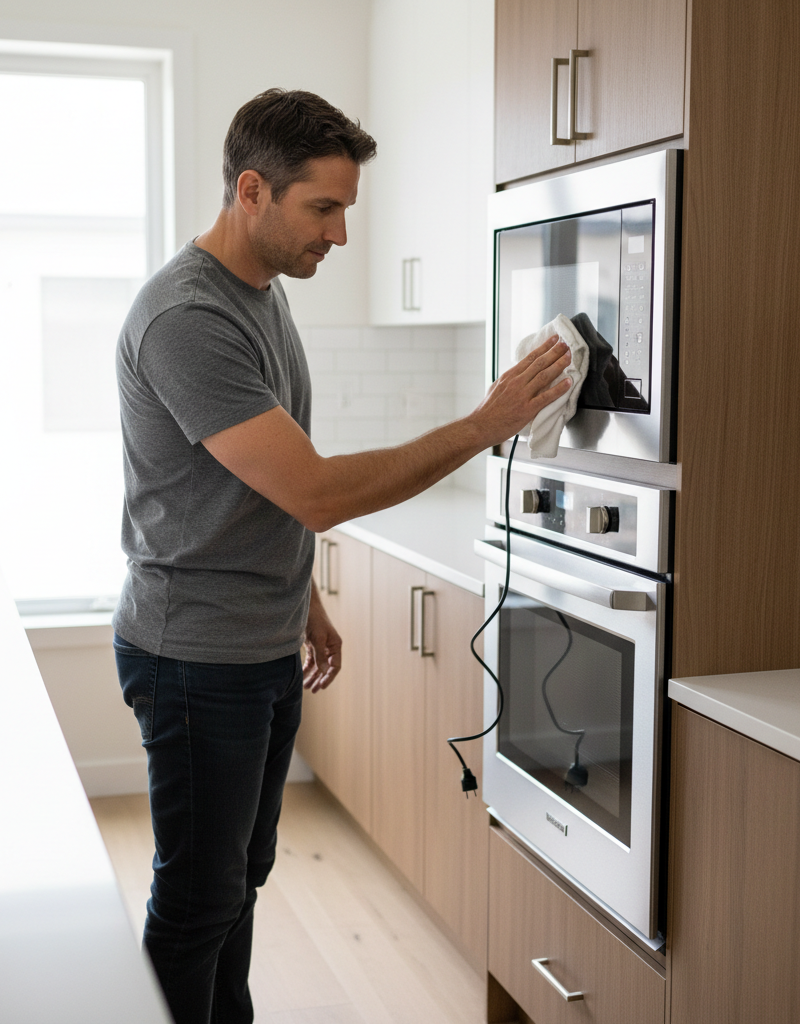
- Unplug the microwave. Seriously. Don't skip that part.
- Plug another appliance into the same outlet. A lamp, a hairdryer, whatever you've got that you know works. If that appliance doesn't come on, there's your issue: dead outlet. Check the breaker panel for a tripped breaker feeding that specific outlet or a GFCI upstream that might've popped. Reset any GFCIs — those outlets with the "TEST" and "RESET" buttons — in the kitchen or nearby bathrooms.
- If the other appliance does work, the outlet's fine. Now take a look at the microwave's power cord for visible damage — frayed wires, scorch marks, ugly kinks. If you see anything like that, stop right there and call a pro. A damaged cord is a fire hazard, plain and simple.
-
Locate and Test the Internal Fuse — The sacrificial lamb.
- Unplug the microwave again, even if you just had it plugged in to test the outlet. Give it at least 5 minutes before you crack it open. Microwaves can hold a nasty charge in the capacitor even when they're unplugged. I'm talking real jolt potential.
- Remove the outer casing. Usually that means a handful of Phillips head screws on the back and sides. Snap pictures as you go — trust me, that makes reassembly a whole lot less miserable.
- Find the main fuse. It's often a glass tube fuse, about 1.25 inches long, usually sitting in a plastic holder or clipped right to the main power board near where the cord comes in. You'll usually see it rated around 15-20 amps, and it might be marked "F1" or "Line Fuse."
- Visually inspect the fuse. See a broken wire inside the glass tube? Then it's blown. If it looks intact, you'll need a multimeter set to continuity or ohms (resistance) mode. A good fuse will show continuity — a beep or near-zero resistance. A bad one will show no continuity at all — infinite resistance or "OL."
- Replacement Fuse: If it's blown, replace it with an identical fuse — same amperage, same voltage rating, same type. Don't get cute and throw in a higher-rated fuse; that's asking for trouble. You can usually find these at hardware stores or online for a few bucks.
- Warning: A blown fuse is often a symptom, not the root problem. If you swap it and it blows again, you've got a deeper issue — maybe a failing magnetron or high-voltage capacitor — and that territory belongs to a pro.
-
Inspect the Door Interlock Switches — The silent gatekeepers.
- With the microwave still unplugged and discharged (that 5-minute wait after unplugging), find the door switches. Usually there are two or three, tucked behind the plastic bezel around the door frame once the outer case is off.
- Look for physical damage. Any switch look broken, bent, or out of place? Sometimes a plastic tab on the door snaps off and won't let the switch engage right.
- Test for continuity. Disconnect the wires from each switch, and keep track of which wire goes where. Use your multimeter on continuity mode. When the switch button is pressed down — like the door's closed — one type of switch (normally open) should show continuity. When it's released, it shouldn't. The other type (normally closed) works the opposite way. A bad switch won't change state or won't show continuity when it should.
- If a switch is bad, replace it. These parts are usually cheap enough, but they do need to match your microwave model. Take a picture of the part number, or the switch itself, before you order. Saves headaches.
-
Reassemble and Test — The moment of truth.
- Put every wire back where it belongs, and make sure the connections are snug. Reinstall the outer casing and get all the screws back in place.
- Plug the microwave back into the wall outlet. If you found the problem, the display should light up and you'll hear that familiar hum. Test it with a cup of water for 30 seconds to see if it heats.
- If it still won't power on, or if the new fuse blows right away, it's time to call in the cavalry. That usually points to a high-voltage component failure, and that's dangerous work best left to licensed appliance repair techs.
Common Causes
- Blown Fuse: Number one on the list. Usually happens after a power surge, an internal short, or just plain old age.
- Faulty Door Interlock Switches: These switches get worked every single time you open and close the door. They wear out, get sticky, or just quit.
- Dead Outlet/Tripped Breaker (not reset): Sometimes the microwave's fine and the power source isn't. Don't assume the breaker fixed itself — test the outlet.
- Loose Power Cord Connection: Not as common, but the cord connection at the internal terminal block can loosen up over time, especially after years of vibration.
- Control Board Failure: The brain can die, too. That's tougher to diagnose without special tools, and a lot of times it means replacing the microwave because boards aren't cheap.
Common Mistakes
- Assuming the Breaker is Fine Without Testing the Outlet: I've lost count of how many times I've shown up and the homeowner swore the breaker was good, but the outlet was dead. Test it with another appliance.
- Not Unplugging the Microwave (or waiting long enough): This one's serious. Microwave capacitors can hold thousands of volts even when the unit's unplugged. Always unplug it and wait at least 5 minutes, preferably 15-30, for them to bleed down.
- Using the Wrong Replacement Fuse: Sticking in a fuse with a higher amperage rating is a bad move and can lead to fire or major damage inside the unit. Match the original specs exactly.
- Ignoring the Underlying Cause of a Blown Fuse: If you replace a fuse and it pops again right away, don't just keep feeding it fuses. There's a short or failing part in there that needs professional attention.
- Prying with Too Much Force: Plastic gets brittle, especially on older microwaves. Take it easy when pulling covers or disconnecting wires so you don't snap clips or tabs.
Cost & Time Breakdown
Here
Related Articles
Keep troubleshooting with these hand-picked guides from FixlyGuide:
- The Annoying Drip: Why Your Refrigerator's Leaking Water (and the 10-Minute Fix) — Don't let a leaky refrigerator ruin your floor! Discover the common culprits behind water leaks and how you can fix most of them in just 10…
- The Mystery of the Cold Oven: Is It Your Power or a $15 Part? — Don't rush to replace your oven when it won't turn on; many common power issues or a simple, inexpensive thermal fuse might be the real cul…
- The Button Blocker: Why Your Microwave Panel Goes Dead (and the Easy Fix) — Don't rush to replace your microwave just because the buttons aren't responding; it's often a simple, DIY-friendly fix.
- The Annoying Hum: The Real Reason Your Fridge Vibrates (And How to Silence It) — Is your refrigerator buzzing or vibrating loudly? Don't ignore that annoying hum. This guide uncovers the common culprits behind fridge vib…
- The Surprising Reason Your Dishwasher Won't Start (It's Not Always the Door) — Don't rush to call a repairman when your dishwasher refuses to start; often, the culprit is a simple, overlooked issue you can fix yourself…
- Why One Room Has No Power (But the Breaker Isn't Tripped) — Discover why a whole room might suddenly lose power even when your circuit breaker stays stubbornly on, and learn how to safely troubleshoo…
What should this project cost?
Enter your project details for a realistic cost range before you call anyone.
Outlet and switch work usually $150–$400; panel upgrades commonly $1,800–$4,200.
- Regional adjustment
- National average
- Labor share (typical)
- ~$709
- Quotes to collect
- 3 written estimates
Educational estimate based on national averages — not a binding quote. Always confirm with written local estimates.
Fixly Project Decision Box
- DIY difficulty
- Professional Recommended
- Estimated time
- Diagnosis 1–2 hours
- Cost level
- Moderate
Main tools / materials
- Non-contact voltage tester
- Outlet tester
- Flashlight
When to stop and call a pro
- Burning smell, scorch marks, or a warm outlet or switch plate
- A breaker that trips again right after being reset
- Any work inside the service panel
- Aluminum wiring or cloth-insulated wiring
Need professional help?
Talk to a Licensed ElectricianGet the print-ready PDF of this guide
A clean, ad-free, printable version you can keep on your phone or pin to the workshop wall. Free with a FixlyGuide account.
- Print-optimized layout
- Tools, materials & every step included
- Saved to your account
Frequently asked questions
Why would my microwave suddenly have no power?+
The most common reasons are a blown internal fuse, a faulty door interlock switch, or a problem with the electrical outlet itself. Less commonly, it could be a damaged power cord or a failure of the main control board.
How do I check if my outlet is working for the microwave?+
Unplug your microwave and plug in another small appliance that you know works, like a lamp or a hairdryer. If that appliance doesn't turn on, the outlet is likely dead, and you should check your home's breaker panel or any GFCI outlets upstream.
Is it safe to replace a microwave fuse myself?+
Yes, if you're comfortable with basic electrical work and proper safety precautions. Always unplug the microwave and wait at least 5-10 minutes for internal capacitors to discharge before opening the case. Use an identical replacement fuse.
What is a microwave door interlock switch, and how does it affect power?+
Door interlock switches are safety mechanisms that prevent the microwave from operating with the door open. If one fails, the microwave's control system thinks the door is open, preventing any power to the unit as a safety measure.
What kind of fuse does a microwave use?+
Microwaves typically use a ceramic or glass tube fuse, usually rated between 15-20 amps, often slow-blow type. It's critical to replace it with an identical fuse regarding amperage, voltage, and type.
My new fuse blew immediately. What does that mean?+
If a replacement fuse blows immediately, it indicates a serious underlying electrical problem, such as a short circuit in a high-voltage component like the magnetron or capacitor. This requires professional diagnosis and repair, as it can be dangerous.
Can a damaged power cord cause a microwave to lose all power?+
Yes, a damaged or frayed power cord can interrupt the electrical supply to the microwave, leading to a complete loss of power. Always inspect the cord for visible damage, and if found, do not attempt to repair it yourself; replace the cord or call a professional.
When should I call a professional for a dead microwave?+
You should call a professional if testing the outlet and replacing the fuse doesn't solve the problem, if a new fuse blows immediately, or if you suspect issues with high-voltage components like the magnetron or capacitor. These repairs involve significant electrical hazards best left to licensed technicians.
Discussion
Loading comments…