- Cut power to the air handler — Switch off the HVAC system at the thermostat, then flip the dedicated 15-amp or 20-amp air handler breaker inside your main electrical panel.
- Safety check: Never stick a brush or vacuum hose down a duct boot while the blower fan can cycle on automatically.
- If your breaker box lacks clear labels, turn the thermostat to "Off" and remove the thermostat faceplate from the wall.
HVAC · High energy usage
| Project category | HVAC |
|---|---|
| Problem type | High energy usage |
| Trade required | HVAC |
| Urgency | Planned project |
| Safety risk | Low safety risk |
| DIY suitability | DIY for experienced homeowners |
| Cost category | High cost |
| Typical timeline | Assessment within weeks; replacement planned off-season |
| Contractor type | Licensed HVAC technician |
Repair option
Duct sealing, insulation, and a tune-up before touching the equipment.
Replacement option
High-efficiency replacement sized by a load calculation, not a rule of thumb.
Common causes
- Aging, low-efficiency equipment
- Leaking ducts losing conditioned air
- Insufficient attic insulation
- Oversized system short-cycling
Relevant tools:project cost estimatorrepair or replace
Published October 22, 2026Last updated October 22, 2026
Tools & materials you'll need
Affiliate linksAs an Amazon Associate FixlyGuide earns from qualifying purchases — at no extra cost to you. Prices and availability are accurate as of publication and subject to change.
Quick Answer
If your HVAC supply registers are blowing gray dust, streaking your ceilings with dark soot-like tracks, or kicking your freshly cleaned room right back into the dirt within hours, a little surface wipe-down won’t cut it. You’ve got to pull the register grilles, break down the greasy dust paste inside the duct boot with an alkaline degreaser, and brush out the first 3 to 6 feet of sheet metal. If you spot fuzzy microbial growth, busted-up fiberglass lining, or dust packed so far back you can’t reach it without a miracle, stop fooling with it and call a NADCA-certified air duct cleaning specialist.
The Problem
You spend four hours on a Saturday doing the deep clean. Baseboards are wiped, the wood floors are vacuumed and damp-mopped, and you’ve even shined up the dining table. Then Sunday morning rolls around and there’s a fine, gray, powdery film sitting on every flat surface. Real nice.
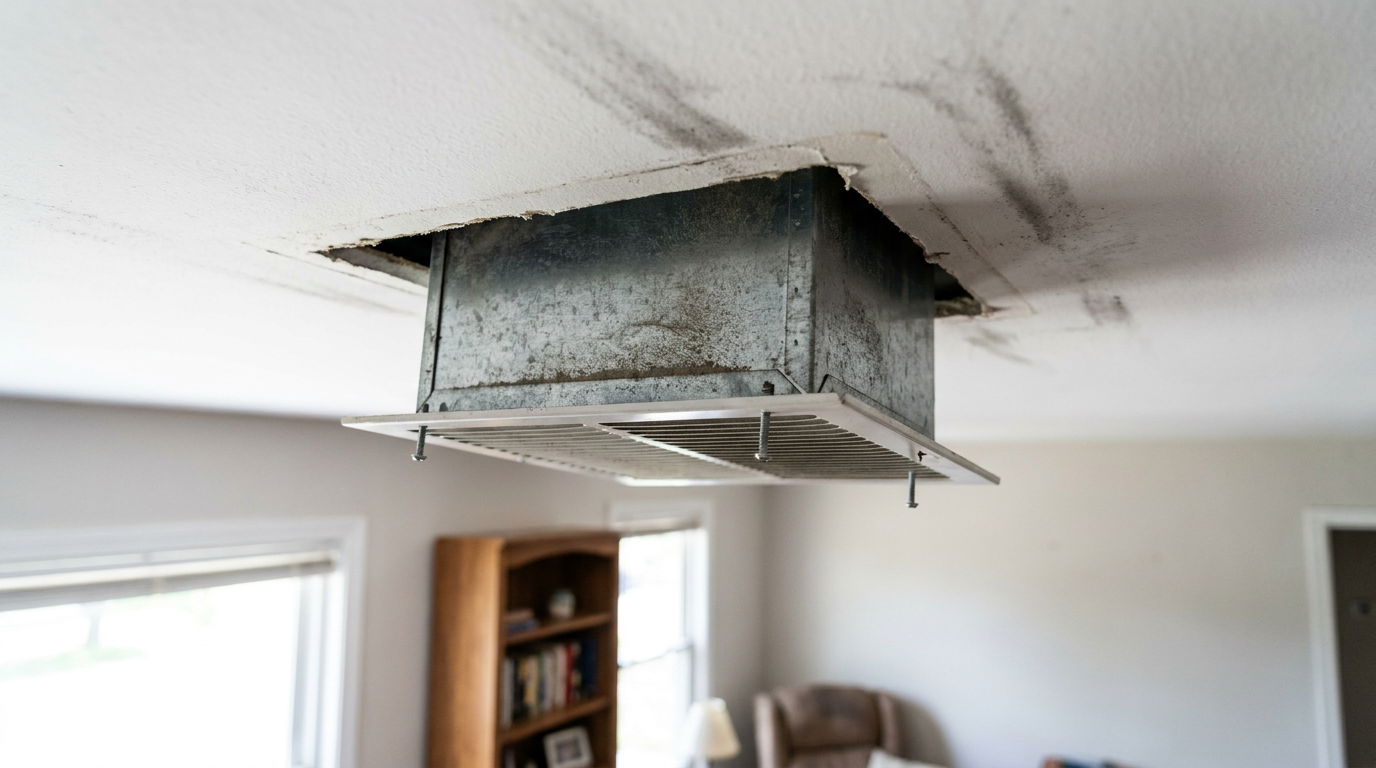
Look up. Around the ceiling registers—especially in homes built with drywall over flexible ductwork—you’ll often see dark, feathery halos fanning out across the textured paint. Folks love to call that furnace soot or black mold. Most of the time, it’s a physical process called "thermal tracking" or "ghosting," paired with nasty, fouled-up duct boots.
Air duct boots, those 90-degree sheet metal transition boxes that tie round flexible ducting into your rectangular register grilles, act like little settling ponds for airborne grime. Over months and years, cooking vapor loaded with vaporized fats drifts into the ceiling registers. It leaves a tacky microscopic film on the inside walls of the boots. Then skin flakes, textile fibers, pet hair, and drywall dust hit that sticky surface and hang on for dear life. Once that crust gets to just 1/16 of an inch thick, every time the blower motor kicks on at 1,200 CFM (cubic feet per minute), that high-speed air starts shaving off tiny bits and firing them straight into your living space. No room air purifier or robot vacuum’s gonna win that fight. That system’s basically an automated dirt cannon.
I pulled a ceiling register in Frisco last month that had exactly this mess—greasy dust, black tracking on the paint, and enough fuzz in the boot to knit a sweater. Same story, different house.
How It Works
Your central heating and cooling system moves hundreds of cubic feet of air every minute through a closed-loop pneumatic loop. The return plenum pulls air from your rooms, draws it through a central filter (typically rated MERV 8 to 11), pulls it across the evaporator coil or heat exchanger, and pushes it through the supply trunk line into smaller branch runs.
+--------------------------------------------------------------+
|                    CENTRAL AIR HANDLER                       |
|   [ Return Air ] --> [ Filter ] --> [ Blower ] --> [ Coil ]  |
+--------------------------------------------------------------+
                                |
                      [ Supply Trunk Line ]
                                |
             +------------------+------------------+
             |                                     |
     [ Flex Duct Run ]                     [ Flex Duct Run ]
             |                                     |
   +--------------------+                +--------------------+
   | Sheet Metal Boot   |                | Sheet Metal Boot   |
   | (Grease/Dust Trap) |                | (Grease/Dust Trap) |
   +--------------------+                +--------------------+
             |                                     |
     [ Ceiling Grille ]                    [ Ceiling Grille ]
             |                                     |
       v v v v v                             v v v v v
   Discharges debris onto ceiling plaster & furniture surfaces
Once the air reaches the register boot, the velocity changes fast. That jump from a 6-inch or 8-inch round flexible duct to a 4x10-inch or 4x12-inch rectangular register creates turbulent eddies. If the seal between your drywall and that metal boot has gaps—which happens in roughly 80% of residential construction—the Bernoulli effect pulls unconditioned, unfiltered attic or wall-cavity air straight into the airstream through negative pressure cracks.
In humid places like North Texas, hot attic air smacks into cool, conditioned metal and the localized relative humidity drops past the dew point. Condensation forms on the hidden side of the drywall and inside the boot collar. That moisture grabs onto ambient dust and turns it into a hard, cake-like layer that you can’t just vacuum off dry. You’ve got to agitate it and emulsify it. No two ways around that.
Step-by-Step Fix
Before you assume the whole HVAC duct system needs a four-figure professional cleaning, work through this targeted deep-cleaning protocol on your supply boots and register grilles. Start with the high-traffic spots: kitchen, living room, and primary bedroom.
-
Cut power to the air handler — Switch off the HVAC system at the thermostat, then flip the dedicated 15-amp or 20-amp air handler breaker inside your main electrical panel.
- Safety check: Never stick a brush or vacuum hose down a duct boot while the blower fan can cycle on automatically.
- If your breaker box lacks clear labels, turn the thermostat to "Off" and remove the thermostat faceplate from the wall.
-
Drop drop cloths beneath each ceiling vent — Spread an 8x10-foot canvas or heavy 3-mil poly drop cloth squarely beneath the register you plan to clean.
- Once you loosen ceiling screws, dried drywall dust, trapped attic insulation, and dead insects are gonna fall straight down.
- Keep children and pets out of the room while registers are open.
-
Back out the register mounting screws — Climb an A-frame step ladder and use a magnetic #2 Phillips screwdriver or a cordless driver on low torque to remove the two mounting screws holding the grille to the ceiling framing.
- Hold the grille firmly against the ceiling with your free hand while removing the second screw so it doesn't fall and gouge your flooring.
- If the grille is caulked or painted shut against the drywall, score the perimeter cleanly using a sharp utility knife before pulling; otherwise, you’ll tear off a ring of ceiling paint.
-
Soak and degrease the register grilles — Carry all removed metal grilles to a deep utility sink or a plastic storage tub filled with 3 to 4 gallons of hot tap water (roughly 120°F) mixed with 1/2 cup of liquid dish soap or an alkaline degreaser.
- Let them soak for 15 minutes to break down the sticky kitchen fats binding the dust.
- Use a soft-bristle wheel brush or an old dish brush to scrub between each louver, rinse thoroughly with clear water, and set them upright on towels to air-dry completely.
-
Vacuum the duct boot interior — Fit a wet/dry vacuum with a high-efficiency HEPA cartridge filter and attach a 1-1/4-inch round dusting brush or narrow crevice tool.
- Reach upward inside the sheet metal boot, vacuuming loose dust along all four walls and the throat of the flexible duct collar.
- Avoid jamming hard plastic crevice wands aggressively into gray flexible inner liners; that thin plastic sleeve tears easy under sharp force.
-
Brush and dislodge stubborn crust — Take a stiff-bristle nylon utility brush or radiator brush and vigorously scrub the galvanized metal walls of the boot box.
- Keep the running vacuum nozzle parked right next to your brush bristles to catch airborne debris before it tumbles down into your face or onto your carpet.
- Wear wrap-around safety glasses and an N95 dust mask during this step—falling particulate will irritate your eyes and throat.
-
Wipe down sheet metal with microfiber and cleaner — Mist a microfiber rag with a multi-surface cleaner or a 50/50 mix of distilled water and 70% isopropyl alcohol until damp, then wipe the interior surfaces of the metal boot.
- Don’t saturate the rag to the point that liquid drips down your arm or pools on the drywall backside.
- If you encounter bare insulation inside an internally lined duct boot, do not wipe with liquid; stop immediately and vacuum with brush attachment only.
-
Seal the gap between duct boot and drywall — Inspect the 1/4-inch to 1/2-inch gap between the outside edge of the galvanized metal boot and the cut edge of the ceiling drywall.
- Bridge this perimeter gap by applying a smooth bead of paintable acrylic latex caulk or high-temperature mastic paste using a standard caulk gun.
- Sealing this perimeter keeps the system from sucking dirty, fiber-filled attic air into your living space every time the HVAC blower cycles.
-
Address ceiling ghosting and stains — Spray the dark soot-like smudge marks on the ceiling paint around the vent opening with an enzyme-based surface cleaner or wipe them down with a melamine foam sponge (Magic Eraser) dampened with warm water.
- Wipe gently; flat ceiling paint rubs through to drywall paper very quickly if scrubbed with excessive force.
- If the ghosting marks are from candle soot or heavy grease, spot-prime the drywall with a shellac-based stain blocker (like Zinsser B-I-N) before touching up with ceiling paint.
-
Reinstall and seal the registers — Position the thoroughly dried grilles back over the openings, line up the screw holes, and hand-thread the screws.
- Drive the screws down until the grille sits flush against the ceiling drywall; do not overtighten, or you will bend the stamped steel flange or strip the drywall anchor.
- Restore power at the breaker panel and switch your thermostat back to cooling or heating mode.
Common Causes
Why do duct boots and ceiling registers get so filthy in the first place? It’s rarely just "house dust." A few different mechanical problems usually stack up and make the mess:
- Unsealed Drywall Boot Cutouts: Builders often cut rough openings in ceiling drywall an inch too wide for the metal boot. Because registers cover the hole, nobody seals the gap. The HVAC blower creates a low-pressure zone that sucks attic dust, fiberglass particles, and blown insulation into the room airstream.
- Low-Efficiency or Ill-Fitting Return Filters: Running flimsy 1-inch fiberglass filters (the blue see-through kind) lets fine dander, pollen, and silt bypass the air handler entirely. The blower then coats the inside of your whole duct network with dust.
- Kitchen Cooking Oils Emulsifying with Airborne Dust: Cooking bacon or searing meat on high heat without running your range hood sends microscopic, aerosolized oil droplets through the house. When your HVAC runs, it pulls these fats through registers, turning dry dust into sticky, glue-like duct grime.
- Attic Flex Duct Air Leaks: Small tears or unglued joints in your attic ductwork allow negative pressure to pull insulation fibers, rodent dander, and soffit dust directly into supply air lines.
- High Indoor Humidity (Above 55% RH): When moisture levels run high, dust swells and sticks hard to cold galvanized sheet metal. It sets up a breeding ground for mildew instead of blowing cleanly out the louvers.
Common Mistakes
Avoid these common DIY blunders that can wreck HVAC components or make your indoor air quality worse:
- Using cheap 1-inch fiberglass filters to "improve airflow." These filters only stop coarse junk like hair and pebbles from hurting the motor; they trap virtually no respirable dust. Use a pleated MERV 8 to MERV 11 filter instead, and replace it every 60 to 90 days.
- Shoving stiff dryer-vent augers deep into flex ducts. Flexible ducting consists of a thin wire helix covered by a fragile 2-mil plastic membrane. Rigid rotating dryer snakes or stiff brush rods will tear the plastic liner to shreds, collapse the inner core, and blow fiberglass insulation directly through your vents.
- Spraying bleach or heavy chemical deodorizers down registers. Bleach corrodes galvanized zinc coatings, causing premature rusting of your sheet metal boots. And when the fan turns on, breathing concentrated chemical mist can cause severe respiratory distress.
- Wiping flat ceiling paint with soaking wet sponges. Ceiling paint is notorious for lacking durability. Scrubbing the black ring around a register with a saturated towel will dissolve the latex binder, leave watermarks, and expose bare drywall backing paper within three passes.
- Ignoring the boot-to-drywall air seal. You can scrub the metal grilles every single weekend, but if you don’t caulk the gap between the drywall cutout and the metal boot frame, attic bypass air will turn your ceiling black again within two months.
Cost & Time Breakdown
| Task | DIY Cost | Pro Cost | Time |
|---|---|---|---|
| Clean 10–12 Supply Register Boots & Grilles | $15–$30 (cleaner, rags, brush) | $150–$300 (deep-clean maid crew) | 2–3 hours |
| Seal Boot-to-Drywall Junctions with Caulk/Mastic | $10–$20 (caulk gun, 2 tubes) | $200–$450 (HVAC tech or handyman) | 1.5–2 hours |
| Full Whole-Home Duct Cleaning (Rotobrush/Negative Air) | Not recommended for DIY | $400–$1,000 (NADCA certified pro) | 3–5 hours |
| Air Handler Blower Wheel & Evaporator Coil Clean | $30–$50 (coil cleaner, PPE) | $250–$600 (licensed HVAC technician) | 2–4 hours |
| Ceiling Ghosting Stain Sealing & Touch-Up Paint | $25–$45 (primer, roller, paint) | $150–$350 (painter) | 1–2 hours |
Tips & Prevention
Keep your supply vents clean and stop dust from spreading across your home with these long-term maintenance habits:
- Upgrade to a 4-inch media filter if your return cabinet allows. A 4-inch deep pleated filter has way more surface area than a 1-inch filter, capturing 85%+ of micro-particulates without choking the static pressure of your blower system.
- Always run your kitchen range hood when cooking. Run your exhaust hood on medium or high whenever you cook with fats or oils—and let it run for five minutes after you turn off the burner. That stops grease vapors before they reach ceiling vents.
- Check register boot boots for moisture twice during summer. In July and August, remove one vent grille in the hottest room. Touch the metal boot box. If it feels wet to the touch, your duct boot isn't insulated properly on the attic side, causing condensation that will rot your drywall and harbor mold.
- Vacuum register faces during your routine weekly cleaning. Use the soft horsehair brush attachment on your canister or stick vacuum to sweep over register louvers weekly. That clears dry lint before static electricity and room humidity fuse it to the painted metal.
- Never run your air system during sheetrock sanding or floor refinishing. Cover your supply and return vents with magnetic plastic covers or contractor paper while doing messy renovations. Running the HVAC during remodeling packs your ducts with gypsum dust in less than an hour.
When to Call a Professional
Cleaning your register boots, soaking your grilles, and sealing drywall edges is a straightforward weekend job. But there are times when DIY duct maintenance is flat-out dangerous or just plain ineffective.
If you shine a bright flashlight into your duct boot and see black, velvety, or raised green-and-white growth spreading across the metal or insulation, stop immediately. Scrubbing active fungal colonies with a household brush releases millions of concentrated spores into your ductwork and contaminates the entire home. You need a remediation specialist to test the growth and clean the system under negative pressure.
Same deal if your home uses internal fiberglass duct board (common in 1970s and 1980s construction) that’s breaking down, flaking, or wet. Household cleaners will wreck the insulation core. If you notice persistent cold drafts blowing out from around closed registers, an attic inspection is needed to check for severed trunk lines or rotted exterior flex sleeves. And if you hear grinding, squealing, or rattling inside your returns, or your evaporator coil is a solid block of ice, that’s not a cleaning issue—that’s an airflow or refrigerant failure that needs an EPA-certified HVAC technician.
Frequently Asked Questions
Why does the ceiling around my air vents get black rings?
Those black rings are caused by a phenomenon called "thermal tracking" or "ghosting." The metal duct boot gets cold during the air conditioning cycle, which cools the surrounding drywall. Warm, moist room air hits this cold perimeter, and microscopic airborne particles—like candle soot, skin cells, and cooking grease—deposit onto the wall through static and condensation. Sealing the gap between your drywall and the duct boot with paintable acrylic caulk or mastic stops this airflow bypass.
Can I run a shop vac hose deep into my flexible air ducts?
No. Standard residential flexible ductwork consists of a thin, fragile plastic film wrapped around a helical wire coil, surrounded by fiberglass insulation. Shoving a rigid shop vac hose or attachments more than 2 to 3 feet down a flex duct can tear the plastic liner. Once the liner is punctured, the HVAC system blows raw fiberglass insulation into your home and pulls dusty attic air directly into the conditioned space.
How often should HVAC supply registers be pulled and deep-cleaned?
Plan to pull, soak, and wash supply register grilles once every 12 to 18 months under normal household conditions. If you have multiple shedding pets, burn paraffin candles frequently, or do extensive high-heat cooking, inspect and clean them every 6 to 9 months. Regular weekly vacuuming of the outside louvers with a soft dusting brush will extend the time between full teardowns.
What chemical cleaner is safe to use inside metal duct boots?
Stick with mild, non-corrosive cleaners like warm water mixed with dish soap, a neutral multi-surface degreaser, or a 50/50 mix of distilled water and isopropyl alcohol. Never use chlorine bleach or acid-based cleaners on galvanized metal duct boots. Bleach strips the protective zinc coating off the steel, triggering rapid rust formation, and leaves harsh chemical fumes that linger in your HVAC airstream for days.
Will deep cleaning my register boots reduce dust on my furniture?
Yes, significantly. Dust that collects on the interior walls of your supply boots is directly in the path of 1,000+ CFM of high-velocity airflow. Every time the blower motor kicks on, mechanical air turbulence shears micro-particles off these surfaces and blows them across your living space. Cleaning the boots and washing the louvers removes that secondary dust reservoir, keeping tables and shelves cleaner between weekly dustings.
Why do my registers smell musty as soon as the AC starts up?
A musty blast of air when the system kicks on (often referred to as "dirty sock syndrome") is typically caused by bacterial or fungal growth on the AC evaporator coil, in the drain pan, or on damp dust layers inside the duct boots. During shutdown cycles, moisture collects on these organic dust layers. When the fan resumes, it pushes the damp odor directly into the room. If cleaning the duct boots does not fix it, have a technician chemically clean your evaporator coil.
Should I cover ceiling vents with filter material to catch extra dust?
No. Placing vent register filter pads or dryer sheets behind your supply grilles adds significant static pressure resistance to your HVAC system. Modern blowers are calibrated precisely to handle specific airflow resistance; choking the supply outlets causes the blower motor to draw more amps, run hotter, and prematurely burn out. Instead of choking your supply registers, install a higher-efficiency pleated filter (MERV 8 to 11) at the central return air grille.
How can I tell if I need a full professional duct cleaning versus just a boot clean?
Perform the flashlight test: remove 3 supply registers in different areas of your home and inspect the first few feet of the ductwork with a high-lumen light and your phone camera. If the heavy dust and crusting are confined to the metal boot boxes, a DIY cleaning will solve the issue. If the flexible duct walls beyond the boot are coated in thick, furry debris, or if you can see debris clinging to the trunk line when peering down the return, book a NADCA-certified professional negative-air cleaning.
Related Articles
Keep troubleshooting with these hand-picked guides from FixlyGuide:
- The Grime That Hides: Why Your Baseboards Always Look Dirty — Even after a thorough cleaning, baseboards can quickly look dingy, often due to overlooked deep-seated dirt, static attraction, and imprope…
- Dog Urine Stains on Hardwood? 10 Steps to Remove the Dark Spots and Odor — Erase stubborn black dog urine stains and kill lingering ammonia smells on hardwood floors using an enzyme-and-peroxide protocol that actua…
- The Grimy Secret Under Your Kitchen Sink: Why That Smell Won't Go Away — Uncover the real reason for that persistent kitchen sink odor and how to banish it for good with simple DIY steps and materials.
- Window Tracks Full of Gunk? How to Get the Grime Out for Good — Your windows won't glide smoothly if the tracks are packed with dust, dead bugs, and sticky grime. Here's how to deep clean them with simpl…
- The Grimy Secret Under Your Oven: Why Your Kitchen Never Feels Truly Clean — Your oven and range hood are silent culprits in your kitchen's battle against persistent grease and grime. This guide tackles how to deep c…
- The Fiery Light Show: Why Your Microwave Is Sparking Inside — Microwave sparking is alarming, but often fixable with some DIY know-how, usually pointing to issues with the waveguide cover, metal object…
What should this project cost?
Enter your project details for a realistic cost range before you call anyone.
Service calls and common repairs run $150–$900; full system replacement typically $6,000–$12,000.
- Regional adjustment
- National average
- Labor share (typical)
- ~$1,935
- Quotes to collect
- 3 written estimates
Educational estimate based on national averages — not a binding quote. Always confirm with written local estimates.
Get the print-ready PDF of this guide
A clean, ad-free, printable version you can keep on your phone or pin to the workshop wall. Free with a FixlyGuide account.
- Print-optimized layout
- Tools, materials & every step included
- Saved to your account
Frequently asked questions
Why does the ceiling around my air vents get black rings?+
Those black rings are caused by a phenomenon called thermal tracking or ghosting. The metal duct boot gets cold during the AC cycle, chilling the surrounding drywall. Warm, moist room air hits this cold spot, and airborne particles like candle soot, pet dander, and cooking grease deposit onto the wall through static and condensation. Sealing the gap between your drywall and the duct boot with paintable acrylic caulk or mastic stops this bypass airflow.
Can I run a shop vac hose deep into my flexible air ducts?+
No. Standard residential flexible ductwork consists of a thin, fragile plastic film wrapped around a helical wire coil, encased in fiberglass. Shoving a rigid shop vac hose or hard attachments more than 2 to 3 feet down a flex duct can tear the plastic liner. Once punctured, the HVAC blows raw fiberglass into your living areas and sucks dirty attic air directly into the conditioned space.
How often should HVAC supply registers be pulled and deep-cleaned?+
Pull, soak, and wash supply register grilles once every 12 to 18 months under normal household conditions. If you have shedding pets, burn candles frequently, or do extensive high-heat cooking, clean them every 6 to 9 months. Regular weekly vacuuming of the outside louvers with a horsehair brush attachment keeps lint from baking onto the metal.
What chemical cleaner is safe to use inside metal duct boots?+
Stick with mild, non-corrosive cleaners like warm water mixed with dish soap, a neutral multi-surface degreaser, or a 50/50 mix of distilled water and 70% isopropyl alcohol. Never use chlorine bleach or acid-based cleaners on galvanized duct boots. Bleach strips the protective zinc coating off the steel, triggering rust, and creates fumes that circulate throughout your home.
Will deep cleaning my register boots reduce dust on my furniture?+
Yes, significantly. Dust that collects on the interior walls of your supply boots is directly in the path of 1,000+ CFM of high-velocity airflow. Every time the blower kicks on, air turbulence shears micro-particles off these surfaces and blows them across your furniture. Cleaning the boots and washing the louvers removes that secondary dust source.
Why do my registers smell musty as soon as the AC starts up?+
A musty blast of air when the system kicks on is typically caused by bacterial or fungal growth on the evaporator coil, in the drain pan, or on damp dust caked inside duct boots. During off cycles, moisture collects on organic dust. When the fan resumes, it blows that damp odor into the room. If cleaning the boot boxes doesn't fix it, hire an HVAC pro to chemically clean your evaporator coil.
Should I cover ceiling vents with filter material to catch extra dust?+
No. Placing register filter pads or dryer sheets behind your supply grilles adds significant static pressure resistance to your HVAC system. Modern blowers are calibrated precisely for specific airflow limits; choking the supply outlets causes the motor to draw higher amperage, overheat, and fail prematurely. Instead, install a higher-efficiency pleated filter (MERV 8 to 11) at your central return air cabinet.
How can I tell if I need a full professional duct cleaning versus just a boot clean?+
Perform the flashlight test: remove 3 supply registers in different rooms and inspect the interior with a bright flashlight and your phone camera. If the heavy dust is confined to the metal boot boxes, a DIY cleaning will solve the issue. If the inner walls of the flexible ductwork beyond arm's reach are coated in a furry gray mat, or if you spot signs of mold, book a NADCA-certified professional cleaning.
Discussion
Loading comments…